Search

Showing posts with label colonial history. Show all posts

02 October 2025

BOOK: Silvia FALCONIERI (dir.), Fou et indigène. L'altérité au prisme du droit colonial en Afrique [Histoire du droit et des institutions] (Paris: Mare & Martin, 2025), 274 p. ISBN 9782386001284, € 31


Abstract:
Issu d’une recherche collective financée par l’Agence nationale de la recherche, le présent ouvrage propose une histoire juridique de la folie dans les territoires africains colonisés par la France entre la fin du XIXe siècle et les années 1960. Que se passe-t-il lorsque la condition juridique spécifique à l’« indigène » se double d’une différence supplémentaire qui touche à la sphère de la pathologie mentale ? Qu’en est-il du traitement juridique de la folie des populations colonisées ? Voyageant à travers les différents territoires africains occupés par la France, cet ouvrage interroge l’intersection de deux formes d’altérité, celles de « fou » et d’« indigène ». Les chapitres qui le composent montrent comment la prise en charge juridique et administrative, mais aussi médicale, de la « folie » de l’« Autre » se fait dans une variété de contextes et suivant des procédures, souvent atypiques, qui peuvent s’écarter du droit commun.

Read more here. 


26 June 2023

BOOK: Paolo CAPPELLINI; Giovanni CAZZETTA (Orgs). Pluralismo giuridico. Itinerari contemporanei, atti dell'incontro di studi, Firenze, 20-21 ottobre 2022. (Milano, Giuffrè, 2023). ISBN 9788828853404 37,05€

(Source:https://www.quadernifiorentini.eu/biblioteca/134/)

Il volume raccoglie gli Atti dell’Incontro internazionale di studi tenutosi a Firenze nell’ottobre del 2022 in occasione dei cinquant’anni dalla fondazione dei Quaderni fiorentini e del Centro di studi per la storia del pensiero giuridico moderno. Calato com’è nei pilastri fondativi dell’ordine giuridico e nei suoi processi di trasformazione, il tema del Pluralismo giuridico incrocia perfettamente i caratteri qualificanti iscritti sin dalle origini nel progetto della Rivista e nelle attività del Centro, intitolato a Paolo Grossi proprio a partire dall’Incontro di ottobre. Il volume  organizza in tre sezioni – Paradigmi, Esperienze, Prospettive – il ricco e vivace confronto tra storici, filosofi del diritto e giuristi di diritto positivo, e contiene altresì gli interventi della Cerimonia di intitolazione a Paolo Grossi del Centro di studi.


Table of Contents

Itinerari contemporanei del pluralismo giuridico. Le ragioni di un Incontro (P. Cappellini, G. Cazzetta, B. Sordi, I. Stolzi)


Paradigmi

 TOMMASO GRECO, Il problema (della scienza) del diritto e le vie del pluralismo

MICHELE GRAZIADEI, Frontiere, legal transplants, comparazioni: le vie del diritto e l’incontro con il pluralismo

CARLA FARALLI, Pluralismo e teoria generale del diritto

FABIO DEI, Razionalità e relativismo nell’antropologia giuridica


Esperienze: il caso della colonizzazione portoghese

CRISTIANO PAIXA˜ O, Pluralismo in gioco: le dispute sulla democrazia costituzionale brasiliana

RICARDO SONTAG, Ordine domestico e ordine statale nel Brasile del XIX secolo: la disciplina degli schiavi

CRISTINA NOGUEIRA DA SILVA, Colonial Justice in Mozambique (1915-1954): Preserving and Changing Indigenous Customary Law

MASSIMO MECCARELLI, Pluralismo giuridico e spazio eccedente. Il laboratorio storiografico brasiliano visto dall’Europa


Prospettive

MASSIMO LUCIANI, La Costituzione e il pluralismo

ENZO CANNIZZARO, Consuetudine e pluralismo normativo nel diritto internazionale

THORSTEN KEISER, Pluralismo e diritto del lavoro

NICOLO` LIPARI, Gli approdi pluralistici del diritto civile


Cerimonia di intitolazione a Paolo Grossi del Centro di studi per la storia del pensiero giuridico moderno

PAOLO CAPPELLINI, Paolo Grossi: una dedica, una presenza

ALESSANDRA PETRUCCI, Saluto

GIUSEPPE BETORI, Saluto

SILVANA SCIARRA, Per Paolo Grossi

PIETRO COSTA, Paolo Grossi: il sapere come istituzione

10 February 2023

BOOK: Nandini BOODIA-CANOO, Slavery, Indenture and the Law: Assembling a Nation in Colonial Mauritius (Abingdon: Routledge, 2023), 220 pp., ISBN 9781032322018, £120


(image courtesy: Routledge)

Book description: 
This book addresses historical issues of colonialism and race, which influenced the formation of multicultural society in Mauritius. During the 19th century, Mauritius was Britain’s prime sugar-producing colony, yet, unlike the West Indies, its history has remained significantly under-researched. The modern demographic of multi-ethnic Mauritius is unusual as, in the absence of an indigenous people, descendants of colonists, slaves and indentured labourers constitute the majority of the island’s population today. Thus, it may be said that the Mauritian nation was "assembled" during the period in question. This work draws on an in-depth examination of the two labour systems through which the island came to be populated: slavery and indenture. In studying the relevant laws, four legal events of historical importance within the context of these two labour systems are identified: the abolition of the slave trade, the abolition of slavery, private indentured labour migration and state-regulated indenture. This book is notable in that it presents a legal analysis of core historical events, thus straddling the line between two disciplines, and covers both slavery and indentured labour in Mauritian history. Mauritius, as an originally uninhabited island, presents a rare case study for inquiries into colonial legacies, multiculturalism and race consciousness. The book will be a valuable resource to scholars worldwide in the fields of slavery, indenture and the legal apparatus of forced labour.
Table of contents: 
Acknowledgements
List of Figures and Tables
Preface
Chapter 1: Introduction
Chapter 2: Historical Background
Part I: Slavery
Chapter 3: The Abolition of the Slave Trade
Chapter 4: The Abolition of Slavery
Part II: Indentured Labour
Chapter 5: Informal Indenture and Apprenticeships
Chapter 6: State-Regulated Indenture and The Emergence of an Indian Peasantry
Chapter 7: Conclusion
Bibliography
About the author: 
Nandini Boodia-Canoo is a lawyer and an academic, currently teaching at Bloomsbury Institute London. Her scholarship is interdisciplinary, covering law, history, international relations and sociology.
More information can be found here. 

21 May 2021

PODCAST: Às vésperas do leviathan


(Source: https://www.politico.eu/wp-content/uploads/2020/04/GettyImages-1152427249-1160x926.jpg)

We have learned of a legal history podcast. Episodes already published:

Cap 2 - Os Jesuítas e Construção da Ordem Jurídica

Cap 3 - A religião como meio de inclusão e de exclusão nas corporações de ofício

Cap 4 - John Locke e as prerrogativas ministeriais: um problema clássico do liberalismo político


More information: https://www.asvesperasdoleviathan.com/

Spotfy page: https://open.spotify.com/show/2B9Jp7a23OigFctdqzfj76 


11 September 2019

POSITION: Belgian Colonial Archives (Belgian State Archives-Belgian Scientific Policy/Université St Louis, DEADLINE 1 OCT 2019)

(image source: Standen&Landen)

Project description:
Les Archives de l’Etat et l’USL-B recrutent un·e docteur·e en Histoire (h/f/x) dans le domaine «archives & histoire coloniales belges» (programme FED-tWIN) Contexte FED-tWIN is a new federal research programme from the Belgian Science Policy Office to promote sustainable cooperation between ten Federal Scientific Institutions and Belgian universities through the funding of joint research profiles. SHARE — Supply a Fair and Transparent Access to a shared Heritage - the ‘Africa Archives’ - to implement Decolonised Research about Belgian colonisation in Congo, Rwanda and Burundi (1885-1962). This FED-tWIN profile aims at taking advantage of the relocation of ‘Africa archives’ to AGR-ARA (State Archives in Belgium) and USL-B (Université Saint-Louis – Brussels) expertise in colonial history in order to enable Belgian, Congolese, Burundian and Rwandan societies to reconnect with their colonial past. The project consists of four WP. One work package (WP) is assigned to each unit. In WP1, the FED-tWIN researcher will increase the accessibility of ‘Africa archives’ by writing new finding aids (mainly inventories and databases), by retro converting old ones and by revising the conditions for consultation. WP2 is dedicated to the digital repatriation of these archives and the transfer of knowledge about those. The researcher will prepare this repatriation by removing diplomatic, technical and ethical obstacles that could hinder this transfer. The ‘Africa archives’ constitute a unique heritage. However, this collection does not contain all the archives of Belgian colonisation. In WP3, the FED-tWIN researcher will search the colonial archives remaining in Central Africa to repatriate a digital copy to Belgium. They will also complete this collection by collecting oral testimonies from European and African colonisation actors. WP4 is a transversal WP focused on communication and dissemination of project results to an audience of historians and archivists, to an audience of citizens and to an audience of students. USL-B is a centre of excellence for research in Belgian colonial history. Its expertise is forged from the exploitation of the ‘Africa archives’ i.e. documents produced by the Ministry of Colonies, the General Government of the Belgian Congo and the services that compose it as well as the mandated administration of Rwanda and Burundi. At the same time, AGR-ARA has a strong and recognised expertise in management, preservation and dissemination of Belgian public archives. Since 2016, its collection includes almost 10 linear kilometres of ‘Africa archives’ until then kept at the Belgian Ministry of Foreign Affairs. AGR-ARA faced a challenge: applying its know-how to a new archival material - the ‘Africa archives’. Only a researcher specialised in Belgian colonisation history with a thorough knowledge of its archives can take it up, to join the existing team and to consolidate expertise. The expert would build their expertise on the basis of the knowledge developed within USL-B on the one hand and AGR-ARA on the other. The researcher will have to develop an unparalleled knowledge about the colonial archival production (e.g. map the main archive producers and their documentary production’s logic) and the archival policies implemented in Congo (1885-1908, 1908-1960) and in Rwanda and Burundi (1924-1962), as well as those currently in force in Europe and Africa for the management of colonial archives. At the same time, they will mobilise the ‘Africa archives’ as teaching material and as a source to conduct an in-depth study of interracial violence in the long run. This protean phenomenon has been widely denounced for the Congo Free State period and the independence, but it must now be considered in a broader way. Interracial violence should be considered in the long term as a tool and a support for any activity in (post)colonial context.
(image source: Standen&Landen)

Read more here.

25 March 2019

BOOK : Rena N. LAUER, Colonial justice and the Jews of Venetian Crete (Philadelphia: University of Pennsylvania Press, 2019). ISBN 9780812250886, £56.00


The University of Pennsylvania Press has published a new book on the usage of the legal system by the Jewish population of 13th century Venetian Crete.

ABOUT THE BOOK

When Venice conquered Crete in the early thirteenth century, a significant population of Jews lived in the capital and main port city of Candia. This community grew, diversified, and flourished both culturally and economically throughout the period of Venetian rule, and although it adhered to traditional Jewish ways of life, the community also readily engaged with the broader population and the island's Venetian colonial government.

In Colonial Justice and the Jews of Venetian Crete, Rena N. Lauer tells the story of this unusual and little-known community through the lens of its flexible use of the legal systems at its disposal. Grounding the book in richly detailed studies of individuals and judicial cases—concerning matters as prosaic as taxation and as dramatic as bigamy and murder—Lauer brings the Jews of Candia vibrantly to life. Despite general rabbinic disapproval of such behavior elsewhere in medieval Europe, Crete's Jews regularly turned not only to their own religious courts but also to the secular Venetian judicial system. There they aired disputes between family members, business partners, spouses, and even the leaders of their community. And with their use of secular justice as both symptom and cause, Lauer contends, Crete's Jews grew more open and flexible, confident in their identity and experiencing little of the anti-Judaism increasingly suffered by their coreligionists in Western Europe.

ABOUT THE AUTHOR

Rena N. Lauer teaches history and religious studies at Oregon State University.

More information here

10 December 2018

JOURNAL: Comparative Legal History VI (2018), No. 2

(image source: Routledge)

Contents:
Editorial (Heikki Pihlajamäki & Matthew Dyson)

Comparative cultures of accountability: the Scottish Exchequer and the Audit Chamber of Holland between 1477 and 1515 (Maurits den Hollander) (open access)
Abstract:
This comparative paper describes the spread of a new culture of probatory accountability in North-western Europe through the study of the Scottish Exchequer and the Audit Chamber of Holland between 1477 and 1515. It allows to re-evaluate persisting views of an inefficient and archaic Scottish Exchequer, as opposed to the ‘Weberian ideal’ of the Burgundian bureaucracy. Both institutions primarily had a fiscal goal, the auditing of accounts, while archival and judicial tasks supported this process. Through a study of the format of important series of these accounts as well as their marginalia, it has been revealed that by 1515 the daily practices surrounding the auditing process in Scotland and Holland showed important similarities. These cases serve to portray that through the auditors’ work, a new written culture of accountability spread among all governmental officials in either Scotland or Holland.

At the end, the creditors win: pre-insolvency proceedings in France, Belgium and the Netherlands (1807–c1910) (Dave De ruysscher) (open access)
Abstract:
In nineteenth-century France, Belgium and the Netherlands, laws imposing pre-insolvency proceedings had different goals. In a first stage, from around 1810 until about 1860, continuity of businesses in distress was not a policy consideration. Rather, legislators purported to give the creditors early control over the insolvent’s estate, which was most often liquidated. Debtor-in-possession features were mostly conceived of as a temporary reward for cooperation; lowered requirements for re-entry in the market after the winding-up of their business were another advantage for cooperating debtors. This was the same in the three aforementioned countries. In the 1870s and 1880s, the French and Belgian legislators created new pre-insolvency proceedings, which allowed debtors to keep their assets. In the Netherlands, fixed-term moratoriums prevented such an approach. Yet, also in Belgium and France, the exemption of secured creditors hampered the feasibility of compositions, and a goal of saving firms in financial peril.

The long reach of English law: a case of incidental transplantation of the English law concept of vicarious liability into Thailand’s Civil and Commercial Code (Adam Reekie & Srutchada Reekie)
Abstract:

Thailand’s Civil and Commercial Code, introduced in 1925, represents a voluntary major legal transplantation by which Thailand adopted a complete new code based on foreign models. This article traces the development of Section 425, which confers liability on employers vicariously for the wrongful acts of their employees, and reveals that the concepts present in the stated sources of the provision do not match those represented by the section in its final form. Rather, the concepts hint at another source, unstated and hitherto uncredited as a source of this part of the Code, the English law doctrine of vicarious liability. This conclusion sheds new light on the complex process of legal transplantation and legal reform in Thailand during the early twentieth century, challenging the orthodox view, and has wider implications for those considering the societal factors which guide and shape legal reform.

Techniques of empire by land law: the case of the Italian colonies (nineteenth and twentieth centuries) (Elisabetta Fiocchi Malaspina)
Abstract:
Land ownership and property registration played a special role in Italian colonialism, in which public and private interests mingled amidst the ambitions of colonising and economic exploitation. Through the legal system of land registration one can examine how European states, here in the context of Italy, used their colonies to adapt and experiment with the legal frameworks of land ownership. As will be shown in the article, what happened in the colonies might have been impossible to carry out in the European context. In the colonies the options varied between implementing a particular European land law used by a European state in its colonies, duly modified or updated, and a compromise between the already-existing land ownership structure and the European land law. The knowledge acquired by implementing different legal frameworks of landownership and land registration in the colonies conversely influenced the legal systems applied in continental Europe.
Book reviews:
System, order and international law: the early history of international legal thought from Macchiavelli to Hegel (Frederik Dhondt)

The causes of war, volume II: 1000 CE to 1400 CE (Jenny Benham)

Byzantine Legal Culture and the Roman Legal Tradition, 867-1056 (Barbara Biscotti)

Conceiving a nation, Scotland to AD 900 (Anthony Smart)

25 September 2018

CALL FOR PAPERS: Colonial Institutions and the Uses of Law in Early Modern South Asia – Radboud Universiteit Indian Ocean World in the 18th Century Workshop Series (DEADLINE: 21 October 2018)


We learned of a call for papers for a workshop on law in relation to 17th and 18th century colonial institutions. Here the call:

28 January 2019, Radboud University Nijmegen (Netherlands)
Organized by: Dries Lyna, Luc Bulten (both Radboud University Nijmegen) and Leonard Hodges (King’s College London)
In partnership with Alicia Schrikker (Leiden University) & International Institute for Asian Studies
Discussant: Nandini Chatterjee (University of Exeter)

Law has long been recognised as one of the most important fields for understanding the creation and maintenance of the colonial state in South Asia. Historians have shown how both criminal and civil law were a means for subjugating and governing colonised populations, as legal codes and property regimes served to maintain the social order and legitimise the extractive capacity of the colonial state. Recent research shifted away from this top-down perspective, and close attention to the actions of indigenous litigants has revealed how local populations used colonial legal systems to serve their own interests, with a great deal of present-day work focusing on legal pluralism. Yet the vast majority of this literature has addressed the question of law and colonialism in South Asia through the lens of the British colonial experience, privileging a particular path with all its subsequent implications for how we conceptualise the trajectory of South Asian history. In addition, the strong focus on British 19th-century institutions seems to have blurred the possible influence of their early modern (or even pre-colonial) predecessors.  

This one-day workshop seeks to complicate teleological readings of law and its relationship to colonial institutions and state-making by drawing on contexts beyond and before British domination in the subcontinent. By evoking the ‘uses of law’ we hope to capture both the constraints and opportunities the creation of colonial institutions posed for a wide range of people, whether colonial administrators, local elites, merchants, farmers or widows.

Central questions in this workshop are:

-        How did pluralistic settings affect the development of colonial institutions, and in what ways did these institutions appropriate and transform indigenous legalities?
-        How might local actors have sought to contest or benefit from particular colonial institutions?
-        And to what extent is it possible to capture indigenous agency when meditated through colonial institutions?

We therefore invite researchers to consider law in relation to 17th- and 18th-century colonial institutions, broadly defined, including courts of law, trading companies, religious missions and tax administrations. We welcome proposals from both junior and senior scholars with different geographical backgrounds, and comparative studies are certainly encouraged. Abstracts (max. 300 words) should be sent to southasianlawradboud@gmail.com before October 22, 2018. Decisions on acceptance of presentations will be communicated no later than October 29, 2018. For more information, contact one of the workshop’s organisers.

06 August 2018

BOOK: Allan GREER, Property and Dispossession : Natives, Empires and Land in Early Modern North America [Studies in North American Indian History] (Cambridge: Cambridge University Press, 2018). ISBN 9781316613696, £ 22.99


(Source: CUP)

Earlier this year, Cambridge University Press published a book on the processes by which forms of land tenure emerged and natives were dispossessed from the sixteenth to the eighteenth centuries in New France (Canada), New Spain (Mexico), and New England.

ABOUT THE BOOK

Allan Greer examines the processes by which forms of land tenure emerged and natives were dispossessed from the sixteenth to the eighteenth centuries in New France (Canada), New Spain (Mexico), and New England. By focusing on land, territory, and property, he deploys the concept of 'property formation' to consider the ways in which Europeans and their Euro-American descendants remade New World space as they laid claim to the continent's resources, extended the reach of empire, and established states and jurisdictions for themselves. Challenging long-held, binary assumptions of property as a single entity, which various groups did or did not possess, Greer highlights the diversity of indigenous and Euro-American property systems in the early modern period. The book's geographic scope, comparative dimension, and placement of indigenous people on an equal plane with Europeans makes it unlike any previous study of early colonization and contact in the Americas.

Provides a comparative approach to the colonization of North America, including a study of French, English, and Spanish colonies
Considers colonization in an indigenous America, contrary to the prevailing Eurocentrism of the history of early modern imperialism
Focuses on property formation as a central dimension of colonization

ABOUT THE AUTHOR

Allan Greer, McGill University, Montréal
Allan Greer is a professor in the Department of History and Classical Studies at McGill University in Montreal, Canada. He holds the Canada Research Chair in Colonial North America at McGill University, Montréal. He has published seven books, including Mohawk Saint: Catherine Tekakwitha and the Jesuits (2005) and La Nouvelle-France et le monde (2009).

TABLE OF CONTENTS

1. Introduction: property and colonization
Part I. Three Zones Of Colonization:
2. Indigenous forms of property
3. Early contacts
4. New Spain
5. New France
6. New England
Part II. Aspects of Property Formation:
7. The colonial commons
8. Spaces of property
9. A survey of surveying
10. Empires and colonies
Part III. Conclusion and Epilogue:
11. Property and dispossession in an age of revolution.

More information here

24 August 2017

BOOK: Assaf LIKHOVSKI, Tax Law and Social Norms in Mandatory Palestine and Israel (New York: Cambridge University Press), 352 p. ISBN 9781107176294, £ 90

Assaf Likhovski (Tel Aviv University) published Tax Law and Social Norms in Mandatory Palestine and Israel in the “Studies in Legal History” series (Cambridge University Press).

(Image source: CUP)

About the Book:
This book describes how a social-norms model of taxation rose and fell in British-ruled Palestine and the State of Israel in the mid-twentieth century. Such a model, in which non-legal means were used to foster compliance, appeared in the tax system created by the Jewish community in 1940s Palestine and was later adopted by the new Israeli state in the 1950s. It gradually disappeared in subsequent decades as law and its agents, lawyers and accountants, came to play a larger role in the process of taxation. By describing the historical interplay between formal and informal tools for creating compliance, Tax Law and Social Norms in Mandatory Palestine and Israel sheds new light on our understanding of the relationship between law and other methods of social control, and reveals the complex links between taxation and citizenship.

About the author:
Assaf Likhovski is a professor of law and legal history at Tel-Aviv University Faculty of Law. He is the author of Law and Identity in Mandate Palestine (2006), which was awarded the Yonathan Shapiro Best Book Award in Israel Studies.

                                      
Table of contents:
Introduction: the intimate fiscal state
Part I. The Rise of Income Taxation:
1. Before the income tax: Jewish Ottoman, and early mandatory taxation
2. The introduction of income taxation in mandatory Palestine
Part II. The Ascendancy of Social Norms:
3. Taxation without law: the Jewish voluntary tax system
4. Law and social norms in early Israeli taxation
Part III. The Transformation of Israeli Taxation and its Law:
5. The rise of tax experts: accountants, lawyers, and economists
6. The transformation of tax law: doctrinal and legislative changes

More information:

07 April 2015

CALL FOR ARTICLES: Congo at War(s). Journal of Belgian History (ed. N. Tousignant); DEADLINE 1 MAY 2015

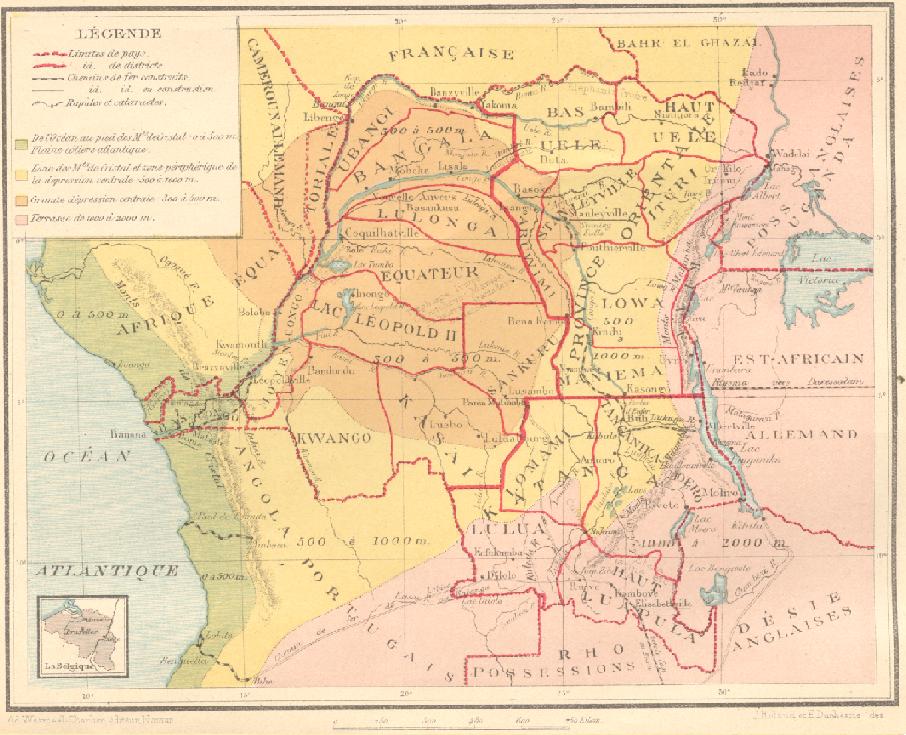
(image: Congo in 1914, source: Wikimedia Commons)

The Journal of Belgian History (Web of Science, ISSN 0035-0869) issued a call for papers for a theme issue on "Congo at War(s)" (ed. Prof. N. Tousignant, Université Saint-Louis/UCLouvain).

More information:
As the centenary of the Great War has been offering its amount of manifestations, publications or exhibitions in Belgium and in neighbouring European countries, it must be underlined that the global dimension, included in the qualification of this four-year period as a ‘World War’, has been largely underrepresented, when not absent or ignored, in Belgium. The diagnostic might sound too categorical, but it reveals the difficulty to imagine the war experience outside specific historical canons. It could be explained by the tradition largely developed in the 1920s (the ‘trench experience’) and the broader inscription into the memory management under the leadership of the Commonwealth War Graves Commission, into the diplomatic negotiations results and conflicting chronological frames. Since 2013, it has been established that most of what we know of what happened in Congo, what were Congo contributions and what were the consequences of the war on Congo future remain largely dated either to 1980s historical research on archives and oral sources available at that moment, or to the 1920s and 1930s printed material produced by the witnesses of the events. On the same token, the access to new archival series and the development of new research questions beyond military history ask for a recalibrated comparative understanding of the African dimension. This issue wants to bring into perspective unpublished contributions to document both wars experiences in Belgian Congo (to be extended to Rwanda and Burundi, if needed). It shall address questions such as neutrality, colonial governance, police activities and socio-demographical consequences of recruitment, forced/coerced labour, resistances and revolts, geopolitics in Sub-Saharan Africa. It excludes the discussion of remembrance and commemoration, as the hard facts need to be known and reinterpreted into a frame of analysis that breaks the exceptionality of the Congo & Belgium experience.
Manifestation of interest:             May 1st, 2015.
A 2500-sign proposal, related to the issues mentioned above must be sent to the editor. Unpublished contributions requested.
Selected papers would be notified by May 15th 2015.
Final version:                             December 15th, 2015.
In English, with a proposal of minimum four illustrations.
 (source: Belgian Association for Contemporary History)   

25 July 2014

BOOK: "Law and Custom in Korea", by Marie Seong-hak Kim


This book sets forth the evolution of Korea's law and legal system from the Chosǒn dynasty through the colonial and postcolonial modern periods. This is the first book in English that comprehensively studies Korean legal history in comparison with European legal history, with particular emphasis on customary law. Korea's passage to Romano-German civil law under Japanese rule marked a drastic departure from its indigenous legal tradition. The transplantation of modern civil law in Korea was facilitated by Japanese colonial jurists who themselves created a Korean customary law; this constructed customary law served as an intermediary regime between tradition and the demands of modern law. The transformation of Korean law by the brisk forces of Westernization points to new interpretations of colonial history and it presents an intriguing case for investigating the spread of law on the global level. In-depth discussions of French customary law and Japanese legal history in this book provide a solid conceptual framework suitable for comparing European and East Asian legal traditions.
  • A comprehensive survey of Korean legal history, covering traditional law, colonial law and modern Korean law
  • The first book in English on Korean colonial law and jurisprudence
  • The first book that approaches Korean legal history from a comparative perspective, providing comparisons between East Asian legal history and European legal history
  • courtesy www.cambridge.org

30 January 2014

NOTICE: Fellowships in Colonial and U.S. History and Culture

The Library Company of Philadelphia Fellowships 

The Library Company, founded by Benjamin Franklin in 1731 and located in Center City Philadelphia, holds over half a million rare books and graphics that are capable of supporting research in a variety of fields and disciplines relating to the history of America and the Atlantic world in the 17th, 18th, and 19th centuries. The holdings include the nation’s second largest collection of pre-1801 American imprints and one of the largest collections of 18th-century British books in America. Information about the subject strengths of the collections can be found here

A catalog of rare books and graphics is available here.

The fellowship program began in 1987 and now has more than 700 alumni. 
A list of former fellows and their topics is available here, along with a list of publications resulting from their fellowship research.

Fellows share opportunities to participate in the Philadelphia region’s vibrant intellectual life while conducting their research in the print, graphics, and manuscript collections of the Library Company and other local institutions. Fellows have an opportunity to present their research publicly through conferences, seminars, and colloquia. The Library Company’s Cassatt House fellows’ residence offers rooms at reasonable rates, along with a kitchen, common room, and offices with internet access and is available to resident and non-resident fellows at all hours.

Generous support for this fellowship program has been provided by the Andrew W. Mellon Foundation, the National Endowment for the Humanities, the Albert M. Greenfield Foundation, the Barra Foundation, the McLean Contributionship, the William Reese Company, ASECS, and William H. Helfand.

19 November 2013

Seminar: Citizenship and Power Strategies between Middle Ages and Modern Era (Rome, 22 November 2013)

What: Teorie di cittadinanza per il mondo medievale, 8th meeting of the seminar Cittadinanze e strategie di potere tra Medio Evo ed Età Moderna, organized by Sara Menzinger, Giuliano Milani and Massimo Vallerani in the framework of the PIMIC Project.
Where: RomaTre University, Law Department, 2nd Floor, Room 278, Via Ostiense 161, Rome.
When: 22 November 2013, 3:00 pm
 
 
Speakers:
Prof. Luigi Nuzzo (Università del Salento): Comunità indigene, modelli di cittadinanza e costruzione dello spazio nelle Indie Spagnole del secolo XVI
 
Prof. Enrica Rigo (Università degli Studi di Roma Tre): Nascita e Conquista: riflessioni su cittadinanza e territorialità nella transizione alla modernità
 
All materials available on ACADEMIA.EDU (only if you have a Facebook or Academia.edu account).  

06 October 2013

CONFERENCE: Colonisation in the 20th century: Continuities, discontinuities and ruptures (Paris, 10-11 October 2013)


 The Centre for Judiciary History (Lille-II) co-organises a conference with the Inalco (Institute for Asian Studies) in Paris, 10-11 October. Legal history, and the comparative study of the British and French models, are on the program. More information on the IHTP (Institut pour l'histoire du temps présent)'s website.
 
(Source: Nomôdos)

22 April 2013

BOOK: Il pregiudizio del colore by Marco Fioravanti

Marco Fioravanti, Il pregiudizio del colore. Diritto e giustizia nelle Antille francesi durante la Restaurazione, Carocci 2012

What: Presentation of the book Il pregiudizio del colore
Where: Napoli, Cappella Pappacoda, Largo S. Giovanni Maggiore
When: 29 April 2013, 3:30 pm

The book will be presentated by the author, together with Ann Thomson, Luigi Nuzzo and Miguel Mellino. Introduction by Girolamo Imbruglia.


05 March 2013

NOTICE: Presentation of Romain Bertrand's "L'histoire à parts égales" at the Ecole Française in Rome (March 8 2013)

What: Presentation of "L'histoire à parts égales" by Romain Bertrand,  with Stefania Gialdroni (Università Roma Tre) and Arthur Weststeijn (Koninklijk Nederlands Instituut Rome), coordinated by Guillaume Calafat (École française de Rome) and François Dumasy (École française de Rome)
Where: École française de Rome, Piazza Navona 62, Rome 
When: March 8 2013, 5:30 pm 

The presentation will take place in English 


07 February 2013

BOOK: Juristas de la independencia

José María Pérez Collados, Samuel Rodrigues Barbosa (eds.), 
Juristas de la independencia, Madrid : Marcial Pons, 2012

The book investigates the extraordinary development of independent constitutional states in Latin-America in the 19th century, from México to Guatemala, from Chile to Argentina, from Colombia to Brasil

For more information click here

The book will be presented today, February 7th 2013, at the Casa de América (Plz. De Cibeles, 2. Madrid), at 7:00 pm.
More information here