Search

Showing posts with label world war one. Show all posts

09 January 2025

BOOK: Florent GARNIER, Anthony FALGAS & Grégory KALFLÈCHE (dir.), Les avis du Conseil d'État (1914-1918). Assurer la permanence de l'État en temps de guerre [Droit public] (Paris: Mare & Martin, 2024), 420 p. ISBN 978-2-38600-095-9, € 40


(image source: Mare & Martin)

Abstract:
Pour le centenaire de la fin de la Grande Guerre, le Conseil d’État publiait 122 avis rendus au Gouvernement durant la période 1914-1918. Ces avis, souvent renvoyés à la hâte et rédigés dans la précipitation, révèlent la façon dont le Conseil d’État, par sa fonction consultative, a soutenu l’État dans l’effort de guerre. Cet ouvrage se propose de retranscrire l’ensemble de ces avis, pour la plupart illisibles et rédigés de façon manuscrite, afin de valoriser ce fonds d’archives et le rendre accessible au plus grand nombre. Pour ce faire, plutôt qu’une présentation chronologique, les auteurs ont fait le choix d’une classification par thèmes. Chacun d’eux sera précédé d’une analyse approfondie afin d’éclairer l’action du Conseil d’État sur les politiques menées. À travers ces demandes d’avis, c’est moins la réponse à une question technique que recherche le Gouvernement que la validation de son action en temps de guerre.

Read more here. 


07 December 2023

BOOK: Miriam GASSNER, Der Vertrag von Sèvres. Vertragstext und Analyse des Friedenschlusses mit der Türkei vom 10. August 1920 im Kontext der Pariser Vorortverträge [Studien zur Geschichte des Völkerrechts, eds. Anne PETERS, Bardo FASSBENDER, Milos VEC & Jochen VON BERNSTORFF; vol. 42] (Baden-Baden: Nomos Verlag, 2023), ,281 p. ISBN 9783848788538. OPEN ACCESS


(image source: Nomos)

Abstract:

The 1920 Treaty of Sèvres between the Allied Powers and Turkey can undoubtedly be described as one of the most significant international treaties of the 20th century. Aiming at reshaping the Middle East, it laid the foundation for the British Empire to reach the peak of its territorial expansion shortly after it was signed. The fact that the treaty has been little noticed in the German-speaking world is probably also due to the fact that until now there has been no complete translation of the treaty into German. The aim of this work is now to provide such a translation and to place the Treaty of Sèvres in the context of the Paris Peace Treaties.

 Read the full book in open access: DOI 10.5771/9783748934110.

16 April 2019

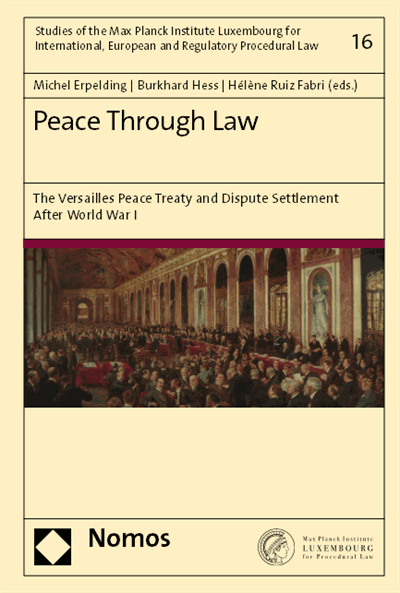
BOOK: Michel ELPERDING, Burkhard HESS & Hélène RUIZ FABRI (eds.), Peace Through: Law The Versailles Peace Treaty and Dispute Settlement After World War I [Studies of the Max Planck Institute Luxembourg for International, European and Regulatory Procedural Law, Bd. 16] (Baden-Baden: Nomos Verlag, 2019), ISBN 978384529916, OPEN ACCESS


Book abstract:
Den Vertrag von Versailles als ein Beispiel von „Frieden durch Recht“ darzustellen, mag rückblickend als Provokation erscheinen. Und doch bestechen der Versailler und die anderen Pariser Friedensverträge von 1919–1920 noch heute durch die schiere Vielfalt und Neuartigkeit der durch sie auf den Plan gerufenen völkerrechtlichen „Experimente“ sowohl substantieller als auch verfahrensrechtlicher Natur. Obwohl viele dieser „Experimente“ auch das Völkerrecht und die internationale Streitbeilegung in der Zeit nach dem Zweiten Weltkrieg grundlegend beeinflusst haben, sind sie heute kaum noch ein Teil des kollektiven Gedächtnisses. Die in diesem Buch vereinigten juristischen und historischen Forschungsarbeiten geben einen Gesamtüberblick über die Art und Weise wie die Pariser Friedensverträge die internationale Streitbeilegung in der Zwischenkriegszeit sowohl substantiell als auch verfahrensrechtlich geprägt haben. Die in diesem Buch enthaltenen Darstellungen teilweise in Vergessenheit geratener internationaler Gerichte und ihren Entscheidungen werden durch Archiv- und Bildmaterial zusätzlich untermauert.
See also conference videos earlier on this blog.

Read the full book on the Nomos website.

(source: ESILHIL Blog)

16 August 2018

CALL FOR PAPERS: Peace Making after the First World War 1919-1923 (National Archives, FCO Historians, Strathclyde University, LSE, British International History Group) (Kew: National Archives, 27-28 JUN 2019); DEADLINE 1 DEC 2018

(image source: Wikimedia Commons)

The National Archives, the Foreign and Commonwealth Office Historians, the University of Strathclyde, the International History Department at the London School of Economics and Political Science, and the British International History Group invite submissions for the upcoming conference ‘Peace making after the First World War 1919 – 1923’.
Taking place from Thursday 27 to Friday 28 June 2019, the first day of the conference will be held at The National Archives and includes a keynote lecture by Professor David Stevenson. The second day of the conference will be hosted by the Foreign and Commonwealth Office Historians at Lancaster House, and will see a range of experts speak on aspects of the peace making process followed by a round table discussion.
Dr Juliette Desplat, Head of Modern Overseas, Intelligence and Security, at The National Archives said:
‘The conference aims to focus not only on the Treaty of Versailles, but also on the other treaties that marked the formal end of hostilities: Saint-Germain (Austria), Neuilly (Bulgaria), Trianon (Hungary), Sèvres (Ottoman Empire) and Lausanne (Turkey).
‘We are delighted that, as part of this, the conference will include an exhibition of The National Archives’ unique collection of certified copies of all the treaties, alongside a selection of other materials.’
Submissions are invited for 20-minute papers, or panels of three papers, to be presented on the first day of the conference, on any aspect of the peace making process. Abstracts should be submitted by Saturday 1 December. See full details of the call for papers.
Join the conversation on social media #PeaceConf

(source: ESILHIL blog & H-Diplo)

24 March 2018

BOOK: Hélène DUFFULER-VIALLE, La réglementation de la prostitution pendant l’entre-deux-guerres L’exemple du nord de la France (Paris: Mare & Martin, 2018), 656 p. ISBN 978-2-84934-314-2, €56

(image source: Mare&Martin)


Book abstract:
Annoncé comme moribond à la fin du XIXe siècle et au début du XXe siècle, le système de réglementation de la prostitution reprend avec vigueur à la sortie de la première guerre mondiale. Le réglementarisme connait alors son « chant du cygne » pendant l’entre-deux-guerres avant d’être « aboli » en 1946. Violemment critiqué avant la seconde guerre mondiale, il s’adapte et se renforce dans une logique hygiéniste et sanitariste, tout en prétendant composer avec les libertés fondamentales des personnes concernées. Entre l’étude des débats juridiques, théoriques et idéologiques, l’analyse des rapports de pouvoir des autorités de régulation, la mise en œuvre concrète de cette réglementation ainsi que sa transgression, et le prisme du genre dans l’analyse des archives juridiques et judiciaires, cette thèse en histoire du droit, forte d’une approche interdisciplinaire, montre que l’enjeu du contrôle dépasse le cadre de la « prostitution » pour viser la sexualité en général avec, comme levier, la peur.

 Prix de thèse de l’École Doctorale Lille-Nord de France

(more information here)

15 March 2016

LECTURE: World War One and the End of Neutrality: A Question Asked in the Wrong Way ? (Royal Flemish Academy of Belgium, Committee for Legal History/VUB CORE, 7 Apr 2016)


The Royal Flemish Academy of Belgium (Committee for Legal History) and the Research Group CORE (Contextual Research in Law) of the Vrije Universiteit Brussel (VUB) invite prof. dr. Eric Schnakenbourg (Université de Nantes/CRHIA/Institut Universitaire de France) for a lecture on the topic:


"World War One and the End of Neutrality:
A Question Asked in the Wrong Way ?"

Prof. dr. Eric Schnakenbourg is full-time professor of History at the University of Nantes and Director of the Research Center on International and Atlantic History. He published his Habilitation à diriger des recherches with the Presses Universitaires de Rennes in 2013 (Entre la guerre et la paix. Neutralite et relations internationales, XVIIe-XVIIIe siècles), and, earlier, his doctoral dissertation on France and Northern Europe in the early 18th Century with Honoré Campion.

The event will take place in the Academy Palace (Simon Stevin-Room), from 12:30 to 14:00.


Registration is mandatory, in view of the limited unmber of seats available: click here for the registration page.

23 June 2015

CALL FOR ABSTRACTS: Doing Justice. Multiple Interplays between Justice & Populations during the Two World Wars (Brussels, 3-4 December 2015); DEADLINE 22 JULY 2015


The Interuniversitary Attraction Pole Justice & Populations ("BeJust 2.0"/Belgian Federal Science Policy) organizes a conference in Brussels (CEGESOMA) on 3-4 December 2015. The event is the result of a cooperation between the universities of Ghent, St Louis, Louvain, The Humboldt Universität zu Berlin, the Research Foundation Flanders (FWO) and the Fonds de la Recherche Scientifique (FRS/FNRS).  

The elaborate description and axes can be found below.

Presentation:
Periods  of  wars  and  foreign  domination  are  of  crucial  importance  in  the  history  of  justice.  They  have led to important shifts in the expectations, practices and actors involved in the field of justice. As  a  result  of  the  often  sudden  change  provoked  by  war,  existing  routines  in  the  broad  field  of justice came under serious pressure. The disruption of predictable patterns stimulated inventiveness.
The  way  in  which  actors  of  justice  dealt  with  those  sweeping  changes  is  an  important  research question. Although different aspects of the impact of armed conflict on justice  have been studied, the dominant approach of most of this work is top-down and highly institutional. As a result of this bias, the actual actors of justice and their practices and expectations in war settings have been largely neglected so far. Drawing from current trends in criminology and the social history of justice, this international conference starts from a grassroots perspective. It focuses on the impact of war on the complex interactions between different actors of justice (individuals and social groups on the one hand, ‘the justice system’ (police, judiciary and penitentiary professionals) on the other hand). The conference  aims  to  highlight  the  emergence  of  new  expectations  of  justice  among  these  actors,  resulting  from  the  war.  It  also  tackles  justice  practices,  strategies  to  cope  with  the  changing circumstances,  new  forms  of  negotiation,  interaction,  relationships  between  populations  and  the formal justice system in this particular context, and the impact of this renegotiation in the long run.
Thematic axes:
ACTORS
War led to the redefinition of the roles of the different actors involved in justice. New roles emerged and  room  to  operate  shifted.  The  claim  of  the  professionals  of  the  formal  justice  system  on  the monopoly of justice was of course to a large extent fictional even in peace time. ‘Doing justice’ is, even in a context of a consolidated state, always the outcome of a complex interplay of informal and formal  actors  of  justice,  as  indicated  for  instance  by  the  importance  of  the  willingness  to  report crimes. 
In war time, the balance in this interaction seems to have shifted at the expense of the formal justice system. Military justices experienced exceptional growth and their authority gradually extended at the expense of regular courts. In areas occupied by foreign armies, the impact on the judicial system was even more substantial. When they were not simply removed, the national courts had to coexist with those of the occupant; new bodies and players then competed with the traditional authorities of
the  judiciary.  Moreover,  people  seemed  to  be  more  inclined  to take  justice  into  their  own  hands.
Significantly,  all major waves of informal justice in Europe during the last two centuries took place in wartimes and revolutions. The distinction between insiders and outsiders of the formal justice system tended to blur as a result of warfare. Informers of secret polices and political factions (like collaborators  and  resistance  fighters)  acquired  a  share  of  the  power  of  constraint  which  was monopolized  in  peacetime  by  state  agents.  Unusual  collaborations,  sometimes  at  the  margins  of legality,  were  established  between  judges  and  civil  society  (like  charity  organizations).  The proliferation  of  judicial  actors  altered  the  balance  of  power  within  the  system.  However,  justice  officials did not passively undergo these changes. Even if their autonomy was reduced from above and rival forces gained power, judges retained discretion in the application and implementation of laws, and in a broader sense tried to cope with the changing circumstances.  

EXPECTATIONS OF JUSTICE
Wars also changed the margins of tolerance of all the actors of justice mentioned above. This was marked  by  a  blurring  of  the  distinction  between  normal  and  abnormal,  tolerated  and  prohibited behavior. New forms of ‘crime’ and new ‘criminals’ emerged. These shifts are particularly revealing in  the  frame  of the  expectations  of  justice  of  these  actors.  These  expectations could  converge,  as shown  by  the  generally  shared  ambition  to  see  pro-German  collaborators  punished  at the  end  of both  occupations,  but  could  also  diverge.  The  reconstruction  of  the  expectations  of  justice  of different actors does not only constitute an access to the moral framework of these actors in the war context, but it is also revealing for the possible conflicts caused or intensified by the experience of the occupation.   
As  a  result  the  concept  of  the  transgressor  was  of  course  redefined.  Specific  categories  of  people facing sanctions emerged (i.e. the enemy, collaborators, foreigners, new citizens, Jews, minorities, black marketers), while existing categories extended due to the exceptional circumstances. Finally, certain  categories  of  the  population  became  subjects  of  increased  surveillance,  being  considered dangerous in view of the continuing tension (e.g. juveniles, tramps, etc.). 

PRACTICES
The diversification of the actors in the justice system and the shifting thresholds of tolerance had of course impact on the practices of justice. Indeed, we can observe a blurring of the borders between popular, criminal, military, administrative and colonial law. Criminal punishment was supplemented by non-standard popular, military or administrative practices. Exceptional measures were taken and often  became  semi-permanent,  as  for  example  the  administrative  internment  of  different  types  of ‘suspects’. Usual sanctions were equally transformed, as judges adapted penalties to the changing circumstances. 
The relationship between the different (formal and informal) actors of justice could take different shapes, ranging from cooperation to hostility. In the occupied zone, through competition between domestic and foreign jurisdictions, lobbyists hoped to benefit from the most favorable jurisprudence.
As  far  as  the  citizens,  individually,  were  concerned, they  were  far  from  passive.  Denunciations,  a quintessential way for ‘weaker’ groups to be heard by the authorities, were growing exponentially. 

A GRASS-ROOTS PERSPECTIVE
In order to reconstruct the complex landscape of actors of justice in war time, and their expectations and practices, a grass-roots approach imposes itself. For this approach to be feasible, it is essential to prioritize archives resulting from actual justice activities. Judicial archives form not only the main track,  but  also  constitute  an  ideal  observatory  for  the  interactions  between  the  different  actors.
Archives  stemming  from police  operations,  the  prison  system  and  administrative  surveillance  are equally suitable. The privileging of this kind of ‘operational sources’ of the criminal justice system in its  broadest  sense  enables  us  to  go  beyond  a  top-down  approach  predominately  based  on  policy sources.

BELGIUM AS A TEST-CASE
Due  to  the  diversity  of  its  war  experiences  in  the  twentieth  century,  Belgium  is  a  particularly interesting  case  to  study  the  impact  of  war  on  the  relations  between  justice  &  populations.  The Belgian army fought in both world wars, for five years in WWI and for 18 days in WWII. The vast majority of the Belgian population experienced both world wars as a period of occupation. Belgium as a colonial power mobilized its African empire as part of the war effort during both world wars, a mobilisation that influenced populations & justice relations. 

Practical information:
Candidates are invited to submit their paper proposal (between 500 and 1000 words) and a short biography to melanie.bost@cegesoma.be and antoon.vrints@UGent.be the 22th of July 2015
 at the latest. The conference will be conducted in English.
Selected proceedings of the conference will be published. 

07 April 2015

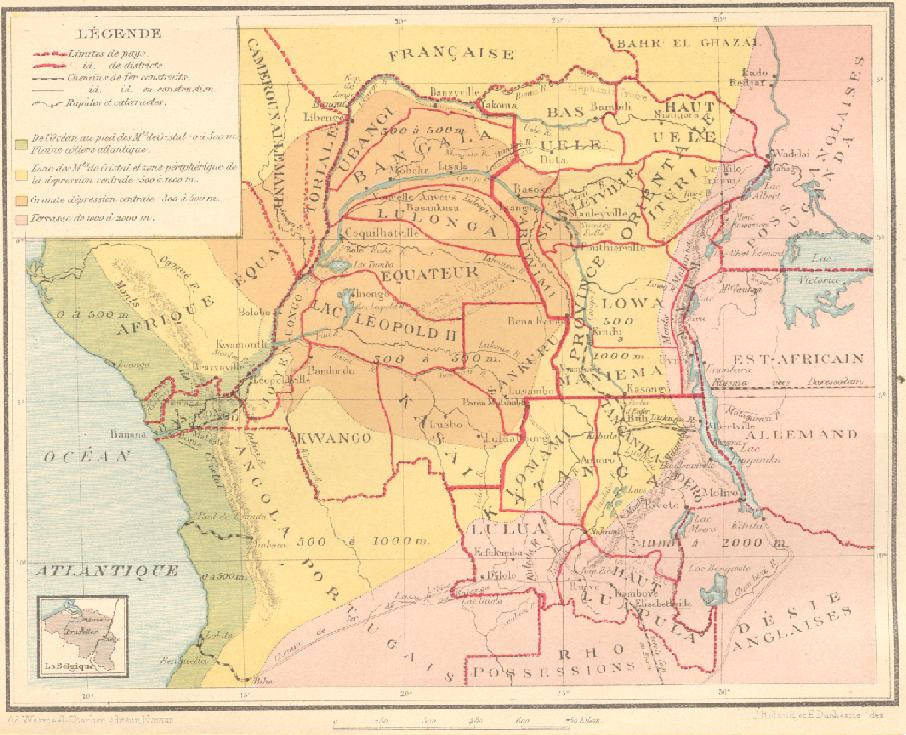
CALL FOR ARTICLES: Congo at War(s). Journal of Belgian History (ed. N. Tousignant); DEADLINE 1 MAY 2015

(image: Congo in 1914, source: Wikimedia Commons)

The Journal of Belgian History (Web of Science, ISSN 0035-0869) issued a call for papers for a theme issue on "Congo at War(s)" (ed. Prof. N. Tousignant, Université Saint-Louis/UCLouvain).

More information:
As the centenary of the Great War has been offering its amount of manifestations, publications or exhibitions in Belgium and in neighbouring European countries, it must be underlined that the global dimension, included in the qualification of this four-year period as a ‘World War’, has been largely underrepresented, when not absent or ignored, in Belgium. The diagnostic might sound too categorical, but it reveals the difficulty to imagine the war experience outside specific historical canons. It could be explained by the tradition largely developed in the 1920s (the ‘trench experience’) and the broader inscription into the memory management under the leadership of the Commonwealth War Graves Commission, into the diplomatic negotiations results and conflicting chronological frames. Since 2013, it has been established that most of what we know of what happened in Congo, what were Congo contributions and what were the consequences of the war on Congo future remain largely dated either to 1980s historical research on archives and oral sources available at that moment, or to the 1920s and 1930s printed material produced by the witnesses of the events. On the same token, the access to new archival series and the development of new research questions beyond military history ask for a recalibrated comparative understanding of the African dimension. This issue wants to bring into perspective unpublished contributions to document both wars experiences in Belgian Congo (to be extended to Rwanda and Burundi, if needed). It shall address questions such as neutrality, colonial governance, police activities and socio-demographical consequences of recruitment, forced/coerced labour, resistances and revolts, geopolitics in Sub-Saharan Africa. It excludes the discussion of remembrance and commemoration, as the hard facts need to be known and reinterpreted into a frame of analysis that breaks the exceptionality of the Congo & Belgium experience.
Manifestation of interest:             May 1st, 2015.
A 2500-sign proposal, related to the issues mentioned above must be sent to the editor. Unpublished contributions requested.
Selected papers would be notified by May 15th 2015.
Final version:                             December 15th, 2015.
In English, with a proposal of minimum four illustrations.
 (source: Belgian Association for Contemporary History)   

12 February 2015

JOURNAL: Traces. Journal of Humanities nr. 27/2, 2014: Thinking with Law


Tracés. Revue de Sciences Humaines (ENS Éditions) published its latest issue on "Thinking with law".

Presentation:
Confronted with lawyers’ long cherished postulate of the autonomy of law and and of its utter « isolation » from the social world, social scientists have often been deterred from investigating legal thought as such. On the other hand, law faculties – particularly French ones —have proved rather reluctant to take up insights from sociology, anthropology and history into their curriculums. However, the last two decades have been witness to significant changes. Setting foot on legal soil, an increasing number of adventurous social scientists have tackled issues regarding both the social uses of law and the technicalities of its machinery. This issue of Tracés gives a snapshot of this changing relationship between law and the social sciences, thereby hinting at promising new prospects for research. Several papers examine how critical thinking has profited from defining law not as a mere instrument of domination, but also as a resource for defining, analysing and occasionally opposing a given situation. Other papers show this shift of perspective to be contingent on a better command of legal operations — e.g. legal fictions or legal qualifications — by social scientists and on their specific understanding of legal reasoning. Getting a better grasp of law might therefore require two tasks: first, combining an attention to the political uses of law with an analysis of the lawyers’ paraphernalia of formal and technical devices; secondly, discriminating more acutely between different types of normativity, in other words offering a comparative history of legal concepts and legal evolution.
 Contents:
"Droit et sciences sociales : les espaces d’un rapprochement" (Guillaume Calafat, Arnaud Fossier & Pierre Thévenin)

"Comment la sociologie peut déplier le droit" (Arnaud Esquerre)

"Peut-on dépasser le droit civil ? Les controverses juridiques autour de la réparation des dommages de guerre (1914-1919)" (Guillaume Richard)

"Le code en tant qu’accomplissement pratique. Respécification ethnométhodologique et cas d’étude égyptien" (Baudouin Dupret)

"L’invention du droit en Occident. Une lecture d’Aldo Schiavone" (Thibaud Lanfranchi)

"Le droit au service de l’égalité ? Comparaison des sociologies du droit de la non-discrimination française et états-unienne" (Vincent-Arnaud Chappe)

"Gender and judging, ou le droit à l’épreuve des études de genre" (Arthur Vuattoux)

"Les droits de l’homme : un cas limite pour le positivisme juridique" (Anna Zielinska)

"Du droit comme discours et comme dispositif" (Sonia Desmoulins-Canselier)

"John Dewey et l’expérience du droit. La philosophie juridique à l’épreuve du pragmatisme " (Liora Israël et Jean Grosdidier)

"Gouvernement-manageur et citoyens-consommateurs. Le cas du Criminal Justice Act 1991" (Nicolas Lacey)

"Indisponibilité, service public, usage. Trois concepts fondamentaux pour le « commun » et les « biens communs" (Paolo Napoli)

"Le droit en situation. Entretien avec Pierre Lascoumes" (Guillaume Calafat/Arnaud Fossier)

More information (fulltext-acces to the introductory article, abstracts) on revues.org or cairn.info (fulltext for subscribers).