Search

Showing posts with label history of international law. Show all posts

24 September 2026

ARTICLE: Arno DAL RI Jr., "François Laurent in Brazil. The defense of the Principle of Nationalities that crossed the Atlantic (1899-1978)" Sartoniana XXXVIII (2025), 53-84 [OPEN ACCESS]


(image source: UGent)

On the journal:

Sartoniana is a yearly publication that publishes the lectures delivered as part of the Sarton Chair of History of Science at Ghent University. All articles are published in open access, as of volume 40 with a CC-BY licence, which permits unrestricted use, distribution, and reproduction in any medium, provided the original author and source are credited.

Read more here: DOI 10.21825/sartoniana.101334.

23 September 2026

BOOK: Luigi LACCHÈ & Vincenzo LAVENIA (eds.), Alberico Gentili e Ugo Grozio: i "momenti" del diritto internazionale e il contributo degli internazionalisti alla costruzione e allo sviluppo della disciplina [Atti del convegno della XXI Giornata Gentiliana; Studi gentiliani, eds. Luca SCUCCIMARRA, Paolo PALCHETTI & Vincenzo LAVENIA; 10] (San Ginesio/Macerata: Centro Internazionale di Studi Gentiliani/EUM, 2026) [OPEN ACCESS], ISBN 979-12-5704-107-6, 222 p.


(image source: EUM)

Presentazione (Luigi Lacchè)

Sessione prima. Alberico Gentili e Ugo Grozio: relazione e "momenti" della storia del diritto internazionale

La giustizia, la religione, la guerre: da Vittoria a Hobbes, attraverso Gentili e Grozio (Carlo Galli)

Legal Imagination and International Power: A History of Capitalism (Martti Koskenniemi)

Not Every Road: Roman Law and History in Gentili's De armis Romanis and De iure belli (Mark Somos)

Rappresentazioni di Alberico Gentili nella scienza del diritto internazionale in Brasile (Arno Dal Ri)

Sessione seconda: Il contributo degli internazionalisti nella costruzione e nello sviluppo del diritto internazionale

Scholarly institutions between Research and Authority (Attila M. Tanzi)

Scholarly interventions and the Impact on 20th century International Law: Notes of Caution and Two Vignettes (Christian J. Tams)

'The Teachings of the Most Higly Qualified Publicists' Today: Scholarship in the Work if the International Law Commission on Subsidiary Means for the Determination of Rules of International Law (Serena Forlatti)

Read the book in open access here.

31 August 2026

PRE-CONFERENCE WORKSHOP: "Conflict, Crisis and Continuity – Historical Perspectives" [European Society of International Law/Société européenne de droit international - IG History of International Law] (Malaga: Universidad de Malaga, 3 SEP 2026)


(image source: ESIL IGHIL)

Abstract:

Contemporary debates frequently describe international law as being in crisis, particularly in light of escalating global conflicts and challenges to normative authority. This year’s pre-conference workshop consisted of two panels convened to examine the resilience of international law amid shifting political conditions during periods of historical upheaval. The first panel explores how territorial conflicts, imperial collapse, and the emergence of nation-states shaped the development of international law in the “semi-periphery” in the aftermath of the Treaty of Versailles. Together, they highlight how post-imperial uncertainty, territorial contestation, and geopolitical realignment not only challenged classical international law in Central and Eastern Europe but also led to the emergence of country-specific or regional approaches toward international law. The second panel examines the relationship between warfare and the evolution of international law from the early modern period to the twentieth century. Through studies of maritime neutrality during the recurrent European wars of the late seventeenth and early eighteenth centuries and the shifting legal treatment of pillage in the aftermath of the Boxer Intervention of 1900, the papers demonstrate how “conflict” often served as a catalyst for adaptation and reinterpretation of classical international legal doctrines.

Program:

09:00 – 09:15 

Introduction and words of welcome (Dr Florenz Volkaert)

09:15 – 10:10

Panel 1: Laws of War or Law on War? History of International Law in Asymmetric Conflicts


Dr Stefano Cattelan (Vrije Universiteit Brussel/Brussels School of Governance): Neutrality as Crisis Management: Small Powers and the Law of the Sea in Recurrent European Wars (c. 1688–1714)

Professor Danny Orbach (The Hebrew University of Jerusalem) & Dr Ziv Bohrer (Bar-Ilan University): A Pendulum of Legal Bandwagoning: The International Law of War on Pillage During and Following the Boxer War


Moderator: Dr Sze Hong Lam, National University of Singapore

10:10-10:30

Break

10:30-11:50

Panel 2: The Paris Peace Conference as a Moment of Crisis? Debates on International Law from a Regional Perspective


Dr Artur Simonyan (University of Regensburg): Between Empires and After Empire: Armenia in the History of International Law


Ágoston Frank (University of Vienna): Conflict and Crisis as the Origin and Driving Force of Hungarian International Law Between the Two World Wars

Peter Odrich (Max Planck Institute for Legal History and Legal Theory, Frankfurt/College of Europe): A Conflictual Affair: Internationalising Upper Silesia


Moderator: Dr Anastasia Hammerschmied, Käte Hamburger Kolleg, Münster

11:50:12:00

Concluding Remarks (Dr Florenz Volkaert)

Read more here.


25 August 2026

YOUTUBE: Michael DOYLE; "More than Just Peace" (Paris: Collège de France, 21 MAY 2026)

Abstract:

John Rawls’s publication of The Law of Peoples was a profound attempt to design a just peace. Beyond the simple cessation of armed hostilities, the Law of Peoples offered more than (just) peace. It committed its peoples to honor human rights, tolerate other decent political regimes and accept a "duty of assistance" owed by all decent societies to all those in dire need. Importantly, for Rawls, the project he outlined in The Law of Peoples is a constructed peace, one that needs to be established among liberal peoples and then extended to other decent societies. The construction raises the questions of why it is that Rawls thought the peace (1) needed to be constructed and could be constructed in a world otherwise divided by insecurity and strife among states. In doing this, he directly addressed the Realist challenges described by Thomas Hobbes in his Leviathan and revived by Thomas Nagel. It also raises the question of (2) why Rawls thought it was necessary to go beyond Perpetual Peace, a Liberal model of international peace constructed by Immanuel Kant (Rawls’s inspiration and answer to the first question), and (3) why Rawls might have thought that the extension beyond the Kantian peace among liberal republics to a wider "just peace" that incorporated a duty of assistance was possible, and indeed "realistic."

More information here. 


15 July 2026

BOOK: Maria Adèle CARRAI & Surabhi RANGANATHAN (eds.), The Cambridge History of International Law, vol. II: International Law in Asia [The Cambridge History of International Law, ed. Randall LESAFFER] (Cambridge: Cambridge University Press, 2026), ISBN 9781009121972, € 163,39

(image source: CUP)

Abstract:
Volume II of The Cambridge History of International Law breaks the mould of Eurocentric histories in the field by exploring international law in Asia from antiquity to decolonisation. Its twenty-six chapters span a vast geography, covering both the landmass and the oceans; offering accounts of statecraft and diplomacy, war and trade; marriage and gift-giving; treaty-making and dispute settlement; ideas of the human and 'the other'; and entanglements of political authority with mercantile, corporate and religious orders. The chapters introduce readers to a diverse cast of characters, from scholars, scientists, geographers, mapmakers; to traders, merchants, shipowners and entrepreneurs; and to women, revolutionaries, pirates, labourers, and monks. The volume explains leading historiographical trends, ponders the challenges of writing Asian histories of international law, highlights available materials and methods, and showcases the conceptual purchase of Asian histories for thinking about international law.

Read more here: DOI  10.1017/9781009121972.


14 July 2026

BOOK: Haakon A. IKONOMOU, Karin VAN LEEUWEN & Morten RASMUSSEN (eds.), The Cambridge Handbook of the League of Nations and International Law (Cambridge: Cambridge University Press, 2026), 558 p. ISBN 9781009655187


(image source: CUP)

Abstract:

Established in the wake of the First World War, the League of Nations fundamentally transformed international politics, global governance and multilateral cooperation in a multitude of fields from the economy, labour and social affairs to colonial, minority and security questions. This Handbook analyses the central role of law in the construction of a new international order under the League of Nations. Drawing from innovative research of recent years that analyses the League of Nations through the prism of ultimate success and failure, it offers twenty-one rich chapters that showcase an interdisciplinary, contextual and archive-based approach with brand new and unexplored case studies that address key topics of the legal history of the League, the International Labour Organization and the Permanent Court of International Justice. Finally, it offers a new historical synthesis of how to understand the role of international law in international organizations during the interwar period.

Read more here: DOI 10.1017/9781009655149. 

13 July 2026

BOOK: Jesse JAMES, Laws of All the Greeks. International Law as Social Reality in Ancient Greece [The History and Theory of International Law, eds. Nehal BHUTA, Francesca IURLARO, Anthony PAGDEN & Benjamin STRAUMANN] (Oxford: OUP, 2026), 456 p. ISBN 9780197838525, 130 GBP


(image source: OUP)

Abstract:

The ancient Greek world was permeated with international law, the binding rules of behavior that Greeks across the Mediterranean followed and enforced for centuries. But why was international law effective in this world? Laws of All the Greeks offers an original answer rooted in contemporary social theory, presenting a definitive account of ancient Greek international law while delving into the social and psychological foundations that made it potent and durable. Challenging recent claims that international law did not exist in the Greek world, Laws of All the Greeks makes a robust case not only for its existence, but for the importance of taking ancient Greek international law as an historical subject in the first place. It provides an updated history of select elements of that law, including the right to private self-help; judicial treaties known as symbola; and piracy. Combining the findings of recent scholarship on Greek history, identity, and social networks, novel readings of documentary and literary sources, and the lessons of sociology and psychology, Jesse James demonstrates how the webs of identity binding the Greek world together affected both the rules of international law and their effectiveness at guiding legal and economic behavior. This study thus complicates and enriches prevailing approaches that emphasize formal institutions, structural features, or economic rationalism, offering instead a model for applying legal sociology to the historical study of international law.

Table of contents:

Part I. Background and Framework
1:Introducing Greek International Law
2:The Reality of Greek International Law
3:Psychology, States, and International Legal Socialization
4:International Identity and Socialization in Ancient Greece
Part II. Syla and Symbola: International Law and Commerce
5:Syla: Approaching Legal Self-Help in the Greek World
6:Syla as Self-Help in Greek International Law
7:Symbola: Social Origins of a Legal Institution
8:Symbola from the Athenian Empire to the Hegemony of Rome
Postscript
Part III. Expanding the View
9:Piracy
10:Oaths
11:The Thessalian Koinon as an International Legal Structure

12:Conclusion

On the author:

Jesse James is a historian, lawyer, and Classicist. He earned his J.D. at the University of California, Berkeley School of Law and practiced law for several years in Manhattan, litigating disputes at state, federal, and international levels. He then earned his Ph.D. in Classics at Columbia University. He has held fellowships at Harvard Law School, the American School for Classical Studies at Athens, the Columbia Institute for Ideas and Imagination in Paris, and the Kommission für Alte Geschichte in Munich.

Read more here.


02 July 2026

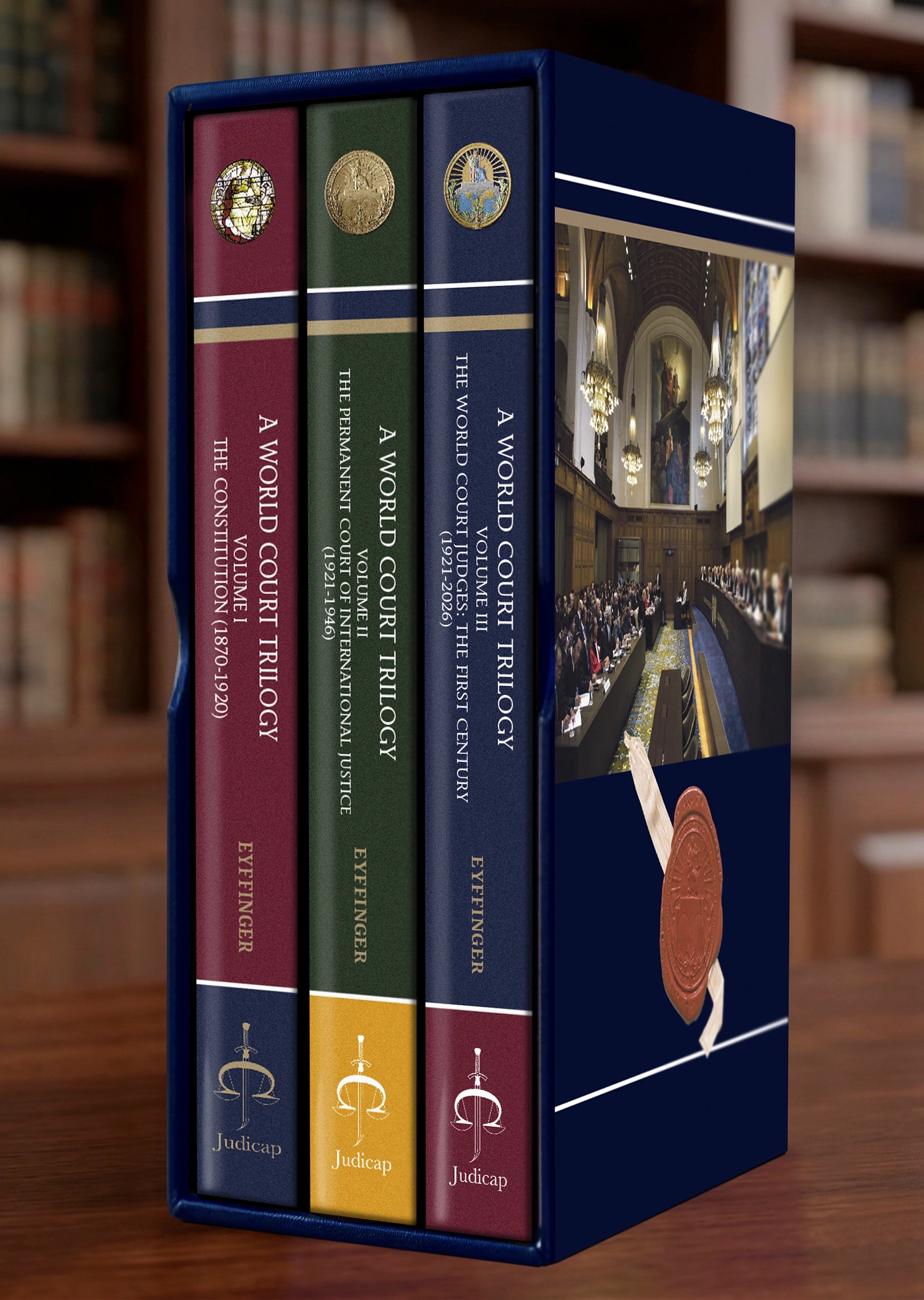
BOOK: Arthur EYFFINGER, A World Court Trilogy (Soesterberg: Uitgeverij Aspekt, 2026), 3 vol. (€ 185 each)


(image source: Guy Clémart)

Abstract:

Three decades after his ASIL Award–winning studies on the International Court of Justice (1996) and the First Hague Peace Conference (1999), Arthur Eyffinger now presents a monumental, richly illustrated trilogy charting the complete history of the World Court. The landmark publication offers a panoramic view of the Court’s intellectual origins, institutional development, jurisprudence, and human legacy. Meticulously researched and lavishly documented, A World Court Trilogy is a captivating homage to one of the most critical institutions in upholding the global legal order. The publication marks the eightieth anniversary of the ICJ in mid-April 2026. In anticipation of the eightieth anniversary of the ICJ in 2026, Arthur Eyffinger produced A World Court Trilogy. The ambitious project covers the concept of the idea, the  genesis and the first century of operation of the ‘World Court’ (the International Court of Justice in the Peace Palace at The Hague) in three substantial volumes. The project is twofold. It provides for volumes that feature a lavishly illustrated presentation of the subject-matter, next to volumes that present the texts only. This latter version includes ample documentation sections and full indexes for reference purposes to the student of the law. All volumes include a wealth of  biographies and including reviews of the lives of all the judges who ever served on the Court.

Volumes:

(1) Volume I: The Constitution (1870-1920) This volume assesses the period of constitution of the Court from the wider historical perspective and in light 
of the time-honoured aspiration to improve on the condition of mankind.

(2) Volume II: The Permanent Court of International Justice (1921-1946) This volume covers the implementation of the 
concept and the pioneering years of the PCIJ in 
the Interbellum Years.

(3) Volume III: The World Court Judges, the First Century (1921-2026) This volume introduces eighty years of operation of 
the ICJ, then to focus on the members of the Court. 
It provides biographical sketches of all the Judges, who have served on the Bench of the institution from 
1921 - 2026.

Read more on Guy Clémart's website. [Guy Clémart is Arthur Eyffinger's pseudonym] 


22 June 2026

JOURNAL: European Journal of International Law XXXVI (2025), nr. 4 (Nov)


(image source: OUP)

Koskenniemi’s Lauterpacht: A ‘Gentle Civilizer’? (Robert Schütze)
DOI 10.1093/ejil/chaf069
Abstract:

Hersch Lauterpacht’s normative project has been subject to a number of excellent studies in the past – most notably by Martti Koskenniemi. The central image of the latter’s ‘Lauterpacht’ is, famously, that of a backward-looking thinker: Lauterpacht is portrayed as a ‘natural lawyer’ who nostalgically looks back into the 19th century as the last representative of a ‘Victorian tradition’ in international law. This article wishes to critique and challenge this influential intellectual portrait. In order to do this, it revisits Lauterpacht’s rich academic oeuvre in three sections. Section 2 begins with a reconstruction of Lauterpacht’s understanding of the judicial function – a function on which much of Koskenniemi’s Lauterpacht hinges. Section 3 explores the legislative function within Lauterpacht’s international legal order, while section 4, subsequently, investigates the ‘function’ given to natural law in Lauterpacht’s normative project. Section 5, finally, offers a critical challenge to Koskenniemi’s ‘Lauterpacht’ and re-evaluates the place that he should be given within the history of 20th-century international law. A conclusion contends that Lauterpacht is best characterized as a utopian international federalist, whose supranational legacy has largely remained unredeemed.

A History of the Hague Academy’s First Century: Computational Insights from the Recueil des cours (Damien Charlotin & Michael Waibel) [OPEN ACCESS]
DOI 10.1093/ejil/chaf058 
Abstract:

The Hague Academy’s flagship publication, the Collected Courses / Recueil des cours, sheds light on the evolution of international law over the last century. Our computational analysis reveals a dynamic field that expanded into new domains even as other fields receded into the background. Headquartered in the Netherlands and established with US funding, the Hague Academy was, from the outset, a Western institution. Its Collected Courses and their authors underscore this legacy. We tested two hypotheses through computational analysis: first, that the Academy has thus far under-delivered on its aspiration of being representative of all regions and legal traditions and, second, that the characteristics of the Collected Courses, such as length, language and topics, have changed over the Academy’s first century in light of political developments and shifting policy priorities. Our findings confirm both hypotheses. Empirically mapping the characteristics of the courses and the lecturers over the past 100 years affords a ‘bird’s eye’ view of the Hague Academy that allows for a better understanding of its evolution. The findings of our data analysis provide the groundwork for deeper scholarly inquiry into how they might interconnect and relate to the construction of international expertise and authority.

International Environmental Law after Half a Century (Jorge E. Viñuales)
DOI 10.1093/ejil/chaf065
Abstract:

This symposium assesses the evolution – or, more neutrally, the trajectory – of international law as it relates to the environment in the last half-century. In the decades since the 1972 Stockholm Conference on the Human Environment and until 2025, a watershed for climate litigation (but for little else), the development-environment equation that haunts every environmental negotiation, every instrument and much of the case-law became only more polarized. In this introductory article, I discuss three main aspects of this assessment, as they arise from the contributions to this symposium: (i) the case for reconsidering the overall retrospective narrative of international environmental law; (ii) the possible reasons explaining its inability to address humanity’s geological impact; and (iii) the role of international law in relation to the balancing of the terms of the development-environment equation. The purpose is not descriptive; it is analytical, and sometimes critical. It is an effort to provide the context that is most relevant for an understanding of these contributions.

Reflections on the Structure of International Environmental Law after Half a Century (Edith Brown Weiss & Lydia Slobodian)
DOI 10.1093/ejil/chaf056
Abstract:

We inhabit a new geological epoch – the Anthropocene – in which humans are the major force affecting the Earth System, with potentially catastrophic results. We also live in a kaleidoscopic world with many actors, in addition to states, many different legal instruments and abrupt, rapid changes in issues and coalitions. Increasingly, we face problems of commons and public goods at multiple geographical levels. This is the reality that international environmental law now must govern. While this body of law has had certain successes in the last half-century, progress in many areas has been incremental. As this article argues, international environmental law must undergo transformational change that takes account of these critical changes in the global context, reconsiders the adequacy of legacy legal structures and treats the Earth as a holistic system with humanity as an integral part. Specifically, it needs to overcome five disconnects: (i) between the narrow anthropocentric scope of legal frameworks and the integrated character of the Earth System; (ii) between the siloed and ad hoc approach to individual environmental problems and their integrated connection in the Earth System; (iii) between the legal need for certainty and the inherent uncertainties and changes in the relevant science; (iv) between the legal prioritization of the present generation and the needs of future generations; and (v) between the theoretical recognition of the rights of marginalized and vulnerable communities and indigenous peoples in sustainable development and their practical exclusion from participation and justice.

The Rise of International Environmental Law, 1946–1993: Narrow Limits and Extensive Tasks (Outi Penttilä & Martti Koskenniemi) [OPEN ACCESS]
DOI 10.1093/ejil/chaf060
Abstract:

Environmental lawyers have devoted little attention to their discipline’s past, and when they have done so, they have often narrated the past as showing that the field is becoming progressively more self-aware and sophisticated so as to reach its present stage of maturity. In this article, we trace a somewhat different course. We follow the emergence of the field from the 1950s to its eventual collapse into ‘sustainable development’. To do this, we examine the processes that created and shaped its boundaries in such a way that it gradually came to see itself as a specific type of professional project with a blueprint for international legal reform. We examine the way in which topics became included in and excluded from the field. And we focus especially on the diplomatic, professional and academic tensions that shaped the field and eventually led it from its early environmentalist orientation to its present-day efforts to engage with wider issues of social development and international justice.

International Environmental Law: A Law of Side Effects ? (Jorge E Viñuales)
DOI 10.1093/ejil/chaf057
Abstract:

A reader examining a contemporary account of international environmental law 20, 30 or 50 years from now may be interested not only in its accuracy but also in what the account conveys of our own generational perception of our past. By then, several features will have become evident to that reader, which our generation missed or under-estimated. One above all is likely to connect our and their perception of what international environmental law had to face: humanity, through its production and consumption processes, is changing not only human history but also the dynamics of the entire Earth System in what some see as a new geological epoch defined by humans, the ‘Anthropocene’. This major fact is and will remain with us, and the extent to which it can be addressed depends on whether we see it and integrate it in our policies. This article argues that such is not the case of the social practice we call international environmental law, and this is, above all, for a very specific reason: international environmental law is built around an asymmetry between the legal organization of production and consumption processes – the ‘transaction’ – and the regulation of their side effects or ‘negative externalities’. At the core of international environmental law lies a deliberate effort to preserve legal space for the transaction – the very processes that led us into the Anthropocene – while aiming to minimize its negative side effects for the global environment. It is an odd mismatch, akin to a legal requirement to keep the dam gates open while also requiring that the flooded areas be kept as dry as possible. International environmental law is faced with impacts affecting the geological timescale, but it is structured to preserve the cause of the problem and focus on side effects unfolding in a human timescale.

Book reviews

  •  Natasha Wheatley, The Life and Death of States: Central Europe and the Transformation of Modern Sovereignty (Ville Kari)
  • An International Anomaly. Colonial Accession to the League of Nations, by Thomas Gidney (Felix Lange)
  • Paulo Borba Casella. International Law, History and Culture (Michel Erpelding)

Read the journal here. 


08 June 2026

BOOK: Ignacio DE LA RASILLA, Jiangyu WANG & Congyan CAI (eds.), Histories of International Law in China All Under Heaven? (Oxford: Oxford University Press, 2026), 688 p. ISBN 9780198888345, 170 GBP


(image source: OUP)

Abstract:
Histories of International Law in China: All Under Heaven? offers a groundbreaking exploration of China's engagement with international law over the past two centuries. Written by an interdisciplinary group of international law scholars and legal historians, it provides a longue durée perspective, revealing both enduring patterns and profound shifts in China's approach to the global legal order. Beginning with China's millennia-old Sino-centric worldview-rooted in the Confucian concept of Tianxia (All under Heaven)-the book traces China's evolving relationship with international law from its period of isolation to its forced entry into the Western legal system during the First Opium War (1839-1842). It examines the transformation of China's legal landscape through the fall of the Qing Dynasty (1911), the Republican era (1912-1949), and the establishment of the People's Republic of China (1949). The book explores China's relationship with international law from 1949-including through the Cultural Revolution-until the 'reform and opening-up' era and the end of the Cold War. Histories of International Law in China sheds light on often-overlooked historical episodes and key conceptual legacies shaping China's approach to the international legal order. A unique feature is its curated biographies, including multiple long-forgotten or invisible protagonists, such as pioneering women in the history and theory of international law and China. Engagingly written and meticulously researched, this volume offers invaluable insights for legal scholars and researchers interested in understanding China's historical and contemporary role in shaping and making international law.

Table of contents:

I. National Histories of International Law
1.:Histories of International Law in China: An Introduction, Ignacio de la Rasilla, Jiangyu Wang
2.:China and the Turn to the National in the History of International Law, Ignacio de la Rasilla
II. Before and Beyond the Encounter: From Sino-Centric Isolation to Defensive Acculturation to International Law
3.:International Law in China: From Ancient Times to the Encounter, Xinyu Huang
4.:The Opium Wars, Extraterritoriality and International Drug Control, Inge Van Hulle
5.:China's Early Insertion in International Law Through the Protection of its Nationals Abroad: The Rock Springs Massacre, Mimetism and External State Building, Frédéric Mégret & Wanshu Cong
6.:Lost and Found in Translation: How Europeanized International Law Became Universalized in Modern China, Wensheng Qu & Li Wan
7.:'Unequal' Relations between China, Korea, and Japan: The 1895 Treaty of Shimonoseki and Extradition Treaties, Masaharu Yanagihara
8.:A History of Italian Colonialism in China at the Turn of the 20th century, Luigi Nuzzo
9.:China, the Western Standard of Civilization and The Hague Peace Conferences of 1899 and 1907, Mingqian Li
III. International Law in China during the Republican Period
10.:The Republic of China and the League of Nations, Ryan Martinez Mitchell
11.:Professionalizing International Law in China During the Republican, Pasha L. Hsieh
12.:The Introduction of Soviet Theory of International Law to China: How Chinese International Lawyers Turned to Marxism, Congyan Cai and Jie Liu
13.:In the Garden of Gethsemane: US-Sino Relations in the History of International Law during the Republican Period, Christopher R. Rossi
IV. International Law in China from the New China to the Opening-Up and Reform Process
14.:China's International Law and the 'Third World' during the Revolutionary Period (1949-1978), Ignacio de la Rasilla
15.:China, the Cold War and International Law, Jiangyu Wang
16.:Towards a Principle-based International Order? the Origin of China's International Law Vocabulary in the 1950s-1960s, Yifeng Chen
17.:Two Empires: China, Russia and the Soviet Union in the History of International Law, Lauri Mälksoo
18.:China and International Law during the Cultural Revolution and Its Aftermath, Straton Papagianneas
19.:Human Rights and Democracy for All under Heaven in China: Historical Engagements with Two Challenging Principles, Eva Pils
20.:The Decolonization of Hong Kong: from the Unequal Treaties to the Basic Law, Fen Ling
21.:China's Evolving (Re-)Engagement with International Law: From the "Reform and Opening to the Outside World" to Building "Foreign-Related Rule of Law", Jacques deLisle
V. Chinese Historical Portraits in International Law
22.:Wang Chung-hui (1881-1958), Yang Liu
23.:Wellington Koo' (1888-1985), Maria Adele Carrai
24.:Zhou Gengsheng (1889-1971), Chao Wang and Guoqiang Luo
25.:Hsiang Che-chun (1892-1987), Zenghua Zhuo
26.:Li Haopei (1906-1997), Guoyong Zou and Li Jue
27.:Ni Zhengyu (1906-2003), Yayezi Hao & Hong Yu
28.:Han Depei (1911-2009), Yongping Xiao & Jue Li
29.:Wang Tieya (1913-2003), Ken Yang
30.:Qiu Shaoheng (1913-2009), Chao Wang
31.:Zhao Lihai (1916-1996), Ken Yang
32.:Chen Ti-Chiang (1917-1983), Xiaobin Xu
33.:Chinese Women in the Histories of International Law: Forgotten Names and Unfamiliar Paths, Ken Yang

Read more here. 

03 June 2026

BOOK: John MARRIOTT, Land, Law and Empire. The Origins of British Territorial Power in India (Cambrige: CUP, 2025), ISBN 9781009602099, € 32,68


(image source: CUP)


Abstract:

In this innovative exploration of British rule in India, John Marriott tackles one of the most significant and unanswered questions surrounding the East India Company's success. How and when was an English joint stock company with trading interests in the East Indies transformed into a fully-fledged colonial power with control over large swathes of the Indian subcontinent? The answer, Marriott argues, is to be found much earlier than traditionally acknowledged, in the territorial acquisitions of the seventeenth century secured by small coteries of English factors. Bringing together aspects of cultural, legal and economic theory, he demonstrates the role played by land in the assembly of sovereign power, and how English discourses of land and judicial authority confronted the traditions of indigenous peoples and rival colonial authorities. By 1700, the Company had established the sites of Madras, Bombay and Calcutta, providing the practical foothold for further expansion.

Read the book here: DOI 10.1017/9781009602099 

02 June 2026

YOUTUBE: Guillaume QUERNET, "1919 : l’invention des dommages de guerre ?" [Les Lois de l'Histoire, Paul CHAUVIN] (Paris: Université Sorbonne Paris Nord, 20 MAR 2026)


Abstract:

Imaginons que la France entre demain en guerre… Et que votre maison secondaire du Cap Ferret soit détruite par un missile… Que faire ?! Il est peu probable que l’ennemi paye les dégâts ; et presque impossible que votre assurance vous couvre… Que faire alors ?! Vous tournez vers l’État… oui mais rien ne l’y oblige ! Encore faut-il qu’une loi soit votée ! Telle est la solution adoptée depuis la Première Guerre mondiale. Pourquoi les choses ont-elles seulement évolué à ce moment tardif de l’histoire de France ? Que se passait-il auparavant ? Quels dommages furent ensuite indemnisés : seulement les destructions ou d’autres sortes de pertes ? Y avait-il des conditions à remplir pour l’être ? Fallait-il, par exemple, prouver une faute militaire ? Voilà quelques-unes des questions posées à l’historien du droit Guillaume Quernet que j’ai eu le plaisir de recevoir le lundi 9 mars 2026 dans les studios des Lois de l’Histoire.

 Watch the episode above or on Youtube.

29 May 2026

BOOK: Luigi NUZZO, Simulacri di sovranità. Una storia del diritto internazionale a Tianjin [Per la storia del pensiero giuridico moderno, ed. Giovanni CAZZETTA; vol. 147] (Milano: Lefebvre Giuffrè, 2026). ISBN: 978828884312, pp. 394, € 57,00


ABOUT THE BOOK

Collana: Per la storia pensiero giuridico moderno.

Attraverso l'analisi delle costruzioni giuridiche, delle strategie diplomatiche e delle pratiche di governo mediante le quali, tra Otto e Novecento, Gran Bretagna, Francia, Stati Uniti, Germania e Italia ottennero e amministrarono le rispettive concessioni nei pressi della città di Tianjin, il volume ricostruisce una delle possibili storie del diritto internazionale. È una storia 'fangosa', come i territori occupati dalle potenze occidentali. Una storia che prende forma nella trama dei rapporti tra consolati, legazioni e ministeri, nelle negoziazioni con il governo e i funzionari cinesi, negli atti di espropriazione, nelle speculazioni degli imprenditori commerciali, nei progetti militari di governance internazionale e nei tentativi di riforma del sistema giurisdizionale. Oggetto di una molteplicità di discorsi giuridici e di pratiche sociali, le concessioni di Tianjin costituirono un vero e proprio laboratorio per sperimentazione di nuove forme giuridiche. Esse spinsero i giuristi a interrogarsi sui limiti del diritto internazionale e a immaginare nuove categorie interpretative per comprendere spazialità inedite, non riconducibili alle forme tradizionali di Stato, nazione o città. Lo studio dei lease agreements che ne costituirono il fondamento consente, pertanto, di cogliere come pratiche di governo e ardite costruzioni giuridiche abbiano spezzato il nesso tra potere governamentale, territorio e sudditi, modificando profondamente il concetto di sovranità e dando origine a nuovi spazi sociali. Al tempo stesso, gli atti appropriativi all'origine di quegli accordi consentono di guardare in modo più consapevole alla storia del diritto internazionale e al rapporto tra diritto e violenza, e permettono, ancora una volta, di identificare nell'occupazione l'atto fondativo di un nuovo ordine giuridico.


ABOUT THE AUTHOR 

Luigi Nuzzo è professore ordinario di Storia del diritto medievale e moderno e Storia del diritto internazionale presso l'Università del Salento.


More information with the publisher.

26 May 2026

BOOK: Dominika UCKIEWICZ, Accountability for War Crimes in the Policy of the Polish Government-in-Exile. A Legal and Historical Analysis (Leiden/Boston: Martinus Nijhoff/Brill, 2026), ISBN 9789004759015, OPEN ACCESS


(image source: Brill)

Abstract:

This book excavates the often neglected role of the Polish government-in-exile within the Allied war crimes trial programme and post-1945 international law. Drawing on newly examined archival sources and biographies of key émigré lawyers, it reveals how Polish and other Eastern European jurists helped define the concept of accountability for wartime atrocities long before the Allies convened at Nuremberg. Combining legal and historical approaches, this book traces the Central and Eastern European influence on the UN War Crimes Commission and Allied policy, showing how their ideas about justice, responsibility, victim’s perspective, and law continue to resonate in modern interpretations of the legacy of Nuremberg.

Read more here: DOI 10.1163/9789004759015.

22 May 2026

BOOK: Ville KARI, The Classical Doctrine of Civil War in International Law [Cambridge Studies in International and Comparative Law, eds. Larissa VAN DEN HERIK, &Jean D'ASPREMONT] (Cambridge: Cambridge University Press, 2026), ISBN 9781009218665


(image source: CUP)

Abstract:

In the classical law of nations there was a doctrine of civil war. This book sets out to recover the forgotten legal tradition that shaped the modern world from 1575-1975. The result is an autonomous reassessment of four hundred years of the law of insurgencies and revolutions, both in state practice and in legal scholarship. Its journey through centuries of rebellion and the rule of law touches some of the most basic questions of international law across ages. What does it mean to stand among the nations of the world? Who should be welcomed among the subjects of international law, who should not, and who should decide? Its findings not only help make the classical doctrine understandable again, but also offer potential new insights for present-day lawyers about the origins, aspirations and vulnerabilities of the legal tradition with which they work today.
Rad more here.

15 May 2026

SEMINAR: Cécile VIDAL, "L’argument du suicide dans le débat sur l’abolition de la traite et de l’esclavage en Grande-Bretagne et en France au XVIIIe siècle" (Paris: Sorbonne Université, 15 MAY 2026)


(image source: Sorbonne Université)

Cécile Vidal will intervene in the seminar hosted by the "Pôle Europe des Lumières" at Sorbonne Université on Wednesday 27 May at 17:30.

Title:

L’argument du suicide dans le débat sur l’abolition de la traite et de l’esclavage en Grande-Bretagne et en France au XVIIIe siècle.

More information here.

14 May 2026

PODCAST: Scott Andrew KEEFER, "Building the Palace of Peace: The Hague Conference of 1907 and Arms Control before the World War" [Voices of JHIL]


Abstract:

In Episode 9 of the Voices of JHIL podcast, we once again turn to history to discuss timely and pressing questions. This time, Scott Andrew Keefer joins us to discuss his article “Building the Palace of Peace: The Hague Conference of 1907 and Arms Control before the World War,” published in JHIL 9(1) (2007), 35–81, which explores the international legal dynamics of the naval arms race of the early 20th century. From a comparative historical analysis of the multilateral failure of the 1907 Hague Conference and the bilateral success of the 1902 Argentine-Chilean Naval Armament Treaty, we move on to broader questions regarding international law’s capacity to respond to global security issues.

On the speaker:

Dr. Scott Andrew Keefer, Senior Lecturer in History at Bournemouth University. 

More information here. 

08 May 2026

JOURNAL: Journal of the History of International Law/Revue d'histoire du droit international XXVIII (2026), nr. 1 (May)


(image source: Brill)

Localising Civil Wars International Law, the Spanish Civil War, and the Institutionalisation of ‘Non-Intervention’ (Rémi Fuhrmann)
DOI 10.1163/15718050-12340234
Abstract:

The non-intervention policy adopted by European Powers during the Spanish Civil War is often relegated as a matter of realpolitik in which international law, if relevant at all, was only disregarded. This article posits that the non-intervention agreement (NIA) and its institutionalisation were an attempt to redefine the relationship between international law and civil war. However, the so-called non-intervention system and its underlying discourse of localisation, developed in the context of the Spanish civil war, were as much a legal innovation as they were a reactionary project subordinated to the interests and will of the powerful states. Through an ostensibly neutral international legal language which put the insurgents and the established government on the same a-legal footing in order to ‘localise’ the Spanish civil war, the discourse of localisation eventually failed in providing European powers a legal and technical escape out of the politics on the interwar period. Far from illustrating any inherent deficiency of the work of legal creativity in the context of collective security mechanisms, the exploration of the NIA rather points towards the banal and continuous problem of the monopolisation by a few states of the ability and authority to imagine and implement legal innovation.

On Creating a Space Power The United States, International Law, and the Shaping of Outer Space in the 1950s and 1960s (Eleni Ilia)
DOI: 10.1163/15718050-12340233
Abstract:

This article critically examines the early development of space law during the formative 1950s and 1960s, revealing how legal, diplomatic, and political forces converged to shape both the international governance of outer space and the emergence of the United States as the dominant space power. Moving beyond conventional narratives that celebrate space law as a triumph of multilateral cooperation, the article argues that early space law functioned as a strategic ‘world-making’ tool that constructed myths, narratives, and imaginaries that framed outer space not merely as a new physical domain but as a geopolitical canvas embodying Cold War power dynamics. Central to this process was the United Nations Committee on the Peaceful Uses of Outer Space (COPUOS), alongside key US lawyer-diplomats, who crafted legal principles that advanced American diplomatic and strategic interests while shaping global perceptions of space as the final frontier. By analysing archival records, diplomatic exchanges, and legal texts, the article reveals how competing worldviews and interests influenced early space law’s content and institutional design. It highlights the interplay between bilateral negotiations among superpowers and multilateral deliberations, exposing how unresolved legal questions were strategically postponed or reframed to maintain US influence. Ultimately, the article contends that space law’s origins were neither neutral nor inevitable but were actively produced by powerful actors weaving ideological projects into the fabric of international law. This legacy continues to inform contemporary debates on space governance, underscoring the enduring significance of early Cold War legal and political imaginaries.

The Beginnings of International Nature Conservation Law with the Svalbard (Spitsbergen) Treaty of 1920 A Transnational Initiative of European Natural and Legal Scientists (Julian Lubini)
DOI: 10.1163/15718050-bja10143
Abstract:

This article describes the genesis of Article 2 of the Svalbard Treaty of 1920. This convention, which came into force 100 years ago on 14 August 1925, not only subjects this Arctic Archipelago to the sovereignty of Norway, but also contains an agreement on nature conservation that, for the first time, is truly international, multilateral and global in protecting nature for its own sake. This article examines this special aspect of the history of international law using contemporary literature and archival sources. Particular attention is paid to previous initiatives by experts from various disciplines and national origins to protect Arctic nature. The project can be seen as a milestone in international nature conservation law, which was originally driven by efforts in Germany and Sweden in particular and was then enforced by Norway and the United States after the First World War. It is also regarded as paradigmatic for the formation of new international regimes, a feature that came to typify modern international law in its capacity to regulate specific interests and challenges.

Book reviews

  •  Relations internationales et droit(s). Acteurs, institutions et législations comparées (1815–1914), edited by Raphaël Cahen, Sara L. Kimble, Pierre Allorant, Walter Badier and P. Sean Morris (Eliana Augusti)
  • The Holy Alliance. Liberalism and the Politics of Federation, written by Isaac Nakhimovsky (Raphaël Cahen)
Read more with Brill.

REMINDER: Call for Nomination 2025 ESIL IG History of International Law Article Prize (ESIL Interest Group History of International Law) [DEADLINE 30 JUN 2026]


(image source: ESIL IGHIL)


The ESIL IG History of International Law invites nominations of an article with major impact on international legal history, published in 2023–2025 (English/French only).

Key rules:
  • Nominated articles must focus on history and international law.
  • No self-nominations.
  • One nomination per person only.
  • Submit via institutional email to esil.ighilprize@gmail.com with subject:
                    [FirstName_SURNAME_Paper title], + PDF of nominated article attached.

More details, including in French, about the prize can be found in our previous announcements.

Conveners

Anastasia Hammerschmied – Florenz Volkaert – Sze Hong Lam – Monica Garcia-Salmones

(source: ESIL IGHL)

07 May 2026

BOOK: Samuel MOYN & Meredith TERRETTA (eds.), The Cambridge History of Rights, vol. V: The Twentieth and Twenty-First Centuries [The Cambridge History of Rights, eds. Nehal BHUTA, Anthony PAGDEN & Mira L. SIEGELBERG] (Cambridge: Cambridge University Press, 2026), €140,05


(image source: CUP)

Abstract:
The concept of a right, and the idea of human rights, were familiar abstractions on the brink of the twentieth century. But the history of political mobilization since shows that human rights had a transformative capacity in that century that no prior age had demonstrated. Through the twentieth century, human rights became institutionalized internationally in laws, movements, and organizations that transcended state-based citizenship and governance – which irrevocably changed the politics around them. Rights continued to evolve as the imperial world order transitioned to a postcolonial world of sovereign states as a primary form of political organization. Through twenty-six essays from experts around the world demonstrating how this period is historically distinctive, volume five of The Cambridge History of Rights is a comprehensive and authoritative reference for the history of rights in the twentieth and twenty-first centuries.

Table of contents:
General editor introduction Nehal Bhuta, Anthony Pagden and Mira L. Siegelberg Introduction Samuel Moyn and Meredith Terretta 1. Genealogies and human rights Ben Golder Part I. Rights, Politics and Mobilization Around the World: 2. Women's rights in international politics, 1900 –1967 Jean Quataert deceased 3. Rights and empire Miguel Bandeira Jerónimo and José Pedro Monteiro 4. Human rights and self-determination Umut Özsu 5. Rights and communism Ned Richardson-Little 6. Regional rights projects and decolonization in the twentieth century Anne-Isabelle Richard and Stella Krepp 7. Hierarchies of rights Barbara Keys 8. Human rights and cold war foreign policy Michael Cotey Morgan Part II. Forms and Fora of Rights Claiming: 9. Visions of human rights Adam Etinson and Jiewuh Song 10. On the critique of rights Jessica Whyte 11. Race, rights and the politics of petitioning Emma Stone Mackinnon 12. Transnational NGOs and human rights Jan Eckel 13. The 1993 world conference on human rights and the new rights ecosystem 14. Transitional justice, legal non-performatives and the sentiments of moving on Kamari Maxine Clarke Part III. Rights Causes and Their Evolution: 15. Rights without subjects: a history of children's human rights Linde Lindkvist 16. Development as the imperialism of 'free' trade: rights, liberalism and the engineering of African economies Alden Young and Tinashe Nyamunda 17. Economic and social human rights in the twentieth century Steven Jensen 18. Christianity, religious rights and decolonization Justin Reynolds 19. (Trans)gender identity and international human rights law Sandra Duffy 20. Resistance and insistence: making postcolonial indigenous rights Miranda Johnson 21. Health Sara Silverstein 22. Human rights and warfare Boyd van Dijk 23. The rights of artificial intelligence Jim Davies 24. Rights and environmental change Kerri Woods 25. Memorialisation, commemoration, and rights Bonny Ibhawoh 26. Empires of real estate: neoliberal legality and the right to housing Brenna Bhandar.


Read more here: DOI 10.1017/9781108938839.