Search

Showing posts with label eighteenth century history. Show all posts

05 June 2026

BOOK: Benoît CARRÉ, Distribuer l’argent du roi au XVIIIe siècle. La monarchie dévoilée (Villeneuve d'Asq: Presses universitaires du Septentrion, 2025), ISBN 978-2-7574-4486-3 [OPEN ACCESS]

(image souce: OpenEdition)


Abstract:

Under the Ancien Régime, the finances of the King of France were shrouded in secrecy until the famous Necker decided to publish estimates of the monarchy’s income and, above all, expenditure. The public then discovered the staggering amount of the pensions that Louis XVI was paying to a large proportion of the nobility. At the time of the Revolution, the National Assembly decided to investigate and revealed the way in which public funds derived from tax coercion had been used to subsidise courtiers. This book tells the story both of the investigation and of the object investigated. By describing for the first time, using unpublished archives, the uses of this social practice that linked the king to the nobility, the author casts a new light on the forces behind the final crisis of the Ancien Régime and traces the genesis of the first retirement system for the State civil service.

On the author:

Chercheur en histoire moderne, spécialiste de l’Ancien Régime et de la Révolution. Il est docteur de l’université de Lille depuis 2018. Distribuer l’argent du roi au xviiie siècle. La monarchie dévoilée est son premier livre.

Read the book here: DOI  10.4000/14c77.

03 June 2026

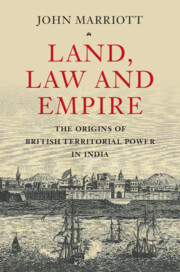
BOOK: John MARRIOTT, Land, Law and Empire. The Origins of British Territorial Power in India (Cambrige: CUP, 2025), ISBN 9781009602099, € 32,68


(image source: CUP)


Abstract:

In this innovative exploration of British rule in India, John Marriott tackles one of the most significant and unanswered questions surrounding the East India Company's success. How and when was an English joint stock company with trading interests in the East Indies transformed into a fully-fledged colonial power with control over large swathes of the Indian subcontinent? The answer, Marriott argues, is to be found much earlier than traditionally acknowledged, in the territorial acquisitions of the seventeenth century secured by small coteries of English factors. Bringing together aspects of cultural, legal and economic theory, he demonstrates the role played by land in the assembly of sovereign power, and how English discourses of land and judicial authority confronted the traditions of indigenous peoples and rival colonial authorities. By 1700, the Company had established the sites of Madras, Bombay and Calcutta, providing the practical foothold for further expansion.

Read the book here: DOI 10.1017/9781009602099 

30 March 2026

BOOK: Boudewijn SIRKS (ed.), contr. Christian BROM, Egbert KOOPS & Tim VAN POLANEN, The Observationes tumultuariae of Johan van Bleiswijk (1684–1748) [Legal History Library, eds. Dirk HEIRBAUT, Michelle McKINLEY, Matthew C. MIROW & C.H. VAN RHEE, 81] (Leiden/Boston: Martinus Nijhoff/Brill, 2026), ISBN 9789004750630, € 157,94


(image source: Brill)

Abstract:

In the Dutch Republic, courts made decisions by voting and judgments were not given reasoned motivations. Although some judges kept a record of the preceding deliberations, the only extensive collections we have had until recently from the eighteenth century are those of van Bijnkershoek and Pauw. Fortunately, we are also in possession of the Observationes of Johan van Bleiswijk (in 1723–1748 a colleague of van Bijnkershoek). Van Bleiswijk provides an overview of the various opinions relating to cases at the time, but also expounds on his own views. In this way, he sheds light on his own perspective and legal views. Hence, van Bleiswijk’s Observationes are a most welcome addition to our knowledge of judicial decision-making in the Dutch Republic.

On the editor:

Boudewijn Sirks is Emeritus Regius Professor of Civil Law at the University of Oxford and Fellow of All Souls College. He has published articles on the Hoge Raad (Supreme Court) of Holland and Zeeland in the Dutch Republic and edited C. van Bijnkershoek, W. Pauw, Index in observationes tumultuarias (2005). 

Read more here: DOI  10.1163/9789004750616.

01 December 2025

SEMINAR: Catherine VOLPILHAC-AUGER, "Montesquieu et les "exilés"" (Séminaire Parlement(s) et cours souveraines, 12 DEC) [HYBRID]


Séminaire Parlement(s) et cours souveraines

La prochaine séance du séminaire “Parlement(s) et cours souveraines”  aura lieu :

                                      Vendredi 12 décembre 2025 (16h30-18h30)

Catherine VOLPILHAC-AUGER (ENS Lyon, IHRIM, UMR 5317), « La grande crise de 1753 : Montesquieu et les parlementaires exilés à Bourges  ».

Répondant : Thibault BARBIEUX ( Université Versailles -Saint Quentin)

Le séminaire se tiendra dans les locaux de l’Institut d’Histoire du Droit-Jean Gaudemet (salle Administration ou salle Collinet, selon la disponibilité), 4 rue Valette, 75005 Paris, esc. de gauche sous le hall, 3e étage.

Voici le lien de connexion ZOOM pour toutes les personnes qui ne pourraient pas se déplacer à l’Institut, sachant que nous vous remercions, lorsque vous le pouvez bien sûr, de privilégier la présence dans nos locaux.

Participer à la réunion Zoom

https://us02web.zoom.us/j/83968347357?pwd=z1uP60q7oK5ekpzbYAEmqnF8M5Wtzk.1

ID de réunion: 839 6834 7357

Code secret: 35560

(source: Parlementdeparis)

28 October 2025

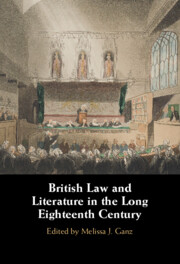
BOOK: Melissa J. GANZ (ed.), British Law and Literature in the Long Eighteenth century (Cambridge: Cambridge University Press, 2025), ISBN 9781009224185, € 105,4


(image source: Cambridge Core)

Abstract:
The law underwent significant changes in eighteenth-century Britain as jurists and legislators adapted doctrines to fit the needs of an increasingly commercial, industrial, and imperial society. This volume reveals how legal developments of the period shaped and were shaped by imaginative writing. Reading canonical and lesserknown texts from the Restoration to the Romantic era, the chapters explore literary engagements with libel law, plague law, marriage law, naturalization law, the poor laws, the law of slavery and abolition, and the practice of common-law decision-making. The volume also considers the language and form of legal treatises and judicial decisions, as well as recent appropriations of the period's literature and legal norms by the Christian right. Through these varied case studies, the volume deepens our knowledge of law and literature's mutual entanglements in the long eighteenth century while shedding light on legal and ethical questions that remain of concern to this day.

On the editor:

Marquette University, Wisconsin

Read more here: DOI 10.1017/9781009224185. 

04 October 2024

JOURNAL: Les Pays-Bas dans les systèmes impériaux [dir. Marie KERVYN & Yves JUNOT] (Études sur le XVIIIe siècle 51 (2023)) (ISBN 978-2-8004-1870-4)


(image source: editions-ULB)

Abstract:

Une Belgique « espagnole », « autrichienne » puis « française » à l'époque moderne, vraiment ? Au cours du XVIIIe siècle, les Pays-Bas méridionaux furent successivement incorporés aux Empires des Habsbourg d’Espagne puis d’Autriche et, par conquête, à la France. Avec l'émergence de l’État-nation et de ses « histoires nationales » au XIXe siècle, la lecture et l’analyse de la trajectoire de ces territoires rattachés à des ensembles politiques « étrangers » ont été sujettes à des biais et leur mémoire se retrouve encore partagée entre plusieurs pays. Aujourd’hui, la déconstruction de cette vision nationale ouvre une autre compréhension de ces configurations complexes. À ce titre, ce volume propose un bilan critique de l’historiographie qui a presque toujours traité séparément ces séquences historiques. Il souligne les continuités et interroge les enjeux de la gouvernance des anciens Pays-Bas comme espaces singuliers des systèmes impériaux européens au cours du XVIIIe siècle.

Table of contents:

Introduction
     Systèmes impériaux, Pays-Bas habsbourgeois et (dé)construction de l'État moderne - Un état de la recherche

Première partie - Gouverner à distance. Entre culture civique locale et intégration dans un système composit
     
Mediating Local Identities as a Tool of Integration - The Austrian and French Regimes Compared (Southern Nederlands, 1715-1814)
     Les officiers fiscaux de Brabant : agents politiques du gouvernement à distance (deuxième moitié du XVIIIe siècle) - Le cas des demandes d'amortissement des organisations religieuses
     De Vienne à Bruxelles - La manifestation du pouvoir habsbourgeois à Bruxelles au temps du gouvernement de Charles de Lorraine (1744-1780)

Deuxième partie - Les enjeux de la gouvernance à travers l'ordre public et la sécurité
     
A Border Case Study in Sint-Donaas - Criminal Trial Resolution ans Mapping Material
     Les aspirations à une police impériale dans l'espace belge, de Joseph II à Napoléon Ier (1780-1815) - Regard historiographique

Troisième partie - La modernisation économique dans les nouvelles stratégies impériales
     Juste une « guerre de la Marmite » ? - La politique globale de Joseph II et l'échec de la tentative de réorientation économique dans les Pays-Bas autrichiens, 1784-1785
     Entre exclusif et transit - Perspective de relance du commerce extérieur des départements belges

Bibliographie

Index des noms de persoones

Index des noms de lieux

Personalia

On the editors:

Marie Kervyn est chargée de cours en histoire moderne à l'ULB. Ses activités de recherche portent sur l’espace méridional des Pays-Bas habsbourgeois et, plus généralement, sur les frontières de l’Empire des Habsbourg. Elles investiguent les questions liées à la réception de migrants, à l’extranéité et à l’identification des personnes dans une perspective d’histoire « sociale du politique ».

Yves Junot est maître de conférences en histoire moderne à l'Université polytechnique Hauts-de-France (Valenciennes). Spécialiste des élites urbaines des Pays-Bas espagnols, il développe ses recherches sur les frontières et leurs logiques transrégionales, sur les processus de réconciliation et de renégociation des pactes politiques entre pouvoirs locaux et monarchie hispanique et sur la résilience des sociétés des XVIe et XVIIe siècles.

On the journal:

Created in 1974 at the initiative of Roland Mortier and Hervé Hasquin, this interdisciplinary series is an internationally renowned journal with premier scientific ranking.  Aiming to promote research on the long XVIIIth Century, it proposes interdisciplinary thematic issues. Mingling literature, history, art history and history of ideas, architecture, urbanism, but also social and medical sciences and philosophy, the journal takes up an intersectional perspective to gauge the interplay and inteferences that constitute an epoch's specific reality. Successively lead by Roland Mortier and Hervé Hasquin, Bruno Bernard and Manuel Couvreur, before the current tandem of Valérie André and Brigitte D'Hainaut, the 'Études sur le XVIIIe siècle'/'Studies on the XVIII Century' are supported by an editorial board and a scientific commission tasked with evaluating the submissions. The journal is financially supported by the FRS/FNRS and its various issues are integrally available in open access one year after their publication in print.

Read more here.