Search

Showing posts with label Jews. Show all posts

06 September 2024

SEMINAR SERIES: Between Exchange and Expulsion Jews and Christians in France, 1096–1394 (Paris: Institut historique allemand, 17-19 SEPT 2024)


Ce colloque, organisé du mardi 17 au jeudi 19 septembre 2024 à l'Institut historique allemand (Paris), abordera les relations entre juifs et chrétiens en France de 1096 à 1394 en évaluant les facteurs sociaux, juridiques, économiques et culturels qui ont influencé la cohabitation judéo-chrétienne pendant et après les croisades.

L’accent sera mis sur les échanges interreligieux et les évolutions des deux religions: en ce qui concerne le rapport aux textes sacrés, il existe des preuves d’un dialogue soutenu; au niveau social, de nombreux indices laissent supposer une intégration harmonieuse de la communauté juive dans la société chrétienne. Cependant, jusqu‘au xiie siècle, il n’existe pas de dispositions exhaustives ancrant la place de la population juive dans le droit. Au lieu de cela, on observe à partir de la fin du XIIe siècle, des expulsions récurrentes, motivées par des intérêts religieux, économiques et politiques, aboutissant finalement à l‘expulsion définitive des juifs de France en 1394.

The conference explores the interactions between Christians and Jews in France from 1096 to 1394, focussing on social, legal, economic and cultural factors that influenced Jewish-Christian coexistence during and after the Crusades. It centres on interreligious exchange and the transformations of both religions: With regard to the handling of sacred scriptures, there is evidence of an intensive dialogue. This also applies to the social sphere where many indications suggest an inclusion of the Jewish community in Christian society. On the other hand, until the 12th century there were no detailed regulations that formalised the place of the Jewish population in law. Instead, it can be observed that from the end of the 12th century onwards, successive expulsions fuelled by religious, economic and political interests ultimately led to the final expulsion of the Jews from France in 1394.

Sur inscription : event@dhi-paris.fr


PROGRAM

Tuesday, 17 September 2024

14.00–14.30 – Welcome and Introduction, Klaus Oschema (DHIP), Görge Hasselhoff (TU Dortmund), Judith Kogel (IRHT/CNRS), Amélie Sagasser (DHIP)

14.45–16.45 – Panel 1: Everyday Life Chair: Amélie Sagasser (DHIP)

  • Manon Banoun (Univ. Paris I Panthéon-Sorbonne), Jews in Medieval Paris and Rouen. Two Different Archaeological and Topographical Approaches
  • Marie Dejoux (Univ. Paris I Panthéon-Sorbonne), The Jews and the Territorial Officers. From Cooperation to Forced Collaboration (13th–14th centuries)
  • Nureet Dermer (Hebrew Univ. of Jerusalem), Jews in Paris Between Expulsions, 1360–1394 17.

15–18.00 – Keynote Lecture, William Chester Jordan (Princeton Univ.), Expulsions of Jews from France Chair: Klaus Oschema (DHIP)


Wednesday, 18 September 2024

9.15–11.15 – Panel 2: Juridical and Court Life Chair: Kirsten Wallenwein (DHIP)

  • Amélie Sagasser (DHIP), Jews and Judaism in the French Canonical Collections of the 12th Century
  • Pinchas Roth (Bar-Ilan Univ.), Jewish Urban Life in Medieval Paris: Glimpses from the Rulings of Rabbi Yehiel of Paris
  • Mario Macias López (Univ. Autònoma de Barcelona), Odo of Châteauroux’s 1248 Sentence as a Source of Jurisdictional Legitimation in Fourteenth-Century Inquisitorial Manuals

11.40–13.00 – Panel 3: Bishops and Jews Chair: Alexander Fidora (Univ. Autònoma de Barcelona)

  • Görge Hasselhoff (TU Dortmund), The Bishop and the Jews. William of Auvergne and the Talmud Trials
  • Judith Kogel (IRHT/CNRS), Jewish-Christian Controversies in Narbonne During the Thirteenth Century: The Milhemet Mitswa

14.00–15.20 – Panel 4: Cultural and Scribal Activites Chair: Judith Kogel (CNRS/IRHT)

  • Sarit Shalev-Eyni (Hebrew Univ. Jerusalem), Jewish-Christian Encounters in French Illuminated Manuscripts
  • Katelyn Mesler (Univ. Heidelberg), Vernacular Verses: New Approaches to Medieval Hebrew-French Bible Glossaries
  • 16.00–17.30 – Guided Tour: The Jewish Marais, Musée d‘art et d‘histoire du Judaïsme (mahJ) 71 Rue du Temple, 75003 Paris


Thursday, 19 September 2024

9.00–11.00 – Panel 5: Intellectual Life Chair: Görge Hasselhoff (TU Dortmund)

  • Wout van Bekkum (Univ. Groningen), Hebrew Poetry from Medieval France and Provence as Hypotext for Latin Translations
  • Miri Rubin (Queen Mary Univ. London), Ecclesia and Synagoga. Some Thirteenth Century French Interpretations
  • Judah Galinsky (Bar-Ilan Univ.), »The Law as Allegory«? French Rabbinic Responses to a Christian Polemic

11.20–12.30 – Round table: Between Exchanges and Expulsions. Perspectives with Elisheva Baumgarten (Hebrew Univ. Jerusalem), Alexander Fiodora (Univ


More information can be found here.

06 November 2020

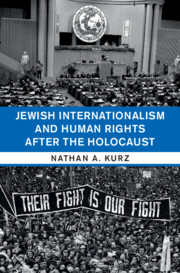
BOOK: Nathan A. KURZ, Jewish Internationalism and Human Rights after the Holocaust (Cambridge: Cambridge University Press, 2020). ISBN 9781108834926, 29.99 GBP


(Source: CUP)

Cambridge University Press is publishing a book on the relationship between Jewish internationalism and international rights protection in the second half of the twentieth century.

ABOUT THE BOOK

Nathan A. Kurz charts the fraught relationship between Jewish internationalism and international rights protection in the second half of the twentieth century. For nearly a century, Jewish lawyers and advocacy groups in Western Europe and the United States had pioneered forms of international rights protection, tying the defense of Jews to norms and rules that aspired to curb the worst behavior of rapacious nation-states. In the wake of the Holocaust and the creation of the State of Israel, however, Jewish activists discovered they could no longer promote the same norms, laws and innovations without fear they could soon apply to the Jewish state. Using previously unexamined sources, Nathan Kurz examines the transformation of Jewish internationalism from an effort to constrain the power of nation-states to one focused on cementing Israel's legitimacy and its status as a haven for refugees from across the Jewish diaspora.

ABOUT THE AUTHOR

Nathan A. Kurz, Birkbeck College, University of London

Nathan A. Kurz has taught at Yale University and Birkbeck College, University of London and has served a visiting fellow at Oxford University.

TABLE OF CONTENTS

Dramatis Personae

Introduction

1. “Individual rights were not enough for true freedom”

2. Who Will Tame the Will to Defy Humanity?

3. The Consequences of 1948

4. Exit from North Africa

5. From Antisemitism to “Zionism is Racism”

6. The Inadequacy of Madison Avenue Methods

7.“Good words have become the servants of evil masters”

Conclusion

Bibliography.


More info here

07 October 2020

CALL FOR PAPERS: “A Lost World?” Jewish International Lawyers and New World Orders (1917–1951) (University of Jerusalem, 24-25 May 2021) (DEADLINE: 15 November 2020)


We learned of a call for papers for a conference on "Jewish International Lawyers and New World Orders”. The conference will take place party or fully online on 24-25 May 2021. Here the call:

The first half of the 20th century featured two dramatic attempts to construct New World Orders following the two World Wars. These attempts included the establishment of ambitious international governance frameworks in the form of the League of Nations, the Permanent Court of International Justice and the International Labor Organization after the First World War and the United Nations Organization, the International Court of Justice and the Bretton Woods System after the Second World War. In parallel with these developments, landmark agreements were reached resulting in a radical transformation of the Westphalian state system, and, in particular, with regard to the relationship between states, individuals and groups. These agreements included other major instruments such as the post-World War One minority treaties, the Slavery Convention (1926), the Kellogg-Briand Pact (1928), the Geneva Conventions of 1929 and 1949, the London Charter (1945), the Genocide Convention (1948), the Universal Declaration of Human Rights (1948) and the Refugees Convention (1951). It can be argued that the norms and institutions established in this dramatic period revolutionized international law in diverse fields, ranging from international human rights law, through international criminal law and international humanitarian law, to international economic law.

Recent years have seen a sharp increase in historical research describing the unique contribution of prominent Jewish international lawyers to the development of modern international law. Among the prominent publications belonging to this genre one can mention Philippe Sands’ "East West Street", focusing on the life and work of Raphael Lemkin and Hersch Lauterpacht (2017), Gilad Ben-Nun’s book on the Fourth Geneva Convention which highlights the contribution of Georg Cohn, Georges Cahen-Salvador and Nissim Mevorah (2020), James Leoffler and Moria Paz’s edited volume on the Law of Strangers (2019), James Loeffler’s "Rooted Cosmopolitans: Jews and Human Rights in the Twentieth Century" (2018), Nathan Kurz’s "Jewish Internationalism and Human Rights after the Holocaust" (2020) and Rotem Giladi’s publications on Israel and the Refugees and Genocide Convention (2015). A number of earlier works also touched upon multiple dimensions of the topic, including the contributions of prominent Jewish international lawyers, such as Hans Kelsen and Jacob Robinson, and on the relationship between the experience of being uprooted and interest in international law.

The conference seeks to invite lawyers, historian and academics from other relevant disciplines to take stock of this growing literature, that analyzes the contribution of Jewish international lawyers to the major developments in international law noted above, and to address the following questions: Can one truly speak of a “Jewish school” in international law? Or can one allude to a number of “Jewish schools” speaking in different voices? Can the contributions of Jewish international lawyers be distinguished from other contemporary trends shaped by migration and/or attachment to cosmopolitan ideals? If so, what are the main contours of this Jewish school(s)? How is it related to Jewish thought and experience generally or to the collective interests of the Jewish people in the relevant period? Does anything remain of this tradition in the 21st century? Has this tradition affected the approach to international law of Israel and international Jewish institutions? To what extent does the categorization of certain authors as “Jewish” do injustice to their own self- identification as individuals or as nationals of specific countries? To what extent has the Jewish stance(s) toward international law changed since the creation of the State of Israel (and to what extent is there a Jewish-Israeli School (or schools) that are distinct from the Jewish school(s)(? In particular, how may these questions be related to what some have seen as Israel’s skeptical stance towards many of the universal or cosmopolitan values articulated in the post-World War eras. Finally, can any contemporary lessons be drawn from this phenomenon and, if so, what are they?

Understanding the historic experience represented by the contribution of Jewish international lawyers in the period in question may also help researchers better understand contemporary attitudes towards international law as well as the feasibility of changing them.

The Call

Researchers interested in addressing issues related to the themes of the conference are invited to respond to this call for papers with a 1-2-page proposal for an article and presentation, along with a brief CV. Proposals should be submitted by email to Mr. Tal Mimran, the coordinator of the International Law Forum (tal.mimran(at)mail.huji.ac.il) no later than 15 November 2020.

Applicants should be notified of the committee's decision by 15 December 2020. Written contributions (of approx. 10-25 pages) based on the selected proposals should be submitted by 1 May 2021. The Israel Law Review (a Cambridge University Press publication) has expressed interest in publishing selected full length papers based on conference presentations, subject to its standard review and editing procedures.

Conference Academic Committee:

Eyal Benvenisti, Cambridge University/Hebrew University of Jerusalem

Tomer Broude, Hebrew University of Jerusalem

Dan Diner, Jabob Robinson Institute, Hebrew University

Elisabeth Gallas, Dubnow Institute

Rotem Giladi, Dubnow Institute

Philipp Graf, Dubnow Institute

Guy Harpaz, Hebrew University of Jerusalem

Moshe Hirsch, Hebrew University of Jerusalem

Yaël Ronen, Israel Law Review, Hebrew University of Jerusalem

Yuval Shany, Hebrew University of Jerusalem

Malcolm Shaw, Essex Court Chambers/Hebrew University of Jerusalem

Yfaat Weiss, Dubnow Institute


More info here

19 November 2019

BOOK: Jay R. BERKOVITZ, Law's Dominion: Jewish Community, Religion, and Family in Early Modern Metz (Leiden-New York, Brill) ISBN 978-90-04-41740-3, EUR €63.00


(Source: Brill)

We learned of the publication of a new book on early modern Jewry and the law in Metz.

ABOUT THE BOOK

In Law’s Dominion, Jay Berkovitz offers a novel approach to the history of early modern Jewry. Set in the city of Metz, on the Moselle river, this study of a vibrant prerevolutionary community draws on a wide spectrum of legal sources that tell a story about community, religion, and family that has not been told before.

Focusing on the community’s leadership, public institutions, and judiciary, this study challenges the assumption that Jewish life was in a steady state of decline before the French Revolution. To the contrary, the evidence reveals a robust community that integrated religious values and civic consciousness, interacted with French society, and showed remarkable signs of collaboration between Jewish law and the French judicial system.

ABOUT THE AUTHOR

Jay R. Berkovitz, Ph.D. (1983), Brandeis University, is Distinguished Professor of Judaic and Near Eastern Studies (Emeritus) at the University of Massachusetts Amherst. He has published extensively in the fields of early modern history and law, including Protocols of Justice (Brill, 2014).

TABLE OF CONTENTS

Contents
Preface
Acknowledgments
Abbreviations
Maps

Introduction


Part 1: Foundations

1 Writing Jewish History through a Legal Lens
 Rabbinic Responsa Literature
 Communal Registers (Pinkasim)
 Lay and Rabbinic Court Records
 Law as a Cultural System
 The Production of the Metz Pinkas Beit Din

2 The Foundations of the Metz Kehillah
 Return of the Jews to France and the Establishment of the Metz Community
 Ritual and Identity
 Material Culture
 Economic Integration


Part 2: Community, Governance, Authority

3 Communal Autonomy and Governance
 Electoral and Administrative Procedures
 Consumption and Social Status
 Poverty and Social Welfare
 Juridical Autonomy and Recourse to Non-Jewish Courts
 Policing Religious and Cultural Boundaries

4 Lay and Rabbinic Judicial Authority
 Lay and Rabbinic Tribunals
 Sources of Law
 Judicial Procedure
 Functions of the Beit Din

5 Navigating the Challenges of Multiple Jurisdictions
 Language
 Production of Bi-lingual Documents
 Patterns of Litigation in the Beit Din
 Judicial Behavior of the Metz Beit Din
 The Acquaintance of the Beit Din with French Law and Judicial Procedure
 Navigating the Two Systems
 The Impact of French Law on Rabbinic Jurisprudence


Part 3: Family Affairs

6 Guardianship and Inheritance
 Guardianship
 Inheritance
 Testamentary Charity

7 Women, Marriage, and Property
 Betrothal and Marriage
 Marital Property
 Women in Credit and Commerce

8 Conclusion and Epilogue 
Glossary
Bibliography
Index 

More info here

02 September 2019

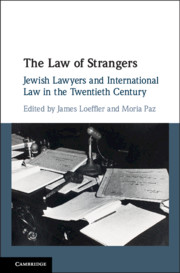
BOOK: James Benjamin LOEFFLER and Moria PAZ, The Law of Strangers Jewish Lawyers and International Law in the Twentieth Century (Cambridge: Cambridge University Press, 2019). ISBN 9781107140417, $ 110.00


(Source: CUP)

Cambridge University Press has published a new edited collection dealing with biographies of important Jewish scholars for 20th century international law.

ABOUT THE BOOK

From the Nuremberg Trials to contemporary human rights, Jews have long played prominent roles in the making of international law. But the actual ties between Jewish heritage and legal thought remain a subject of mystery and conjecture even among specialists. This volume of biographical studies takes a unique interdisciplinary approach, pairing historians and legal scholars to explore how the Jewish identities and experiences shaped their legal thought and activism. Using newly-discovered sources and sophisticated interpretative methods, this book offers an alternative history of twentieth-century international legal profession - and a new model to the emerging field of international legal biography.

Presents engaging biographical case studies that expand knowledge of key historical figures while contributing to larger questions about Jews and law

Engages legal specialists, historians, and other scholars interested in the questions of religion, ethnicity, politics, and international law

Illuminates the state of the field, and the emerging new directions in legal history, international law, and society studies

ABOUT THE EDITORS

James Loeffler, University of Virginia
James Loeffler is Jay Berkowitz Professor of Jewish History at the University of Virginia and former Dean's Visiting Scholar at the Georgetown University Law Center. He is the author of Rooted Cosmopolitans: Jews and Human Rights in the Twentieth Century (2018).

Moria Paz, Stanford University, California
Moria Paz is a Fellow at the Law School, Stanford University, California and the Center for National Security and the Law at Georgetown University Law Center. She is the author of the forthcoming book, Network or State?: International Law and the History of Jewish Self-Determination.

TABLE OF CONTENTS

1. Introduction: the law of strangers James Loeffler and Moria Paz
Part I. Hersch Zvi Lauterpacht:
2. The 'natural right of the Jewish people': Zionism, international law, and the paradox of Hersch Lauterpacht James Loeffler
3. A closet positivist: Lauterpacht between law and diplomacy Martti Koskeniemmi
Part II. Hans Kelsen:
4. Assimilation through law: Hans Kelsen and the Jewish experience Eliav Lieblich
5. Philosophy beyond historicism: reflections on Hans Kelsen and the Jewish experience Leora Batnitzky
Part III. Louis Henkin:
6. Louis Henkin, human rights, and American-Jewish constitutional patriotism Samuel Moyn
7. Louis Henkin and the genealogy of Jewish/American liberalism William Forbath
Part IV. Egon Schwelb:
8. Egon Schwelb and the human rights legal activism within borders Mira Siegelberg
9. 'Emotional restraint' as legalist internationalism: Egon Schwelb's liberalism after the fall Umut Özsu
Part V. René Cassin:
10. A most inglorious right: René Cassin, freedom of movement, Jews and Palestinians Moria Paz
11. There's no place like home: domicile, René Cassin, and the Aporias of modern international law Nathaniel Berman
Part VI. Shabtai Rosenne:
12. Shabtai Rosenne: the transformation of Sefton Rowson Rotem Giladi
13. Shabtai Rosenne: a personal aspect Philippe Sands
Part VII. Julius Stone:
14. Enablement and constraint: Julius Stone and the contradictions of the sociological path to international law Jacqueline Mowbray
15. An axionormative dissenter: reflections on Julius Stone David N. Myers
Index.

More info here

29 August 2019

BOOK: David G. DALIN, Jewish Justices of the Supreme Court From Brandeis to Kagan (Lebanon (New Hampshire): Brandeis University Press, 2017). ISBN 978-1-61168-238-0, $35.00


Brandeis University Press has published a book on Jewish justices in the history of the US Supreme Court in 2017 which we had not yet reported on. 

ABOUT THE BOOK

The first history of the eight Jewish men and women who have served or who currently serve as justices of the Supreme Court

Jewish Justices of the Supreme Court examines the lives, legal careers, and legacies of the eight Jews who have served or who currently serve as justices of the U.S. Supreme Court: Louis D. Brandeis, Benjamin Cardozo, Felix Frankfurter, Arthur Goldberg, Abe Fortas, Ruth Bader Ginsburg, Stephen G. Breyer, and Elena Kagan.

David Dalin discusses the relationship that these Jewish justices have had with the presidents who appointed them, and given the judges’ Jewish background, investigates the antisemitism some of the justices encountered in their ascent within the legal profession before their appointment, as well as the role that antisemitism played in the attendant political debates and Senate confirmation battles.
Other topics and themes include the changing role of Jews within the American legal profession and the views and judicial opinions of each of the justices on freedom of speech, freedom of religion, the death penalty, the right to privacy, gender equality, and the rights of criminal defendants, among other issues.

TABLE OF CONTENTS
• Acknowledgments
• Before Brandeis: Presidents, Presidential Appointments, and America’s Jews, 1813–1912
• Louis D. Brandeis: “People’s Attorney,” Presidential Adviser, and Zionist
• Justice Brandeis: Supreme Court Nomination and Senate Confirmation Fight
• Benjamin N. Cardozo: Redeeming the Family Name
• Felix Frankfurter: City College to the New Deal
• Mr. Justice Frankfurter: The Court Years
• Arthur J. Goldberg: A Promising Tenure Cut Short
• Abe Fortas: A Tale of Achievement and Scandal
• Three Jewish Justices: Ginsburg, Breyer, and Kagan Join the Court
• Notes
• Index
ABOUT THE AUTHOR
DAVID G. DALIN, a historian and rabbi, is the author, coauthor or editor of eleven books, including Religion and State in the American Jewish Experience (coauthored with Jonathan D. Sarna) and The Presidents of the United States and the Jews. His articles and book reviews have appeared in a variety of publications, including American Jewish History, Commentary, Modern Judaism, the Weekly Standard, the American Jewish Year Book, and the Jewish Review of Books.

All info here

25 March 2019

BOOK : Rena N. LAUER, Colonial justice and the Jews of Venetian Crete (Philadelphia: University of Pennsylvania Press, 2019). ISBN 9780812250886, £56.00


The University of Pennsylvania Press has published a new book on the usage of the legal system by the Jewish population of 13th century Venetian Crete.

ABOUT THE BOOK

When Venice conquered Crete in the early thirteenth century, a significant population of Jews lived in the capital and main port city of Candia. This community grew, diversified, and flourished both culturally and economically throughout the period of Venetian rule, and although it adhered to traditional Jewish ways of life, the community also readily engaged with the broader population and the island's Venetian colonial government.

In Colonial Justice and the Jews of Venetian Crete, Rena N. Lauer tells the story of this unusual and little-known community through the lens of its flexible use of the legal systems at its disposal. Grounding the book in richly detailed studies of individuals and judicial cases—concerning matters as prosaic as taxation and as dramatic as bigamy and murder—Lauer brings the Jews of Candia vibrantly to life. Despite general rabbinic disapproval of such behavior elsewhere in medieval Europe, Crete's Jews regularly turned not only to their own religious courts but also to the secular Venetian judicial system. There they aired disputes between family members, business partners, spouses, and even the leaders of their community. And with their use of secular justice as both symptom and cause, Lauer contends, Crete's Jews grew more open and flexible, confident in their identity and experiencing little of the anti-Judaism increasingly suffered by their coreligionists in Western Europe.

ABOUT THE AUTHOR

Rena N. Lauer teaches history and religious studies at Oregon State University.

More information here

31 August 2014

BOOK: "Jews in Early Christian Law", J. V. Tolan, N. de Lange, L. Foschia, C. Nemo-Pekelman (eds.)


Jews in Early Christian Law 
Byzantium and the Latin West, 6th-11th centuries

379 p., 156 x 234 mm, 2014

All information here

The sixth to eleventh centuries are a crucial formative period for Jewish communities in Byzantium and Latin Europe: this is also a period for which sources are scarce and about which historians have often had to speculate on the basis of scant evidence. The legal sources studied in this volume provide a relative wealth of textual material concerning Jews, and for certain areas and periods are the principal sources. While this makes them particularly valuable, it also makes their interpretation difficult, given the lack of corroborative sources.
The scholars whose work has been brought together in this volume shed light on this key period of the history of Jews and of Jewish-Christian relations, focusing on key sources of the period: Byzantine imperial law, the canons of church councils, papal bulls, royal legislation from the Visigoths or Carolingians, inscriptions, and narrative sources in Hebrew, Greek and Latin. The picture that emerges from these studies is variegated. Some scholars, following Bernhard Blumenkranz, have depicted this period as one of relative tolerance towards Jews and Judaism; others have stressed the intolerance shown at key intervals by ecclesiastical authors, church councils and monarchs.
Yet perhaps more than revealing general tendencies towards "tolerance" or "intolerance", these studies bring to light the ways in which law in medieval societies serves a variety of purposes: from providing a theologically-based rationale for social tolerance, to attempting to regulate and restrict inter-religious contact, to using anti-Jewish rhetoric to assert the authority or legitimacy of one party of the Christian elite over and against another. This volume makes an important contribution not only to the history of medieval Jewish-Christian relations, but also to research on the uses and functions of law in medieval societies.