Search

Showing posts with label Scottish Legal History. Show all posts

02 September 2025

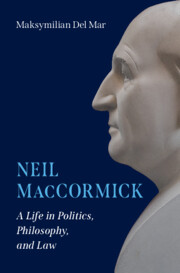
BOOK: Maksymilian DEL MAR, Neil MacCormick. A Life in Politics, Philosophy, and Law (Cambridge: Cambridge University Press, 2025), ISBN 9781009609937, €58,36


(image source: CUP)

Abstract:

Neil MacCormick (1941–2009) was one of the twentieth century's most important legal philosophers and one of Scotland's most influential public intellectuals. This book tells the story of his political and philosophical life, from his intensely political childhood as the son of 'King John', one of the founders of the Scottish National Party, through to his involvement in Scottish politics – especially as the author of SNP's constitutional policy – and his role as a Member of the European Parliament, helping to draft the European Constitution. With special attention to MacCormick's character, this book offers a reading of his entire oeuvre, covering his contributions to theories of legal and moral reasoning, institutional legal theory, nationalism, post-sovereignty, subsidiarity, and constitutional pluralism in Europe. This book reads MacCormick as a highly creative thinker who excelled in the art of constructing inclusive middles and thereby developed his own distinctive approach to politics and philosophy.

Read more here: DOI 10.1017/9781009609937. 

(source: Legal History Blog)

13 June 2024

BOOK: Andrew R. C. SIMPSON and Jørn ØYREHAGEN SUNDE (eds.), Comparative Perspectives in Scottish and Norwegian Legal History, Trade and Seafaring, 1200-1800 (Edinburgh: University Press, 2023). ISBN: 9781399503877, pp. 344, £95.00


(Source: Edinburgh UP)


ABOUT THE BOOK

There were significant points of contact and similarities in the ways in which the laws of Scotland and Norway developed. The Treaty of Perth of 1266 was of significance in the state formation of both countries, and in the determination of their territorial boundaries. The laws and customs applicable in the Orkneys and the Shetlands remain distinctive due to Norse influence, centuries after those islands became subject to Scottish sovereignty. The extensive trading links between two countries united by the North Sea raises the question of how trade between the territories was regulated.

This book brings together experts in Norwegian and Scottish legal, economic and political history to explore these points of contact. It breaks new ground, considering Scots law in terms of its historical interactions and similarities with another national legal system, rather than in terms of its place at the intersection between the common law and the civilian traditions.


TABLE OF CONTENTS


Introduction - by Andrew R C Simpson, Jørn Øyrehagen Sunde, pp 1-32

PART 1 - The Medieval Period, ca. 1200–ca. 1500, pp 33-34

1 - The Treaty of Perth: Union of the realm and the king’s law - by Erik Opsahl, pp 35-62

2 - The Treaty of Perth: Union of the realm and the laws of the kingdom - By Dauvit Broun, pp 63-94

3 - Law and Administrative Change in Norway, Twelfth–Fourteenth Centuries - by Jørn Øyrehagen Sunde, pp 95-121

4 - Law and Administrative Change in Scotland, Twelfth–Fourteenth Centuries - by Alice Taylor, pp 122-154

5 - Urban Legal Procedure in Fourteenth Century Norway - by Miriam Jensen Tveit, pp 155-180

6 - Urban Legal Procedure in Fourteenth Century Scotland: A fresh look at the 1317 court roll of Aberdeen - by Andrew R. C. Simpson, pp 181-208

PART 2 - The Early Modern Period, ca. 1500–ca. 1800, pp 209-210

7 - War and Peace: Scottish-Norwegian relations in the early modern period (ca. 1520–1707)- by Steve Murdoch, pp 211-231

8 - Traders and Immigrants: A Norwegian perspective on Scottish-Norwegian economic relations from the fifteenth to the early seventeenth century - by Per G Norseng, pp. 232-271

9 - Norm and Fact: Timber trade in early modern western Norway (1530–1730) - by Sören Koch, pp 272-296

10 - The Law and Economy of Shipwreck in Scotland during the Sixteenth Century - by J. D. Ford, pp 297-321

Index, pp 322-332


More information with the publisher.

30 May 2024

BOOK: J.D. FORD, Local Customs and Common Laws. Essays on the Law Governing Maritime Commerce in Sixteenth-Century Scotland [Legal History Library, ed. Remco VAN RHEE, Dirk HEIRBAUT & Matthew C. MIROW; 67] (Leiden/Boston: Martinus Nijhoff/Brill, 2024), ISBN 978-90-04-69500-9

(image source: Brill)

Abstract:

Lawyers in Scotland in the later sixteenth century took a disproportionate interest in the law governing maritime commerce. Some essays in this collection consider their handling of the subject in treatises they wrote. Other essays, however, show that disputes relating to maritime trade were handled in a different way in the courts of the towns at which ships arrived. Further essays examine the relationship between these contrasting perspectives. Although the essays focus on the law governing maritime commerce in Scotland, they also contribute to a wider debate about the nature of maritime law in early-modern Europe.

Author:

J.D. Ford holds the chair of Civil Law at the University of Aberdeen. His edition of Alexander King’s Treatise on Maritime Law appeared in 2018, and his book about The Emergence of Privateering was published by Brill in 2023. 

Read more here. 


28 April 2023

BOOK: Stephen BOGLE, Contract Before Enlightenment: The Ideas of James Dalrymple, Viscount Stair, 1619-1695 (Oxford: Oxford University Press, 2023), 304 pp, ISBN 9780192884961, £90


(image courtesy: Oxford University Press)

Book description: 
Contract Before the Enlightenment represents a fresh investigation of what was then a ground-breaking approach to the law of contract written by James Dalrymple, Viscount Stair (1619-1695), lauded by some as the founding father of Scots law.

As a judge and public figure, Stair was at the forefront of both political and legal developments in Scotland from the 1640s until he died in 1695. This study explores the development and reception of his ideas relating to the law of contract on the eve of the Scottish Enlightenment. It is here that Stair's legal legacy is most evident, and where the imprint of Calvinism, Aristotelianism, and Protestant natural law can be found within Scottish legal thought.

In his legal treatise, the Institutions of Law of Scotland you find a sophisticated, innovative, and novel synthesis of Roman law with Stair's own Calvinist variant of a Protestant natural law theory. Yet it is also possible to find, once the theistic premises of Stair's natural law theory are dropped, the beginnings of a form of Scottish moral philosophy that rose to prominence in the eighteenth century.

Undoubtedly, Stair is not only a key figure within Scottish legal history but also significant to how we understand the transition of Scottish intellectual life from the execution of Charles I to the emergence of the Scottish Enlightenment.

Table of contents: 
Introduction: Transforming the Law of Contract
1:Contractual Thought Before Stair
2:Roman Law as a Source of Contract Law
3:A New Basis for the Law of Contract
4:Standing by the Faith of Pactions and Promises
5:Stair's 'Plain Method' and Structure
6:Human Action, the Will, and Freedom
7:Freedom, Liberty, and Conscience
8:Freedom to Contract in the Seventeenth Century
9:The Reception of Stair's Contractual Thought

About the author: 
Stephen Bogle is a Senior Lecturer in Private Law at the University of Glasgow. He graduated from the University of Edinburgh in 2005 with an MA (Mental Philosophy) before commencing his LLB at the University of Strathclyde (2007). After qualifying as a solicitor in Scotland (2010), he returned to the University of Edinburgh to do both his LLM by Research (2012) and PhD (2016).

More information can be found here. 

03 October 2022

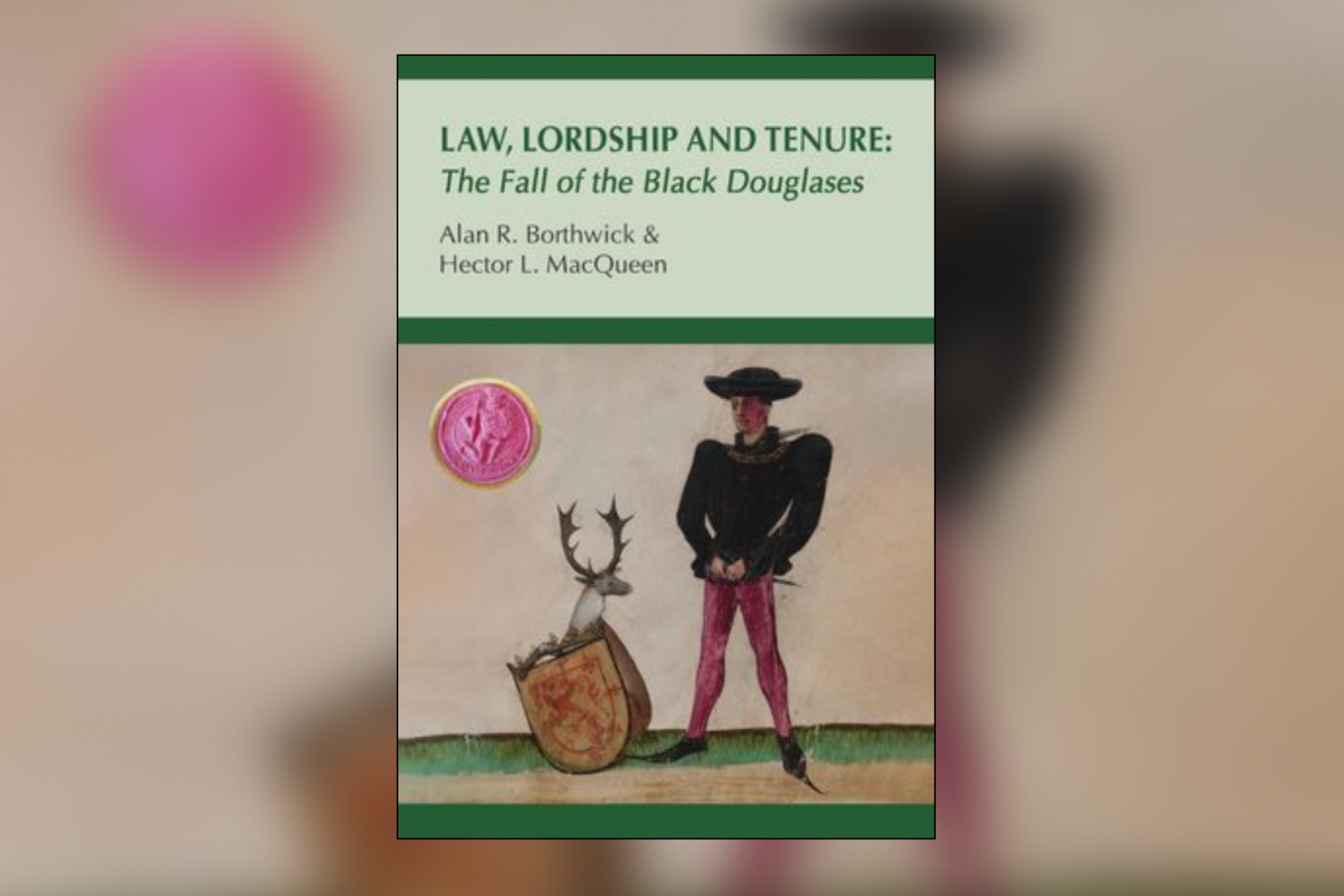
BOOK LAUNCH : Law, Lordship and Tenure: The Fall of the Black Douglases (Edinburgh/Zoom, 6 October 2022)


The Edinburgh Centre for Legal History is having an event to celebrate the publication of ‘Law, Lordship and Tenure: The Fall of the Black Douglases’.

About the book
This book is a new interpretation of the fall of later medieval Scotland’s greatest noble family, the Black Douglases, in 1455. The discussion reaches back in time to over a century before, as the family began its rise to the pinnacle of Scottish society. The killing of William eighth earl of Douglas by King James II in 1452 receives particular attention, as also the way in which he, his brother James (his successor as earl), and their predecessors exercised their power and authority as earls and lords, and it is suggested that their identifiable failings in this provide the key to understanding the catastrophe that befell the family in 1455. The principal analytical tool is the law relevant to these events and the specific meaning and significance of the documents (which is often a legal question) that evidence them. It is argued that this form of analysis is at least as relevant as any more political approach and that ‘legal consciousness’ was a vital feature of Scottish noble society.


About the authors
Alan Borthwick has been one of the archivist staff of the now National Records of Scotland for over 30 years, and in that time has worked in a variety of posts. He has been Head of the Private Records section since 2007. Alan was the lead curator for the NRS exhibition in 2005 at the Scottish Parliament when the Declaration of Arbroath was last publicly displayed. He was also lead curator for the two exhibitions of the "Wallace document" of 1300, at the Scottish Parliament (2012) and at Stirling Castle (2014). His PhD thesis, on the reign of King James II (1437-1460), was completed in 1989. He also contributed a number of articles to the Oxford Dictionary of National Biography (2004). Other contributions include "Montrose v Dundee and the Jurisdiction of Parliament and Council over Fee and Heritage in the Mid-Fifteenth Century", Parliamentary History xv (1) (1996) 33-53 and "An Addition to Scotia Pontifica", Innes Review xxxix (1) 61-64.

Hector MacQueen is Emeritus Professor of Private Law at the University of Edinburgh Law School, having previously been a member of staff from 1979 to 2021. He has worked on various aspects of Scottish legal history, especially in the medieval period, where his best-known work is Common Law and Feudal Society in Medieval Scotland (1993; reissued 2016). He also writes about 'legal nationalism' in Scotland and on the history of copyright. Hector is currently Vice-President of the Stair Society, having previously been its Literary Director 1999-2017. He is also a Fellow of the British Academy and of the Royal Society of Edinburgh, having been Vice-President (Humanities) of the latter 2008-2011. He is a Vice-President of the Scottish Text Society. He was awarded a CBE in the 2019 Birthday Honours list. Alan and Hector have previously co-authored a number of published articles, focussed mainly on mid-fifteenth century litigation.

Event Link

Register on Zoom

Source: University of Edinburgh


12 January 2022

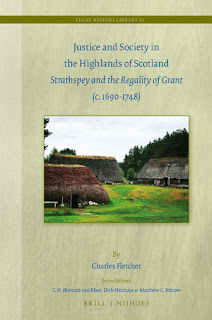
BOOK: Charles FLETCHER, Justice and Society in the Highlands of Scotland. Strathspey and the Regality of Grant (c. 1690-1748) (Leiden: Brill, 2021). ISBN: 978-90-04-47251-8, €112.00

(Source: Brill)

ABOUT THE BOOK

Series: Legal History Library, Volume: 53

This book fills a significant gap in our current understanding of early modern Scottish history. It is the first systematic consideration of the workings of seigneurial courts of feudal lords in 18th century Scotland. For several hundred years, these courts were one of the main forums for justice across Europe. Until 1748, Scottish courts of barony and regality handled both criminal complaints and civil disputes; they made by-laws and levied taxes; they set wages and enforced morality. The 18th century was a time of epoch-defining events in Scotland, such as the Jacobite rebellions, and union with England. The amount of literature on this period of Scottish history is extensive; it is therefore remarkable that the story of these courts has been left untouched. 

ABOUT THE AUTHOR

Charles Fletcher, Ph.D. (2019), University of Edinburgh. His main fields of interest are the culture and history of the highlands of Scotland and Scottish legal history.

TABLE OF CONTENTS

Preface 
Acknowledgements 
List of Illustrations 
Conventions and Abbreviations 
Glossary 

1 Introduction 
 1.1 Heritable Justice in Scotland 
 1.2 Seigneurial Justice: Scotland in European Context 
 1.3 The Regality of Grant 

2 The Clan Grant and the Regality Court 
 2.1 Strathspey in the Early Eighteenth Century 
 2.2 The Lairds of Grant, the Fine and the Regality Court of Grant 
  2.2.1  The Lairds of Grant 
  2.2.2  Bailies of the Regality of Grant 
  2.2.3  The Fine of Clan Grant: John Grant of Dalrachney 
 2.3 Conclusion 

3 The Regality Court and Its Procedures 
 3.1 Court Officials 
  3.1.1  Clerks of the Court 
  3.1.2  Procurators Fiscal 
  3.1.3  Officers 
  3.1.4  Birlawmen 
 3.2 How, Why and When Were Courts Convened? 
  3.2.1  When? 
  3.2.2  Where? 
 3.3 The Court Day 

4 Actions for Debt 
 4.1 Debt and Credit in Strathspey 
 4.2 The Collection of Rents 
 4.3 Poinding 
 4.4 Debt and Divisions in the Grant Family: Unwarranted Poinding 1710–1711 
  4.4.1  Rental Crisis 
  4.4.2  Case Study: Ludovick Grant of that Ilk v. Mungo Grant of Mullochard and Others 
 4.5 Conclusion 

5 Criminal Jurisdiction 
 5.1 Violent Crime and the Regality Court of Grant 
  5.1.1  Trends in Violent Crime 
  5.1.2  Gendered Differences in Violence 
  5.1.3  Types of Violence 
   a) Violent Threats and Caution 
   b) Violent Disputes 
 5.1.4  Process 
 5.1.5  Punishment 
 5.2 Serious Crime and the Regality Court of Grant 
 5.3 The Northern Circuit of the Justiciary Court and the Regality of Grant 
  5.3.1  1708–1710 
  5.3.2  1711–1747 
  5.3.3  After Abolition, 1748–1753 
 5.4 Conclusion 

6 Economic and Social Control 
 6.1 Economic Control 
  6.1.1  Food Supplies 
  6.1.2  Regulation of Employment 
   a) The Problem of ‘Loose’ Servants 
   b) Wages 
   c) Other Trades 
  6.1.3  The Relationship between the Regality Court and the Justices of the Peace 
 6.2 Religious and Social Control 
  6.2.1  People 
  6.2.2  Kirk Session Business and the Regality Court of Grant 
  6.2.3  Slander 
  6.2.4  Funding the Kirk 
 6.3 Local Governance, Conclusions 

7 The Regality Court and the Landed Estate 
  Woodlands, Game, Farming and Improvement 
 7.1 Protecting the Laird’s Woodlands and Game 
  7.1.1  Woodlands and Their Management in Eighteenth-century Strathspey 
  7.1.2  The Regality Court and the Woods 
   a) Continuity and Change 
   b) The York Buildings Company 
 7.2 Game 
  7.2.1  Hunting, Fishing and Game in the Regality of Grant 
  7.2.2  Poaching Cases in the Regality Court 
 7.3 Improvement and Farming 
  7.3.1  Pastoral Farming 
 7.4 Conclusion 

8 Land Tenure 
 8.1 Tacks and Tenure 
 8.2 Vassal’s Labour Services 
 8.3 Conclusion 

9 Conclusion 
 9.1 Justice, Society, and Heritable Jurisdictions 
 9.2 Jurisdiction 
 9.3 Heritable Justice after 1748 

Bibliography 
Index 


More information with the publisher.


20 December 2021

JOURNAL: The Journal of Legal History XL (2021), nr. 1


(image source: ESCLH Blog)

Articles

Natural Law in Early Twentieth Century Ireland – State (Ryan) v Lennon and its Aftermath (Thomas Mohr) OPEN ACCESS
DOI 10.1080/01440365.2021.1893946
Abstract:
This article examines the relationship between natural law and Irish law held by constitutional drafters, academic commentators and judges in the early twentieth century. References to natural law values in interpreting Irish law were not acceptable before 1922 when the entire island of Ireland remained part of the United Kingdom. The emergence of the self-governing Irish Free State in 1922 did not immediately change this position and natural law was limited to a peripheral position during the drafting of the first Irish Constitution. This article examines how and why the use of natural law by the Irish courts became increasingly acceptable by the middle of the twentieth century. It will also examine the connection between the drafting of the 1922 Constitution of the Irish Free State and the 1934 judgment of the Supreme Court in State (Ryan) v Lennon. This provides a new perspective on the judgments delivered in this case and on the origins of the use of natural law in interpreting Irish constitutional law. The article will also examine the legacy of State (Ryan) v Lennon, the position of natural law in the 1937 Irish Constitution and the evolving position of natural law in the decades that followed.

The Matrimonial Family in Byzantine Imperial Law: An Overview from Late Antiquity Until the Tenth Century AD (Manuel Vial-Dumas)
DOI 10.1080/01440365.2021.1893947
Abstract:

This article analyses the representation of the matrimonial family in Byzantine legislation. It provides an overview of the basic structures of the system from the time of Constantine the Great until the tenth century. The article considers the elements that can be seen in both the ideal conception provided by imperial law and the customs that imperial legislation recognized even when they differed from the ideal representation. In this reconstruction two types of matrimonial family are discussed: one that involves the transfer of property between families of origin and one that does not. From the matrimonial family, constituted without transfer of property, the logic behind the structure of exchange between families can be understood. This is especially revealing as regards its purpose, namely, the protection of the children and the surviving spouse and the conservation of the matrimonial family’s inheritance.

‘By Fraud and Collusion’: Feudal Revenue and Enforcement of the Statute of Marlborough, 1267–1526 (Ashley Hannay)
DOI 10.1080/01440365.2021.1893948
Abstract:

Following the Statute of Marlborough 1267, feoffments which were designed to deprive lords of wardship could in some circumstances be deemed ‘collusive’ or ‘fraudulent’. This was further complicated from the mid-fourteenth century onwards by the common practice of creating uses to circumvent the common law rules prohibiting the devise of land by last will. The effect of uses being created to perform last wills was that lords, in particular the king, were losing out on their feudal incidents. The current view, put forward by legal historians, is that the Crown struggled to enforce the Statute of Marlborough after 1410, and that the ‘campaign’ against this loss of feudal revenue began in the 1520s. This article seeks to re-examine this view, particularly in relation to how Marlborough and collusion were understood and the Crown’s approach to the avoidance of feudal incidents before the Statute of Uses 1536.

Scottish Legal History Group Report 2020

Migrations of Manuscripts 2020 (Sir John Baker)

Book reviews

  • Law and Society in England 1750–1950 by William Cornish, Stephen Banks, Charles Mitchell, Paul Mitchell and Rebecca Probert, Oxford, Hart Publishing, 2019, 2nd ed., lvii + 721 pp. (including index)., £39.99 (paperback), ISBN 9781849462730 (Ciarian McCabe) 
Read the whole issue with Taylor & Francis Online.

10 June 2021

BOOK: Craig ANDERSON, Roman Law for Scots Law Students (Edinburgh: Edinburgh University Press, 2021) ISBN 9781474450195, 40.00 GBP


Edinburgh University Press has published a textbook guide to how Roman law influenced Scots law.

ABOUT THE BOOK

A textbook guide to how Roman law influenced Scots law, supported with online student resources

  • Gives a clear, general account of Roman private law: how it developed and how it was administered
  • Explains how Roman law influenced later law in Scotland and elsewhere
  • Guides readers in using Roman materials for modern legal problems
  • Includes chapter summaries and suggestions for further reading

From property law to delict and unjustified enrichment, this textbook focuses on those areas of Roman law that have been most influential on Scots law.

By using this book, students will enter practice with a greater depth of understanding of the roots of modern Scots law, helping them to feel confident in using Roman materials when tackling today's legal problems.

ABOUT THE AUTHOR

Craig Anderson is Lecturer in Law at Robert Gordon University.

TABLE OF CONTENTS

Part I: The Historical and Constitutional Context of Roman Law

Part II: The Law of Persons

Part III: The Law of Things – Property

Part IV: The Law of Things – Succession

Part V: The Law of Things – Obligations

Index


More info here

25 November 2020

BOOK: Jackson W. ARMSTRONG & Edda FRANKOT (Eds.), Cultures of Law in Urban Northern Europe: Scotland and its Neighbours c.1350–c.1650 (London: Routledge, 2020). ISBN 9780367206796, 34.99 GBP

(Source: Routledge)


Routledge is publishing a book on cultures of law in urban Northern Europe during the period 1350-1650.

ABOUT THE BOOK

Drawing together an international team of historians, lawyers and historical sociolinguists, this volume investigates urban cultures of law in Scotland, with a special focus on Aberdeen and its rich civic archive, the Low Countries, Norway, Germany and Poland from c. 1350 to c. 1650.


In these essays, the contributors seek to understand how law works in its cultural and social contexts by focusing specifically on the urban experience and, to a great extent, on urban records. The contributions are concerned with understanding late medieval and early modern legal experts as well as the users of courts and legal services, the languages and records of law, and legal activities occurring inside and outside of official legal fora. This volume considers what the expectations of people at different status levels were for the use of the law, what perceptions of justice and authority existed among different groups, and what their knowledge was of law and legal procedure. By examining how different aspects of legal culture came to be recorded in writing, the contributors reveal how that writing itself then became part of a culture of law.


Cultures of Law in Urban Northern Europe: Scotland and its Neighbours c.1350–c.1650 combines the historical study of law, towns, language, and politics in a way that will be accessible and compelling for advanced level undergraduates and postgraduate to postdoctoral researchers and academics in medieval and early modern, urban, legal, political, and linguistic history.

ABOUT THE EDITORS

 Jackson W. Armstrong is a Senior Lecturer in History at the University of Aberdeen, Scotland. He is the author of England’s Northern Frontier: Conflict and Local Society in the Fifteenth-Century Scottish Marches (2020).

Edda Frankot is Associate Professor in History at Nord University in Bodø, Norway. She specialises in late medieval urban, maritime and legal history. She is the author of ‘Of Laws of Ships and Shipmen’. Medieval Maritime Law and its Practice in Urban Northern Europe (2012).


TABLE OF CONTENTS


Investigating Cultures of Law in Urban Northern Europe

Jackson W. Armstrong and Edda Frankot

PART I: TELLING TALES

Chapter 1: Telling Tales: Maritime Law in Aberdeen in the Early Sixteenth Century

J.D. Ford

PART II: COMMUNICATION OF LAW

Chapter 2: Common Books in Aberdeen, c. 1398 - c. 1511

William Hepburn and Graeme Small

Chapter 3: The Language of Medieval Legal Record as a Complex Multilingual Code

Joanna Kopaczyk

Chapter 4: The Vernacularisation of the Aberdeen Council Registers (1398–1511)

Anna D. Havinga

PART III: JURISDICTION AND CONFLICT

Chapter 5: Urban law in Norwegian market towns: Legal culture in a long fourteenth century

Miriam Tveit

Chapter 6: The Burgh and the Forest: Burgesses and Officers in Fifteenth-Century Scotland

Michael H. Brown

Chapter 7: Pax Urbana. The Use of Law for the Achievement of Political Goals

Jörg Rogge

Chapter 8: Recalcitrant Brides and Grooms. Jurisdiction, Marriage, and Conflicts with Parents in Fifteenth-Century Ghent

Chanelle Delameillieure and Jelle Haemers

PART IV: LAW IN PRACTICE, IN AND OUT OF COURT

Chapter 9: Legal Business Outside the Courts: Private and Public Houses as Spaces of Law in the Fifteenth Century

Edda Frankot

Chapter 10: Conflicts about Property: Ships and Inheritances in Danzig and in the Hanse Area (Fifteenth to Sixteenth Centuries)

Justyna Wubs-Mrozewicz

Chapter 11: ‘Malice’ and Motivation for Hostility in the Burgh Courts of Late Medieval Aberdeen

Jackson W. Armstrong

PART V: MEN OF LAW IN SCOTLAND

Chapter 12: Bells, Clocks and the Beginnings of ‘Lawyer Time’ in Late Medieval Scotland

David Ditchburn

Chapter 13: Andrew Alanson: Man of Law in the Aberdeen Council Register, c. 1440 - c. 1475?

Andrew R.C. Simpson

Chapter 14: Notaries and Advocates in Early Modern Aberdeen

Adelyn L.M. Wilson


More info here

31 July 2020

BOOK: Alice TAYLOR, The Shape of the State in Medieval Scotland, 1124-1290 (Oxford: Oxford University Press, 2020). ISBN 9780198861256, 40.00 USD


(Source: OUP)

Oxford University Press is publishing the paperback edition of Professor Alice Taylor’s “The Shape of the State in Medieval Scotland, 1124-1290” (we had not yet reported on the 2016 hardback edition).

ABOUT THE BOOK

This is the first full-length study of Scottish royal government in the twelfth and thirteenth centuries ever to have been written. It uses untapped legal evidence to set out a new narrative of governmental development. Between 1124 and 1290, the way in which kings of Scots ruled their kingdom transformed. By 1290 accountable officials, a system of royal courts, and complex common law procedures had all been introduced, none of which could have been envisaged in 1124.

The Shape of the State in Medieval Scotland, 1124-1290 argues that governmental development was a dynamic phenomenon, taking place over the long term. For the first half of the twelfth century, kings ruled primarily through personal relationships and patronage, only ruling through administrative and judicial officers in the south of their kingdom. In the second half of the twelfth century, these officers spread north but it was only in the late twelfth century that kings routinely ruled through institutions. Throughout this period of profound change, kings relied on aristocratic power as an increasingly formal part of royal government. In putting forward this narrative, Alice Taylor refines or overturns previous understandings in Scottish historiography of subjects as diverse as the development of the Scottish common law, feuding and compensation, Anglo-Norman 'feudalism', the importance of the reign of David I, recordkeeping, and the kingdom's military organisation. In addition, she argues that Scottish royal government was not a miniature version of English government; there were profound differences between the two polities arising from the different role and function aristocratic power played in each kingdom.

The volume also has wider significance. The formalisation of aristocratic power within and alongside the institutions of royal government in Scotland forces us to question whether the rise of royal power necessarily means the consequent decline of aristocratic power in medieval polities. The book thus not only explains an important period in the history of Scotland, it places the experience of Scotland at the heart of the process of European state formation as a whole

ABOUT THE AUTHOR

Alice Taylor, Reader in Medieval History, King's College London

Alice Taylor is a Reader in Medieval History at King's College London. She was born in London and studied History at St Peter's College, Oxford. After receiving her doctorate from Oxford in 2009, she was a Research Fellow at King's College, Cambridge until 2011, when she joined the History Department at KCL. The Shape of the State was her first book, and was jointly awarded the Royal Historical Society's Whitfield Prize in 2017. Also in 2017, she was awarded a Philip Leverhulme Prize for History.

TABLE OF CONTENTS

Acknowledgements
List of Maps and Tables
List of Abbreviations
Preliminary notes
Introduction
Part 1: Rulers and Ruled, 1124-1230
1. The early Scottish state?
2. Common Burdens in the Regnum Scottorum
3. Written law and the maintenance of order, 1124-1290
Part II: The emergence of a bureaucratic state, c.1170-1290?
4. The institutions of royal government, c.1170-1290
5. The development of a common law, 1230-1290
6. Accounting and Revenue, c.1180-1290
7. A bureaucratic government?
Conclusion
Appendix
Bibliography

More info here

16 June 2020

BOOK: Michael LOBBAN & Ian WILLIAMS (eds.), Networks and Connections in Legal History (Cambridge: University Press, 2020). ISBN: 1108490883, £ 85.00

Networks and Connections in Legal History
(Source: CUP)


ABOUT THE BOOK

Network and Connections in Legal History examines networks of lawyers, legislators and litigators, and how they shaped legal development in Britain and the world. It explores how particular networks of lawyers - from Scotland to East Florida and India - shaped the culture of the forums in which they operated, and how personal connections could be crucial in pressuring the legislature to institute reform - as with twentieth century feminist campaigns. It explores the transmission of legal ideas; what happened to those ideas was not predetermined, but when new connections were made, they could assume a new life. In some cases, new thinkers made intellectual connections not previously conceived, in others it was the new purposes to which ideas and practices were applied which made them adapt. This book shows how networks and connections between people and places have shaped the way that legal ideas and practices are transmitted across time and space.

ABOUT THE EDITORS

Michael Lobban is Professor of Legal History at the London School of Economics and Political Science, England. He is the author of The Common Law and English Jurisprudence, 1760-1850 (1991) and A History of the Philosophy of Law in the Common Law World, 1600-1900 (2007), as well as one of the authors of volumes XI-XIII of The Oxford History of the Laws of England. 
Ian Williams is Associate Professor at the University College London Faculty of Laws, England. His research interests are principally in legal history, particularly early-modern English legal history. He is co-editor of Landmark Cases in Criminal Law.

TABLE OF CONTENTS

1. Introduction - Michael Lobban and Ian Williams
2. Networks and Influences: Contextualising Personnel and Procedures in the Court of Chivalry - Anthony Musson 
3. Men of law and legal networks in Aberdeen, principally in 1600-1650 - Adelyn Wilson 
4. Calling Time at the Bar: First women barristers and their networks and connections - Judith Bourne
5. The Thistle, the Rose, and the Palm: Scottish and English Judges in British East Florida - M. C. Mirow; 
6. 'The Bengal Boiler': Legal Networks in Colonial Calcutta - Raymond Cocks; 
7. The White Ensign on Land: The Royal Navy and Legal Authority in Early Sierra Leone - Tim Soriano; 
8. A Broker's Advice: Credit Networks and Mortgage Risk in the Eighteenth-century Empire - Julia Rudolph; 
9. Trans-Atlantic connections: The many networks and the enduring legacy of J.P. Benjamin -  Catharine MacMillan; 
10. Interpretatio ex aequo et bono, the emergence of equitable interpretation in European legal scholarship -  Lorenzo Maniscalco; 
11. Shakespeare and the European Ius Commune - R. H. Helmholz; 
12. Law Reporting and Law Making: the Missing Link in Nineteenth-century Tax Law - Chantal Stebbings; 
13. John Taylor Coleridge and English Criminal Law - Philip Handler


More information here


09 June 2020

BOOK: Kenneth McK NORRIE, A History of Scottish Child Protection Law (Edinburgh: Edinburgh University Press, 2020). ISBN 9781474444170, £120.00


Edinburgh University Press is publishing a book on the history of Scottish child protection law.

ABOUT THE BOOK

Kenneth Norrie traces the assumptions that underlay child protection law at particular periods of time and identifies the pressures for change – giving a clearer understanding of how and why the contemporary law is designed and operates as it does.

Particular issues are traced in legislative detail, including court processes, the changing thresholds for state intervention, the increasing regulation of children’s homes and foster care, the developing rules on corporal punishment and the earlier practice of compulsory emigration to the colonies of children removed from their parents.

The transformation of adoption is also covered in comprehensive detail. In drawing out key themes and common threads, Norrie sets contemporary developments against their historical context and offers a fuller understanding of child protection law in Scotland.

ABOUT THE AUTHOR

Kenneth Norrie is Professor of Law at Strathclyde Law School. He has taught Family Law for over 20 years, both in Scotland and abroad and has written many of the major textbooks on the subject, as well as numerous articles on child protection and same-sex families. He has advised the Scottish Parliament on most of its recent family law legislation and was a member of the children’s panel for ten years.

The table of contents, as well as more info, can be found here

20 September 2019

BLOG: Prof. John HUDSON (St Andrews) on "The historical differences between Scottish and English Law, and what it means for Brexit" (BBC History Extra)

(image source: BBC History Extra)

Presentation:
This week has seen challenges to the prorogation of UK parliament in both Scottish and English courts. Ahead of an appeal in the Supreme Court of the United Kingdom, Professor John Hudson of the University of St Andrews explains why elements of Scots and English law remain distinct to this day…
Read more with History Extra.

10 July 2019

ARTICLE: Philip LOFT, "Litigation, the Anglo-Scottish Union, and the House of Lords as High Court, 1660-1875" (Historical Journal LXI (2018), nr. 4, pp. 943-967 (OPEN ACCESS)

(image source: Cambridge)

Abstract:

This article examines the role of the House of Lords as the high court from the Restoration of 1660 to the passage of the Appellate Jurisdiction Act in 1876. Throughout this period, lay peers and bishops judged appeals on civil law from the central courts of England and Wales, Ireland (aside from between 1783 and 1800), and Scotland after the Union of 1707. It has long been known that the revolution of 1688–9 transformed the ability of parliament to pass legislation, but the increased length and predictability of parliamentary sessions was of equal significance to the judicial functions performed by peers. Unlike the English-dominated profile of eighteenth-century legislation, Scots constituted the largest proportion of appellants between 1740 and 1875. The lack of interaction between Westminster and Scotland is often seen as essential to ensuring the longevity of the Union, but through comparing the subject matter of appeals and mapping the distribution of cases within Scotland, this article demonstrates the extent of Scottish engagement. Echoing the tendency of Scottish interests to pursue local, private, and specific legislation in order to insulate Scottish institutions from English intervention, Scottish litigants primarily sought to maintain and challenge local privileges, legal particularisms, and the power of dominant landowners.
Read the article in full on Cambridge Core.

28 June 2019

BOOK: Thomas GREEN, The Spiritual Jurisdiction in Reformation Scotland - A Legal History (Edinburgh: Edinburgh University Press, 2019). ISBN 9780748699988, $110.00


(Source: OUP)

Oxford University Press is publishing a new book on the spiritual jurisdiction in reformation Scotland.

ABOUT THE BOOK

Re-evalutes the medieval Church in Reformation Scotland from the perspective of legal history

This book examines the Scottish Reformation from a new perspective--that of the legal system and lawyers. For the leading lawyers of the day, the Scottish Reformation presented a constitutional and jurisdictional crisis of the first order. In the face of such a challenge moderate judges, lawyers and officers of state sought to restore order in a time of revolution by retaining much of the medieval legacy of Catholic law and order in Scotland.

ABOUT THE AUTHOR

Thomas Green is Postdoctoral Fellow at the School of Law, University of Edinburgh and a Director of The Scottish Archive Network (SCAN) Ltd.

TABLE OF CONTENTS

Introduction
1. The Suppression of the Courts of the Catholic Church in Scotland
2. Revolution and Law: The Reformation Parliament, the Proclamation of Leith, and the Law of Oblivion
3. Papal and Episcopal Jurisdiction in Scotland following the Reformation Crisis
4. The Rise of the Courts of the Church of Scotland
5. The Lords of Council and Session
6. The Court of the Commissaries of Edinburgh
7. The Commissary Courts and the Jurisdiction of the Courts of the Church of Scotland
Conclusion

Appendix
Outline Chronology
Select Bibliography
Index

More information here

07 March 2019

JOURNAL: The Journal of Legal History XL (2019), Issue 1

(image source: University of Glasgow)

The Emergence and Development of Statutory Process for the Compulsory Purchase of Land for Transport Infrastructure in England and Wales, c.1530–1800 (Stephen Gadd)
Abstract:
Before 1539, highway improvement in England and Wales (other than the clearance of illegal obstructions) was achieved only by crown licence following a satisfactory inquisition ad quod damnum. Magna Carta chapter 39 recorded that ‘that no free man is to be … disseised … except by … the law of the land’, but in the wake of other wide-ranging reforms in the 1530s, amid a growing sense of the common weal and desire for ‘improvement’, parliament overcame this obstacle to economic infrastructural development by adjustment of ‘the law of the land’, assuming prerogative power and delegating by statute the authority for the compulsory purchase of land. In this case it was for river navigation at Exeter, and not until 1662 was the power extended to roads. Compensation was always to be paid, but legislation rarely stipulated the explicit outright purchase of freehold. Parliament was willing to grant these powers to trustees or other public bodies, or indeed to private individuals, but only if it was considered that doing so served the public interest.
Rebutting the Presumption: Rethinking the Common Law Principle of Marital Coercion in Eighteenth- and Nineteenth-Century England (Emily Ireland)
Abstract:
While many historians refer to the legal presumption of marital coercion when discussing patterns of lenient judicial treatment of women in eighteenth-and nineteenth-century English criminal trials, few have analyzed the presumption in enough detail to ascertain the impact it genuinely had. This article undertakes close legal analysis of marital coercion. It argues that the presumption was not frequently referred to in nineteenth-century Old Bailey criminal trials for receiving stolen goods because of increasing judicial strictness as to the application of the presumption. A defendant had to prove her marriage, her husband’s presence at the crime scene, and, by the nineteenth century, evidence of her husband’s actual control. The presumption may have shifted from an irrebuttable presumption to one rebuttable upon proof that any of these requirements were absent. Therefore, women’s lenient court treatment during the modern period cannot be straightforwardly attributed to frequent successful recourse to marital coercion.
‘It is necessary that the issue be heard to cry or squall within the four [walls]’: Qualifying for Tenancy by the Curtesy of England in the Reign of Edward I (Gwen Seaborne)
Abstract:
This article considers the test used to determine the presence or absence of life in newborn babies, in relation to a widower’s entitlement to remain in land brought to the marriage by his wife, as tenant by the curtesy of England. To qualify for curtesy, a widower needed to have produced a live and legitimate child, but, since even a short period of life was sufficient, there might be disputes as to whether a child which was now dead had ever been alive. The common law therefore had to develop a way of settling this difficult matter of confirming or denying the presence of life. Several thirteenth-century sources show an emphasis on a sound as an indicator of life. This article considers the use of a sound criterion in this area, arguing that thinking and practice surrounding the appropriate test were more complex, less settled, and more interesting than has been represented in somewhat perfunctory accounts in the work of later lawyers and legal historians. This is significant for the understanding of this area of medieval law, but also has broader implications within legal history and historiography, and for scholars from other fields such as medieval social and medical history.
Scottish Legal History Group Report 2018
Migrations of Manuscripts 2018 (sir John Baker)

Book Reviews:
Commentaries on the Laws of England (Ian Williams)
A History of Tort Law: 1900-1950 (Mark Wilde)
Ecclesiastical Law, Clergy and Laity: A History of Legal Discipline and the Anglican Church (Charlotte Smith)
Read all papers on Taylor&Francis online.

10 December 2018

JOURNAL: Comparative Legal History VI (2018), No. 2

(image source: Routledge)

Contents:
Editorial (Heikki Pihlajamäki & Matthew Dyson)

Comparative cultures of accountability: the Scottish Exchequer and the Audit Chamber of Holland between 1477 and 1515 (Maurits den Hollander) (open access)
Abstract:
This comparative paper describes the spread of a new culture of probatory accountability in North-western Europe through the study of the Scottish Exchequer and the Audit Chamber of Holland between 1477 and 1515. It allows to re-evaluate persisting views of an inefficient and archaic Scottish Exchequer, as opposed to the ‘Weberian ideal’ of the Burgundian bureaucracy. Both institutions primarily had a fiscal goal, the auditing of accounts, while archival and judicial tasks supported this process. Through a study of the format of important series of these accounts as well as their marginalia, it has been revealed that by 1515 the daily practices surrounding the auditing process in Scotland and Holland showed important similarities. These cases serve to portray that through the auditors’ work, a new written culture of accountability spread among all governmental officials in either Scotland or Holland.

At the end, the creditors win: pre-insolvency proceedings in France, Belgium and the Netherlands (1807–c1910) (Dave De ruysscher) (open access)
Abstract:
In nineteenth-century France, Belgium and the Netherlands, laws imposing pre-insolvency proceedings had different goals. In a first stage, from around 1810 until about 1860, continuity of businesses in distress was not a policy consideration. Rather, legislators purported to give the creditors early control over the insolvent’s estate, which was most often liquidated. Debtor-in-possession features were mostly conceived of as a temporary reward for cooperation; lowered requirements for re-entry in the market after the winding-up of their business were another advantage for cooperating debtors. This was the same in the three aforementioned countries. In the 1870s and 1880s, the French and Belgian legislators created new pre-insolvency proceedings, which allowed debtors to keep their assets. In the Netherlands, fixed-term moratoriums prevented such an approach. Yet, also in Belgium and France, the exemption of secured creditors hampered the feasibility of compositions, and a goal of saving firms in financial peril.

The long reach of English law: a case of incidental transplantation of the English law concept of vicarious liability into Thailand’s Civil and Commercial Code (Adam Reekie & Srutchada Reekie)
Abstract:

Thailand’s Civil and Commercial Code, introduced in 1925, represents a voluntary major legal transplantation by which Thailand adopted a complete new code based on foreign models. This article traces the development of Section 425, which confers liability on employers vicariously for the wrongful acts of their employees, and reveals that the concepts present in the stated sources of the provision do not match those represented by the section in its final form. Rather, the concepts hint at another source, unstated and hitherto uncredited as a source of this part of the Code, the English law doctrine of vicarious liability. This conclusion sheds new light on the complex process of legal transplantation and legal reform in Thailand during the early twentieth century, challenging the orthodox view, and has wider implications for those considering the societal factors which guide and shape legal reform.

Techniques of empire by land law: the case of the Italian colonies (nineteenth and twentieth centuries) (Elisabetta Fiocchi Malaspina)
Abstract:
Land ownership and property registration played a special role in Italian colonialism, in which public and private interests mingled amidst the ambitions of colonising and economic exploitation. Through the legal system of land registration one can examine how European states, here in the context of Italy, used their colonies to adapt and experiment with the legal frameworks of land ownership. As will be shown in the article, what happened in the colonies might have been impossible to carry out in the European context. In the colonies the options varied between implementing a particular European land law used by a European state in its colonies, duly modified or updated, and a compromise between the already-existing land ownership structure and the European land law. The knowledge acquired by implementing different legal frameworks of landownership and land registration in the colonies conversely influenced the legal systems applied in continental Europe.
Book reviews:
System, order and international law: the early history of international legal thought from Macchiavelli to Hegel (Frederik Dhondt)

The causes of war, volume II: 1000 CE to 1400 CE (Jenny Benham)

Byzantine Legal Culture and the Roman Legal Tradition, 867-1056 (Barbara Biscotti)

Conceiving a nation, Scotland to AD 900 (Anthony Smart)

05 September 2018

CONFERENCE: After Pufendorf: Natural Law and the Passions in Germany and Scotland (24-27 October 2018, St. Andrews)


(Source: Wiki)

Via intellectualhistory.net, we learned of a conference on late natural law thinkers in Germany and Scotland.

By the middle of the eighteenth century, a number of authors who taught and wrote about natural law saw themselves as being engaged in a very different intellectual and academic activity than that of the natural lawyers of earlier generations. While staying within the mode of natural law, the deep-going revision that they understood themselves to be undertaking – each in their separate way – was to shift the idea of natural law as something that human nature needed somehow to have imposed upon it to the idea of natural law as in some sense inherent in human nature itself. Furthermore, they saw the relevant aspects of human nature to be the emotions or passions that drove people in their active lives. This development in natural law thinking has been referred to as an anthropological approach, as a turn from law to moral philosophy, as the formulation of a ‘Recht des Gefühls’, as a sentimental natural law, etc.

It was a line of argument that took several different forms and was articulated in quite different contexts, yet it is recognizable in thinkers as different as Johann Jacob Schmauss in Göttingen and Adam Smith in Glasgow. It was, however, a development that had started much earlier as part of the intense debates at the turn of the century about the nature and validity of Samuel Pufendorf’s natural law. Philosophers, legal theorists and theologians associated with the new university in Halle were the leading disputants, and a particularly important turning point in the debates about Pufendorf was Christian Thomasius’ abnegation during the early years of the new century of the deeply Pufendorfian ideas of natural law that he had been propagating with great impact previously.

Only a few years later, we see a reaction against Pufendorf in Scotland that has a number of strikingly similar features to that in Germany. Here the leading figure was Francis Hutcheson who had a broad influence on the intellectual culture that we now refer to as the Scottish Enlightenment and among whose students was Adam Smith. Across deep differences in philosophical, theological, legal and political contexts in Germany and Scotland the similarities in thoughts about natural law are striking, not only because of the idea of the passionate foundations for natural law, but also because these ideas in both cultural spheres led to some of the sharpest formulations of rights theories and to a historicisation of morality and law that pointed towards the dissolution of the natural law language. While acknowledging the many differences between the German and the Scottish thinkers, similarities such as these are so intriguing that they warrant joint consideration in a conference.

Programme organisers: Frank Grunert (Halle); Knud Haakonssen (St. Andrews/Erfurt)
Local organisers: James Harris and Richard Whatmore (St. Andrews)

For more information or to attend the conference, please contact Elsie Johnstone.