Search

Showing posts with label Early Modernity. Show all posts

28 August 2026

CFP: Premodern State Formation: New Themes and Directions (Dresden: Dresden University of Technology, 20-21 MAY 2027) [DEADLINE 31 OCT 2026]

(Source: TU Dresden)


Organised by: Klaas Van Gelder (Brussels) & Hannes Ziegler (Dresden)

Practical:

Date: 20.-21.5.2027

Place: Dresden University of Technology

Abstract:

Late medieval and early modern societies are often considered to be relatively static: They were estate-based with limited demographic and economic expansion and relatively stable forms of rule, even though dynasties came and went, and multiple regions were part of different composite polities over the centuries. One of the most important challenges in explaining this period remains, however, that these were also, and at the same time, societies in transition. A highly promising model of not only describing but also explaining change with a view to these societies was and still remains the theory of state-building that seeks to explain the transition from medieval forms of statehood to the “modern” state. It

underlines the increasing involvement of the state in everyday matters, the growth of its bureaucratic apparatus, its territorial expansion, and its growing authority. Nevertheless, the causes, catalysts, chronology and consequences of these processes of state-building remain hotly debated until the present day. 

This conference seeks to resume a discussion on state-building that has been somewhat neglected in recent years. Nearly twenty years after the publication of the seminal 2009 volume on “Empowering Interactions” by Wim Blockmans, André Holenstein, and John Mathieu, a wide array of works on the various issues connected to state-building (i.e. taxation, litigation, fiscal-military expansion, etc.), has been published, but what is lacking is a forum to bring this research together and discuss the state of the art of the field in a more condensed manner. “Empowering Interactions” was, after all, the temporary endpoint of a long debate around the question whether state-building was best described as happening “from above” or “from below”. In the shadow of this larger debate, however, other topics have emerged and other problems are being discussed that only marginally touch on this debate. 

The role of gender (and more particularly: women) in processes of state-building is a case in point, but so is the question on how rural landscapes can be integrated in processes hitherto largely conceived by “centrist” perspectives dominated by courts, capitals and cities. Cases such as these are not adequately addressed in what is currently often considered to be the state of the field, and there are likely still more. Furthermore, new and promising analytical concepts have been developed that urged historians to pay greater attention to specific aspects of the aforementioned processes, such as ‘accountability’ and ‘popular control’.

This conference aims to take stock of the current state of the research connected to, resulting from and inspired by the Empowering Interactions approach. It is an open invitation to researchers working in the field of late-medieval and/or early modern state-building to showcase their research and explore the conceptual and methodological lacunae in current research. What is – above and beyond the “Empowering Interactions” – the state of the field? What are the most pressing blank spaces? What are the most promising new avenues of research? Topics of interest include (but are not limited to):

- Litigation
- Rural communities
- Petitions
- Representative institutions
- Dynasties
- Women
- Public administrations
- Cities and towns
- Republicanism
- Media and print

We are currently looking for papers (ca. 25min) addressing one or more of the above aspects. If you are interested in participating, please send an abstract by 31 October 2026 of no more than 500 words and a short CV (1-2 pages) to klaas.van.gelder@vub.be and hannes.ziegler@tu-dresden.de. The organizers are hoping to reimburse participants for travel and accommodation costs.

More information here.

19 February 2026

ONLINE SEMINAR: 'Kings of Privateering: A History of the Spanish enterprise' with Vera Moya - German Maritime Museum & Prize Papers Project (23 FEB 2026, 1-2 pm CET)


(Source: Prize Papers Project)


Dr Vera Moya Sordo is a Mexican archaeologist and historian whose work dives into shipwrecks, life and fear aboard ships, and the hidden world of privateering. She has held positions at the University of Navarra, INAH-Mexico, and the Nautical Archaeology Society (UK), and is part of the international Red Imperial Contractor State Group, exploring how warfare and state-building were shaped by society itself.

What to expect: Contrary to the traditional historiographical view of Spanish privateers having limited or nonexistent agency, they were fundamental instruments of modern naval warfare and the deployment of monarchical power internationally. Among these "kings" of privateering, those who operated in the Caribbean throughout the 18th century exemplify a multifaceted agency, mobilizing resources for war, trade, smuggling, the slave trade, and other businesses, both regionally and beyond imperial geopolitical borders.

The online lecture series "Ships & Seafaring 1500–1800" is presented as a special collaboration between the German Maritime Museum, Leibniz Institute for Maritime History in Bremerhaven (Deutsches Schifffahrtsmuseum der Leibniz Association) and the Prize Papers Project (Carl von Ossietzky University of Oldenburg / The National Archives, UK) and hosted together with Nele Popp.

Register here: https://lnkd.in/eKkz_8X6.

                     https://www.eventbrite.com/e/ships-seafaring-15001800-tickets-1931080938069

12 November 2024

REMINDER CFP:CALL FOR PAPERS: Workshop 'Freedom of the seas and freedom of the individual: a historical appraisal' (London: School of Oriental and African Studies University of London, 7 FEB 2025) [DEADLINE 20 NOV 2024]


Call for papers

Freedom of the seas is a time-honoured principle of international law and the dogma of old and new maritime powers. Traditionally associated with Western-dominated legal doctrine and imperialist mindset, freedom of the seas allowed European states to expand and engage in direct trade with East and West, eventually leading to imperialism and colonisation. Conceptually, its genesis is generally attributed to the Dutch jurist Hugo Grotius and his advocacy in favour of Dutch trade interests in the Indian Ocean in the early XVII century. However, this narrative entirely overlooks forms of State practice and customs developed in other regions of the world, let alone other contemporary or pre-existing scholars.

Generally portrayed in a positive light and recognised as an inherent right of states, freedom of the seas has also benefitted peoples and individuals. Many people oppressed on land have turned to the sea in an effort to leave war and discrimination and to seek refuge and a better future. Starting with Aeneas escaping by ship from the burning Troy, down to the pilgrims of the Mayflower and the thousands of people who have used maritime routes for migration, the free seas have always been the means for trying to reach safety and protection and a way to be able to freely pursue one’s opinions and beliefs, ultimately furthering societal change and visions of a fairer world. 

However, freedom of the seas has also its dark side. The principle has underpinned colonial domination and allowed the slave trade in the Atlantic Ocean and other seas. These lesser known aspects have remained unresearched for many decades. Only recently did they start coming to the forefront, with scholars drawing parallels between old and new state practices to limit free use of the seas by individuals, while allowing slavery and forced labour.

Starting from these premises, the research project on freedom of the seas and protection of human rights, funded by the British Academy and led by Professor Irini Papanicolopulu at SOAS, organises a Workshop, bringing together leading experts and emerging young scholars to debate the relationship between freedom of the seas and individual freedom in a historical perspective. The workshop will take place at SOAS, University of London (UK) on 7 February 2025.

This call for papers invites young scholars to explore various aspects of the relationship between freedom of the seas and individual freedom in a historical perspective, focusing on the XV-XIX centuries. Thematically, we invite participants to deal with aspects relating but not limited to the following topics:

- Historically, who could benefit from the freedom of the seas? And to what purpose? 
- What consequences did this produce upon the determination of the rights (and the duties) that states and individuals had at sea and over the sea? 
- How does the freedom of the seas reflect the deeply entrenched patterns of domination that characterise much of early international law? 
- To what extent (if any) could it be considered to embody also different values? 
- What legal tools were developed to allow some actors to freely use the seas while limiting the freedom of others? 
- Which actors were most relevant at sea, and how does the private/public divide factor into this?
- Why were some empires/State powers particularly proactive in attempting to legally defend their arguments?

Papers may focus on a specific jurist, geographic area, school of thought, historical period, or may address more transversal aspects across the identified timeframe and regions, and may do so from a variety of approaches. We particularly encourage papers from young scholars based in the Global South.

Abstracts of 800-1000 words, addressing the theme and methodology of the proposed paper, and accompanied by an academic CV are to be submitted to al77@soas.ac.uk and ip14@soas.ac.uk by Wednesday 20 November 2024. Selected candidates will be informed by Wednesday 27 November 2024 and must submitted a 7000-8000 words paper by 6 January 2025. The draft papers will be then distributed to the discussants and will be presented and discussed in the course of the Workshop of 7 February 2025. 

Selected participants may be offered a scholarship to cover their travel and accommodation expenses for participating in the workshop. Scholars from the Global South, at early career stage, or belonging to underrepresented groups in Higher Education will be prioritised for the scholarship.

Key Dates 
20 November 2024: deadline for the submission of abstracts
27 November 2024: communication of selection outcome
6 January 2025: deadline for the submission of draft papers
7 February 2025: workshop
For further information please contact Dr Andrea Longo at al77@soas.ac.uk 

01 November 2024

CALL FOR PAPERS: Workshop 'Freedom of the seas and freedom of the individual: a historical appraisal' (London: School of Oriental and African Studies University of London, 7 FEB 2025) [DEADLINE 20 NOV 2024]


Call for papers

Freedom of the seas is a time-honoured principle of international law and the dogma of old and new maritime powers. Traditionally associated with Western-dominated legal doctrine and imperialist mindset, freedom of the seas allowed European states to expand and engage in direct trade with East and West, eventually leading to imperialism and colonisation. Conceptually, its genesis is generally attributed to the Dutch jurist Hugo Grotius and his advocacy in favour of Dutch trade interests in the Indian Ocean in the early XVII century. However, this narrative entirely overlooks forms of State practice and customs developed in other regions of the world, let alone other contemporary or pre-existing scholars.

Generally portrayed in a positive light and recognised as an inherent right of states, freedom of the seas has also benefitted peoples and individuals. Many people oppressed on land have turned to the sea in an effort to leave war and discrimination and to seek refuge and a better future. Starting with Aeneas escaping by ship from the burning Troy, down to the pilgrims of the Mayflower and the thousands of people who have used maritime routes for migration, the free seas have always been the means for trying to reach safety and protection and a way to be able to freely pursue one’s opinions and beliefs, ultimately furthering societal change and visions of a fairer world. 

However, freedom of the seas has also its dark side. The principle has underpinned colonial domination and allowed the slave trade in the Atlantic Ocean and other seas. These lesser known aspects have remained unresearched for many decades. Only recently did they start coming to the forefront, with scholars drawing parallels between old and new state practices to limit free use of the seas by individuals, while allowing slavery and forced labour.

Starting from these premises, the research project on freedom of the seas and protection of human rights, funded by the British Academy and led by Professor Irini Papanicolopulu at SOAS, organises a Workshop, bringing together leading experts and emerging young scholars to debate the relationship between freedom of the seas and individual freedom in a historical perspective. The workshop will take place at SOAS, University of London (UK) on 7 February 2025.

This call for papers invites young scholars to explore various aspects of the relationship between freedom of the seas and individual freedom in a historical perspective, focusing on the XV-XIX centuries. Thematically, we invite participants to deal with aspects relating but not limited to the following topics:

- Historically, who could benefit from the freedom of the seas? And to what purpose? 
- What consequences did this produce upon the determination of the rights (and the duties) that states and individuals had at sea and over the sea? 
- How does the freedom of the seas reflect the deeply entrenched patterns of domination that characterise much of early international law? 
- To what extent (if any) could it be considered to embody also different values? 
- What legal tools were developed to allow some actors to freely use the seas while limiting the freedom of others? 
- Which actors were most relevant at sea, and how does the private/public divide factor into this?
- Why were some empires/State powers particularly proactive in attempting to legally defend their arguments?

Papers may focus on a specific jurist, geographic area, school of thought, historical period, or may address more transversal aspects across the identified timeframe and regions, and may do so from a variety of approaches. We particularly encourage papers from young scholars based in the Global South.

Abstracts of 800-1000 words, addressing the theme and methodology of the proposed paper, and accompanied by an academic CV are to be submitted to al77@soas.ac.uk and ip14@soas.ac.uk by Wednesday 20 November 2024. Selected candidates will be informed by Wednesday 27 November 2024 and must submitted a 7000-8000 words paper by 6 January 2025. The draft papers will be then distributed to the discussants and will be presented and discussed in the course of the Workshop of 7 February 2025. 

Selected participants may be offered a scholarship to cover their travel and accommodation expenses for participating in the workshop. Scholars from the Global South, at early career stage, or belonging to underrepresented groups in Higher Education will be prioritised for the scholarship.

Key Dates 
20 November 2024: deadline for the submission of abstracts
27 November 2024: communication of selection outcome
6 January 2025: deadline for the submission of draft papers
7 February 2025: workshop
For further information please contact Dr Andrea Longo at al77@soas.ac.uk 

22 May 2024

BOOK: Nuno VILA-SANTA, Knowledge Exchanges Between Portugal and Europe Maritime Diplomacy, Espionage, and Nautical Science in the Early Modern World (15th-17th Centuries) (Amsterdam: University Press, 2024). ISBN: 9789048560479, pp. 372, € 141,00


(Source: AUP)


ABOUT THE BOOK

Following recent historiographical appeals on the need to study knowledge exchanges between European maritime rivals and their impact on overseas expansionist processes, this book makes this study for the Portuguese overseas empire between the fifteenth and seventeenth centuries. As the first European maritime power to systematically launch long-distance voyages, Portugal became a model worth emulation when Spain, France, England and the Dutch Republic started their own overseas enterprises. In different chapters that each adopt a case study relation (Portugal-Spain, Portugal-England, Portugal-France and Portugal-Dutch Republic), this book documents how Portuguese maritime knowledge was outsourced by its maritime rivals. The impact that Portuguese nautical knowledge had is evaluated, resorting particularly to a wide range of diplomatic and espionage documents. Finally, the book discusses the alleged Iberian secrecy policies regarding maritime knowledge, explaining why there is no serious reason to consider their success.


ABOUT THE AUTHOR

Nuno Vila-Santa is a post-doctoral fellow from the RUTTER project founded by the European Research Council. His main works deal with the history of the Portuguese overseas empire in Asia and with Portuguese connections to Europe in the 16th century


TABLE OF CONTENTS

Acknowledgments

Introduction: Maritime History and History of Knowledge for the 16th Century European History

1. The First Global Exchange and Dispute Over the Globe: The Portuguese–Spanish Nautical Interchange (1415–1580)

2. Unexpected or Predictable Espionage and Diplomacy? Portuguese Nautical Knowledge and the English Voyages to West Africa (1551–59)

3. Spying Ambassadors for a French Overseas Empire? Michel de Seure and Jean Nicot’s Maritime and Cosmographical Espionage in Portugal (1557–61)

4. Mare Clausum and Secret Science: João Pereira Dantas and the Portuguese Strategies to Control French and English Overseas Plans (1557–68)

5. A Spy or a Go–Between? Jan Huygen van Linschoten, the Itinerario, and the Rise of Dutch Overseas Expansion (1583–1611)

Conclusion: Five Connected Histories of Knowledge? Portugal, Spain, France, England, the Dutch Republic, and the Attempted Secrecy Policies

Illustrations

Quoted Bibliography and Sources

Index


More information with the publisher.

12 January 2022

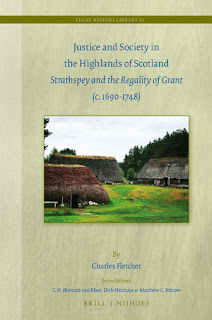
BOOK: Charles FLETCHER, Justice and Society in the Highlands of Scotland. Strathspey and the Regality of Grant (c. 1690-1748) (Leiden: Brill, 2021). ISBN: 978-90-04-47251-8, €112.00

(Source: Brill)

ABOUT THE BOOK

Series: Legal History Library, Volume: 53

This book fills a significant gap in our current understanding of early modern Scottish history. It is the first systematic consideration of the workings of seigneurial courts of feudal lords in 18th century Scotland. For several hundred years, these courts were one of the main forums for justice across Europe. Until 1748, Scottish courts of barony and regality handled both criminal complaints and civil disputes; they made by-laws and levied taxes; they set wages and enforced morality. The 18th century was a time of epoch-defining events in Scotland, such as the Jacobite rebellions, and union with England. The amount of literature on this period of Scottish history is extensive; it is therefore remarkable that the story of these courts has been left untouched. 

ABOUT THE AUTHOR

Charles Fletcher, Ph.D. (2019), University of Edinburgh. His main fields of interest are the culture and history of the highlands of Scotland and Scottish legal history.

TABLE OF CONTENTS

Preface 
Acknowledgements 
List of Illustrations 
Conventions and Abbreviations 
Glossary 

1 Introduction 
 1.1 Heritable Justice in Scotland 
 1.2 Seigneurial Justice: Scotland in European Context 
 1.3 The Regality of Grant 

2 The Clan Grant and the Regality Court 
 2.1 Strathspey in the Early Eighteenth Century 
 2.2 The Lairds of Grant, the Fine and the Regality Court of Grant 
  2.2.1  The Lairds of Grant 
  2.2.2  Bailies of the Regality of Grant 
  2.2.3  The Fine of Clan Grant: John Grant of Dalrachney 
 2.3 Conclusion 

3 The Regality Court and Its Procedures 
 3.1 Court Officials 
  3.1.1  Clerks of the Court 
  3.1.2  Procurators Fiscal 
  3.1.3  Officers 
  3.1.4  Birlawmen 
 3.2 How, Why and When Were Courts Convened? 
  3.2.1  When? 
  3.2.2  Where? 
 3.3 The Court Day 

4 Actions for Debt 
 4.1 Debt and Credit in Strathspey 
 4.2 The Collection of Rents 
 4.3 Poinding 
 4.4 Debt and Divisions in the Grant Family: Unwarranted Poinding 1710–1711 
  4.4.1  Rental Crisis 
  4.4.2  Case Study: Ludovick Grant of that Ilk v. Mungo Grant of Mullochard and Others 
 4.5 Conclusion 

5 Criminal Jurisdiction 
 5.1 Violent Crime and the Regality Court of Grant 
  5.1.1  Trends in Violent Crime 
  5.1.2  Gendered Differences in Violence 
  5.1.3  Types of Violence 
   a) Violent Threats and Caution 
   b) Violent Disputes 
 5.1.4  Process 
 5.1.5  Punishment 
 5.2 Serious Crime and the Regality Court of Grant 
 5.3 The Northern Circuit of the Justiciary Court and the Regality of Grant 
  5.3.1  1708–1710 
  5.3.2  1711–1747 
  5.3.3  After Abolition, 1748–1753 
 5.4 Conclusion 

6 Economic and Social Control 
 6.1 Economic Control 
  6.1.1  Food Supplies 
  6.1.2  Regulation of Employment 
   a) The Problem of ‘Loose’ Servants 
   b) Wages 
   c) Other Trades 
  6.1.3  The Relationship between the Regality Court and the Justices of the Peace 
 6.2 Religious and Social Control 
  6.2.1  People 
  6.2.2  Kirk Session Business and the Regality Court of Grant 
  6.2.3  Slander 
  6.2.4  Funding the Kirk 
 6.3 Local Governance, Conclusions 

7 The Regality Court and the Landed Estate 
  Woodlands, Game, Farming and Improvement 
 7.1 Protecting the Laird’s Woodlands and Game 
  7.1.1  Woodlands and Their Management in Eighteenth-century Strathspey 
  7.1.2  The Regality Court and the Woods 
   a) Continuity and Change 
   b) The York Buildings Company 
 7.2 Game 
  7.2.1  Hunting, Fishing and Game in the Regality of Grant 
  7.2.2  Poaching Cases in the Regality Court 
 7.3 Improvement and Farming 
  7.3.1  Pastoral Farming 
 7.4 Conclusion 

8 Land Tenure 
 8.1 Tacks and Tenure 
 8.2 Vassal’s Labour Services 
 8.3 Conclusion 

9 Conclusion 
 9.1 Justice, Society, and Heritable Jurisdictions 
 9.2 Jurisdiction 
 9.3 Heritable Justice after 1748 

Bibliography 
Index 


More information with the publisher.


17 December 2021

BOOK: Barbara J. SHAPIRO, Law Reform in Early Modern England. Crown, Parliament and the Press (Oxford: Hart Publishing, 2020). ISBN: 9781509934218, pp. 280, £45.50 (hard back)

(Source: Bloomsbury)

ABOUT THE BOOK

This book provides an illuminating commentary of law reform in the early modern era (1500–1740) and views the moves to improve law and legal institutions in the context of changing political and governmental environments. Taking a fresh look at law reform over several centuries, it explores the efforts of the king and parliament, and the body of literature supporting law reform that emerged with the growth of print media, to assess the place of the well-known attempts of the revolutionary era in the context of earlier and later movements. Law reform is seen as a long term concern and a longer time frame is essential to understand the 1640–1660 reform measures.

The book considers two law reform movements: the moderate movement which had a lengthy history and whose chief supporters were the governmental and parliamentary elites, and which focused on improving existing law and legal institutions, and the radical reform movement, which was concentrated in the revolutionary decades and which sought to overthrow the common law, the legal profession and the existing system of courts. Informed by attention to the institutional difficulties in completing legislation, this highlights the need to examine particular parliaments. Although lawyers have often been seen as the chief obstacles to law reform, this book emphasises their contributions – particularly their role in legislation and in reforming the corpus of legal materials – and highlights the previously ignored reform efforts of Lord Chancellors.

ABOUT THE AUTHOR

Barbara J Shapiro is Professor Emerita and Professor in the Graduate School at the University of California, Berkeley.

TABEL OF CONTENTS

1. Introduction
2. The Early Tudors and Law Reform 1509–58
3. The Elizabethan Era 1558–1603
4. The Early Stuarts 1603–40
5. The Civil War and Parliamentary Rule 1640–49
6. Commonwealth and Protectorate 1649–60
7. The Restoration Era 1660–88
8. Revolution and Beyond 1688–1740
9. Conclusion


More information with the publisher.

16 November 2021

BOOK LAUNCH: Early Modern Privacy. Sources and approaches - University of Copenhagen - 3 December 2021, 16:00-17:00 CET


(Source: KU)

The volume is part of the Brill Series: Intersections, Interdisciplinary Studies in Early Modern Culture

 Early Modern Privacy - Sources and Approaches editors: Michaël Green, Lars Cyril Nørgaard, and Mette Birkedal Bruun

Privacy is often viewed as a modern phenomenon. Early Modern Privacy: Sources and Approaches challenges this view. This collection examines instances, experiences, and spaces of early modern privacy, and opens new avenues to understanding the structures and dynamics that shape early modern societies. Scholars of architectural history, art history, church history, economic history, gender history, history of law, history of literature, history of medicine, history of science, and social history detail how privacy and the private manifest within a wide array of sources, discourses, practices, and spatial programmes. In doing so, they tackle the methodological challenges of early modern privacy, in all its rich, historical specificity. 

Contributors include Ivana Bičak, Mette Birkedal Bruun, Maarten Delbeke, Willem Frijhoff, Michael Green, Mia Korpiola, Mathieu Laflamme, Natacha Klein Käfer, Hang Lin, Walter S. Melion, Hélène Merlin-Kajman, Lars Cyril Nørgaard, Anne Régent-Susini, Marian Rothstein, Thomas Max Safley, Valeria Viola, Lee Palmer Wandel, and Heide Wunder.


The volume is part of the Brill Series: Intersections, Interdisciplinary Studies in Early Modern Culture

Intersections is a peer-reviewed series on interdisciplinary topics in early modern studies. Contributions may come from any of the disciplines within the humanities, such as history, art history, literary history, book history, church history, social history, cultural history, and history of ideas. Each volume focuses on a single theme and consists of essays that explore new perspectives on the subject of study. The series aims to open up new areas of research on early modern culture and to address issues of interest to a wide range of disciplines. Editor: Karl A. E. Enenkel.

Please register via the following link: 

Registration

01 December 2020

BOOK: Ronnie PO-CHIA HSIA (Ed.), A Companion to the Early Modern Catholic Global Missions (Leiden: Brill, 2020). ISBN: 9789004349940, pp. 488, € 190.00

 Cover A Companion to the Early Modern Catholic Global Missions

(Source: Brill)

ABOUT THE BOOK

Series: Brill's Companions to the Christian Tradition, Volume: 80

A survey of the latest scholarship on Catholic missions between the 16th and 18th centuries, this collection of fourteen essays by historians from eight countries offers not only a global view of the organization, finances, personnel, and history of Catholic missions to the Americas, Africa, and Asia, but also the complex political, cultural, and religious contexts of the missionary fields. The conquests and colonization of the Americas presented a different stage for the drama of evangelization in contrast to that of Africa and Asia: the inhospitable landscape of Africa, the implacable Islamic societies of the Ottoman, Safavid, and Mughal empires, and the self-assured regimes of Ming-Qing China, Nguyen dynasty Vietnam, and Tokugawa Japan. 

Contributors are Tara Alberts, Mark Z. Christensen, Dominique Deslandres, R. Po-chia Hsia, Aliocha Maldavsky, Anne McGinness, Christoph Nebgen, Adina Ruiu, Alan Strathern, M. Antoni J. Üçerler, Fred Vermote, Guillermo Wilde, Christian Windler, and Ines Zupanov.

ABOUT THE EDITOR

Ronnie Po-chia Hsia, Ph.D (Yale, 1982) is Edwin Erle Sparks Professor of History and Asian Studies at Penn State University and Academician at the Academia Sinica, Taipei. Among his numerous publications is A Jesuit in the Forbidden City: Matteo Ricci 1552-1610 (Oxford, 2010), which has been translated into Italian and Chinese.

TABLE OF CONTENTS

Acknowledgement 
Notes on Contributors 
Introduction 
Catholic Global Missions and the Expansion of Europe 
Part I. The Americas 
1 Missionizing Mexico: Ecclesiastics, Natives, and the Spread of Christianity 
Mark Christensen 
2 The Andes 
Aliocha Maldavsky 
3 The Missions of Paraguay: Rise, Expansion and Fall 
Guillermo Wilde 
4 Early Modern Catholic Missions in Brazil: The Challenge of the Outsiders 
Anne McGuiness 
5 New France 
Dominique Deslandres 
Part II. Africa 
6 Catholic Missions and Local Rulers in Sub-Saharan Africa 
Alan Strathern 
Part III. Islamic World 
7 Missionaries and French Subjects: The Jesuits in the Ottoman Empire 
Adina Ruiu 
8 Ambiguous Belongings: How Catholic Missionaries in Persia and the Roman Curia Dealt with Communicatio in Sacris 
Christian Windler 
Part IV. Asia 
9 India 
Ines Zupanov 
10 Missions in Vietnam 
Tara Alberts 
11 The Christian Missions in Japan in the Early Modern Period 
M. Antoni and J. Ucerler 
12 Imperial China and the Christian Mission 
R. Po-chia Hsia 
Part V. The Structures 
13 Finances of the Missions 
Fred Vermote 
14 Missionaries: Who were They 
Christoph Nebgen 
Bibliography 
Index


More information available with the publisher.

28 August 2020

ARTICLE: D. L. NOORLANDER, "The Dutch Atlantic world, 1585–1815: Recent themes and developments in the field" (History Compass XVIII (2020), No. 8)


 Abstract:

Scholarship on the Dutch Atlantic has grown and changed a lot in 30 years, with older themes like colonial weakness and insignificance giving way to a newly discovered Dutch vitality. This essay demonstrates the change by summarizing the recent research and highlighting the military, economic, and cultural impact of the Dutch in West Africa and America, plus the possible impacts of both places on the Dutch in Europe. The essay also cautions writers against taking arguments about dynamism, diversity, tolerance, cosmopolitanism, and modernity too far.

(source: Wiley)