Search

Showing posts with label late medieval history. Show all posts

28 August 2026

CFP: Premodern State Formation: New Themes and Directions (Dresden: Dresden University of Technology, 20-21 MAY 2027) [DEADLINE 31 OCT 2026]

(Source: TU Dresden)


Organised by: Klaas Van Gelder (Brussels) & Hannes Ziegler (Dresden)

Practical:

Date: 20.-21.5.2027

Place: Dresden University of Technology

Abstract:

Late medieval and early modern societies are often considered to be relatively static: They were estate-based with limited demographic and economic expansion and relatively stable forms of rule, even though dynasties came and went, and multiple regions were part of different composite polities over the centuries. One of the most important challenges in explaining this period remains, however, that these were also, and at the same time, societies in transition. A highly promising model of not only describing but also explaining change with a view to these societies was and still remains the theory of state-building that seeks to explain the transition from medieval forms of statehood to the “modern” state. It

underlines the increasing involvement of the state in everyday matters, the growth of its bureaucratic apparatus, its territorial expansion, and its growing authority. Nevertheless, the causes, catalysts, chronology and consequences of these processes of state-building remain hotly debated until the present day. 

This conference seeks to resume a discussion on state-building that has been somewhat neglected in recent years. Nearly twenty years after the publication of the seminal 2009 volume on “Empowering Interactions” by Wim Blockmans, André Holenstein, and John Mathieu, a wide array of works on the various issues connected to state-building (i.e. taxation, litigation, fiscal-military expansion, etc.), has been published, but what is lacking is a forum to bring this research together and discuss the state of the art of the field in a more condensed manner. “Empowering Interactions” was, after all, the temporary endpoint of a long debate around the question whether state-building was best described as happening “from above” or “from below”. In the shadow of this larger debate, however, other topics have emerged and other problems are being discussed that only marginally touch on this debate. 

The role of gender (and more particularly: women) in processes of state-building is a case in point, but so is the question on how rural landscapes can be integrated in processes hitherto largely conceived by “centrist” perspectives dominated by courts, capitals and cities. Cases such as these are not adequately addressed in what is currently often considered to be the state of the field, and there are likely still more. Furthermore, new and promising analytical concepts have been developed that urged historians to pay greater attention to specific aspects of the aforementioned processes, such as ‘accountability’ and ‘popular control’.

This conference aims to take stock of the current state of the research connected to, resulting from and inspired by the Empowering Interactions approach. It is an open invitation to researchers working in the field of late-medieval and/or early modern state-building to showcase their research and explore the conceptual and methodological lacunae in current research. What is – above and beyond the “Empowering Interactions” – the state of the field? What are the most pressing blank spaces? What are the most promising new avenues of research? Topics of interest include (but are not limited to):

- Litigation
- Rural communities
- Petitions
- Representative institutions
- Dynasties
- Women
- Public administrations
- Cities and towns
- Republicanism
- Media and print

We are currently looking for papers (ca. 25min) addressing one or more of the above aspects. If you are interested in participating, please send an abstract by 31 October 2026 of no more than 500 words and a short CV (1-2 pages) to klaas.van.gelder@vub.be and hannes.ziegler@tu-dresden.de. The organizers are hoping to reimburse participants for travel and accommodation costs.

More information here.

12 May 2026

BOOK: Niels FIEREMANS, Law, Leverage, and Litigation in Late Medieval Bruges. Foreign Merchants in a City of Justice (Edinburgh: Edinburgh University Press, 2025), 248 p. ISBN 9781399545860, 90 GBP [OPEN ACCESS]


(image source: Edinburgh UP)

Abstract:

Explores the interaction between law and commerce in late medieval Bruges and its impact on the concept of justice Takes an interdisciplinary approach and engages in the debates of commercial history and legal history Draws on extensive archival material from across Europe Challenges the notion that a commercial city tailored its system to merchants Contributes to the field of customary law where scholars diverge from the previous theoretical law treaties and look to what happened in the more practical sources e.g. Litigation records Illustrated with examples to demonstrate key concepts and ideas Late medieval Bruges was a commercial hub that connected Hanseatic, English, Scottish, Portuguese, Spanish, Aragonese, and Italian traders. This book focuses on the conflict resolution of the aldermen and how merchants operated within this legal framework. The key question being whether Bruges was a city of justice. Although this was sometimes claimed by travellers, a lot of merchants confronted with the practicalities of conflict resolution in Bruges, disagreed. Fieremans analyses how customary law, institutional frameworks, and commerce intersected and were challenged by the aldermen's pursuit of justice. By clarifying the working of the aldermen, it advances our knowledge of the basic mechanisms of a late medieval law court and the evolution of the law courts of late medieval Flanders. Taking an interdisciplinary approach, the book focuses on the interplay between commerce and justice, explores the diverse merchant communities, and considers the potential lessons it offers for understanding both historical and modern markets. It sheds light on the pragmatic legal culture of Bruges and the legal mechanisms that partially regulate commerce.

Table of contents: 

Introduction: Historiography and Contribution

Part I. Law. The legal framework of late medieval Bruges

  1. The procedures of the aldermen
  2. The usage of procedures
  3. The goal of these procedures

Part 2. Leverage. The group strategies to adapt the framework

  1. The strategy of economic leverage: the Hanseatic, English and Scottish community
  2. The strategy of political leverage: the Iberian communities
  3. Strategies without privileges: the Italian communities

Part 3. Litigation. The individual strategies adapting the framework

  1. The Council of Flanders and Bruges.
  2. Supralocal courts. The Great Council and the Parliament of Paris
  3. The end of Bruges legal dominance

Conclusion

Read the book in open access here. 

25 August 2025

BOOK: Ernst KANTOROWICZ, Radiances. Unpublished Essays on Gods, Kingship, and Images of the State (Ithaca: Cornell University Press, 2025), 258 p. ISBN 9781501782534

(Image source: Cornell University Press)

Abstract:
Radiances gathers previously unpublished essays by one of the greatest historians of the twentieth century. Although best known for The King's Two Bodies (1957), Ernst Kantorowicz's scholarly expertise ranged from classical antiquity to early modernity and from political pageantry to numismatics. These essays traverse the breadth of his expertise, exploring "radiations" of the themes that were central to his published work: sovereignty, theology, law, and iconography.
The radiations in these engaging essays include the imagery of throne-sharing from the Hellenistic era and Pharaonic Egypt to early Christianity, coronation ceremonies in Byzantium and the West, the Carolingian and Burgundian Renaissances, the relationship between Rome and Christianity, the importance of history as a humanistic pursuit, and the significance of postage stamps in political myth-building. Robert E. Lerner discusses each essay's composition, themes, and place in Kantorowicz's oeuvre. Combining vast knowledge with intellectual delight, Radiances teems with the profound historical insights that distinguished Kantorowicz's scholarship.

On the author:
Ernst Kantorowicz (1895–1963) taught at the University of Frankfurt and University of California, Berkeley, and was a member of the Institute for Advanced Study in Princeton.

More information can be found here.

27 February 2025

SYMPOSIUM: The Worlds of Pre-Modern Neutrality (ca. 1400-1800): Norms, Institutions and Practices (Antwerp: Hendrik Conscience Heritage Library, 8-9 MAY 2025).


Location: Antwerp, Hendrik Conscience Heritage Library
Dates: May 8–9, 2025
Conveners: Stefano Cattelan (Vrije Universiteit Brussel) & Frederik Dhondt (Vrije Universiteit Brussel)
Supported by: FWO Junior Fundamental Research Project G016122N (2024–2026)


Day 1 (May 8)

9:30 – 9:45
Welcoming Remarks
Stefano Cattelan & Frederik Dhondt

9:45 – 10:45
Keynote 1
Silvia Marzagalli (Université Côte d’Azur)
Eighteenth-century neutrality: a view from the sea

10:45 – 11:00
Coffee Break


11:00 – 12:15
Panel I

  • 11:00 – 11:20: Ubaldo Morozzi (Independent Scholar)
    ‘The Great Duke knows how to excuse ingaging himselfe and seemes resolved to remayne neutral’. The system of Tuscan neutrality, 1642–1721
  • 11:20 – 11:40: Bastien Carpentier (Université Paul Valéry Montpellier 3)
    Construire l’autonomie par la neutralité. L’action des repubblichisti de Gênes à l’encontre des Habsbourg d’Espagne (1560-1650)
  • 11:40 – 12:00: Dorian Varenne (Sorbonne Université)
    Un pape neutre? Principe et réalité de la notion de padre comune à l’ère post-tridentine
  • 12:00 – 12:15: Discussion

12:15 – 13:30
Lunch


13:30 – 14:45
Panel II

  • 13:30 – 13:50: Louis Sicking (University of Leiden/VU Amsterdam)
    The (im)possibility of neutrality. Prize Law in legal practice and politics during the war between the Habsburg Netherlands and Denmark-Norway prior to the Peace of Speyer
  • 13:50 – 14:10: Stefano Cattelan (Vrije Universiteit Brussel)
    Between the devil and the deep sea: Venetian neutrality amidst the Bourbon-Habsburg confrontation (1688-1714)
  • 14:10 – 14:30: Géraud Poumarède (Sorbonne Université)
    Négocier la neutralité en temps de guerre: Venise dans la guerre de Succession d'Autriche
  • 14:30 – 14:45: Discussion

14:45 – 16:00
Panel III

  • 14:45 – 15:05: Roeland Goorts (Thomas More University of Applied Sciences)
    The Neutrality of the Prince-Bishopric of Liège
  • 15:05 – 15:25: Julien Régibeau (Université de Liège and KU Leuven)
    Comparer l’incomparable ? Neutralités pontificale et liégeoise en pratique (XVIe-XVIIe siècles)
  • 15:25 – 15:45: Antoine Leclère (Université de Liège and Vrije Universiteit Brussel)
    Une rupture de la neutralité liégeoise ? Négocier la levée d’un régiment français dans la principauté de Liège à la veille de la Révolution (1787-1788)
  • 15:45 – 16:00: Discussion

16:00 – 16:15
Coffee Break


16:15 – 17:30
Panel IV

  • 16:15 – 16:35: Matheus Vila Nova (École Pratique des Hautes Études - PSL, Paris)
    Du Mare Clausum à l’art de la Neutralité: la transformation de la politique étrangère portugaise (1625-1666)
  • 16:35 – 16:55: Mathias Karlsmose (Stockholm University)
    Shaky Neutrality: The Danish East India Company and the Dutch-Portuguese War in Asia, 1620-1655
  • 16:55 – 17:05: Emmanuel Lemée (Université de Picardie Jules Verne)
    L’Angleterre en quête de neutralité (1660-1689)
  • 17:05 – 17:20: Discussion

19:00
Dinner


Day 2 (May 9)

10:00 – 11:00
Keynote 2
Éric Schnakenbourg (University of Nantes)
La neutralité à l’épreuve du monde, XVIe -XVIIIe siècles

11:00 – 11:15
Coffee Break


11:15 – 12:30
Panel V

  • 11:15 – 11:35: Joshua Meeks (US Naval War College in Newport, Rhode Island)
    Weapons of the Strong? Great Powers Strategy and Small Power Neutrality in the late 18th Century
  • 11:35 – 11:55: Erik de Lange (Utrecht University)
    Neutral in the Face of Revolution: Traditions of Neutrality and the 1820s Challenge
  • 11:55 – 12:15: Discussion

12:15 – 13:15
Lunch


13:15 – 14:20
Panel VI

  • 13:15 – 13:35: Daniel R. Quiroga (Max Planck Institute for Comparative Public Law and International Law)
    ‘For the Sake of Friends’: Obligations Owed to Allies as a Justification for Violence in International Legal Thought
  • 13:35 – 13:55: Izidor Janzekovic (Central European University)
    The Balance of Sea Power in the Revolutionary Era
  • 13:55 – 14:15: Andreas Häckermann (University of Erfurt)
    The (Im-)Partial Leviathan Neutrality in Carl Schmitt’s Remarks on the Early Modern State
  • 14:15 – 14:35: Discussion

14:35 – 15:15
Outlook and Conclusions

15:30 – 17:00
Visit to the Plantin Moretus Museum


19 September 2024

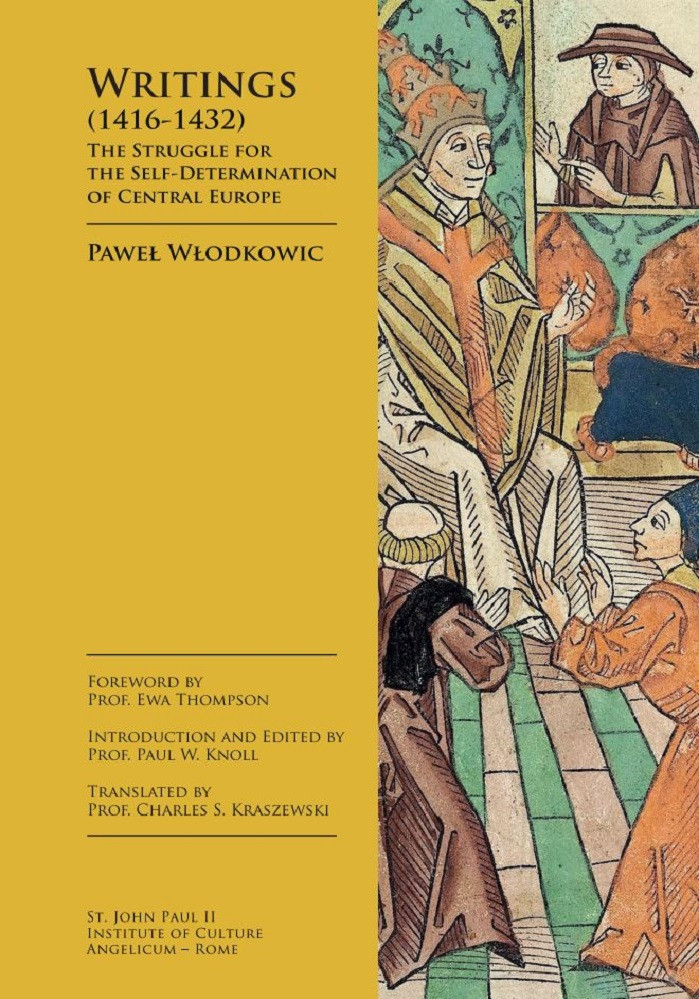
BOOK: Paweł WLODKOWIC, Writings (1416-1432). The Struggle for the Self-Determination of Central Europe (transl. Charles S. KRASZEWSKI, ed. Paul W. KNOLL) (Rome: St. John Paul II Institute of Culture/Evangelicum: 2023), 664 p. ISBN 978-83-67065-44-3 150 Zl.


(image source: Teologiapolityczna)

Abstract:

Paweł Włodkowic and his Tractatus de potestae papae et imperatoris respectu infidelium (Treatise on the Power of the Pope and Emperor Respecting Infidels) presented during the Council of Constance (1414-1418) are the symbols of fundamental for shaping Polish political and social thought focused on the rights of people, their natural inclinations to forming communities subjected to natural law and the law of nations. At the same time, the context of the announcement of his dissertation evokes the greatest diplomatic victory of Poland in Europe at the turn of the Middle Ages and the Renaissance, connected with the pivotal for the peaceful functioning of Central Europe conflict of the Polish-Lithuanian union with the Teutonic Order, whose representatives sought to convert the gentiles by force, and in practice often exterminate them. In the linguistic and substantive manner proper for that period, the scholastic treatise considers questions fundamental and universal for political and religious communities, which boil down to the following issues: Where is the boundary between the just and unjust use of force? What is the significance of the national right to freedom, existence and self-determination for the international peace? Today, we can consider Paweł Włodkowic’s thought from the perspective that allows us to appreciate that this way of thinking eventually created conditions for the emergence of the modern concept of human rights and religious tolerance. Reinforcing the pragmatic and specific political goals that Włodkowic has faced with the original, humanist-Christian approach supported by the highest, in that historical period, scientific and intellectual standards has resulted in presenting the whole of Europe with such ideas that today can be appraised as Polish contribution to development European thought in the fifteenth century and that preceded Francis of Vittoria, one of the fathers of international law, by one century.

Read more here. 

22 December 2023

BOOK: Jean-Marie CAUCHIES & Jean-Marie YANTE (dir.), Ordonnances de Philippe le Bon pour le Comté de Namur 1421-1466 et le Duché de Luxembourg 1443-1464 [Recueil des Ordonnances des Pays-Bas; 1e série: 1381-1506] (Bruxelles: SPF Justice/CRALO-Société Archéologique de Namur, 2023), 208 p.


(image source: KCOWV-CRALO) 

Abstract:

Les ordonnances de Philippe le Bon pour le comté de Namur (1421-1466) et le duché de Luxembourg (1443-1464) viennent de rejoindre la deuxième section de la première série (1381-1506) du Recuel des Ordonnances des Pays-Bas. Les professeurs émérites Jean-Marie Cauchies (Université Saint-Louis Bruxelles, Université catholique de Louvain) et Jean-Marie Yante (Université catholique de Louvain), membres de la Commission Royale pour la Publication des Anciennes Lois et Ordonnances de Belgique, ont rédigé une introduction (pp. 5-24), et soigné l'édition scientifique et érudite de 42 et 23 actes namurois, ainsi que 38 actes luxembourgeois. Le volume est accompagné d'un index des noms propres (pp. 187-196) et d'un index des matières (pp. 197-199).

Cette publication a bénéficié du soutien de la Commission Royale pour la Publication des Anciennes Lois et Ordonnances de Belgique et de la Société archéologique de Namur, d'une subvention de la Fondation pour la protection du patrimoine culturel, historique et artisanal (Lausanne) et du Centre belge d'histoire rurale (Section de Louvain-la-Neuve).
Ordering:
Le volume peut être commandé auprès de la Bibliothèque du SPF Justice.

Source: KCOWV/CRALO blog. 

06 December 2023

BOOK: Quentin VERREYCKEN, Crimes et gens de guerre au Moyen Âge : Angleterre, France et principautés bourguignonnes au XVe siècle (Paris: PUF, 2023), 277 p., ISBN 9782130826439, €27


(image source: PUF)

Abstract:
Dans le royaume de France au XVe siècle, les violences charriées par la guerre de Cent Ans forgent une image particulièrement négative de l’homme de guerre. Face aux exactions perpétrées par les soldats (pillage, brigandage, viol, destruction), il devient urgent pour les autorités de réagir. Mais à une époque où la notion de « crimes de guerre » n’existe pas, pas plus que les conventions de Genève ou les tribunaux pénaux internationaux, comment réguler efficacement la violence militaire ? À la fin du Moyen Âge, dans un contexte de renforcement du pouvoir monarchique et de restauration de la justice, c’est par le biais de la répression mais également du pardon que le gouvernement royal parvient tant bien que mal à mettre au pas les gens de guerre.

A book presentation will take place on 12 December in Chaumont (Haute-Marne, France). More information here. 


25 May 2023

ARTICLE: Sandro NOTARI, "Statuta Urbis, 1469. La prima riforma pontificia dello statuto comunale di Roma.Profili storico-giuridici" (Historia et Ius 15 APR 2023) (OPEN ACCESS)


Abstract:

In 1469 Pope Paul II, as lord of the city, issued the municipal statutes of Rome (statuta Urbis). The essay examines these statutes, which represent the first reform of the Roman municipal law issued by a pope after the end of municipal autonomy and the establishment of the papal signoria in 1398. The papal statutes of 1469 are compared to the popular regime’s statutes of 1363, which remained in effect until then. The papal reform conforms the statutes to the new system of seignorial government by removing officials and organs elective of the commune. However, Paul II left intact the structure of the statutes of 1363 and introduced few changes to civil and criminal law. Thanks to this reform, many vestiges of medieval legal romanitas were transmitted to later ages: the statuta Urbis, after being revised and modified, remained in effect until the 19th century.

Read the article on Historia et Ius (an open access peer reviewed journal). 

09 February 2022

ARTICLE: Jamie PAGE, "No Way to Run a Brothel? Prostitution and Policey in the Late Medieval Holy Roman Empire" (German History, XL (2022), Nr. 1, 1-21)


(image source: OUP)

Abstract:

This article addresses the relationship between civic prostitution and the concept of ‘gute Policey’ in the late fifteenth and early sixteenth centuries. It takes as its object of discussion a series of so-called Frauenhausordnungen (brothel ordinances or brothel rules) from the cities of Nuremberg, Nördlingen, Strasbourg, Constance and Ulm. Previous discussions have characterized Frauenhausordnungen from these cities as members of a coherent genre of regulations, a grouping which this article contests. By placing the creation of new brothel regulations in these cities in the larger context of the emergence of ‘gute Policey’ as a crucial category within domestic administration, the article seeks to expose civic authorities’ moral ambiguities about the role of prostitution in society, which originated well before the Reformation, often seen as the key factor in the vanishing of public prostitution from the urban landscape in the early modern era.

Read further here (DOI 10.1093/gerhis/ghab082) 

05 July 2021

BOOK: Joseph CANNING, Conciliarism, Humanism and Law. Justifications of Authority and Power, c. 1400-C. 1520 (Cambridge: CUP, 2021), ISBN 9781108831796, 75 GBP


(image source: CUP)

Book abstract:

How was power justified in late medieval Europe? What justifications did people find convincing, and why? Based around the two key intellectual movements of the fifteenth century, conciliarism in the church and humanism, this study explores the justifications for the distribution of power and authority in fifteenth- and early sixteenth-century Europe. By examining the arguments that convinced people in this period, Joseph Canning demonstrates that it was almost universally assumed that power had to be justified but that there were fundamentally different kinds of justification employed. Against the background of juristic thought, Canning presents a new interpretative approach to the justifications of power through the lenses of conciliarism, humanism and law, throwing fresh light on our understanding of both conciliarists' ideas and the contribution of Italian Renaissance humanists.

On the author:

Joseph Canning is Affiliated Lecturer in the Faculty of History at the University of Cambridge. A Fellow of the Royal Historical Society, he is the author of The Political Thought of Baldus de Ubaldis (1987), A History of Medieval Political Thought, c.300-c.1450 (1996) and Ideas of Power in the Late Middle Ages, 1296-1417 (2011).

(read more with CUP) 


01 April 2021

BOOK: Maciej MIKULA, Municipal Magdeburg Law (Ius municipale Magdeburgense) in Late Medieval Poland. A Study on the Evolution and Adaptation of Law (Leiden: Brill, 2021). ISBN: 978-90-04-42967-3, € 144.00


(Source: Brill)

ABOUT THE BOOK

Series: Medieval Law and Its Practice, Volume: 30

In this volume, Maciej Mikuła analyses the extant texts of the Ius municipale Magdeburgense, the most important collection of Magdeburg Law in late medieval Poland. He discusses the different translation traditions of the collection; the application of Magdeburg Law in different cities; how differences between the versions could affect the application of the rights; and how the invention of printing influenced the principle of legal certainty. Mikuła ultimately shows that the differences between the texts not only influenced legal practice, but also bear out how complex the process was of the adaptation of Magdeburg Law.

ABOUT THE AUTHOR

Maciej Mikuła, Ph.D. (2012), habilitation (2018), Jagiellonian University in Cracow, is Assistant Professor at that university. He has published monographs, editions and articles on law in medieval and early modern Poland.


More information with the publisher.

25 January 2021

BOOK: Antonio MUSARRA, Il Grifo e il Leone. Genova e Venezia in lotta per il Mediterraneo (Bari: Laterza, 2020). ISBN: 9788858140727, pp. 272, € 24,00

 
(Source: Laterza)

ABOUT THE BOOK

Luogo d’incontri e contaminazioni, nel basso Medioevo il Mediterraneo fu, anche e soprattutto, un luogo di aspri scontri. Genova e Venezia – così come Pisa o la corona catalano-aragonese – si resero protagoniste d’una lotta senza quartiere, ricorrendo a ogni mezzo, lecito o illecito, per assicurarsi il controllo delle principali rotte di trasporto. Sin dalla fine dell’XI secolo, le due città, grandi potenze navali e commerciali, erano andate imponendo il proprio predominio sul Mediterraneo orientale, moltiplicando i propri insediamenti. Le loro attenzioni s’erano volte all’Egitto e alla costa siro-palestinese, divenuti dopo le crociate una parte essenziale del mondo. La conquista veneziana di Costantinopoli, nel 1204, rivoluzionò il quadro politico, dando avvio ai primi scontri tra le due marine. Con la cosiddetta ‘guerra di San Saba’, conclusasi con la cacciata dei genovesi da Acri, capitale del regno di Gerusalemme, si giunse per la prima volta allo scontro aperto. Da questo momento, il Grifo e il Leone esprimeranno un’accesa rivalità, scandita da innumerevoli battaglie navali, che si protrarrà per oltre un secolo e mezzo.

ABOUT THE AUTHOR

Antonio Musarrra insegna Storia medievale alla Sapienza Università di Roma. Con il Mulino ha pubblicato «Genova e il mare nel Medioevo» (2015), «Acri 1291. La caduta degli stati crociati» (2017), «Il crepuscolo della crociata» (2018) e, con Franco Cardini, «Il grande racconto delle crociate» (2019).


The table of contents is available in PDF version, here. More information with the publisher.

13 October 2020

WEBINAR: In terra toscana un evento decisivo per la Chiesa Universale nel tardo Medioevo: il Concilio di Pisa del 1409, Giornate di Studio della Fondazione Centro Studi sulla Civiltà del Tardo Medioevo - Online, live streaming on Facebook: 19/10/2020 & 5/11/2020


Giovedì 29 Ottobre e Giovedì 5 Novembre 2020 alle ore 15 La Fondazione Centro Studi sulla Civiltà del Tardo Medio Evo organizza 2 giornate di studio in modalità a distanza. Gli appuntamenti potranno essere seguiti in diretta streaming sulla pagina Facebook della Fondazione e successivamente saranno resi disponibili sul canale Youtube della stessa.


More information here.