Search

Showing posts with label natural law. Show all posts

27 May 2026

BOOK: Nicolas HUTEN, Basile MÉRAND & Nicolas SILD (eds.), Droit administratif et droit naturel. Premier regard (Paris: LexisNexis, 2026), ISBN 9782711943729, € 29


(image source: LexisNexis)

Abstract:

Le droit naturel classique n’a longtemps suscité d’intérêt que de la part des historiens du droit et des idées, convaincus à juste titre de son utilité pour la compréhension du droit contemporain. Après avoir récemment fait l’objet d’une certaine attention de la doctrine privatiste, le moment est venu pour la doctrine publiciste d’apporter sa contribution à ce renouveau. Telle est la finalité de cet ouvrage, qui envisage le droit administratif à l’aune des catégories du droit naturel classique. L’objet de ces pages pourra légitimement surprendre. À première vue, en effet, le droit administratif est un droit de la puissance publique, certes modéré par le contrôle du juge, mais qui semble exclure par principe toute approche sous l’angle de la justice ou de l’équité. Ce premier regard, qui en appelle d’autres à l’avenir, propose de revenir sur cette idée fort répandue. Sans nier la dimension politique du droit administratif, les contributions réunies dans le présent ouvrage montrent que ce droit est souvent marqué par la présence discrète d’une conception classique, c’est-à-dire gréco-romaine, du droit naturel, tant dans sa construction historique que dans l’application qu’en fait aujourd’hui le juge administratif dans les domaines les plus variés.

Contributiors:

 Miguel Ayuso, Henri Bouillon, Nicolas Huten, Alice Lassale, Basile Mérand, David Mongoin, Marjolaine Monot Fouletier, Jean Claude Ricci, Nicolas Sild.

Read more here. 

19 February 2026

BOOK: Luigi TAPARELLI d'AZEGLIO, Saggio teoretico di diritto naturale appoggiato sul fatto. Naturrechtslehre. Eine theoretische Abhandlung über das natürliche Recht auf objektiver Grundlage (ed. Marco SCHRAGE) [Politische Philosophie und Rechtstheorie des Mittelalters und der Neuzeit; ,Abt. I. Texte] (Stuttgart-Bad Cannstatt: Frommann & Holzboog) 7 vol. ISBN 978-3-7728-2980-2


(image source: F-H)

Abstract:
Das Hauptwerk des Luigi Taparelli d’Azeglio SJ (1793–1862), ›Saggio teoretico di diritto naturale appoggiato sul fatto‹, ist die Blaupause für die moderne, von Papst Leo XIII. initiierte katholische Soziallehre. Die in diesem 1855 in vierter – der letzten von Taparelli ergänzten und überarbeiteten – Auflage erschienenen Werk ausgeführten prinzipiellen Erwägungen und Grundzüge sind auch für gegenwärtige theologisch-ethische Positionierungen in der katholischen Kirche relevant. Im deutschsprachigen Raum gibt es jedoch nur eine Übersetzung von seiner ersten, in den Jahren 1840–1843 sukzessive veröffentlichten Auflage; sie stammt bereits aus dem Jahr 1845. Dem Desiderat einer modernen Übersetzung der vierten Auflage wird nun durch eine zweisprachige Ausgabe entsprochen und eine jede der sieben Abhandlungen des ›Saggio teoretico‹ in einem separaten Band herausgegeben.

Read more here. 


02 February 2026

BOOK: Pierre-Anne FORCADET & Corinne LEVELEUX-TEIXEIRA (dir.), La Nature et le Droit médiéval. Entre savoirs et normes [POLEN - Pouvoirs, lettres, normes; 38] (Paris: Classiques Garnier, 2025), 332 p.


(image source: Classiques Garnier)

Abstract:

Dans un article de 1967, Lynn White attribuait au christianisme médiéval une vision prédatrice du monde. Ce débat, relancé par la crise écologique, reste peu exploré par les juristes. Le présent ouvrage comble ce vide en étudiant les liens entre droit et nature au Moyen Âge.

Read more here: DOI 10.48611/isbn.978-2-406-18777-6.

18 December 2025

BOOK: Wouter DRUWÉ, Randall LESAFFER & Geert SLUIJS (eds.), Natural Law and Domestic Government in the Early Modern Period [Legal History Library, eds. Dirk HEIRBAUT, Michelle MCKINLEY, Matthew C. MIROW & C.H. VAN RHEE; vol. 80] (Leiden/Boston: Martinus Nijhoff/Brill, 2025), ISBN 978-90-04-74871-2, €160,93


(image source: Blackwell's)

Abstract:

Natural Law and Domestic Government in the Early Modern Period examines how natural law informed evolving ideas of governance from the sixteenth to eighteenth centuries. Through case studies spanning France, the Low Countries, England, Iberia, and colonial America, this volume explores how jurists, theologians, and political thinkers grappled with questions of sovereignty and justice. Contributors analyse influential figures from Bodin and Coke to Tuldenus and Lipsius, tracing how natural law intersected with legal concepts of rights, obligations, contracts, and associations. By uncovering diverse and contested uses of natural law, this collection offers a nuanced account of its enduring role in shaping early modern statecraft and political thinking.

On the editors:

Wouter Druwé is an associate professor of Roman law and legal history at KU Leuven. He studies the interaction between late medieval and early modern learned law (ius commune) and legal practice, with a particular focus on the Low Countries. Randall Lesaffer is a professor of legal history at KU Leuven and Tilburg University. His research focuses on the history of international law in early modern Europe. He is the general editor of The Cambridge History of International Law and the Brill book series Studies in the History of International Law. Geert Sluijs is a Ph.D. candidate at KU Leuven, holding degrees in law, philosophy, and intellectual history. His research interests include early modern legal and intellectual history. He has previously published on these topics, in particular regarding the Leuven scholar Tuldenus. 

Read more here: DOI 10.1163/9789004748712.

25 February 2025

CONFERENCE: 'Le droit naturel: les enjeux terminologiques d'un concept' (Paris: Université Paris II Pantheon-Assas, 6-7 MARCH 2025)

(Source: Univdroit)

Présentation

La polysémie du concept de droit naturel est un fait unanimement reconnu. Tout en reconnaissant les failles d'une périodisation des conceptions jusnaturalistes, l'historiographie conserve néanmoins l'idée de « figures historiques » parvenant à en cristalliser le sens pour une période donnée. L'histoire du droit naturel est présentée comme constituée par une série de grands auteurs, « comme on saute de sommet en sommet, sans mettre le pied dans les vallées du savoir » (Scattola, 1999, p. 5).

L'objectif du colloque est d'explorer une partie de ces « vallées ». Il propose de dégager les multiples facettes de cette notion complexe en se centrant sur les travaux d'auteurs « mineurs » ou méconnus de la première modernité, où la pluralité de sens du droit naturel est si manifeste. Les désaccords touchent tout autant à son fondement qu'à sa nature, ses sujets, ou sa finalité. Les différences interprétatives ne recoupent pas celles des grandes traditions de pensée. Le recours à des méthodologies et à des sources diverses ne suffit pas à les expliquer. Comment expliquer ces divergences définitionnelles ? Quels enjeux soulevaient les choix opérés par les auteurs ? Enfin, quelles ont été la réception et l’utilisation de cette polysémie dans l’espace culturel qui a suivi la première modernité ?


Programme

Jeudi 6 mars 2025

9h00 : Accueil des participants

Présidence : Frédéric Gabriel, IHRIM, UMR 5717 

9h30 : L'ancrage du jusnaturalisme moderne dans les textes des juristes romains. Une cause ou un remède à la polysémie ?
Dario Mantovani (Collège de France

10h30 : La réception de la critique par Valla de la notion de droit naturel d'Ulpien au XVIe siècle
Rafael Ramis Barceló, Université de Majorque

11h30 : La doctrine du droit naturel de Fernando de Mendoza
Gaëlle Demelemestre, IHRIM, UMR 5717

12h30 : Pause déjeuner

Présidence : Jean-Louis Halpérin, ENS-PSL

15h00 : A quoi nous sert le droit naturel ? Réflexions à partir de la pratique des avis juridiques dans la scolastique moderne
Wim Decock, Université catholique de Louvain

16h00 : Le droit naturel des « barbares » : les termes de la question au XVIe siècle
Luisa Brunori, CTAD, UMR 707

17h00 : De l'homme animal politique à l'homme animal social avec l'école du droit de la nature et des gens
Pierre Bonin, Université Paris I

18h00 : Fin de la 1ère journée


Vendredi 7 mars 2025

 9h15 : Accueil des participants

Présidence : Cristina Vano, Université de Naples – Frédéric II

9h30 : Quel droit naturel pour les juristes du XIXe après Kant et Bentham ?
Jean-Louis Halpérin, ENS-PSL

10h30 : La notion de droit naturel chez Eugène Lerminier
Olivier Descamps, Université Paris II

11h30 : Le droit au naturel. Une écologie du jusnaturalisme
Pierre Thévenin, ISSP, UMR 7220

12h30 : Clôture


L'inscription est nécessaire pour pouvoir assister au colloque ou pour une connexion à distance. Elle se fait par l'envoi d'un message à : olivier.descamps@u-paris2.fr

Colloque organisé par le CTAD ; l’IHRIM, l’ENS, PSL, le CNRS et l’Université Paris II Panthéon-Assas sous la direction scientifique de Luisa Brunori – CNRS-CTAD - Gaëlle Demelemestre – CNRS-IHRIM - Olivier Descamps – Université Paris II et Jean-Louis Halpérin – ENS-PSL

Université Paris II Panthéon-Assas
Salle des Conseils
12 Place du Panthéon, 75005 Paris

Visiter le site.

08 November 2023

BOOK: Elisabetta FIOCCHI MALASPINA & Gabriella SILVESTRINI (eds.), Natural Law and the Law of Nations in Eighteenth- and Nineteenth-Century Italy [Early Modern Natural Law: Studies & Sources; eds. Laura BECK VARELA, Frank GRUNERT & Knud HAAKONSSEN, 6] (Leiden/Boston: Martinus Nijhoff, Brill, 2023), X + 326 p., ISBN 9789004685130 [OPEN ACCESS]


(image source: Brill)

Abstract:

This volume sheds new light on modern theories of natural law through the lens of the fragmented political contexts of Italy in the eighteenth and nineteenth centuries, and the dramatic changes of the times. From the age of reforms, through revolution and the ‘Risorgimento’, the unification movement which ended with the creation of the unified Kingdom of Italy in 1861, we see a move from natural law and the law of nations to international law, whose teaching was introduced in Italian universities of the newly created Kingdom. The essays collected here show that natural law was not only the subject of a highly codified academic teaching, but also provided a broader conceptual and philosophical frame underlying the ‘science of man’. Natural law is also a language wherein reform programmes of education and of politics have taken form, affecting a variety of discourses and literary genres. The open access publication of this book was financially supported by the Swiss National Science Foundation.

Contributors:

Alberto Clerici, Vittor Ivo Comparato, Giuseppina De Giudici, Frédéric Ieva, Girolamo Imbruglia, Francesca Iurlaro, Serena Luzzi, Elisabetta Fiocchi Malaspina, Emanuele Salerno, Gabriella Silvestrini, Antonio Trampus.

Read or download the full book here. 

12 July 2023

CFP: Workshop 'Arguing over Empire: Hugo Grotius, European Expansionism and Slavery' - University of Dundee, 6-7 June 2024 [DEADLINE 31 AUGUST 2023]

(Source: University of Dundee)


Workshop Theme 

The Dutch humanist and jurist Hugo Grotius (1583-1645) is generally regarded as a ‘founding father of modern international law.’ However, he was also one of the early architects of Dutch colonial and imperial rule in the East Indies. Between 1604 and 1615, he served the Dutch East India Company (VOC) as a legal advisor and political lobbyist. In this capacity, he wrote memoranda and policy documents providing legal and political justifications for the Company’s commercial and military activities in monsoon Asia.  In 1604, Grotius was commissioned by the VOC to write a treatise to defend the seizure of a Portuguese vessel off the coast of Johor (present-day Singapore). In his lengthy treatise, currently known as On the Law of Prize and Booty (De iure praedae), he argued that the Portuguese violated the natural rights of the Dutch by preventing them from sailing to the East Indies and engaging in trade with native populations. As judicial recourse was lacking, even a private trading company such as the VOC could wage a ‘just war’ to enforce its natural rights. On the Law of Prize and Booty remained unpublished during Grotius’ lifetime, except for chapter 12, which appeared in 1609 as The Free Sea (Mare liberum), still a key text in international law today.   As VOC spokesperson at the Anglo-Dutch colonial conferences of 1613 and 1615, Grotius explained to the directors of the English East India Company (EIC) that the VOC was legally justified to monopolize the spice trade.  The inhabitants of the Spice Islands benefited from a protection/tribute exchange: by means of spice deliveries, they compensated the VOC for the high costs of providing armed protection against their enemies.  When the EIC directors pointed out that, in fact, the VOC used violence against native populations to impose its monopoly, they were told by Grotius that the natives’ unwillingness to stick to their contractual obligations to the VOC merely demonstrated the latter’s “perfidy,” which required punishment by the VOC.  Grotian thinking about natural law, contracts and just war thus legitimized Dutch expansion overseas and the dispossession of the native.  

Grotius’ On the Law of War and Peace (De iure belli ac pacis, 1625) is a case in point.  Although the author was an exile in Paris by then, he relied on many years of practical experience as a VOC advisor and lobbyist in writing his magnum opus. In On the Law of War and Peace, he elaborates the views presented in The Free Sea by conceptualizing the natural rights to travel and free passage, the rights to settle in uninhabited lands and use natural resources, and the right to free trade between ‘persons at a distance’ --invoked by Europeans to demand access to non-European markets and territories.  Likewise, Grotius defense of unequal alliances and protection/tribute exchanges figure prominently in On the Law of War and Peace.  As the author explains, unequal alliances and treaties can lead to a transfer of sovereignty, by allowing the ‘superior party’ to place garrisons on the territory of the ‘inferior party’.  Obviously, these are all arguments supporting the VOC’s claims-making in the East Indies, both against European competitors and native populations.  On the Law of War and Peace also provides a legal justification of slavery as part of natural law and the law of nations.  In the author’s view, those who are defeated in a just war can be enslaved under the law of nations, while human beings may also ‘voluntarily’ submit to slavery under natural law. Moreover, the children of the enslaved inherit the unfree status of their parents according to On the Law of War and Peace. 

The aim of this two-day workshop is to explore the many connections between Grotius’ thinking about natural law and the law of nations and his full-throated defense of European expansion overseas and slavery. We invite contributors to critically examine these connections by addressing the imperialist and colonialist readings of Grotius’ theory of natural rights, just war, property, unequal treaties and alliances, monopoly contracts, slavery, and the role of private actors (e.g., trading companies). We specifically welcome contributions that engage with the following questions:  

• What were non-European responses to, or engagement with, such imperialist and colonialist readings? For instance, how did East-Indian rulers receive and interpret, or indeed resist, Grotian conceptualizations of natural rights and (monopoly) contracts? Were alternative conceptualizations proposed to contest Grotius’ justification of slavery?   

• What was the relationship between the ‘Grotian tradition of international law’ and colonial practices in the early modern and modern eras? How were Grotian discourses of international law used to justify colonial warfare, native dispossession and slavery in the Americas, Asia and Africa between the 17th and 20th centuries?  For instance, how did Grotian ideas about natural law, freedom of trade and humanitarianism (protecting the oppressed from inhumane treatment) contribute to justifying colonial warfare, and what role did private trading companies play in these wars?  

In addressing questions like these, we seek to understand the ambivalent relation between, on the one hand, Grotius’ innovate contributions to international law and humanitarianism, and, on the other hand, the use of his concepts to justify (Western) colonialism and imperialism.   

The workshop ‘Arguing over Empire: Hugo Grotius, European Expansionism and Slavery’ is part of a series of conferences preceding the celebration in 2025 of the 400th anniversary of Grotius’ opus magnum De iure belli ac pacis published in 1625. Previous conferences in this series have dealt with, e.g., ‘Grotius’ Contribution to Commercial  and Maritime Law’ and ‘Nonconsequential theories of strict liability in historical perspective.’  

Keynotes:  

A paper proposal of max. 300 words should be sent to M.J.Vanittersum@dundee.ac.uk and m.dewilde@uva.nl The deadline for submissions is 31 August 2023. Applicants will be notified by 15 October 2023 whether their paper proposal has been accepted or not.  The organizing committee will use two criteria in the selection of paper proposals: intellectual quality and potential fit with the workshop theme.  The workshop is meant to be interdisciplinary and small-scale, allowing plenty of time for discussion and interaction. Available slots are limited. However, the committee’s aim is to invite speakers from diverse backgrounds (age, geography, gender, and career status).   

The workshop takes place on location. Speakers who are unable to participate in person may do so online.  Unfortunately, the organizing committee is not able to cover the costs of accommodation or travel.  Selected speakers are requested to obtain funding themselves.   

Speakers are expected to submit a draft paper before 1 April 2024. These draft papers will be circulated in advance of the workshop. Each speaker will be given a 30-minutes time slot, which includes 20 minutes for presentation and 10 minutes for questions and discussion.   

Our aim is to publish (revised versions of) the presented papers in a leading international journal related to Grotius, the history of international law, or the history of colonialism.   

Organizing Committee: 

Inge Van Hulle (Leuven University and Max Planck Institute, Frankfurt am Main)  

Martine van Ittersum (University of Dundee)  

Jacob Giltaij (University of Amsterdam)  

Jeroen Vervliet (Max Planck Institute, Luxembourg)  

Marc de Wilde (University of Amsterdam) 


14 April 2023

CONFERENCE: 'Natural Law and Domestic Government' - KU Leuven, 27-28 April 2023 - Speakers’ conference programme


KU Leuven will host a two-day conference on the interaction between natural law-thinking and domestic government in early modern Europe on 27 and 28 April, where academics both junior and senior will be presenting their research. Anyone interested in attending one or more sessions is kindly requested to register their attendance by sending an e-mail to naturallawconference@kuleuven.be.

Speakers’ conference programme


[All conference talks will take place in the Irish College – Iers College, Janseniusstraat 1, 3000 Leuven]

This conference is organised by the KU Leuven Research Unit Roman Law and Legal History (Faculty of Law and Criminology). It is co-funded by the Research Foundation – Flanders (FWO), project nr. G0C4421N.

Thursday 27 April 2023

9u Reception with coffee in the Irish College.
9u30 Opening session.
- 9u30: Word of welcome by the conference organisers.
- 9u45: Keynote speech by prof. dr. Annabel Brett (University of Cambridge) on “Natural law and human difference: The possibility condition in later scholastic thought.”
11u Coffee break. 
11u15
- 11u15: Ms. Rosalind Acland (University of Cambridge) on “Edward Coke’s Ciceronian Common Law (1552-1634).”
- 11u45: Dr. Signy Gutnick Allen (University of Zurich) on “Locke’s Theory of Economic Citizenship: Natural Law, Property and Charity.” 
- 12u15: discussion.
13u Lunch.
14u  
- 14u: Mr. Geert Sluijs (KU Leuven) on “Stewardship and statesmanship. Justus Lipsius and Diodorus Tuldenus on the natural law of government in the Early Modern Low Countries.”
- 14u30: Dr. Paolo Astorri and prof. dr. Lars Nørgaard (University of Copenhagen) on “The notion of potestas in the works of Henning Arnisaeus (1570-1636).”
- 15u: discussion.
15u45 Coffee break.
16u  
- 16u: Ms. Sarah Papa (Goethe University Frankfurt) on “Between the People and the Priest: a case of expropriation of land for the ‘common good’ in eighteenth- century Portuguese America.”
- 16u30: Mr. Rafael Mateus (Federal University of Ceará, Fortaleza) on “Mutability of Lex et Ius Naturale in Domingo de Soto’s De Iustitia et Iure.” 
- 17u00: discussion.
18u Conclusion of the day’s sessions.


Friday 28 April 2023

9u Coffee in the Irish College.
9u15 Keynote speech by prof. dr. Marie Seong-Hak Kim (St. Cloud State University) on “Bodin, Natural Law, and the Crisis of the French Renaissance Monarchy.”
10u30 Coffee break.
11u  
- 11u: Dr. Ki-Won Hong (Yonsei University) on “Leibniz’s Critique of Pufendorf’s Concepts of Sovereignty and German Federation.”
- 11u30: Mr. Carlos Eduardo Perez Crespo (University of Hamburg) on “Emer de Vattel’s Monarchical Theory of Constituent Power.”
- 12u: discussion.
12u45 Lunch. 
13u45  
- 13u45: Mr. Pedro Ricardo da Silva Santos (KU Leuven) on “Fides and the nature of Feudum in the legal thought of Petrus Gudelinus (1550-1619).”
- 14u15: Dr. Jeffrey Dymond (University of Zurich) on “Association and Corporation in Humanist Jurisprudence.”
- 14u45 discussion.
15u30 Closing remarks by prof. dr. Alain Wijffels (KU Leuven).
16u Conference end. 

16 March 2023

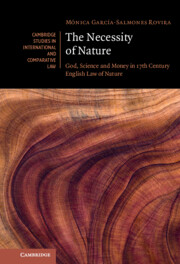
BOOK: Mónica GARCÍA-SALMONES ROVIRA, The Necessity of Nature. God, Science and Money in 17th Century English Law of Nature [Cambridge Studies in International and Comparative Law, ed. Larissa VAN DEN HERIK & Jean d'ASPREMONT; 179] (Cambridge: CUP, 2023); ISBN 9781009332149, 120 GBP

(image source: CUP)


Book description:

To understand our current world crises, it is essential to study the origins of the systems and institutions we now take for granted. This book takes a novel approach to charting intellectual, scientific and philosophical histories alongside the development of the international legal order by studying the philosophy and theology of the Scientific Revolution and its impact on European natural law, political liberalism and political economy. Starting from analysis of the work of Thomas Hobbes, Robert Boyle and John Locke on natural law, the author incorporates a holistic approach that encompasses global legal matters beyond the foundational matters of treaties and diplomacy. The monograph promotes a sustainable transformation of international law in the context of related philosophy, history and theology. Tackling issues such as nature, money, necessities, human nature, secularism and epistemology, which underlie natural lawyers' thinking, Associate Professor García-Salmones explains their enduring relevance for international legal studies today.

On the author:

Mónica García-Salmones Rovira is Global Law Fellow in the Alvaro d'Ors Global Law Chair, ICS, at the University of Navarre, and a Senior Fellow at the Erik Castrén Institute of International Law, University of Helsinki. She is the author of The Project of Positivism in International Law (2013) and co-editor of Cosmopolitanisms in Enlightenment Europe and Beyond (2013) and International Law and Religion (2017). 

Table of contents:

Table of Contents:
Introduction
I Altering the Perception of Nature
II Nature and The Light of Nature
III Needs, Politics and Money
IV Necessity and Liberalism
IV Outline of Chapters
  • 1. A Christian Science: Searching for the Common Good and the Public Good
1.1 Deism, Neoplatonism and the Light of Reason
1.2 Scepticism and Moral Righteousness
1.3 Hobbes and Locke versus Filmer on Political Economy
1.4 The New Oeconomies: Household – State – Nature
  • 2. Hobbes's Doctrine of Necessity
2.1 Hobbes's Doctrine of Necessity and Existence
2.2 Necessitarian Metaphysics and (Human) Body in Avicenna and Hobbes
  • 3. Necessities, Natural Rights and Sovereignty in Leviathan
3.1 Hobbes's Necessity, Theology and Natural Laws
3.2 The Doctrine of Necessity in Leviathan
  • 4. Reformers on the Necessary Knowledge
4.1 Useful Knowledge as the Only Necessary Knowledge: Benjamin Worsley in Context
4.2 All-Encompassing Human Necessities
  • 5. Necessity, Free Will and Conscience: Robert Sanderson
5.1 Logician and Theologian
5.2 The Mechanical Conscience
  • 6. The Grand Business of Nature
6.1 The Oeconomy of Nature
6.2 The Fact of Man
6.3 The Grand Business of Nature
  • 7. Robert Boyle, the Empire over Nature
7.1 Nothing Is Necessary: Benjamin Worsley Revisited
7.2 The Transmutator of Nature
7.3 Undoing Nature
  • 8. Locke's Early Writings
8.1 Independent Judgment of Conscience, Public Order and Public Interest
8.2 Undoing Conscience
  • 9. Medicine, Oeconomy and Needs
9.1 The Oeconomy of Needs
9.2 Physicians and Oeconomia
  • 10. Money and the Doctrine of Necessities
10.1 Locke's Doctrine of Necessities
10.2 Usury, Interest and Science
  • 11. The Scientification of Money
11.1 The Science of Interest
11.2 The Morality of Capital
  • 12. The Doctrine of Necessities and the (Public) Good
12.1 Necessity and Necessities in Knowledge and Morality: An Essay Concerning Human Understanding
12.2 Necessities, Dominion and Money in the Two Treatises of Government
  • Conclusions 

(source: ESIL IGHIL)

More information with CUP.

06 March 2023

CONFERENCE PROGRAMME: "Droit et nature au Moyen Âge" - 16-17 marzo 2023, Orléans

(Source: Calenda)

La rencontre scientifique des 16 et 17 mars prochain est le second volet d’une enquête sur le thème du droit et de la nature au Moyen Âge. Pluridiscplinaire et abordant différentes thématiques (les animaux, l'environnement, le surnaturel...) sous des angles variés, cette manifestation sera aussi l’occasion de faire le point sur les recherches en cours. 

Jeudi 16 mars 2023

8h45: Accueil

Session I: Contrôler le surnaturel

  • 9h00  Jean-Pierre Poly (Université Paris Nanterre), L'origo des Mérovingiens. Chamanisme et pouvoir féminin au Ve siècle
  • 9h45  Julien Véronèse (Université d’Orléans), "[Magi] sanguine utuntur et victimis, et saepe contingunt mortuorum corpora" (Decretum Gratiani, IIa pars, q. 5, c. 14) : nigromancie et usages du corps humain aux derniers siècles du Moyen Âge

10H30 Pause

  • 10h45  Jean-Patrice Boudet (Université d’Orléans), Retour sur une censure : la condamnation de l'astrologie à Paris en 1494
  • 11h30  Sara Menzinger (Université Roma Tre),  Fictions in the 12th century canon law thought

Session II: Naturaliser la domination

  • 14h00  Marco Castelli (Université d'Etat de Milan), Praeter naturam : la Physique d’Aristote et le miracle dans la fondation de la plenitudo potestatis
  • 14h45  Raphaël Eckert (Université de Strasbourg), La naturalité de la société et de l’État au XIIe siècle. Une relecture de Gaines Post
  • 15h30  Clémentine Girault (Université de Paris Cité),  Normes de genre et normes d’espèce dans les traités d’éducation en français (XIVe-XVe siècles)

16h15 Pause

Session III: Penser l’animalité

  • 16h30  Alexandre Mimouni (Université de Paris 2), La nature de l'animal en droit canonique médiéval
  • 17h15. Bruno Laurioux (Université de Tours), Ces animaux qu’on ne mange pas

Vendredi 17 mars 2023

Session IV: Qualifier juridiquement le monde

  • 9h30  Marie Bassano (Université de Toulouse), De quelques problèmes sur les rapports de l’homme et de la nature chez les juristes savants (XIIIe-XVe)
  • 10h15  Dante Fedele (CNRS Lille), Les juristes médiévaux et la mer

11H00 PAUSE

  • 11h15  Claire De Blois (Université Paris Cité), Mythe et réalités de la « frontière naturelle » au Moyen Âge
  • 12h00  Joël Chandelier (Université de Paris 8), Conclusions

28 October 2022

BOOK: Francesco VIOLA. Storia del Diritto Naturale, 1900-2020. (TORINO: Giapichelli, 2021). ISBN 9788892138919. EUR 20,90


(Source: https://www.giappichelli.it/1900-2020-9788892138919)


Nell’immagine della copertina Mosè è rappresentato nell’atto di rompere le Tavole della Legge di fronte all’idolatria del vitello d’oro. Ma con quest’atto i frantumi dei principi di diritto naturale penetrano nelle regole e nelle legislazioni di tutti i popoli seppur in modo confuso, disordinato, caotico e non rare volte contraddittorio. Tuttavia questi principi germinali, nonostante la loro imperfezione, conservano il ruolo di difesa dal vitello d’oro del diritto, cioè dall’idolatria della legge umana in quanto non vincolata da qualsivoglia contenuto, l’idolatria della mera legalità. Questa storia recente del diritto naturale intende illustrare quest’idea mostrando che nel pensiero giuridico sono presenti ragioni che non si sa da dove vengono e che spingono il giurista a guardare oltre le mani dell’uomo.


I. La prima rinascita 1.1. Diritto naturale e scienza giuridica 5 1.2. Il giusnaturalismo cattolico 8 1.3. Formalismo e diritto naturale 15 1.3.1. La natura del diritto 18 1.3.2. I valori del diritto 26 1.4. Antiformalismo e diritto naturale 32 1.4.1. Il diritto vivente 33 1.4.2. Neotomismo positivista 37 1.4.3. Colmare le lacune e trovare la regola giuridica 42 1.4.3.1. L’insormontabile diritto naturale 43 1.4.3.2. Un diritto naturale transeunte e fragile 45 1.4.3.3. Gli scopi del diritto 49 1.5. Al di là del formalismo e dell’antiformalismo 52 II Diritto naturale e totalitarismo 2.1. Il diritto nazista 57 2.2. Il processo di Norimberga 62III La seconda rinascita 3.1. L’applicazione del diritto naturale 67 3.2. Valori comuni e diritto naturale 69 3.3. La natura della cosa 74 3.3.1. L’esperienza giuridica 77 3.3.2. La condizione umana 78 3.3.3. La struttura ontologica del diritto 81 3.3.4. Ipsa res iusta 84 IV La terza rinascita 4.1. Interpretazione e argomentazione giuridica 89 4.2. Giusnaturalismi cristiani 96 4.3. Evoluzione del diritto positivo 102 4.4. La terza teoria del diritto 107 4.5. Non-positivismo e diritto naturale 111 4.5.1. La pretesa di correttezza 112 4.5.2. L’obbligatorietà del diritto 114 4.5.3. Una teoria giusnaturalistica del diritto positivo 117 4.6. La trama aperta della ragion pratica 119 V Teorie contemporanee del diritto naturale 5.1. La fondazione filosofica della legge naturale 127 5.2. Le nuove teorie giuridiche del diritto naturale 129 5.2.1. L’orientamento epistemologico 132 5.2.2. L’orientamento ontologico 146 5.2.3. L’orientamento ideale 154 5.3. Conclusione 161 Riferimenti 163

19 July 2022

ARTICLE: Felix WALDMANN, "Natural Law and the Chair of Ethics in the University of Naples, 1703-1769" (Modern Intellectual History XIX (2022), No. 1, 54-80) (OPEN ACCESS)


(image source: Cambridge Core)
Abstract:
This articles focuses on a significant change to the curriculum in “ethics” (moral philosophy) in the University of Naples, superintended by Celestino Galiani, the rector of the university (1732–53), and Antonio Genovesi, Galiani's protégé and the university's professor of ethics (1746–54). The article contends that Galiani's and Genovesi's sympathies lay with the form of “modern natural law” pioneered by Hugo Grotius and his followers in Northern Europe. The transformation of curricular ethics in Protestant contexts had stemmed from an anxiety about its relevance in the face of moral skepticism. The article shows how this anxiety affected a Catholic context, and it responds to John Robertson's contention that Giambattista Vico's use of “sacred history” in his Scienza nuova (1725, revised 1730, 1744) typified a search among Catholics for an alternative to “scholastic natural law,” when the latter was found insufficiently to explain the sources of human sociability.

Read the article here: DOI  10.1017/S1479244320000360.

13 June 2022

CFP: Natural law and domestic government. Transformative legal theory in Early Modern Europe - Leuven, 27-28 April 2023 [EXTENDED DEADLINE: 15 September 2022]

(Ambrogio Lorenzetti - Allegory of Good Government. 


Natural law and domestic government

Transformative legal theory in Early Modern Europe

Leuven – 27-28 April 2023

The Early Modern natural law tradition as received from Antiquity and the Middle Ages was in many senses a bridging paradigm. While natural law had been a significant subject of debate among late-medieval theologians, civilians and canonists, it gained a far more central role in legal theory and scholarship from the sixteenth century onwards, in the writings of theologians and jurists alike. As natural law discourse developed over its Early Modern lifespan, it increasingly started to acquire the trappings of a legal theory – underpinning concrete legal notions and offering a paradigm which could be applied to a variety of legal domains and facts. By the early seventeenth century, it had become a major vehicle for conceptions, principles and institutions of law, relating to both private transactions and public governance.

This emergence of natural law as legal theory coincided with the emergence of one legal field to which it would be readily applied; the sphere of the state or the domain of domestic public law. In another sense, it was precisely the growing autonomy and importance of public law and the need for a legal theory underpinning it (as the classic Roman law texts provided insufficient textual support and canon law lost its universality), which fed the rise of legal natural law thinking. This intimate link between natural law and the sphere of domestic governance is made manifest especially in the first modern theories of the polity, where i.a. the articulation of the idea of a state of nature is closely tied together with the Catholic notion of natural rights. It is around this link and its two components that this two-day conference revolves.

We hence especially welcome contributions dealing with the role of natural law in the development of domestic public law in the 16th and 17th centuries (with the possibility to accommodate papers on Early Modern subjects set in the 18th century, before 1789). Subjects of private law with a meaningful link to questions of domestic governance within the outlined period are also welcomed. After all, e.g. the all-important natural law notion of private property was at least in part developed as a premise for theories of the state. Likewise, contributions dealing with the development of domestic public law as a scientific discipline in general will also be considered.

Potential participants are to send in a summary of the proposed paper (200-400 words) to naturallawconference@kuleuven.be by 15 September 2022, also including their academic affiliation and a brief cv (max. 200 words). A maximum of twenty participants will be chosen from among the applicants by the selection committee. Hotel accommodation for the duration of the conference and a conference dinner will be arranged for the speakers at the organiser’s expense. However, we can offer no reimbursement for travel costs.

Full manuscripts will be required by the start of the conference. The contributions of the participants will, after a peer-reviewing process, be published as a collection volume at an internationally reputed publishing house. Professors Annabel Brett (University of Cambridge) and Marie Seong-Hak Kim (St. Cloud State University) will deliver the keynote addresses.      


The conference organisers,     
Wouter Druwé, Randall Lesaffer and Geert Sluijs

30 May 2022

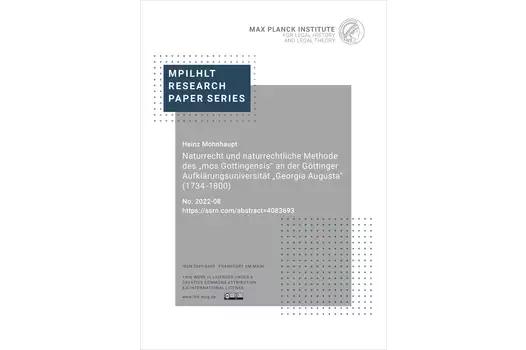
JOURNAL: MPILHLT Research Paper Series, 2021, Vol. 11 No. 4, 05/23/2022

(Image source: MPILHLT)


TABLE OF CONTENTS

Heinz Mohnhaupt (Max Planck Institute for Legal History and Legal Theory), Naturrecht und naturrechtliche Methode des „mos Gottingensis“ an der Göttinger Aufklärungsuniversität „Georgia Augusta“ (1734-1800) / Natural law and the natural law method of the "mos Gottingensis" at the University of the Enlightenment "Georgia Augusta“ (1734-1800)

  • Enlightenment and natural law are mutable concepts. In the founding goals of the Göttingen University "Georgia Augusta", founded in 1734, they are concretely combined to form a utilitarian model of science for all disciplines. Science should be useful and experienceable for state and society. For the system of "Jurisprudentia" this implies an encyclopedically based order of material, which on the one hand is oriented towards pedagogical teaching of the subject matter and on the other hand towards practical exercises. This style of teaching represents the very successful "mos Gottingensis" in the 18th century.
Ignacio Chuecas Saldías (Finis Terrae University), Censuras / Censures (DCH)

  • This article describes the doctrine concerning the canonical penalties known as censures. There are basically three different types of punishment for crimes committed in the context of the ecclesiastical jurisdiction: excommunication (excommunicatio), suspension (suspensio) and interdict (interdictio). After experiencing an important boom during the Late Middle Ages - in part due to the religious-political situation of the period -, the doctrine on censures was widely systematized and commented on by theologians and jurists during the Early Modern Period. In the course of this process, and as a result of the colonial expansion in America, numerous writers dealt with its application in the Spanish American territories. In particular, controversies arose related to the use of excommunications in the numerous confrontations between civil and religious authorities, as well as in interactions with indigenous people, the activities of the Holy Office of the Inquisition, and, of course, the implementation of regulations issued by the Council of Trent.

Jesús Joel Peña Espinosa (INAH), Traslado y renuncia de prelados / Transfer and resignation of an ecclesiastical prelate (DCH)

  • This article studies the juridical bases on which Spanish American ecclesiastics (bishops and parish priests) were able to exercise their capacity to renounce a benefice or to be transferred from one bishopric or parish to another. The spiritual and jurisdictional rights and obligations of the clergy to hold a benefice were regulated by canonical and civil legislation for Spanish America; beyond these norms, we have consulted the theological basis that gives meaning to the relationship between subject and benefice. The two acts, renunciation and transfer, are analyzed in order to elaborate the characteristics and conditions of each one with respect to the historical context of the Hispanic world in its overseas territories, according to the particularities of the law in its most important sources.


ABOUT THE JOURNAL

Since its foundation in 1964, the Max Planck Institute for Legal History & Legal Theory has been dedicated to basic research from a historical perspective in the field of law. A particular challenge embraced by the Institute is to create historical and empirical bases for a critical study of the system of law in a globalized world. To this end, the Institute is paying increasing attention to the interrelationships between European and non-European legal systems. Papers in this series cover topics of the Institute's focus areas. To have your paper included in this series please contact the series editor at ssrn@lhlt.mpg.de


More information can be found here.

09 May 2022

CFP: Natural law and domestic government. Transformative legal theory in Early Modern Europe - Leuven, 27-28 April 2023 (Deadline: 1 June 2022)


(Ambrogio Lorenzetti - Allegory of Good Government. 


Natural law and domestic government

Transformative legal theory in Early Modern Europe

Leuven – 27-28 April 2023

The Early Modern natural law tradition as received from Antiquity and the Middle Ages was in many senses a bridging paradigm. While natural law had been a significant subject of debate among late-medieval theologians, civilians and canonists, it gained a far more central role in legal theory and scholarship from the sixteenth century onwards, in the writings of theologians and jurists alike. As natural law discourse developed over its Early Modern lifespan, it increasingly started to acquire the trappings of a legal theory – underpinning concrete legal notions and offering a paradigm which could be applied to a variety of legal domains and facts. By the early seventeenth century, it had become a major vehicle for conceptions, principles and institutions of law, relating to both private transactions and public governance.

This emergence of natural law as legal theory coincided with the emergence of one legal field to which it would be readily applied; the sphere of the state or the domain of domestic public law. In another sense, it was precisely the growing autonomy and importance of public law and the need for a legal theory underpinning it (as the classic Roman law texts provided insufficient textual support and canon law lost its universality), which fed the rise of legal natural law thinking. This intimate link between natural law and the sphere of domestic governance is made manifest especially in the first modern theories of the polity, where i.a. the articulation of the idea of a state of nature is closely tied together with the Catholic notion of natural rights. It is around this link and its two components that this two-day conference revolves.

We hence especially welcome contributions dealing with the role of natural law in the development of domestic public law in the 16th and 17th centuries (with the possibility to accommodate papers on Early Modern subjects set in the 18th century, before 1789). Subjects of private law with a meaningful link to questions of domestic governance within the outlined period are also welcomed. After all, e.g. the all-important natural law notion of private property was at least in part developed as a premise for theories of the state. Likewise, contributions dealing with the development of domestic public law as a scientific discipline in general will also be considered.

Potential participants are to send in a summary of the proposed paper (200-400 words) to naturallawconference@kuleuven.be by 1 June, 2022, also including their academic affiliation and a brief cv (max. 200 words). A maximum of twenty participants will be chosen from among the applicants by the selection committee. Full manuscripts will be required by the start of the conference. The contributions of the participants will, after a peer-reviewing process, be published as a collection volume at an internationally reputed publishing house. Professors Annabel Brett (University of Cambridge) and Marie Seong-Hak Kim (St. Cloud State University) will deliver the keynote addresses.


The conference organisers,

Wouter Druwé, Randall Lesaffer and Geert Sluijs