Search

Showing posts with label history of ideas. Show all posts

30 September 2025

ARTICLE: Guillaume GRÉGOIRE, "Le droit saisi par l’histoire de ses concepts. La démarche généalogique comme approche contextuelle des phénomènes juridiques" (Revue interdisciplinaire d'études juridiques XCIV (2025), nr 1, 31-65


(image source: cairn)

Abstract:

Au sein des sciences juridiques, le triptyque « droit – science – valeurs » relève de la quadrature du cercle. C’est pourtant l’hypothèse d’une possible ligne de crête que nous souhaiterions avancer, en proposant de poser et de penser l’idéal de neutralité axiologique du chercheur à l’intérieur du postulat d’une inévitable porosité du droit et de la science du droit aux valeurs – donc aussi aux conflits de valeur et aux relations de pouvoir qu’ils impliquent. Cette voie alternative emporte en l’occurrence un certain décalage méthodologique : depuis les normes, les décisions et les institutions vers les discours et les concepts du droit – et ce que ceux-ci révèlent en retour de ces normes, décisions et institutions, ainsi que du monde social dans lequel celles-ci s’insèrent et sur lequel elles agissent. En prenant au sérieux la part de conditionnement social et historique des sciences, il est en effet possible de développer au sein des disciplines juridiques une démarche généalogique en tant qu’élaboration et pratique d’une approche contextuelle du droit. Par l’historicisation des concepts cardinaux du droit et du savoir juridique, il s’agit de concourir à l’œuvre continue de dévoilement et de dénaturalisation des contraintes objectivées que s’impose (et s’imposera toujours) toute société.

Read more here: DOI 10.3917/riej.094.0031. 

05 June 2025

ADVANCE ARTICLE: Nicholas BARDEN, "Bridling the Prince: Humanist Counsel and Its Perils in Jean Calvin's Seneca Commentary" (History of European Ideas 2025)


(image source: Taylor & Francis)

Abstract:

Jean Calvin’s 1532 commentary on Seneca’s De Clementia included his earliest investigation into the role of regulative institutions in restraining the passions of rulers. Northern humanist authors, such as Guillaume Budé, Desiderius Erasmus, and Thomas More, had drawn on Plutarch’s writings concerning high office to develop alternate views on the use of moral instruction, admonition, and counsel to cultivate habits of moral virtue within the prince. This article argues that, in his Seneca commentary, Calvin developed a sustained critique of this northern humanist project of philosophic counsel. Stressing the durability of libidinal desires within the self, Calvin concluded that the power of high office was likely to cultivate in rulers a native arrogance and uncontrolled state of soul that led them to resist moral advice. Instead, Calvin turned to the example of the Spartan ephors as an alternate source of restraint that could establish external limits on the passions and redirect the exercise of royal power towards the public good.

Read more here: DOI  10.1080/01916599.2025.2500432.

03 February 2025

ADVANCE ARTICLE: Edward JONES CORREDERA, "The End of Composite Monarchies: Hugo Grotius’s De iure belli ac pacis and Mid-Seventeenth-Century Iberian Diplomacy" (The English Historical Review)


(image source: OUP)

Abstract:

This article sheds light on the seventeenth-century Catalan, Portuguese and Castilian uses of Hugo Grotius’s De iure belli ac pacis (1625) and, in particular, his chapters on the matter of monarchical succession. By studying the patterns in the ways that Catalan and Portuguese rebels and Spanish diplomats drew on this source to mediate disputes over succession, the article suggests that, while Grotius’s works may have eroded the rights of possession in the Atlantic and the Pacific by building on classical, biblical and Spanish sources, Iberian authors saw the text as a shared rulebook for discussing a sensitive matter that Spain had traditionally resolved through creative ambiguity, by granting and expanding local privileges under the threat of brute force. The article, in this way, encourages a reconsideration of the practical, diplomatic and high-political uses of Grotius’s ideas in Catholic Europe, a reassessment of a clear-cut binary between Dutch ideas of liberty and Spanish visions of empire, and a reconsideration of the historiographical explanation for the decomposition of composite monarchies. 

Read the full article here: DOI 10.1093/ehr/ceae206.

18 August 2022

ARTICLE: Jake Subryan RICHARDS, "Political Thought and the Emotion of Shame: John Stuart Mill and the Jamaica Committee during the Governor Eyre Controversy" (Modern Intellectual History Firstview) (OPEN ACCESS)

(image source: Cambridge Core)

Abstract:

This article argues that the emotion of shame explains how John Stuart Mill and the Jamaica Committee developed intellectual arguments in response to the brutal suppression by Governor Edward Eyre of the Morant Bay rebellion in post-emancipation colonial Jamaica in 1865. Positioning the emotions as integral to cognitive systems, the article traces Mill and the committee's arguments against their opponents, the Eyre Defence Committee. The Jamaica Committee was not solely concerned with liberal imperial order. Instead, under Mill's leadership, the committee sought to reconstruct and defend the pre-rebellion political culture that freedpeople in Jamaica had developed. The committee also demonstrated the illegality of martial law. There were, nonetheless, differences between Mill and other committee members, including Charles Buxton and Frederic Harrison. Shame, the emotion experienced when a subject fails to meet the values to which they are attached, helps to explain these differences. Shame also helped to generate the possibility of reforming the colonial political relationship.

Read more here: DOI  10.1017/S1479244322000154.

19 July 2022

ARTICLE: Felix WALDMANN, "Natural Law and the Chair of Ethics in the University of Naples, 1703-1769" (Modern Intellectual History XIX (2022), No. 1, 54-80) (OPEN ACCESS)


(image source: Cambridge Core)
Abstract:
This articles focuses on a significant change to the curriculum in “ethics” (moral philosophy) in the University of Naples, superintended by Celestino Galiani, the rector of the university (1732–53), and Antonio Genovesi, Galiani's protégé and the university's professor of ethics (1746–54). The article contends that Galiani's and Genovesi's sympathies lay with the form of “modern natural law” pioneered by Hugo Grotius and his followers in Northern Europe. The transformation of curricular ethics in Protestant contexts had stemmed from an anxiety about its relevance in the face of moral skepticism. The article shows how this anxiety affected a Catholic context, and it responds to John Robertson's contention that Giambattista Vico's use of “sacred history” in his Scienza nuova (1725, revised 1730, 1744) typified a search among Catholics for an alternative to “scholastic natural law,” when the latter was found insufficiently to explain the sources of human sociability.

Read the article here: DOI  10.1017/S1479244320000360.

17 June 2021

ONLINE COLLOQUIUM: Regard critique sur les souverainetés (Afrique, Amériques, Asie, Europe) Moyen Âge – xxie siècle) (Paris: Université de Paris/University of Chicago in Paris/CRHIA Nantes/FMSH/CRHEU/EILA), 23-24 JUN 2021)


(image source: Université de Paris)

The University of Paris (and a number of co-organising entities) hosts a two-day online colloquium on sovereignties, from the Middle Ages to the 21st centuries on 23 and 24 June.

Abstract:

This interdisciplinary conference, bringing together historians, legal experts, and political scientists, will focus on the heuristic contribution of the concept of sovereignty, adopting a critical approach of the notion, in examining for instance sovereignties “without State” or “against the State”. Critical theory will help formulate political hermeneutics to better comprehend the concepts of State and power in Europe, the Americas, Asia, and Africa. The theory developed by Jean Bodin in his Six Books on the Commonwealth, and how it has been received from the end of the xvith to the xxist century, is here examined under a new light, not only deconstructing the usual approach on sovereignty, but also addressing the reasons why in Europe it became a fundamental concept for political science, modern theories of the State, and philosophy. Beyond the traditional distinction between “internal” and “external” sovereignty, one of the questions raised is whether Bodin’s assertion that “it is the essence of sovereign power to be unlimited: it is all powerful, or it is nothing” leaves room for debate and consideration on the nature of power in different types of communities: States, or groups of people defined by chosen or inflicted characteristics (ethnic origin, geography, common political preferences, etc.).

Click here for the full program.

16 February 2020

CALL FOR PAPERS, Approches épistémologique et historiographique du droit criminel. Jalons pour une histoire intellectuelle du droit pénal, (Université de Bordeaux), 2 October 2020.

(Source : Université de Bordeaux)

WHEN : Wednesday 2 October 2020

APPLICATION DEADLINE : 26 February 2020 

WHERE : Université de Bordeaux

TOPIC : This symposium aims to promote legal criminal thought and discussing about "an intellectual history of criminal law".

CONTACT :  legalthoughtirm@icloud.com


HOW TO APPLY :

1) Envoi et sélection : Les propositions (500 mots maximum) devront nous parvenir au plus tard le 26 avril 2020 à l’adresse
suivante : legalthoughtirm@icloud.com . Vous serez recontacté.e.s fin mai 2020.
2) Financement : Les participant.e.s sélectionné.e.s seront défrayé.e.s pour le transport et le logement (le cas échéant), et ce dans les limites du budget du colloque.
3) Publication : Les actes de cette journée feront, en principe, l’objet d’une publication dans une revue — sous réserve d'acceptation par son comité de lecture.
4) Présentation : Ce colloque est organisé par Alexandre FRAMBÉRY-IACOBONE et Marine VETTER, doctorant.e.s contractuel.le.s de l’Université de Bordeaux ; il bénéficie du soutien structurel et scientifique de l’Institut de Recherche Montesquieu (IRM-CAHD — Université de Bordeaux), du Centre d’Études et de Recherche sur la Diplomatie, l’Administration publique et le Politique (CERDAP2 — Université de Grenoble Alpes), et du Centre d’Histoire et d’Anthropologie du Droit (CHAD — Université Paris Nanterre).

SCIENTIFIC COMMITTE :
-Antonio AMALFITANO, Docteur en droit (université de Bordeaux) & Docteur en Sciences   politiques (Università Federico II di Napoli) ;
- Jérôme FERRAND, Maître de conférences, Université de Grenoble Alpes ;
- Nader HAKIM, Professeur, Université de Bordeaux ;
- Jean-Louis HALPÉRIN, Professeur, ENS ;
- Martine KALUSZYNSKI, Directrice de recherche CNRS, Pacte ;
- Marie MANIKIS, Professeure, McGill University ;
- Massimo MECCARELLI, Professeur, Università di Macerata ;
- Annamaria MONTI, Professeure, Università Bocconi ;
- Mathieu SOULA, Professeur, Université Paris Nanterre.


02 December 2019

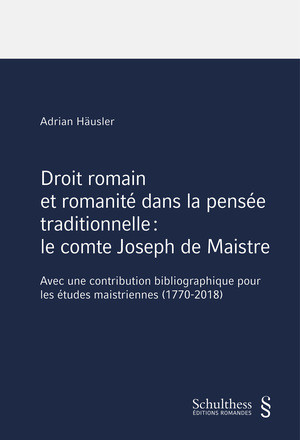
BOOK: Adrian HÄUSLER, Droit romain et romanité dans la pensée traditionnelle : le comte Joseph de Maistre (Schulthess VErlag, 2019), 90 p. ISBN 978-3-7255-8736-0, 38 CHF

(image source: univ-droit)

Book abstract:
L’auteur se penche sur la pensée du comte de Maistre sous l’angle de la romanité, comme tradition juridique, politique et religieuse. Le comte propose une lecture originale de l’idée romaine, dont l’importance ne se limite pas à la diversité du discours idéologique de l’après-Révolution. L’argumentation de ses théories juridico-politiques, illustrées par un rappel de l’exemple romain et de l’importance du fait religieux pour sa constitution, ainsi que ses commentaires - visant à réfuter le discours révolutionnaire - sur la Rome royale, républicaine, impériale et papale, puis sur la continuité impériale par les formes romaines du Sacerdoce et de l’Empire (notamment en Russie), apportent également un éclairage nouveau sur la valeur du droit romain et la pérennité de l’idée romaine. Le chapitre, peu mis en avant, de la réception de la romanité dans la pensée contre-révolutionnaire trouve ici une tribune avec l’examen de l’œuvre du comte Joseph de Maistre.
(source: univ-droit)
 

31 October 2018

INTERVIEW: Anne SCHULT (NYU) interviews Martti KOSKENNIEMI on "Sovereignty, Property and the Locus of Power" (Journal of the History of Ideas Blog)

(image source: JHI Blog)

The Blog of the Journal of the History of Ideas has published an interview with Martti Koskenniemi.

First paragraph:
Anne: Your work has long explored the nature of governance through international law—in the past as much as in the present. The book project you have been working on over the past years, which explores the correlation of sovereignty and property in international law, is no different in this regard. As you seek to illustrate, sovereignty arises from an often hidden foundation of private property relations, while these exact relations are bound to be delimited by what we call ‘public power’—meaning we ultimately have been, and continue to be, governed by both. This argument re-emphasizes some of the questions your earlier work has tackled with regard to the critical role of international law in politics—or, to be more accurate, international law asinternational politics. But it also appears to address a more fundamental problem in the conceptualization of international law by suggesting that seemingly benign relations of private property are intrinsically connected to the realm of international power struggles. In your mind, how does this project depart from, or perhaps even in part revise, your prior work on the origins of modern international law?
Read further here.
(source: ESILHIL Blog)