Rechtsgeschichte – Legal History 34 (2026) out now
Journal of the Max Planck Institute for Legal History and Legal Theory
Last year saw the publication of two significant new books on Rudolf von Jhering, one of the most original legal scholars of the 19th century. In the Research section of this year’s issue of our Institute journal, the books’ authors present their findings for discussion. While Michael Kunze traces Jhering’s life-long quest for a secular foundation of law as an invisible normative order, Mathias Reimann finds both brilliant insights and chaotic tendencies in Jhering’s writings.
Dave De ruysscher’s article on the history of bills of exchange in Western Europe argues that their regulatory framework remained relatively indeterminate between c. 1450 and 1680. Only gradually did a synthesis of Genoese and Dutch methodologies establish itself as the dominant approach. Beate Althammer explores the history of pardoning practices as a part of 19th-century criminal justice reforms. Her analysis of petitions for royal mercy in England and Prussia leads her to question the narrative of a linear change of legal order and pardoning practices. Triin Tark offers a Baltic perspective on the translation of legal texts during the interwar period. She demonstrates how the consistent terminology for ethnic minorities used in the Estonian Law on Cultural Autonomy (1925) was replaced with an eclectic mix of vocabulary by the League of Nations’ translators.
The Research section is completed by Erk Volkmar Heyen taking a closer look at the iconography of the courtroom table from the joint perspective of art and legal history. His analysis of 19th-century French and Belgian satirical images of the judiciary focuses on the relationship between religion and the state.
Art and creativity are also the subjects of this year‘s Forum section. Its 15 short contributions explore the possibilities opened up by creative methods in legal history from a global perspective – with examples from the Americas, Africa and India.
This issue‘s Critique section offers 33 reviews of recent publications relevant to the study of legal history from late antiquity to the 21st century. Under Comptes rendus, we briefly present some key publications by researchers at our Institute.
Thorsten Keiser‘s Marginalia contribution deals with a key characteristic of the Venetian Republic’s constitution from the late Middle Ages to the 18th century: the anonymous denunciation (denuncia segreta). The print issue‘s series of images is also devoted to Venice; the various selected views of the lagoon city all stem from the extensive collections of Frankfurt’s Städel Museum.
Rechtsgeschichte — Legal History 34 is now available in print from the publishers Vittorio Klostermann and online in Open Access via the journal's website.
Search
18 September 2026
JOURNAL: Rechtsgeschichte – Legal History, Journal of the Max Planck Institute for Legal History and Legal Theory, Rg 34 (2026)
21 November 2025
PRIZE: Max Planck-ASLH Dissertation Prize for European Legal History in Global Perspective 2025 to Vladislav LILIC and Daniel R. QUIROGA VILLAMARÍN
Description:
This year's Max Planck-ASLH Dissertation Prize for European Legal History in Global Perspective recognizes two remarkable works. Vladislav Lilić and Daniel R. Quiroga Villamarín offer research that enriches the study of state formation, international order, and the built environments that shaped global governance.
Vladislav Lilić’s dissertation, ‚Empire of States: Law and International Order in Ottoman Europe, c. 1830–1912,‘ completed at Vanderbilt University, presents a fresh account of Balkan state formation. He traces how Montenegro and Serbia took shape through legal conflicts inside imperial institutions. By following figures ranging from Ottoman officials to pastoralists, he shows how disputes over land, authority, and public order gradually redefined political belonging and enabled provincial states to form within the empire before entering the international arena. The work rests on multilingual research, a precise structure, and a clear analytical contribution to debates on sovereignty and legal pluralism.
Daniel R. Quiroga Villamarín’s dissertation, “‘Architects of the Better World’: Democracy, Law, and the Construction of International Order (1919–1998),‘ completed at the Graduate Institute in Geneva, examines the emergence of an international parliamentary complex across the twentieth century. He follows the creation of international assemblies from interwar Geneva to the end of the Cold War and analyzes how architectural designs circulated across regions. By linking these physical spaces to global political aspirations, he offers a spatial history of international law grounded in extensive archival research in Europe, Africa, and the Americas. The study introduces a distinctive conceptual frame conveyed through clear and persuasive prose. The Max Planck-ASLH Dissertation Prize honors outstanding dissertations in European legal history with a global orientation, submitted for PhD or JSD degrees awarded in the previous calendar year. It supports work on European legal interactions beyond Europe, transregional legal processes, and theoretical developments connected to imperial or global currents.
Jury:
Lauren Benton (chair) Yale University Thomas Duve Max Planck Institute for Legal History Fahad Bishara University of Virginia Matthew Mirow Florida International University
Source: MPILHLT.
03 July 2024
SCHOLARSHIPS: Visiting Researchers 2025-2026 (Department "Historical Regimes of Normativity", Max Planck Institute for Legal History and Legal Theory) (DEADLINE 30 AUG 2024)
The Department Historical Regimes of Normativity (Prof. dr. Thomas Duve) will award scholarships for research stays of three or six months, starting on 1 April 2025 / 1 July 2025 / 1 October 2025 / 5 January 2026 for PhD students, post-doctoral and senior researchers. Deadline 30 August 2024.
More information here.
Please ensure that your application reaches us at least four months before your intended research stay. Submit your complete application via our online application system.
08 April 2024
REMINDER JOB OFFERS: Three PhD students for the newly established research group “The Hidden Heritage of the European Union: the Legacy of the Law of the League of Nations” (Frankfurt/Main, Max Planck Institute for Legal History and Legal Theory) [DEADLINE: 1 May 2024]
Three PhD students (m/f/div)
The research group
Conventional accounts of European integration have often insisted on the novelty of the supranational law developed in that context, asserting its ‘sui generis’ character and highlighting its differences with earlier forms of international and regional integration. However, recent scholarship has questioned this view, noting that forms of supranational law and institutions already existed during the interwar period. This was the case within the League of Nations and its broader context, which included international(ized) institutions both in Europe (e.g. Danzig, Saar, Upper Silesia…) and in (semi-)colonial settings (e.g. League mandates, international cities, protectorates…). The research group’s central aim will be to identify the continuities and discontinuities between the law of these interwar institutions and the law developed within the context of European integration. To do so, it will not only look at the relevant institutions and the norms they generated, but also at the actors that developed and used these norms, whether as legal professionals or as ‘subaltern’ individuals or groups.
Possible research themes, which, ideally, should cover both the interwar period and the early stages of European integration, include:
- the law and practice of/before/vis-à-vis supranational institutions (including courts);
- the protection and representation of labour;
- the role of the International Chamber of Commerce;
- the relation between regional integration and global trade liberalization.
Job description
Your key responsibility is to develop and complete a doctoral dissertation within the confines of the research group’s central aim, possibly (but not exclusively) in relation to one of the abovementioned research themes. You are also expected to publish and disseminate your research findings in close co-operation with the other members of the research group, including by contributing data to an online repository.
Your profil
A university degree in law, humanities or social sciences that has been completed with above-average success is required. You have an excellent command of English, both spoken and written and are proficient in either French or German. Knowledge of other languages relevant to the project (e.g. Arabic, Italian, Polish, Spanish…) is not a requirement but will be considered as an asset.
Your curriculum vitae shows the potential to conduct research at an internationally high level. You work meticulously and are able to handle deadlines. You work independently and have a strong interest in interdisciplinary, archival and comparative work. You have the ability to play an active collaborative role in the research group.
Our offer
We offer an attractive and international work environment with an unparalleled research infrastructure and a good working atmosphere. The payment is currently 3,000 € per month (gross), which equals approximately 2,045 € after taxes, depending on family circumstances, plus a special annual payment. The job is a full time position (currently 39 hours per week). While you will be based in Frankfurt/Main, there are generous opportunities for mobile working (at present, up to 40 per cent per month). The position is a fixed-term appointment for three years, with the possibility of renewal for a further year in exceptional circumstances. There is no obligation or expectation to teach, although we encourage you to take up limited teaching assignments if you wish to do so.
You will have unlimited access to our world leading library and a multitude of databases. You will be provided with a work space and will receive extensive academic and administrative support. There are generous grants for research trips to archives and libraries, as well as for attending conferences. A variety of personal and career development opportunities is available, including funding for German language classes.
The Max Planck Society is committed to increasing the number of individuals with disabilities in its workforce and therefore encourages applications from such individuals. Furthermore, the Max Planck Society seeks to increase the number of women in those areas where they are underrepresented and therefore explicitly encourages women to apply.
The Max Planck Society strives for gender equality and diversity. We welcome applications from all backgrounds.
Application process
The application should be in English or German or French and should contain the following documents:
- Cover letter naming your research project and explaining to what extent your profile meets the selection criteria
- Names and addresses (by post and electronically) of three scientists who have agreed to issue you with a letter of reference
- Detailed CV containing a list of any publications you might have
- Copies of your school leaver’s certificate and degree certificate
- Preliminary research project (up to five pages) fitting within the group’s general
- Written sample of approx. 20 printed pages (e.g. master thesis sample, journal articles, book chapters, etc.)
Your application must be submitted online via the following link by the closing date of 1st May, 2024: https://www.lhlt.mpg.de/job-offers.
Please provide your referees with all your application documents and ask them to send their references direct to jobs@lhlt.mpg.de no later than 1st May, 2024. References may only be sub-mitted by email. They do not have to be signed as long as they are emailed from the official mail address of the referee. Strong candidates will be invited for an interview.
Contact
Informal enquiries may be directed to Dr. Michel Erpelding (erpelding@lhlt.mpg.de). For questions as to the terms and conditions of employment please contact Ms. Anna Heym (jobs@lhlt.mpg.de).
18 March 2024
JOB OFFERS: Three PhD students for the newly established research group “The Hidden Heritage of the European Union: the Legacy of the Law of the League of Nations” - (Frankfurt/Main, Max Planck Institute for Legal History and Legal Theory) [DEADLINE: 1 May 2024]
Three PhD students (m/f/div)
The research group
Conventional accounts of European integration have often insisted on the novelty of the supranational law developed in that context, asserting its ‘sui generis’ character and highlighting its differences with earlier forms of international and regional integration. However, recent scholarship has questioned this view, noting that forms of supranational law and institutions already existed during the interwar period. This was the case within the League of Nations and its broader context, which included international(ized) institutions both in Europe (e.g. Danzig, Saar, Upper Silesia…) and in (semi-)colonial settings (e.g. League mandates, international cities, protectorates…). The research group’s central aim will be to identify the continuities and discontinuities between the law of these interwar institutions and the law developed within the context of European integration. To do so, it will not only look at the relevant institutions and the norms they generated, but also at the actors that developed and used these norms, whether as legal professionals or as ‘subaltern’ individuals or groups.
Possible research themes, which, ideally, should cover both the interwar period and the early stages of European integration, include:
- the law and practice of/before/vis-à-vis supranational institutions (including courts);
- the protection and representation of labour;
- the role of the International Chamber of Commerce;
- the relation between regional integration and global trade liberalization.
Job description
Your key responsibility is to develop and complete a doctoral dissertation within the confines of the research group’s central aim, possibly (but not exclusively) in relation to one of the abovementioned research themes. You are also expected to publish and disseminate your research findings in close co-operation with the other members of the research group, including by contributing data to an online repository.
Your profil
A university degree in law, humanities or social sciences that has been completed with above-average success is required. You have an excellent command of English, both spoken and written and are proficient in either French or German. Knowledge of other languages relevant to the project (e.g. Arabic, Italian, Polish, Spanish…) is not a requirement but will be considered as an asset.
Your curriculum vitae shows the potential to conduct research at an internationally high level. You work meticulously and are able to handle deadlines. You work independently and have a strong interest in interdisciplinary, archival and comparative work. You have the ability to play an active collaborative role in the research group.
Our offer
We offer an attractive and international work environment with an unparalleled research infrastructure and a good working atmosphere. The payment is currently 3,000 € per month (gross), which equals approximately 2,045 € after taxes, depending on family circumstances, plus a special annual payment. The job is a full time position (currently 39 hours per week). While you will be based in Frankfurt/Main, there are generous opportunities for mobile working (at present, up to 40 per cent per month). The position is a fixed-term appointment for three years, with the possibility of renewal for a further year in exceptional circumstances. There is no obligation or expectation to teach, although we encourage you to take up limited teaching assignments if you wish to do so.
You will have unlimited access to our world leading library and a multitude of databases. You will be provided with a work space and will receive extensive academic and administrative support. There are generous grants for research trips to archives and libraries, as well as for attending conferences. A variety of personal and career development opportunities is available, including funding for German language classes.
The Max Planck Society is committed to increasing the number of individuals with disabilities in its workforce and therefore encourages applications from such individuals. Furthermore, the Max Planck Society seeks to increase the number of women in those areas where they are underrepresented and therefore explicitly encourages women to apply.
The Max Planck Society strives for gender equality and diversity. We welcome applications from all backgrounds.
Application process
The application should be in English or German or French and should contain the following documents:
- Cover letter naming your research project and explaining to what extent your profile meets the selection criteria
- Names and addresses (by post and electronically) of three scientists who have agreed to issue you with a letter of reference
- Detailed CV containing a list of any publications you might have
- Copies of your school leaver’s certificate and degree certificate
- Preliminary research project (up to five pages) fitting within the group’s general
- Written sample of approx. 20 printed pages (e.g. master thesis sample, journal articles, book chapters, etc.)
Your application must be submitted online via the following link by the closing date of 1st May, 2024: https://www.lhlt.mpg.de/job-offers.
Please provide your referees with all your application documents and ask them to send their references direct to jobs@lhlt.mpg.de no later than 1st May, 2024. References may only be sub-mitted by email. They do not have to be signed as long as they are emailed from the official mail address of the referee. Strong candidates will be invited for an interview.
Contact
Informal enquiries may be directed to Dr. Michel Erpelding (erpelding@lhlt.mpg.de). For questions as to the terms and conditions of employment please contact Ms. Anna Heym (jobs@lhlt.mpg.de).
06 February 2023
CALL FOR PAPERS : New Approaches for Extracting Heterogeneous Reference Data (MPI for Legal History and Legal Theory - Frankfurt, 15/16 May 2023) (DEADLINE: 28 February 2023)
The MPI in Frankfurt has a call for papers for a hybrid workshop on ‘New Approaches for Extracting Heterogeneous Reference Data’.
Summary
Extracting heterogeneous references from texts,
in particular from historical documents and humanities or legal scholarship is
an unresolved problem. Yet, there is currently no coordinated effort to develop
solutions. We therefore invite scholars and practitioners from the social
sciences, the humanities and the informational and computational disciplines to
join us in a workshop in which we want to define the problem(s), establish the
state of the art and share resources. The overarching aim of the event is to
find ways for jointly developing new tools and workflows which are able to
unlock previously untapped reference/citation data in the humanities, law and
the social sciences. A particular focus lies on newly emerging technologies
that are based on (pre-trained) language models.
The full call can be found here.
04 November 2022
JOB: 2 PhD Positions Project ‘Glocalising Normativities’ (Max Planck Institute for Legal History and Legal Theory - DEADLINE: 30 November 2022)
two PhD Students (m/f/d) - Glocalising Normativities
The Glocalising Normativities (GloNo) project aims to construct a global history of knowledge of normativity production in a vast historical space that includes sites in Asia, Africa, Europe and the Americas. All of these regions were, at some point in their respective histories, under the sphere of influence of one of the two Iberian empires: Portugal and Spain. The GloNo project looks at these places from a long-term perspective from the late 15th to the early 21st century and proposes an emphasis on localized observations of the histories of knowledge of normativity within a global horizon. However, we do not seek to create a comprehensive legal history of the entire imperial space, but rather to develop a global legal history focusing on an interdisciplinary and non-Eurocentric approach to further a critical understanding of the idea of law. We propose an understanding of legal history as a historical process of cultural translation of knowledge of normativity. In pursuing a legal-theoretical pragmatic understanding of knowledge of normativity, the GloNo project combines a global perspective on legal history with local case studies based on the detailed analysis of archival sources in a broader context. These case studies provide insights into how the production of norms is always localized, i.e. socially and culturally translated, based on manifold social practices and different epistemic communities. For our analysis, we rely on the concept of "Historical Regimes of Normativity", or stable arrangements in which the translation of knowledge of normativity takes place in relation to a particular field of action. In order to overcome the binary division of the local versus the global, we propose five analytical units as "Historical Regimes of Normativity” in order to pursue decentralized knowledge production and their stabilizing effect on the normative orders being analyzed: governance, dependency, ownership, diversity and tradition.
Your key responsibility is to develop and complete a doctoral dissertation within the parameters of the research group. Doctoral students are expected to publish and disseminate their research findings in close co-operation with the other members of the research group.
You hold a university degree in history, law, or other related field that has been completed with above-average success. Applicants should hold a master’s degree at the time the PhD contract is signed. Candidates may already be enrolled in a PhD program in any university worldwide.
You are proficient in Portuguese and/or Spanish, and good knowledge of English is expected. Knowledge of additional languages relevant to the regional focus is not required but will be considered an asset.
Your curriculum vitae shows the potential to conduct research at an internationally high level. You work meticulously and are able to handle deadlines. You work independently and have a strong interest in interdisciplinary, archival, and comparative work. You have the ability to play an active collaborative role in the research group.
We offer an attractive and international work environment with unparalleled research infrastructure and a good working atmosphere. The candidate will have the opportunity to take part in an interdisciplinary international research group, benefit from continuous scientific exchange, a comprehensive library and the possibility of research stays in Germany and abroad.
PhD positions are currently paid 2,721.84€ gross, which works out to approximately 1,800€ after taxes. The majority of the 39-hour workweek is dedicated to carrying out the doctoral project.
The positions are fixed-term appointments for three years and may be extended for one additional year. In accordance with our works agreement, mobile working up to 40% is possible.
The Max Planck Society strives for gender equality and diversity. We welcome applications from individuals with disabilities. We also seek to increase the number of women in those areas where they are underrepresented and therefore explicitly encourage women to apply. Likewise, applications from persons underrepresented in science and research with regard to gender, age, professional and cultural backgrounds, sexual orientation and nationality are encouraged.
Application process
The application should be in English, Portuguese or Spanish and should contain the following documents:
- Cover letter naming your research project and explaining to what extent your profile meets the selection criteria.
- Detailed CV including a list of any publications you might have.
- Copies of your university certificates.
- Preliminary research project (up to five pages, not including bibliography) on a local or regional case study located in one of the regions listed above (any sites under the sphere of influence of one of the two Iberian empires), specifically indicating archives and sources. This document has to justify the integration of the case study into the GloNo project and describe how it fits into the overarching framework of the project.
Your application must be submitted online via the link below by the closing date of November 30, 2022. Outstanding candidates will be invited to an interview.
You are encouraged to contact Dr. Luisa Stella Coutinho (coutinho@lhlt.mpg.de) for any inquiries regarding the scientific aspects of the project. For questions as to the terms and conditions of employment, please contact Ms. Anna Heym (jobs@lhlt.mpg.de).
31 October 2022
SEMINAR SERIES: MPI-TAU Transnational Legal History Workshop (Fall Semester 2022-2023, ONLINE)
The Berg Foundation Institute for Law and History at The Buchmann Faculty of Law, Tel Aviv University, and the Max Planck Institute for Legal History and Legal Theory will continue the joint MPI-TAU Transnational Legal History Workshop in the Fall Semester, 2022/2023.
The workshop meets Tuesdays 19.00-20.30 (Frankfurt time) and 20:00-21:30 (Tel Aviv time). This year's organizers and moderators are Thomas Duve (MPI), Ron Harris (TAU), Assaf Likhovski (TAU), Stefan Vogenauer (MPI).
Sessions will be conducted on Zoom, and based on pre-circulated papers. For the first time, the workshop will also be open for students from Goethe University. Registration for participation is required (at this page).
PROGRAM
1 November 2022 - Taisu Zhang (Yale University), The Modern State and the Rise of the Business Corporation
8 November 2022 - Eduardo Zimmermann (Universidad de San Andrés, Buenos Aires), Towards a Transnational Legal History of the Administrative State in Latin America
15 November 2022 - Phillip I. Lieberman (Vanderbilt University), The Use of Jewish Legal Sources to Tell Islamic Economic History
22 November 2022 - Mitra Sharafi (University of Wisconsin), Fear of the False in Colonial South Asia
29 November 2022 - Roy Kreitner (Tel Aviv University), Concepts, Contexts, Contests
6 December 2022 - Baudouin Dupret (CNRS), Mind the step: Standardizing the Mind, Stepping into Positive Law (Egypt, 1897-1949)
13 December 2022 - Jean-Louis Halpérin (EHESS), Doctrinal circulations in criminal law 1764-1914
20 December 2022 - Inge Van Hulle (mpilhlt / KU Leuven), The Cambridge history of international law in Africa
10 January 2023 - Philip Bajon (mpilhlt), European Law and the Passage to Majority Rule in the European Union
17 January 2023 - Lena Foljanty (Universität Wien/mpilhlt), Writing a comparative history of legal orders in transition: Methodological reflections
24 January 2023 - Priyasha Saksena (University of Leeds), Limping Marriages: Race, Class, and Divorce Jurisdiction in the British Empire
More information can be found here.
06 October 2022
JOB: Postdoctoral and Research Scholarships – Max Planck Institute for Legal History and Legal Theory (January-June 2023) (DEADLINE: 31 October 2022)
The MPI in
Frankfurt currently has a call for up to six scholarships for postdoctoral and
senior researchers.
We award several
Postdoctoral and Research Scholarships annually to enable outstanding
researchers to spend time at the Max Planck Institute for Legal History and
Legal Theory. Scholarship holders are expected to pursue their own research
project, which should relate to the Institute’s current research agenda.
For the first half of the year 2023, the Department European and Comparative Legal
History (Stefan Vogenauer) will award
up to 6 scholarships for Postdoctoral and Senior Researchers proposing to work
on one of the following topics:
Applications should include the following documents, written in
English
- Research proposal (up to 2500
words), including an explanation as to how the project relates to the
Department’s main research activities
- CV
- List of
publications
- Names and contact details of two
scholars who have agreed to provide references (upon request)
- Scan of the completed and signed
form ‘Additional Application Details’
- Three relevant publications of the
last five years (as PDFs)
Deadline: All applications must be submitted via the online application system by 31 October 2022. Decisions will be communicated
before the end of the following month.
Scholarships run for either 3 or 6 months, starting at the beginning of January
or April.
Scholars will receive a monthly stipend of either € 2,500 (postdoctoral
researchers) or € 3,000 (senior researchers). Income from existing employment
relationships or scholarships has to be set off against the amount awarded and
will thus be taken into account when determining the exact amount of the
stipend.
Contact
Anna Heym, International Office, io@lhlt.mpg.de
More info here
30 May 2022
JOURNAL: MPILHLT Research Paper Series, 2021, Vol. 11 No. 4, 05/23/2022
TABLE OF CONTENTS
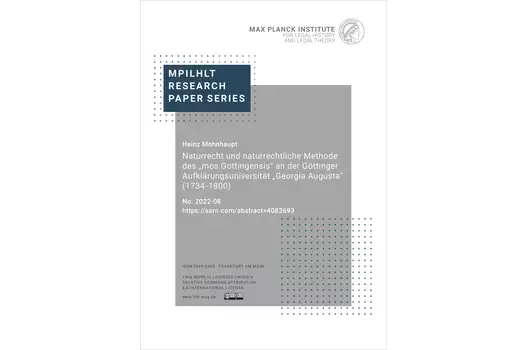
Heinz Mohnhaupt (Max Planck Institute for Legal History and Legal Theory), Naturrecht und naturrechtliche Methode des „mos Gottingensis“ an der Göttinger Aufklärungsuniversität „Georgia Augusta“ (1734-1800) / Natural law and the natural law method of the "mos Gottingensis" at the University of the Enlightenment "Georgia Augusta“ (1734-1800)
- Enlightenment and natural law are mutable concepts. In the founding goals of the Göttingen University "Georgia Augusta", founded in 1734, they are concretely combined to form a utilitarian model of science for all disciplines. Science should be useful and experienceable for state and society. For the system of "Jurisprudentia" this implies an encyclopedically based order of material, which on the one hand is oriented towards pedagogical teaching of the subject matter and on the other hand towards practical exercises. This style of teaching represents the very successful "mos Gottingensis" in the 18th century.
- This article describes the doctrine concerning the canonical penalties known as censures. There are basically three different types of punishment for crimes committed in the context of the ecclesiastical jurisdiction: excommunication (excommunicatio), suspension (suspensio) and interdict (interdictio). After experiencing an important boom during the Late Middle Ages - in part due to the religious-political situation of the period -, the doctrine on censures was widely systematized and commented on by theologians and jurists during the Early Modern Period. In the course of this process, and as a result of the colonial expansion in America, numerous writers dealt with its application in the Spanish American territories. In particular, controversies arose related to the use of excommunications in the numerous confrontations between civil and religious authorities, as well as in interactions with indigenous people, the activities of the Holy Office of the Inquisition, and, of course, the implementation of regulations issued by the Council of Trent.
Jesús Joel Peña Espinosa (INAH), Traslado y renuncia de prelados / Transfer and resignation of an ecclesiastical prelate (DCH)
- This article studies the juridical bases on which Spanish American ecclesiastics (bishops and parish priests) were able to exercise their capacity to renounce a benefice or to be transferred from one bishopric or parish to another. The spiritual and jurisdictional rights and obligations of the clergy to hold a benefice were regulated by canonical and civil legislation for Spanish America; beyond these norms, we have consulted the theological basis that gives meaning to the relationship between subject and benefice. The two acts, renunciation and transfer, are analyzed in order to elaborate the characteristics and conditions of each one with respect to the historical context of the Hispanic world in its overseas territories, according to the particularities of the law in its most important sources.
ABOUT THE JOURNAL
Since its foundation in 1964, the Max Planck Institute for Legal History & Legal Theory has been dedicated to basic research from a historical perspective in the field of law. A particular challenge embraced by the Institute is to create historical and empirical bases for a critical study of the system of law in a globalized world. To this end, the Institute is paying increasing attention to the interrelationships between European and non-European legal systems. Papers in this series cover topics of the Institute's focus areas. To have your paper included in this series please contact the series editor at ssrn@lhlt.mpg.de
More information can be found here.
10 February 2022
JOB OFFER: PhD or Postdoc ERC IberLAND ‘Beyond Property Law. Law and Land in the Iberian World (1510-1850) (DEADLINE: 20 February 2022)
We learned of an open PhD or
post-doc position at the Max Planck Institute for Legal History and Legal
Theory. More info here
One PhD or Postdoc researchers
(m/f/div) for the ERC research group IberLAND
“BEYOND PROPERTY. LAW AND LAND IN
THE IBERIAN WORLD (1510-1850)”
directed by Dr. Manuel Bastias
Saavedra, with a case study compatible with the following focus:
Goa (and Old Conquests), 1510-1630
IberLAND explores the history of land tenure in a long-term and global
perspective by focusing on the territories of the former Portuguese and Spanish
empires in what has recently been labelled the Iberian world. The Iberian
crowns of Portugal and Castile, beginning in the 15th century, connected
diverse peoples and communities across Africa, Asia, Europe, and the Americas.
In doing so, they for the first time transformed the questions of how to own
and how to use land into an issue of global dimensions. While this age of
discovery and colonialism has often been regarded as the first phase of the
transplantation of European concepts of property from Europe to the
non-European world, IberLAND seeks to disrupt this narrative by looking at the
history of land tenure not as a process of diffusion from Europe to the world,
but as a process of decentred legal innovation. To do this, the project will
move beyond the idea of property and focus on land relations to understand the
sets of social relations established between people and land. This conceptual
approach provides a way of observing how law was produced at the local level
through the combination of practice and doctrine. To connect legal doctrines to
local practices, the project’s analysis will focus on different sets of
institutions that structured land relations in different places in the Iberian
world. This conceptual and analytical framework will be applied to six case
studies focusing on New Spain, Goa, Cape Verde, Spain, Brazil and the
Philippines, enabling us to overcome the diffusionist mindset that has pervaded
the study of law and empire.
Job description
Your key responsibility is to develop research within the framework of the
research group with focus on one of the three regions and temporal foci above.
Researchers are also expected to discuss, publish, and disseminate their
research findings in close co-operation with the other members of the research
group. PhD researchers are expected to develop and complete a doctoral
dissertation.
Your profile
You hold a university degree in history, law, anthropology, or other related
field that has been completed with above-average success. Applicants should
hold a master’s degree at the time the PhD contract is signed. Candidates may
already be enrolled in a PhD program in any university worldwide. Applicants
who already have a PhD may apply for the Postdoc position.
You are fully proficient in Portuguese and/or Spanish, and good knowledge of
English is expected. Knowledge of additional languages relevant to the regional
focus is not required but will be considered an asset.
Your curriculum vitae shows the potential to conduct research at an
internationally high level. You work meticulously and are able to handle
deadlines. You work independently and have a strong interest in
interdisciplinary, archival, and comparative work. You have the ability to play
an active collaborative role in the research group.
Our Offer
We offer an attractive and international work environment with unparalleled
research infrastructure and a good working atmosphere. The candidate will have
the opportunity to take part in an interdisciplinary international research
group, benefit from continuous scientific exchange, a comprehensive library and
the possibility of research stays in Germany and abroad.
The research position is full-time (39 hours per week) and is paid according to
the German Civil Service Collective Agreement (TVöD Bund), level E13. PhD
researchers are paid the equivalent of 65%.
The position is a fixed-term appointment for three years. In exceptional cases,
a PhD position can be extended for up to one additional year.
The Max Planck Society is committed to increasing the number of individuals
with disabilities in its workforce and therefore encourages applications from
such individuals. Furthermore, the Max Planck Society seeks to increase the
number of women in those areas where they are underrepresented and therefore
women are explicitly encouraged to apply.
We encourage applications from all backgrounds.
Application process
The application can be in English, Portuguese, Spanish or German and should
contain the following documents (in one pdf document):
- Cover letter naming your research project and
explaining to what extent your profile meets the selection criteria
- Detailed CV containing a list of any publications you
might have
- Preliminary research project (up to five pages, not
including bibliography) on a local or regional case study fitting within
one of the four regions indicated above, specifically indicating archives
and sources. (Applicants working on other regions of the Iberian World
may be considered but should contact Dr. Bastias Saavedra before applying).
- Copies of your university certificates
Your application must be submitted online via the following link by the closing
date of February 20, 2022: https://www.lhlt.mpg.de/job-offers.
Outstanding candidates will be invited to an interview.
Contact
You are encouraged to contact Dr. Bastias Saavedra (bastias@lhlt.mpg.de) for any inquiries
regarding the scientific aspects of the project. For questions as to the terms
and conditions of employment, please contact Ms. Anna Heym (jobs@lhlt.mpg.de).
26 January 2022
JOURNAL: MPILHLT Research Paper Series, 2021
A basic bibliography on the history of Ibero-America and the Spanish Caribbean in the colonial period - Otto Danwerth
Municipal Republics and its imprint on Independence processes. Rio de la Plata, first half of the Nineteenth Century. (Las repúblicas municipales y su proyección en los procesos de independencia. Río de la Plata, primera mitad del siglo XIX) - Alejandro Aguero
06 December 2021
CALL FOR PAPERS: Change over time in the Iberian Worlds: stabilising regimes of normativity (deadline 20 December 2021) - Max Planck Institute for Legal History and Legal Theory
The mpilhlt’s Glocalising Normativities project aims to construct a global history of normative production by studying the interaction of local processes of the cultural translation of normative knowledge within global networks in the early modern Iberian worlds.
For the project’s 2022 Annual Conference and the resulting publication, we are looking for contributions focusing on legal change and stability in any region of the Portuguese and Spanish empires in Asia, Africa, Europe and the Americas during the early modern period. We want to explore how legal history can offer a particular perspective for understanding legal change. Discussions of case studies, comparisons, long-term perspectives as well as methodological and analytical approaches – particularly in conversation with the long-standing tradition of discussions on legal change – are welcome. A detailed description of the conference’s topic and its conceptual framework can be found in the full text of the Call (link below).
The selected papers will first be discussed as drafts in a virtual meeting to be held in April 2022. The final papers will be discussed in person (should the pandemic situation allow) in Frankfurt am Main at the Glocalising Normativities Annual Conference on 19–21 October 2022, and subsequently submitted for publication in the Brill series Max Planck Studies in Global Legal History of the Iberian Worlds.
The deadline for submission of proposals is 20 December 2021.
The full text of the Call is available here.
Teaser image: Francisco de Holanda, De aetatibus mundi imagines (1545) CC-BY-NC-ND 4.0, Biblioteca Nacional de España
05 November 2021
SUMMER SCHOOL: Max Planck Summer Academy for Legal History (4-15 July 2022, Frankfurt) (DEADLINE: 31 January 2022)
We learned that the Max Planck
Institute for Legal History and Legal Theory is organizing a summer school on
legal history again.
Date
4 July – 15 July 2022
The Course
The Max Planck Summer Academy for
Legal History provides a selected group of highly motivated early-stage
research students, usually PhD candidates, with an in-depth introduction to
basic approaches and methods in legal history.
The Summer Academy consists of
three parts. The first part introduces the international group of PhD students
to sources, methodological approaches and theoretical models as well as to
controversial research debates on fundamental research fields of legal history.
The introductory courses are led by members of the Institute and external guest
speakers. In the second part, the invited participants present their own
projects within the context of the respective year’s special topic. The third
part of the Academy offers the opportunity to all participants to further
develop their own research by making use of the library and by discussing their
projects with the Institute’s experts in the different fields of legal history.
The course will take place at the
Max Planck Institute for Legal History and Legal Theory in Frankfurt am Main,
Germany.
This year’s theme: Using History
in Law
History teaches us that people
all over the world have invoked the past or tradition to legitimise or
delegitimise norms. Even today, in countries across the globe and in very
diverse legal cultures, but also at the level of international law, ‘tradition’
is allocated an important role in the construction of legal systems and in
substantiating legal claims.
Why and under what historical
conditions and circumstances did jurists assign such a high authority to the
past? In which intellectual contexts and based on what understanding of
epistemology, philosophy of history, or religious beliefs is the past used as
an argument to legitimise or delegitimise existing or future law? And what
force do historical arguments have in today’s laws?
Applicants to the 2022 Summer
Academy are encouraged to present research projects that give special
consideration to the significance of using History in Law.
Eligibility Requirements
Early-stage research students,
usually PhD candidates.
Working knowledge of English is
required, German is not a prerequisite.
Application
All applications must be
supported by a CV, a project summary (approx. 10 pages) and a letter of
motivation. Please send yur applications via e-mail to: summeracademy@lhlt.mpg.de.
Submission deadline for
applications is 31 January 2022.
Fees
There is no participation fee.
Accommodation will be provided by the organisers. Participants, however, will
be responsible for covering their travel expenses. There will be a limited
number of scholarships available.
All info here
01 October 2021
WORKSHOP: Online Transnational Legal History Workshop (October 2021-January 2022)
The current pandemic has encouraged many to experiment with
new formats for research and teaching. In our own contribution to the trend,
the Max Planck Institute for Legal History and Legal Theory and the Faculty of
Law at Tel Aviv University, in cooperation with the Faculty of Law at Goethe-Universität
Frankfurt, will be hosting an online Transnational Legal History Workshop this
coming semester.
Participants will discuss pre-circulated legal history
papers that go beyond national framings, with authors hailing from institutions
around the world. A sample of authors and topics:
· James
Whitman, "From Masters of Slaves to Lords of Lands: Imagining Ownership in
the Western World"
· Doreen
Lustig, "Towards a Grassroots History of International Law"
· Tamara
Morsel-Eisenberg, "Rabbinic Responsa and Legal Communication"
· Paul du
Plessis, "The Limits of Legal History"
· Elisabetta
Fiocchi, "Transnational Entanglements in Land Law and Land Registration in
the 19th Century"
· Heikki
Pihlajamäki, "Transnational Elements in Colonial Laws: Spain, Portugal and
the Netherlands"
The workshop will meet online Tuesdays at 7 pm Frankfurt
time from mid-October to mid-January (with a break for Christmas/New
Years).
Participation in the workshop is open to all interested
scholars, junior and senior alike. Students may be able to receive academic
credit through Tel Aviv University.
For more information and to register participation, please
contact mpitauwkshp@gmail.com.
Thomas Duve (MPI & Goethe)
David Schorr (TAU)
Stefan Vogenauer (MPI & Goethe)
11 February 2021
NEWS: Virtual Events in Legal History Questionnaire
The Max Planck Institute for
Legal History and Legal Theory has asked input from legal historians for a
questionnaire on virtual events in legal history.
Dear colleagues,
After roughly one year of
covid-19 pandemic, working from homeoffice, online team meetings and many other
online things have come to shape our academic lives. Even academic conferences
nowadays are starting to be organized as virtual events rather than be postponed
indefinitely. However, no clear picture of benefits and drawbacks of virtual
conference formats has emerged, let alone a common knowledge about best
practices and about the many different forms that such virtual events can take.
At the Max Planck Institute for
Legal History and Legal Theory, we thus had the idea to launch a survey in
order to solicit the opinions of the legal historians’ community on these
things. This survey is meant to establish a glimpse of the state of virtual
events in our discipline: the expectations and demands of scholars, the traps
to avoid, and maybe even some ideas worth probing.
We cordially invite legal
historians of all shades to participate and fill out our questionnaire. It
contains about 40 questions in 5 groups/pages (General Questions, Activity
Formats, Socializing, Publishing, General Comment) and it should take you
roughly 15 minutes to complete. We will be very thankful for every response.
The questionnaire will remain
open throughout all of February, closing on Feb 28 at 23:59:59 UTC. Results
will be published on our homepage (https://www.rg.mpg.de/) and announced or reported on at
various media like twitter, newsletters, blogs and journal sites. The survey
adheres to very strict rules about data protection, which is one reason why we
will not be able to send you a confirmation message or information about the
results individually (the questionnaire is simply not asking for your e-mail
address).
If you have any questions about
the survey, please send a message to dlh@rg.mpg.de and we will be happy to answer.