Search

Showing posts with label Law and Custom. Show all posts

13 February 2019

CALL FOR PAPERS: Revue Noesis (DEADLINE: 1 June 2019)


The revue Noesis (the journal of the Centre de Recherches en Histoire des Idées de l’Université de Nice) has launched a call for contributions for a double-volume on “the philosophy of customary law ”. Here the call :

For more than 20 years, the peer-reviewed journal Noesis has been at the forefront of French contemporary philosophy. Affiliated to the Center for Research in the History of Ideas (CRHI) of the University of Nice Sophia Antipolis, Noesis publishes two special editions a year, collecting paper around a topic chosen by its scientific committee. The Philosophy of Customary Law will be the name of the Spring 2020 double issue. It follows the organization of a conference on the “Philosophy of Customary Law” in May 2018.

The call

Far from considering the phrase « customary law » as a self-evident truth, papers will aim at identifying and trying to solve the many tensions created by the juxtaposition of two separate but parallel forms of social regulation: law and custom. What matters then is to investigate the ambiguity behind the very idea of customary law. Does it point out one more sort of law, or does it designate an autonomous kind of law, with its own features and not reducible to the law?

Answering these questions requires without any doubts an enquiry about the peculiar dynamics of customary law, grounded on both empiricist and theoretical perspectives. To know whether it is a form among others of law or it is specific enough to be called a genus of law, it is crucial to define its principles. If this law is called customary it is because custom is key to it as a source of law. Understanding the specific features of customary law means therefore striving to understand what role custom plays to shape the very nature of customary law.

It will be necessary to investigate the way the main role assigned to customs determines the very existence of specific institutions and peculiar criteria of the bigger law frame that regulates the individual. Any legal system that includes custom as its element must establish spatial, temporal and logical frame of custom proofs. Nevertheless, Anglo-Saxon Common law and its peculiar principles mustn’t overshadow any attempt to grasp the principles and the peculiarities of customary law; and we will be particularly sensitive to the way the customary law settles in pluralist contexts, where different customary laws can be concurrent. In these conditions the interaction between law and custom takes the shape of a normative conflict more than of a coherent customary law.

Exploring the limits and the fictions of customary procedures adopted by the Common Law could be the first step of both a new deployment of the customary law potential and an enquiry about its foundations. Indeed, it would be of extreme interest to study the different forms of customary law in eras where the Common Law model is spreading at different levels and domains, especially in international law, and where customary law is adopted in de-colonized regions where the law system is marked by a strong plurality of contexts.

Peculiar stakes of these contexts force to investigate both the limits and the flexibility of customary law. Do evolutions of scales and domains concern the essence of customary law, if this nature exists? Or are they only variations of a single nature beyond the peculiarities of each embodiment? It will also be necessary – among other issues – to address the specific effectiveness of customary law, and to determine if it lays on the same constraint as the law; and if it is supported by peculiar institutions and applications. The question of the role of the sanction is in this respect essential.

In the wake of these reflections it is necessary to note that custom is reduced to the status of simple source of the law in every law called customary, and is therefore deprived of every autonomous form of normative power. It is not custom that is not acknowledged as custom according to the processes required and in the name of the institutions and criteria defined by law. In this case, custom is not anything more than one of the many possible sources of law, and concurring with them; it has not a primary juridical existence.

This is the reason why John Austin could so easily disqualify custom self-sufficiency, arguing – with Hobbes and against the historical school – that the very nature of law prevents custom to be effective on its own besides the implicit or explicit, direct or indirect acknowledgement by the sovereign. One of the main ambitions of this collective publication would be indeed to question Austin’s position. This could in turn allow to address the issue of the substantial or accessory priority of the phrase « customary law ». Beyond this lies the very issue of the autonomy of custom as a social regulation tool.

In order to do that, one could be tempted to consider what disappears of custom and what does not, in customary law, so as to really understand its very nature. This brings us to discuss the specific subject of the codification of custom, the cornerstone of customary law. This codification is neverde facto a neutral act, and it will be more relevant to point out from every point of view all the implicit tensions of the codification, which standardize and stabilize power balances or social and economic struggles. One of the axes of the study, already well known in social science but overlooked by philosophy, would be that of interaction between formal law and custom in de- colonized countries.

Legal codification is one of these moments when powers and knowledge meet with most intensity. The “historical school” of law maintained the necessity of combining law studies with humanities, and we can now include social sciences such as economy, anthropology and sociology. We will therefore investigate which place these disciplines can or should have within the codification and definition of custom; we will also enquiry about their legitimacy, methods and approaches.

The question arises of which place one should give to specific case studies in this volume. It is clear that they must be crucial while studying customary law as a theoretical object; but no discourse should be limited to a series of descriptions of different customary laws.

The following, non-exhaustive list of questions should allow to prefigure various leads:
Does « customary law » locution show a specific mode of social regulation between the juridical and the customary? Is custom a source of law? Or could be considered as an object beyond or before it? Does a specific form of customary law exist despite its different expressions? Does a model of customary law exist – such as the international law?

Which transformations does custom endure when integrated with the « customary law »? Which philosophical implications does codification of custom produce within customary law? Which are the stakes of the very existence of customary law in pluralist and decolonized contexts? What are the relationships between customary law on one side and moral or juridical standards such as human rights on the other? What is the place of customary law within social change dynamics?

Which interactions and which concerns exist about humanities, social sciences and law with respect to custom? Which are the links of customary law with localities, territories, their history and their social displaying? How different disciplines of social and human sciences allow to reflect upon these phenomena and their conflict with law’s peculiar formality?

Submissions
The committee and the editors will make their selection from a set of complete papers only.
Proposals will not be reviewed.

Papers may be as long as 35.000 characters / 7.500 words. This does not include: the main title, abstracts, footnotes, the author’s presentation etc. Only the main text counts in the total of words.
Papers may be written in French, English and Italian only. They should be sent to the following email addresses altogether, by June 1st, 2019.
noesis@listes.unice.fr edoardo.frezet@gmail.com marc.goetzmann@unice.fr luke.mason@bcu.ac.uk
To ensure an unbiased selection, the document must be anonymous. It must be modifiable, therefore .doc files are preferable. Please include in your email a separate document that states your name, affiliation, topics of interests. We should provide an answer by August 1st, 2019.

Then, selected papers might need some modifications. The final versions of the papers will be dueby September 15, 2019.

(Source: Hi-D)

24 October 2017

CALL FOR PAPERS: The Philosophy of Customary Law (Nice, 14-16 May 2018); DEADLINE 15 NOV 2017

THE ONTOLOGY OF CUSTOMARY LAW
The very expression of customary law brings us to a first, preliminary acknowledgment: speaking of a customary law compels to single out the genus (law) from the species (the so-called customary law). Customary law appears then like a specific form of law, sharing with it the general features and categories of a legal approach. However calling a law customary is not the same as to speak about contract or penal law.
Customary law is indeed not one of the sub-species of law, and can itself be called genus. It is also worth reminding that the expression “customary law” seems to single out a specific source among the four traditional ones – legislation, doctrine, custom and precedents. It would seem odd, indeed, to speak about a “legislative law”, “doctrinal law” or even “precedents law”. What matters then is to investigate the ambiguity behind the very idea of customary law. Does it point out one more sort of law, or does it designate an autonomous kind of law, with its own features and not reducible to the law?
PRINCIPLES OF CUSTOMARY LAW
Answering these questions requires without any doubts an enquiry about the peculiar dynamics of customary law, grounded on both empiricist and theoretical perspectives. To know whether it is a form among others of law or it is specific enough to be called a genus of law, it is crucial to define its principles. If this law is called customary it is because custom is key to it as a source of law. Understanding the specific features of customary law means therefore striving to understand what role custom plays to shape the very nature of customary law.
It will be necessary to investigate the way the main role assigned to customs determines the very existence of specific institutions and peculiar criteria of the bigger law frame that regulates the individual. As Blackstone’s Commentaries show, any legal system that includes custom as its element must establish spatial, temporal and logical frame of custom proofs. Nevertheless, Anglo-Saxon Common law and its peculiar principles mustn’t overshadow any attempt to grasp the principles and the peculiarities of customary law; and we will be particularly sensitive to the way the customary law settles in pluralist contexts, where different customary laws can be concurrent. In these conditions the interaction between law and custom takes the shape of a normative conflict more than of a coherent customary law.
Exploring the limits and the fictions of customary procedures adopted by the Common Law could be the first step of both a new deployment of the customary law potential and an enquiry about its foundations. Indeed, it would be of extreme interest to study the different forms of customary law in eras where the Common Law model is spreading at different levels and domains, especially in international law, and where customary law is adopted in de-colonized regions where the law system is marked by a strong plurality of contexts.
Peculiar stakes of these contexts force to investigate both the limits and the flexibility of customary law. Do evolutions of scales and domains concern the essence of customary law, if this nature exists? Or are they only variations of a single nature beyond the peculiarities of each embodiment? It will also be necessary – among other issues – to address the specific effectiveness of customary law, and to determine if it lays on the same constraint as the law; and if it is supported by peculiar institutions and applications. The question of the role of the sanction is in this respect essential. Underlying this is the very issue of the self-sufficiency of custom as a social regulation form.
CUSTOMARY LAW WITHOUT CUSTOM?
In the wake of these reflections it is necessary to note that custom is reduced to the status of simple source of the law in every law called customary, and is therefore deprived of every autonomous form of normative power. It is not custom that is not acknowledged as custom according to the processes required and in the name of the institutions and criteria defined by law. In this case, custom is not anything more than one of the many possible sources of law, and concurring with them; it has not a primary juridical existence.
This is the reason why John Austin could so easily disqualify custom self-sufficiency, arguing – with Hobbes and against the historical school – that the very nature of law prevents custom to be effective on its own besides the implicit or explicit, direct or indirect acknowledgement by the sovereign. One of the main ambitions of this conference would be indeed to question Austin’s position. This could in turn allow to address the issue of the substantial or accessory priority of the phrase “customary law”. Beyond this lies the very issue of the autonomy of custom as a social regulation tool.
THE PROBLEM OF CODIFICATION
In order to do that, one could be tempted to consider what disappears of custom and what does not, in customary law, so as to really understand its very nature. This brings us to discuss the specific subject of the codification of custom, the cornerstone of customary law. This codification is never de facto a neutral act, and it will be more relevant to point out from every point of view all the implicit tensions of the codification, which standardize and stabilize power balances or social and economical struggles. One of the axes of the study, already well known in social science but
overlooked by philosophy, would be that of interaction between formal law and custom in de-colonized countries.
Legal codification is one of these moments when powers and knowledge meet with most intensity. The “historical school” of law maintained the necessity of combining law studies with humanities, and we can now include social sciences such as economy, anthropology and sociology. We will therefore investigate which place these disciplines can or should have within the codification and definition of custom; we will also enquiry about their legitimacy, methods and approaches.
WINDOWS ON ARTS
Other domains of knowledge and creation cannot be excluded from the discourse we would like to build. We could especially ask ourselves if literature and other arts are able to produce introspective discourses about the nature of customary law, in the wake e.g. of Ismaël Kadaré Avril Brisé. An artistic perspective could actually open to other stakes of customary law and of societies concerned by it. Among these concerns we can find the issue of the “tradition” – “modernity” dialectics and the role and place of an individual. The way in which customary law of different peoples confronts the evolution of global communities is certainly a shared issue among many artists and authors, be their perspective nostalgic, aesthetic or critical.
EMPIRICAL CONCERNS. CUSTOMARY LAWS, SOCIAL SCIENCES AND THE HUMANITIES
The question arises of which place one should give to specific case studies during this conference. It is clear that they must be crucial while studying customary law as a theoretical object; but no discourse should be limited to a series of descriptions of different customary laws. It will be of particular interest to adopt a comparative approach, analyzing especially how specific branches of customary law – such as the property rights – codify all the issues we have seen, and how different law categories allow to reformulate.
Every example is an opportunity to explore these topics without excluding other issues. Besides, it is neither required to address only contemporary stakes of customary law nor to unfold historical processes. The topicality of customary law is acknowledged, and the history of its evolution is essential to understand the contemporary dynamics it implies. The various questions arising from this conference should reflect the historical deepness of customary law, without overlooking to explore how social sciences and humanities address the customary law from different perspectives.
The following, non-exhaustive list of questions should allow to prefigure various leads:
  • Does “customary law” locution show a specific mode of social regulation between the juridical and the customary?
  • Is custom a source of law? Or could be considered as an object beyond or before it?
  • Does a specific form of customary law exist despite its different expressions? Does a model of customary law exist – such as the international law?
  • Which transformations does custom endure when integrated with the “customary law”?
  • Which philosophical implications does codification of custom produce within customary law?
  • Which are the stakes of the very existence of customary law in pluralist and decolonized contexts?
  • What are the relationships between customary law on one side and moral or juridical standards such as human rights on the other?
  • What is the place of customary law within social change dynamics?
  • What is the place of the relations between law and custom in arts? Does a specifically artistic point of view exist about custom?
  • Does it consist in representing, criticizing or glorifying custom?
  • Which interactions and which concerns exist about humanities, social sciences and law with respect to custom?
  • Which are the links of customary law with localities, territories, their history and their social displaying?
  • How different disciplines of social and human sciences allow to reflect upon these phenomena and their conflict with law’s peculiar formality

DEADLINE/APPLICATION

1st submission deadline: November 15, 2018. Proposals (with a title) will be between 300 and 750 words and anonymous, but the applicant is asked to join a presentation with his or name, with the title of the proposal. CV are accepteds. Send your proposals to both
Marc Goetzmann : mgoetzmann@unice.fr and Edoardo Frezet : edoardo.frezet@gmail.com
There is no registration fee for the conference.
We will provide accommodation (2 nights) and food for the whole conference, with a conference dinner included.
We will not systematically cover the cost of transportation. Depending on the available funds, we will prioritize junior researchers that cannot be supported financially by their institution.
Languages of the conference will be French and English.
Any researcher, junior or senior, may submit a proposal. The interdisciplinary nature of the conference calls for a broad number of subjects. Therefore, only the relevance of the proposal to the conference, and not the field of the potential speaker, will be evaluated. Please note that the organizers want this conference to be as inclusive as possible.
See here the complete call: Customary Law Conference Presentation CFP

Organizing Committee
  • Pierre-Yves Quiviger. Professor of legal philosophy at the Philosophy Department of the University of Nice Sophia Antipolis
  • Marc Goetzmann. PhD student at the University of Nice Sophia Antipolis
  • Edoardo Frezet. PhD student at the University of Nice Sophia Antipolis
 Scientific Committee
  • Philippe Audeagean. Professor of philosophy at the University of Nice Sophia Antipolis
  • Laetitia Guerlain. Associate Professor of Law at the University of Bordeaux
  • Philippe Hameau. Associate Professor of Anthropology at the University of Nice Sophia Antipolis
  • Nader Hakim. Associate Professor of Law at the University of Bordeaux
  • Mélanie Plouviez. Associate Professor of philosophy at the University of Nice Sophia Antipolis
  • Pierre-Yves Quiviger. Associate Professor of philosophy at the University of Nice Sophia Antipolis

28 September 2015

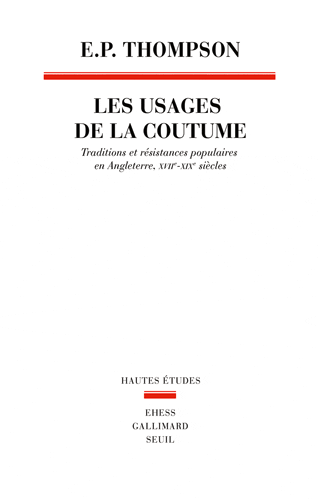
BOOK: Edward P. THOMPSON, The Uses of Custom. Tradition and Popular Resistance in England, 17th-18th Centuries [Hautes Etudes; French translation by Jean BOUTIER and Arundhati VIRMANI]. Paris: EHESS/Gallimard/Seuil, 2015. ISBN 978-2-02-118078-7, € 30.


(image source: EHESS.fr)

Nomôdos announced the translation in French (by Jean Boutier & Arundhati Virmani) of the famous historian Edward P. Thompson's work on custom and popular resistance.

Abstract:
Intellectuel peu conventionnel, E. P. Thompson n’a jamais séparé la rigueur et l’inventivité de ses recherches de son engagement militant pour un socialisme humaniste. Cette anthologie de textes majeurs, pour la première fois traduits en français, analyse à partir du cas anglais les transformations des sociétés européennes.
Les usages de la coutume propose la traduction en français de Customs in Common, ouvrage dans lequel l’historien britannique Edward P. Thompson avait rassemblé en 1991 ses articles majeurs. Tous ont marqué la réflexion historiographique depuis près de cinq décennies. 
À l’aide de notions comme l’histoire vue d’en bas, l’agency, l’économie morale ou la discipline du travail industriel, Thompson, à partir du cas anglais, y analyse les transformations des sociétés européennes entre le XVIIe et le XIXe siècle. Dans une société travaillée par le paternalisme de la noblesse, les tensions sur le marché des subsistances, la privatisation des biens communs ou l’impossibilité du divorce, l’auteur scrute les luttes des hommes et des femmes du peuple pour conserver leur place et leurs droits, batailles dont il n’a cessé de rappeler l’actualité. La défense de la coutume y apparaît alors comme le principal moyen pour s’opposer aux réformes qui ouvrent la voie à la société libérale.

Table of contents:
Présentation
Jean Boutier, Arundhati Virmani
Préface et remerciements
Abréviations
Chapitre premier. Coutume et culture
Chapitre II Les patriciens et la plèbe
Chapitre III. Coutume, droit et droits collectifs
Chapitre IV. L’économie morale de la foule anglaise au xviiie siècle
Chapitre V. L’économie morale revisitée
Chapitre VI. Temps, discipline du travail et capitalisme industriel
Chapitre VII. La vente des épouses
Chapitre VIII. Rough Music
Index
Bibliographie des travaux d’Edward P. Thompson
Crédits

More information on the publisher's website.

19 March 2015

BOOK: Antoine ASTAING & François LORMANT (eds.), Lawyers and Custom, From the Middle Ages to the Civil Code [Histoire du Droit] (Nancy UP, 2015), 272 p., ISBN 9782814301382, € 20


Nomôdos announced the publication of a collective work on "lawyers and custom", collecting papers presented at the University of Nancy (Lorraine) in 2010. The book is part of the Legal History collection of Nancy UP.

Abstract:
La coutume, sorte de droit établi par les mœurs, semble appartenir au juriste. Quel est cependant le rôle exact joué par celui-ci, tant dans l'élaboration des règles coutumières, leur application et leur évolution?
Les 1er et 2 juillet 2010, le Centre Lorrain d’Histoire du Droit (EA 1142) et le Réseau des historiens du Droit du Grand-Est ont organisé à Nancy un colloque international pour aborder ces questions. Les réponses sont diverses d’un pays, d’une province ou parfois d’une seigneurie à l’autre. Les chercheurs qui s’intéressent aux différentes régions de France ou d’ailleurs (Québec, Tunisie, République Démocratique du Congo, ...) ont ainsi pu confronter les résultats de leurs recherches.
Au-delà d’une géographie coutumière, c’est une véritable géographie des forces de pouvoir, inscrites dans la longue durée, qui s’est dégagée. Une géographie, mais peut-être surtout une chronologie de ces forces, locales ou royales.

Table of contents:
  • Antoine Astaing – Avant propos
  • Virginie Lemonnier-Lesage – Préface
  • Jean Gay – La coutume dans le Comté de Bourgogne au Moyen Âge;
  • Luc Gueraud – L'invocation de la Consuetudo Regni et de la Consuetudo Francie dans les actes de la chancellerie capétienne (XIIe-XIIIe siècles);
  • Maïté Lesne-Ferret – Du «parfait juriste» dans des coutumes des pays de droit écrit, au XIIIe siècle ;
  • Isabelle Mathieu – La coutume vue à travers les archives de la pratique judiciaire: le cas des tribunaux seigneuriaux de l'Anjou et du Maine (XIVe-milieu XVIe siècles);
  • Christian Dugas de la Boissonny – Barthélémy de Chasseneuz (1480-1541);
  • Alain Durieux – Comment ont été rédigés et publiées les Coutumes générales du bailliage de Meaux (3-5 octobre 1509);
  • Jean Coudert – Le droit de chasse des bourgeois d'Épinal et sa défense (XVe-XVIe siècles);
  • Florent Roemer – Avocat général et coutumes;
  • Jean Bart – Les commissaires à terrier, rédacteurs de coutumes;
  • David Gilles – Les juristes de la Nouvelle-France face à la Coutume de Paris: histoire d'une adaptation sous influence;
  • François Lormant – Paul Chaline : Méthode générale pour l'intelligence des coutumes de France, Metz, chez Antoine éditeur-imprimeur, 1725.;
  • Oualid Gadhoum – La coutume en droit privé tunisien: déclin ou persistance?
  • Yves Jeanclos – Si la loi était une coutume qui a réussi?
  • Lucien Katchunga Kanefu – Du rôle du juge dans l’évolution ou l’extinction d’une coutume. Le cas de la coutume traditionnelle africaine au Congo-Belge (actuelle République Démocratique du Congo).

More information on the publisher's website.

19 August 2014

CONFERENCE & CFP: “Law, Custom and Ritual in the Medieval Mediterranean" (Lincoln, 13-15 July 2015)


WHAT:   “Law, Custom and Ritual in the Medieval Mediterranean”, fourth biennial conference of the Society for the Medieval Mediterranean

WHERE: University of Lincoln

WHEN: Monday 13th July to Wednesday 15th July 2015

All information here
Deadline: Abstracts for individual papers and proposals for sessions should be emailed to the conference email address (smmconference2015@gmail.com) by the end of the day on Saturday 18th October 2014.


The Society for the Medieval Mediterranean is pleased to announce that the fourth biennial conference of the Society  will take place at the University of Lincoln from Monday 13th July to Wednesday 15th July 2015. The theme of the conference is “Law, Custom and Ritual in the Medieval Mediterranean” and the keynotes will be delivered by Professor Maribel Fierro (CSIC, Madrid: "Obedience to the ruler in the Medieval Islamic West: legal and historical perspectives") and Dr Andrew Marsham (University of Edinburgh: “Rituals of accession in early Islam: a comparative perspective”).

25 July 2014

BOOK: "Law and Custom in Korea", by Marie Seong-hak Kim


This book sets forth the evolution of Korea's law and legal system from the Chosǒn dynasty through the colonial and postcolonial modern periods. This is the first book in English that comprehensively studies Korean legal history in comparison with European legal history, with particular emphasis on customary law. Korea's passage to Romano-German civil law under Japanese rule marked a drastic departure from its indigenous legal tradition. The transplantation of modern civil law in Korea was facilitated by Japanese colonial jurists who themselves created a Korean customary law; this constructed customary law served as an intermediary regime between tradition and the demands of modern law. The transformation of Korean law by the brisk forces of Westernization points to new interpretations of colonial history and it presents an intriguing case for investigating the spread of law on the global level. In-depth discussions of French customary law and Japanese legal history in this book provide a solid conceptual framework suitable for comparing European and East Asian legal traditions.
  • A comprehensive survey of Korean legal history, covering traditional law, colonial law and modern Korean law
  • The first book in English on Korean colonial law and jurisprudence
  • The first book that approaches Korean legal history from a comparative perspective, providing comparisons between East Asian legal history and European legal history
  • courtesy www.cambridge.org