Search

Showing posts with label French Legal Philosophy. Show all posts

24 August 2022

ARTICLE: Michael C. BEHRENT, "A Foucauldian Defense of the State: Blandine Kriegel and the État de Droit" (Modern Intellectual History, First View)


(image source: Cambridge Core)

Abstract:

This paper examines the career and thought of French political philosopher Blandine Kriegel (b. 1943) from the standpoint of the most striking paradox they present: though she was a student of Michel Foucault, who was famous for his critique of central role that political thinking has traditionally accorded the state, Kriegel has, since the mid-1970s, been one of the foremost champions of the concept of état de droit—the state as the embodiment of the “rule of law”—in French political debates. At a time when post-1968 critics of Marxism and totalitarianism (notably the so-called nouveaux philosophes) were arguing that states were inherently despotic, Kriegel mounted an original defense of the state, which, she argued, had played a central role in establishing legal rights that freed individuals from the “slavery” of civil society. She was able to do this, in part, by drawing on several suggestive elements found in Foucault's work: his concept of biopolitics, the claim that individuals and subjectivity are constituted through power relations, and the insight that war and sovereignty represent alternative ways of conceptualizing power. In this way, she used aspects of Foucault's political thought to arrive at a decidedly non-Foucauldian appreciation of the modern state.

Read more here: DOI  10.1017/S1479244321000615.

16 July 2020

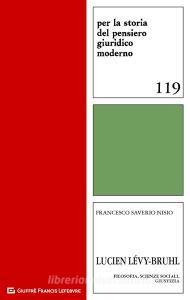
BOOK: Francesco Saverio NISIO, Lucien Levy-Bruhl. Filosofia, scienze sociali, giustizia (Milano: Giuffrè, 2019). ISBN: 8828807822, pp. VIII-796, € 80.00

Lucien Levy-Bruhl. Filosofia, scienze sociali, giustizia
(Source: Giuffrè)

ABOUT THE BOOK

Lucien Lévy-Bruhl (1857-1939), per trent'anni storico della filosofia moderna alla Sorbona e poi infaticabile uomo d'azione nel difendere l'esigenza morale dell'intelligenza dell'altro (all'epoca, il «primitivo») e l'attenzione ad un modo del pensiero, o «mentalità», al contempo concettuale ed affettiva, ha attraversato con perfetta lucidità non pochi ambiti delle scienze umane a cavallo fra Otto e Novecento (antichità classica, storia della filosofia, sociologia, antropologia, politica), imprimendo in ciascuno di essi il segno indelebile di un pensiero singolare ed inconfondibile, e non meno offrendo idee vivissime per l'estensione anche in ambiti ulteriori - tra i quali il giuridico - di prospettive di ricerca filosofica centrate sull'esperienza della «partecipazione». Oltre ad offrire il ritratto intellettuale del percorso molteplice di un filosofo impegnato nell'«aggiungere qualcosa alla conoscenza scientifica della natura umana utilizzando i dati dell'etnologia», in dialogo con Spinoza e Hume; nonché a sottolineare in maniera specifica ed inedita la riflessione sui temi del diritto e della giustizia nell'intera sua opera; il volume ricostruisce, anche, alcuni profili del rapporto che con Lévy-Bruhl hanno intessuto in forma diretta o mediata le culture giuridiche francese ed italiana nella seconda metà del Novecento, attraverso personalità di indubbia centralità ed animate da grande sensibilità antropologico-filosofica come Villey, Carbonnier, Capograssi, Grossi, Costa, Sacco. Corredato da un approfondito apparato bibliografico, il volume include una selezione di documenti di e su Lévy-Bruhl, dei quali alcuni inediti; nonché prime o nuove traduzioni di testi di Gilson, I. Meyerson, M. Blondel, Lévinas, Gurvitch ed altri.

ABOUT THE AUTHOR

Francesco Saverio Nisio è professore associato in filosofia del diritto presso il dipartimento di Giurisprudenza, Università degli Studi di Foggia.

TABLE OF CONTENTS

PDF version available here.


More information with the publisher.

13 July 2020

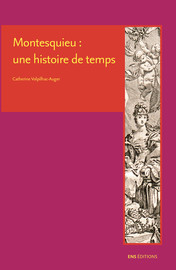
BOOK: Catherine VOLPILHAC-AUGER, Montesquieu: une historie de temps (Lyon: ENS Éditions, 2017). ISBN: 9782847888553, pp. 268, 22.00 €

Montesquieu : une histoire de temps
(Source: ENS Éditions)


ABOUT THE BOOK

Redécouvrir Montesquieu, en son temps et dans le temps long de l’histoire: les œuvres clés du siècle des Lumières, Lettres persanes, L’Esprit des lois, Considérations sur les Romains, prennent tout leur sens si l’on prend en compte à la fois leur dimension littéraire, politique, philosophique, historique, juridique. Des temps forts de l’histoire, comme la découverte des Indes par Alexandre, le voyage africain d’Hannon ou l’invasion de l’Europe par les Huns, la prise de pouvoir par Auguste et le long règne de Justinien, révèlent la puissance de l’esprit humain et la faiblesse des sociétés soumises au pouvoir d’un seul. L’histoire, ancienne ou récente, devient le champ d’action privilégié de la pensée politique, tout en révélant la place infime de l’individu à l’échelle des siècles et des nations. À travers ce monde sans héros, régi par des causes générales et profondes, apparaissent les qualités maîtresses d’un écrivain philosophe : la liberté de l’esprit et l’acuité du regard, révélées par la succession des lectures, parfois contradictoires, qui en ont été données.

ABOUT THE AUTHOR

Catherine Volpilhac-Auger est professeur de littérature française moderne et contemporaine à l'ENS de Lyon, membre du laboratoire IHRIM, présidente de la société Montesquieu. Elle codirige depuis 1998 l'édition des Œuvres complètes de Montesquieu.

TABLE OF CONTENTS

Note préliminaire
Introduction
I. Les Lettres persanes ou le temps de la fiction
1. « J’ai vu »
2. Les Lettres persanes : une histoire de suicide et de twist
3. Pour en finir avec la « chaîne secrète » des Lettres persanes
II. Entre passé et présent : le temps des Romains
4. De Rome aux Romains, le passé au présent
5. D’Octave à Auguste : le début de la fin
6. De Rome à l’Europe : la biche des Palus-Méotides
7. Les Romains, quelques siècles plus tard
III. De l’Antiquité à L’Esprit des lois : le pouvoir et les savoirs
8. Montesquieu et l’impérialisme grec : Alexandre ou l’art de la conquête
9. De l’Antiquité à Pierre le Grand : la mer Caspienne vue de France au XVIIIe siècle
10. De la Collectio juris à L’Esprit des lois : Justinien au tribunal de Montesquieu
11. L’Antiquité, lointaine ou proche ? Montesquieu et le Périple d’Hannon
IV. Au-delà de l’histoire
12. Les deux infinis. Montesquieu historien des catastrophes ?
13. Comment écrire l’histoire ?
14. Montesquieu et l’histoire : une occasion manquée ?
15. Tocqueville et Montesquieu : récrire l’histoire ?


More information with the publisher.

18 March 2020

BOOK: Violaine GIACOMOTTO-CHARRA, La philosophie naturelle en langue française. Des premiers textes à l'oeuvre de Scipion Dupleix [Travaux d'Humanisme et Renaissance, vol. 605] (Genève: Droz, 2020), 600 p. ISBN 9782600019699, 75 EUR

(image source: Wikimedia Commons)

Abstract:
Surtout connu pour ses ouvrages d’histoire, le juriste condomois Scipion Dupleix fut aussi l’un des tout premiers à écrire en français un corpus complet de philosophie scolastique. Dans les années 1600-1610, il publia un ensemble de textes couvrant la logique, la philosophie naturelle, l’éthique et la métaphysique, qui connut en son temps un immense succès sous le nom de Corps ou de Cours de philosophie. Notre ouvrage analyse le travail de vulgarisateur de Dupleix, en se fondant plus particulièrement sur les textes traitant de philosophie naturelle. Il examine le statut et la place de cette discipline dans les milieux lettrés, l’adaptation de la langue française à la philosophie jusque-là exprimée en latin, les raisons qui ont pu pousser un jeune magistrat de province à entreprendre une vaste entreprise de diffusion philosophique et le détail du travail du texte, pour tenter de cerner les raisons d’écrire la philosophie en langue française à la toute fin de la Renaissance.
(source: Droz)

11 December 2019

OPEN ACCESS: Digitization of the Dictionnaire de l'Académie Française (BnF)

(image source: Gallica (BnF))

The BnF announced the full digitization of the Dictionnaire de l'Académie Française (1694).

Read the two volumes here.

24 October 2017

CALL FOR PAPERS: The Philosophy of Customary Law (Nice, 14-16 May 2018); DEADLINE 15 NOV 2017

THE ONTOLOGY OF CUSTOMARY LAW
The very expression of customary law brings us to a first, preliminary acknowledgment: speaking of a customary law compels to single out the genus (law) from the species (the so-called customary law). Customary law appears then like a specific form of law, sharing with it the general features and categories of a legal approach. However calling a law customary is not the same as to speak about contract or penal law.
Customary law is indeed not one of the sub-species of law, and can itself be called genus. It is also worth reminding that the expression “customary law” seems to single out a specific source among the four traditional ones – legislation, doctrine, custom and precedents. It would seem odd, indeed, to speak about a “legislative law”, “doctrinal law” or even “precedents law”. What matters then is to investigate the ambiguity behind the very idea of customary law. Does it point out one more sort of law, or does it designate an autonomous kind of law, with its own features and not reducible to the law?
PRINCIPLES OF CUSTOMARY LAW
Answering these questions requires without any doubts an enquiry about the peculiar dynamics of customary law, grounded on both empiricist and theoretical perspectives. To know whether it is a form among others of law or it is specific enough to be called a genus of law, it is crucial to define its principles. If this law is called customary it is because custom is key to it as a source of law. Understanding the specific features of customary law means therefore striving to understand what role custom plays to shape the very nature of customary law.
It will be necessary to investigate the way the main role assigned to customs determines the very existence of specific institutions and peculiar criteria of the bigger law frame that regulates the individual. As Blackstone’s Commentaries show, any legal system that includes custom as its element must establish spatial, temporal and logical frame of custom proofs. Nevertheless, Anglo-Saxon Common law and its peculiar principles mustn’t overshadow any attempt to grasp the principles and the peculiarities of customary law; and we will be particularly sensitive to the way the customary law settles in pluralist contexts, where different customary laws can be concurrent. In these conditions the interaction between law and custom takes the shape of a normative conflict more than of a coherent customary law.
Exploring the limits and the fictions of customary procedures adopted by the Common Law could be the first step of both a new deployment of the customary law potential and an enquiry about its foundations. Indeed, it would be of extreme interest to study the different forms of customary law in eras where the Common Law model is spreading at different levels and domains, especially in international law, and where customary law is adopted in de-colonized regions where the law system is marked by a strong plurality of contexts.
Peculiar stakes of these contexts force to investigate both the limits and the flexibility of customary law. Do evolutions of scales and domains concern the essence of customary law, if this nature exists? Or are they only variations of a single nature beyond the peculiarities of each embodiment? It will also be necessary – among other issues – to address the specific effectiveness of customary law, and to determine if it lays on the same constraint as the law; and if it is supported by peculiar institutions and applications. The question of the role of the sanction is in this respect essential. Underlying this is the very issue of the self-sufficiency of custom as a social regulation form.
CUSTOMARY LAW WITHOUT CUSTOM?
In the wake of these reflections it is necessary to note that custom is reduced to the status of simple source of the law in every law called customary, and is therefore deprived of every autonomous form of normative power. It is not custom that is not acknowledged as custom according to the processes required and in the name of the institutions and criteria defined by law. In this case, custom is not anything more than one of the many possible sources of law, and concurring with them; it has not a primary juridical existence.
This is the reason why John Austin could so easily disqualify custom self-sufficiency, arguing – with Hobbes and against the historical school – that the very nature of law prevents custom to be effective on its own besides the implicit or explicit, direct or indirect acknowledgement by the sovereign. One of the main ambitions of this conference would be indeed to question Austin’s position. This could in turn allow to address the issue of the substantial or accessory priority of the phrase “customary law”. Beyond this lies the very issue of the autonomy of custom as a social regulation tool.
THE PROBLEM OF CODIFICATION
In order to do that, one could be tempted to consider what disappears of custom and what does not, in customary law, so as to really understand its very nature. This brings us to discuss the specific subject of the codification of custom, the cornerstone of customary law. This codification is never de facto a neutral act, and it will be more relevant to point out from every point of view all the implicit tensions of the codification, which standardize and stabilize power balances or social and economical struggles. One of the axes of the study, already well known in social science but
overlooked by philosophy, would be that of interaction between formal law and custom in de-colonized countries.
Legal codification is one of these moments when powers and knowledge meet with most intensity. The “historical school” of law maintained the necessity of combining law studies with humanities, and we can now include social sciences such as economy, anthropology and sociology. We will therefore investigate which place these disciplines can or should have within the codification and definition of custom; we will also enquiry about their legitimacy, methods and approaches.
WINDOWS ON ARTS
Other domains of knowledge and creation cannot be excluded from the discourse we would like to build. We could especially ask ourselves if literature and other arts are able to produce introspective discourses about the nature of customary law, in the wake e.g. of Ismaël Kadaré Avril Brisé. An artistic perspective could actually open to other stakes of customary law and of societies concerned by it. Among these concerns we can find the issue of the “tradition” – “modernity” dialectics and the role and place of an individual. The way in which customary law of different peoples confronts the evolution of global communities is certainly a shared issue among many artists and authors, be their perspective nostalgic, aesthetic or critical.
EMPIRICAL CONCERNS. CUSTOMARY LAWS, SOCIAL SCIENCES AND THE HUMANITIES
The question arises of which place one should give to specific case studies during this conference. It is clear that they must be crucial while studying customary law as a theoretical object; but no discourse should be limited to a series of descriptions of different customary laws. It will be of particular interest to adopt a comparative approach, analyzing especially how specific branches of customary law – such as the property rights – codify all the issues we have seen, and how different law categories allow to reformulate.
Every example is an opportunity to explore these topics without excluding other issues. Besides, it is neither required to address only contemporary stakes of customary law nor to unfold historical processes. The topicality of customary law is acknowledged, and the history of its evolution is essential to understand the contemporary dynamics it implies. The various questions arising from this conference should reflect the historical deepness of customary law, without overlooking to explore how social sciences and humanities address the customary law from different perspectives.
The following, non-exhaustive list of questions should allow to prefigure various leads:
  • Does “customary law” locution show a specific mode of social regulation between the juridical and the customary?
  • Is custom a source of law? Or could be considered as an object beyond or before it?
  • Does a specific form of customary law exist despite its different expressions? Does a model of customary law exist – such as the international law?
  • Which transformations does custom endure when integrated with the “customary law”?
  • Which philosophical implications does codification of custom produce within customary law?
  • Which are the stakes of the very existence of customary law in pluralist and decolonized contexts?
  • What are the relationships between customary law on one side and moral or juridical standards such as human rights on the other?
  • What is the place of customary law within social change dynamics?
  • What is the place of the relations between law and custom in arts? Does a specifically artistic point of view exist about custom?
  • Does it consist in representing, criticizing or glorifying custom?
  • Which interactions and which concerns exist about humanities, social sciences and law with respect to custom?
  • Which are the links of customary law with localities, territories, their history and their social displaying?
  • How different disciplines of social and human sciences allow to reflect upon these phenomena and their conflict with law’s peculiar formality

DEADLINE/APPLICATION

1st submission deadline: November 15, 2018. Proposals (with a title) will be between 300 and 750 words and anonymous, but the applicant is asked to join a presentation with his or name, with the title of the proposal. CV are accepteds. Send your proposals to both
Marc Goetzmann : mgoetzmann@unice.fr and Edoardo Frezet : edoardo.frezet@gmail.com
There is no registration fee for the conference.
We will provide accommodation (2 nights) and food for the whole conference, with a conference dinner included.
We will not systematically cover the cost of transportation. Depending on the available funds, we will prioritize junior researchers that cannot be supported financially by their institution.
Languages of the conference will be French and English.
Any researcher, junior or senior, may submit a proposal. The interdisciplinary nature of the conference calls for a broad number of subjects. Therefore, only the relevance of the proposal to the conference, and not the field of the potential speaker, will be evaluated. Please note that the organizers want this conference to be as inclusive as possible.
See here the complete call: Customary Law Conference Presentation CFP

Organizing Committee
  • Pierre-Yves Quiviger. Professor of legal philosophy at the Philosophy Department of the University of Nice Sophia Antipolis
  • Marc Goetzmann. PhD student at the University of Nice Sophia Antipolis
  • Edoardo Frezet. PhD student at the University of Nice Sophia Antipolis
 Scientific Committee
  • Philippe Audeagean. Professor of philosophy at the University of Nice Sophia Antipolis
  • Laetitia Guerlain. Associate Professor of Law at the University of Bordeaux
  • Philippe Hameau. Associate Professor of Anthropology at the University of Nice Sophia Antipolis
  • Nader Hakim. Associate Professor of Law at the University of Bordeaux
  • Mélanie Plouviez. Associate Professor of philosophy at the University of Nice Sophia Antipolis
  • Pierre-Yves Quiviger. Associate Professor of philosophy at the University of Nice Sophia Antipolis

26 August 2015

BOOK: "Dictionnaire des philosophes français du XVIIe siècle - Acteurs et réseaux du savoir" Luc Foisneau (ed.) (Paris 2015)


Dictionnaire des philosophes français du XVIIe siècle - Acteurs et réseaux du savoir
 
 Luc Foisneau (ed.) 
all information here
 
Eight thematic introductions, 690 entries, and a historical index raisonné make the Dictionnaire des philosophes français du xviie sièclean indispensable instrument for new explorations into the networks and agents of knowledge between the Renaissance and the Enlightenment.
 
Huit introductions thématiques, six cent quatre-vingt-dix entrées et un index historique et raisonné font du Dictionnaire des philosophes français du xviie siècle l'instrument indispensable d'une exploration nouvelle des réseaux et des acteurs du savoir entre Renaissance et Lumières.