Search

17 November 2016

CFP: "Les exceptions intermédiaires" (Rome, January 30 - February 3 2017)


WHAT Les exceptions intermédiaires, Atelier doctoral

WHEN January 30 - February 3 2017

WHERE Rome, École française de Rome, Piazza Farnese 67

all information here

deadline December 5 2016


L’École française de Rome, en collaboration avec le Centre interuniversitaire d’histoire et d’archéologie médiévales, l’Institut Marcel Mauss-Centre d’études des normes juridiques « Yan Thomas » et l’Università Roma Tre, organise un séminaire doctoral annuel à Rome du 30 janvier au 3 février 2017.

Alors que la concentration théoriquement provisoire de compétences dans un seul organe est devenue marginale dans les États constitutionnels, les régimes dérogatoires autorisant des restrictions de libertés et des transferts partiels de compétences juridictionnelles vers des autorités administratives se multiplient et se banalisent. Et sans doute s’agit-il de phénomènes qui ne concernent pas seulement l’époque contemporaine et les États occidentaux, mais des périodes historiques et des régimes très différents. Alors que l’état d’exception change – au moins momentanément – la nature du régime, les exceptions intermédiaires demeurent intégrées dans un régime donné et l’altèrent en quelque sorte quantitativement. Elles posent un problème de seuil et d’orientation. L’accumulation des petites exceptions peut à la longue faire insensiblement mais durablement basculer la nature d’un régime. Et les exceptions introduites donnent un nouveau profil au régime qu’il est souvent difficile de saisir avec précision.

C’est ce domaine intermédiaire qu’il s’agit d’explorer et dont il convient de faire ressortir les traits distinctifs tant d’un point de vue contemporain et comparatiste que d’un point de vue historique, dans une variété de perspectives, juridique autant que théorique et historique, et sous différents profils empiriques.


CONFERENCE: "Ius Romanum - Leges barbarorum. Alle radici giuridiche dell'Europa" (Naples, November 25 2016)


WHAT Ius Romanum - Leges barbarorum. Alle radici giuridiche dell'Europa

WHEN November 25 2016, 11:00

WHERE University of Naples, Cortile delle Statue, Via Mezzocannone, 8/Via Paladino, 39

15 November 2016

CONFERENCE: Belgian-Dutch Legal History Colloquium 2016 (Maastricht University, 16-17 Dec 2016)

(image source: Maastricht University)

The biennal Belgian-Dutch Legal History Colloquium will take place in Maastricht (Netherlands), after its latest edition in Brussels in 2014 (see earlier on this blog).

The organisers circulated the following scientific programme (in Dutch):
--- 21ste Nederlands-Belgisch Rechtshistorisch Colloquium ---
-- Maastricht 16 & 17 december 2016 --
- Programma -
Vrijdag 16 december 2016
Groote Sociëteit, Vrijthof 36
09.00-09.30 Ontvangst
09.30-10.00 L’Amuse-Bouche
Niels Graaf (KNIR) 
Het Romeinse recht is dood, lang leve de rechtsgeschiedenis? Over de functieverandering van de rechtshistorische discipline, 1809-2000 
Discussie
10.00-11.00 Herschrijven van de Geschiedenis 
Johan Van de Voorde (Universiteit Antwerpen) 
Zijn de Belgen Napoleons trouwste onderdanen? Een onderzoek naar de mogelijke opheffing en vervanging van de Code Napoléon in België als (voormalig) deel van het Verenigd Koninkrijk der Nederlanden
Dirk Heirbaut (UGent) 
Henri De Page, Belgiës grootste jurist? 
Discussie
11.00-11.30 Pauze 
11.30-13.00 De Gehuwde Vrouw 
Kaat Cappelle (Vrije Universiteit Brussel)Huwelijkscontracten en testamenten in het zestiende-eeuwse Antwerpen: de onderhandelingspositie van de getrouwde vrouw 
Benoît Lagasse (Universiteit Luik/UGent)Is de Luikse "mainplévie" van toepassing in Maastricht? Analyse van de observatio 356 van Charles de Méan 
Ana Delić (Tilburg University)The Conflict of Laws Revolution for Married Women 
Discussie 
13.00-14.30 Lunch 
14.30-16.30 Het Contract: een Maakbaar Product van zijn Tijd
Paolo Astorri (KU Leuven) 
The impact of the Lutheran Reformation on the law of contracts 
Wouter Druwé (FWO/KU Leuven) 
Afkoopbaarheid van renten in Nederlandse consilia en decisiones (ca. 1500-1650) 
Discussie 
Sebastiaan Vandenbogaerde (UGent) 
De impact van de Eerste Wereldoorlog op het Belgische privaatrecht 
Sebastian Krafzik (KU Leuven) 
The Influence of Economic and Political Discourses on Banking Regulation in the Course of the 20th Century: A Study of Great Britain and Germany
Discussie 
16.30-17.00 Pauze 
17.00-18.00 Ontstaan van Recht 
Caroline Laske (UGent) 
Consideration – the origins of the term and concept: Legal History meets Lexical Semantics 
Agustin Parise (Maastricht University) 
Dutch, French, or Spanish Building Block? The Inclusion of the Burgerlijk Wetboek (1838) in the Spanish Concordancias (1843) of Saint-Joseph 
Discussie 
18.00-22.00 Receptie & Diner (Au Quartier Petit Bonheur, Kapoenstraat 32)
 
Zaterdag 17 december 2016 
Faculteit Rechtsgeleerdheid, Bouillonstraat 1-3, Feestzaal 
09.00-11.00 Aan de Grenzen van het Internationaal Recht 
Dante Fedele (KU Leuven) 
Between private law and public law: the contribution of the ius commune to the conceptualisation of diplomatic representation 
Inge Van Hulle (Tilburg University) 
Anglo-African Legal Connections and the Early Nineteenth-Century Roots of Britain’s Imperial International Law in West Africa (1815-1884)  
Discussie 
Viktorija Jakjimovska (KU Leuven) 
Law and decision-making in Great Britain related to foreign civil wars 
Amélie Verfaillie (UGent) 
Civil Society’s Fight against Torture – Amnesty International as Éminence Rouge?  
Discussie 
11.00-11.30 Pauze 
11.30-13.00 Beschermd Belang 
Harry Runia (RUG) 
Enkele grepen uit de geschiedenis van bescherming van bezit 
Vincent van Hoof (RU Nijmegen) 
Het zaaksgevolg van de generale hypotheek in het Romeinse recht revisited 
Jelle Jansen (RUG) 
De vestiging van een zekerheidsrecht voor een natuurlijke verbintenis 
Discussie 
13.00-14.30 Lunch 
14.30-16.30 Rechtspraak als Spiegel van de Maatschappij (1) 
Cato van Paddenburgh (KU Leuven) 
De professionalisering van het rechtersambt en de ontwikkeling van een deontologie voor rechters in de Nederlanden van de 16de en 17de eeuw. 
Marc Ronvaux (Université Catholique de Louvain) 
De gerechtelijke activiteit van de Grote Raad te Mechelen in de 18de eeuw: het voorbeeld van de beroepen uit Namen 
Discussie 
JM Milo & EGD van Dongen (Utrecht University) 
Echte Mannen, Woorden en Daden: Eer en Verbintenis voor het Hof van Utrecht in de 18de Eeuw 
Ronnie Bloemberg (RUG) 
De ontwikkeling van het strafrechtelijk bewijs in Nederland tussen 1750 en 1870 
Discussie 
16.30-17.00 Pauze 
17.00-18.00 Rechtspraak als Spiegel van de Maatschappij (2) 
Katrin Vanheule (KU Leuven) 
La Libre Belgique vraagt gerechtigheid – de repressie van contraspionage voor de Duitse bezetter na de Eerste Wereldoorlog 
Mariken Lenaerts (Maastricht University) 
De herinterpretatie van het begrip ‘Rechtsfähigkeit’ onder het nationaalsocialisme 
Discussie 
18.00-20.00 Receptie (Faculteit Rechtsgeleerdheid, Bouillonstraat 1-3, Lenculenhal)
The conference website offers the opportunity to register, as well as practical details.

07 November 2016

CALL FOR ABSTRACTS: Society for Legal and Institutional History of Flanders, Picardy and Wallonia, International Days (Maastricht, 26-27 May 2017); DEADLINE 25 MAR 2017

(image source: Maastricht.nl)

The Société d'histoire du droit et des institutions des pays flamands, picards et wallons holds its annual international days in Maastricht, from 26 to 27 May 2017. The deadline for proposals is 15 March 2017. The Society accepts papers in Dutch, French and English, irrespective of their link with the conference theme.

International Days of the Society for Legal and Institutional History of Flanders, Picardy and Wallonia Maastricht 26-27 May 2017 

The Society for Legal and Institutional History of Flanders, Picardy and Wallonia holds its annual "International days" at the ‘Regionaal Historisch Centrum Limburg, The event is co-organized by Dr. Jacques van Rensch of the Regionaal Historisch Centrum Limburg in Maastricht. 
The theme of the conference is :  ‘The rule of law and revolutions’
The theme incorporates the rule of law and revolutions in a broad sense (revolutions, revolts, resistance) in different periods and also the influence on the rule of law, since Antiquity till today.Presentations can be held in French, English  and Dutch. Speakers have to sent a summary to the organisation (in French and/or English). 
Participants are welcome on Friday 26 mai 2017 and Saturday 27 May, at 10.00 a.m. at the Archives « Regionaal historisch centrum Limburg » in Maastricht, Sint Pieterstraat 7 (next to the church). Lunches and diner are served in  restaurant « Petit Bonheur », Achter de Molens 2, 6211 JA Maastricht, (Tél.: 043 321 5109). 
The programme will be sent to the participants before  25 April 2017. Participants have to registrate  by email to: vonbone21@gmail.com and to j.m.milo@uu.nl or by mail Emese von Bóné, Erasmus Universiteit Rotterdam, ESL, Capgroep Privaatrecht, Postbus 1738, 3062 PA Rotterdam (Pays-Bas).Propositions can be sent before 25 March 2017 by email to vonbone21@gmail.com and to j.m.milo@uu.nl, or by mail to  Emese von Bóné, Erasmus Universiteit Rotterdam, ESL, Vakgroep Privaatrecht, Postbus 1738, 3062 PA Rotterdam (Pays-Bas).The fee for inscriptions are 25 € (for documentation and coffee/tea). Lunches on Friday and Saturday are 20 € each. Diner on Friday night is 60 € per person. 
The  total some can be paid on the account of  the Société d'histoire du droit et des institutions des pays flamands picards et wallons:
IBAN NLI5INGB0002108724 BIC INGBNL2A (au nom de: Soc D-Hist Du Droit Et Des Inst Flam Pic Et Wall). It is possible to pay cash at the conference  (cheques are not accepted)Participants will have to make their own hotel reservations. A plan of the city and a list of hotels will be sent by email to the participants as soon as the conference fee is paid.We all hope to welcome you in Maastricht in May. 

Announcement in French:

Les journées internationales d'histoire du droit et des institutions auront lieu cette année à Maastricht, les 26 et 27 mai 2017, à l'invitation du Dr Jacques van Rensch, Archiviste des Archives du « Regionaal historisch centrum Limburg ».Le thème qui a été retenu par le bureau de la Société, est le suivant :
« Règle de droit et révoltes  »Ce thème principal comprend les règles de droit et les révolutions au sens large, donc les révolutions, révoltes, résistances de toutes les époques, ainsi que leur l’influence sur la règle de droit, depuis l’Antiquité jusqu’à nos jours.Les interventions peuvent être faites en français, en anglais ou en néerlandais. Les orateurs sont priés d’envoyer un résumé à l’avance aux organisateurs (en français et/ou anglais).
Les participants seront accueillis le vendredi 26 mai 2017, à 10h00, aux Archives du « Regionaal historisch centrum Limburg » à Maastricht, Sint Pieterstraat 7 (à côté de l’église).
Les séances de travail se dérouleront aux Archives du « Regionaal historisch centrum Limburg » le vendredi 26 mai 2017, à partir de 10h00, et le samedi 7 mai, dès 10h00. Les déjeuners seront pris au restaurant « Petit Bonheur », Achter de Molens 2, 6211 JA Maastricht, (Tél.: 043 321 5109).L’assemblée générale de la Société se tiendra le vendredi 27 mai 2017, après les séances de travail.Notre traditionnel banquet se déroulera le vendredi soir, également au restaurant « Petit Bonheur »,  Achter de Molens 2, 6211 JA Maastricht, (Tél.: 043 321 5109). Le programme détaillé des journées sera communiqué ultérieurement aux participants, qui sont priés de renvoyer le formulaire d’inscription ci-joint avant le 25 avril 2017 par courriel à vonbone21@gmail.com et à j.m.milo@uu.nl ou par courrier à Emese von Bóné, Erasmus Universiteit Rotterdam, ESL, Capgroep Privaatrecht, Postbus 1738, 3062 PA Rotterdam (Pays-Bas).Afin de nous permettre de dresser le programme définitif du colloque, nous prions les personnes désireuses de communiquer, de faire parvenir leur proposition de communication avant le 25 mars 2017 par courriel à vonbone21@gmail.com et à j.m.milo@uu.nl, ou par courrier à Emese von Bóné, Erasmus Universiteit Rotterdam, ESL, Capgroep Privaatrecht, Postbus 1738, 3062 PA Rotterdam (Pays-Bas).Les frais d'inscription aux journées s'élèvent à 25 € et comprennent la documentation et les pauses-café. Les déjeuners des vendredi et samedi sont à réserver au préalable pour la somme de 20 € chacun. Les frais de participation au banquet du vendredi soir sont de 60 € par personne. Ces sommes sont à verser au moment de l’inscription par virement bancaire européen sur le compte de la Société d'histoire du droit et des institutions des pays flamands picards et wallons:
IBAN NLI5INGB0002108724 BIC INGBNL2A (au nom de: Soc D-Hist Du Droit Et Des Inst Flam Pic Et Wall).En cas de problème à effectuer le paiement par virement préalable, il est possible de payer sur place le premier jour du colloque. Notez que les chèques ne sont plus acceptés aux Pays-Bas.
Une liste d’hôtels à Maastricht et un plan de la ville seront envoyés par mail à chaque participant dès son inscription. Nous vous invitons à procéder vous-même à votre réservation dès que possible. 
Le bureau de la Société, 

Le Président,                                                   Le Secrétaire Général,
Philippe ANNAERT                                       Christian PFISTER   
Les Vice-Présidents,                                    Les Secrétaires, 
          Emese VON BÓNÉ                                        Michael MILO
Tanguy LE MARC’HADOUR                       Stanislas HORVAT
Registration via this form:
Société d'histoire du droit et des institutions
des pays flamands, picards et wallons
(fondée à Lille en 1929)
Journées internationales d'histoire du droit et des institutions
MAASTRICHT, 26-27 mai 2017
FORMULAIRE D'INSCRIPTION/REGISTRATION FORM
Madame, Monsieur/Mr, Mrs :
Adresse/Address :
Téléphone/Phone:
Adresse e-mail/E-mail address :
Participera aux journées/Will participate OUI/YES NON/NO 25 €
Sera accompagné(e)/Accompanying persons OUI/YES NON/NO
Nombre de personnes accompagnantes/Number of accompanying persons ……..
Participera au déjeuner/Will take lunch
Du vendredi/Friday OUI/YES NON/NO 20 €
Personnes accompagnantes/Accompanying persons …… x 20 € …. €
Du samedi/Saturday OUI/YES NON/NO 20 €
Personnes accompagnantes/Accompanying persons …… x 20 € …. €
Participera au banquet du vendredi soir OUI/YES NON/NO 60 €
/Will have dinner on Saturday evening
Personnes accompagnantes/Accompanying persons …… x 60 € …. €
Total à payer/total amount to be paid :      ………… €

Formulaire à retourner avant le 25 avril 2017/Please send this document before April 25th 2017  
par e-mail à/by e-mail: vonbone21@gmail.com et/and j.m.milo@uu.nl
par courrier/by mail: Emese von Bóné, Lindesingel 66, 3053 JK Rotterdam, Pays-Bas/Nederland


03 November 2016

BOOK SERIES: Methodica. Einführungen in die rechtshistorische Forschung, Max Planck Institute for European Legal History

The Max Planck Institute for European Legal History published the series Methodica. Einführungen in die rechtshistorische Forschung. 

Recently, two volumes were added to the collection:

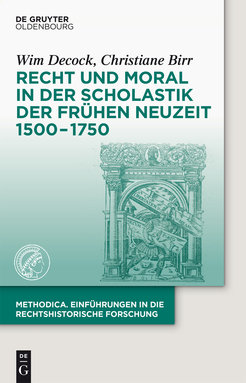
1. Recht und Moral in der Scholastik der Frühen Neuzeit 1500-1750 (Wim Decock & Christiane Birr) (ISBN 978-3-11-037967-9, € 19,65)

(image source: MPI Frankfurt
Die Untersuchungen zur frühneuzeitlichen Scholastik erleben gerade eine Hochkonjunktur. Juristen, Philosophen, Theologen und Wirtschaftswissenschaftler nähern sich je nach eigener Perspektive den Texten der "Spanischen Spätscholastiker" oder "katholischen Naturrechtler" an. Neuanfänger wie auch Experten erhalten in diesem Band neben Hilfsmitteln zur eigenständigen Quellenforschung auch einen fächerübergreifenden Einblick in den Forschungsstand.

Table of contents:
Vorwort der Herausgeber | V

Vorwort | VII
Teil 1: Einführung
1 „Scholastik“ | 3
1.1 Im Dienst der Gesellschaft | 3
1.2 Verdunklung | 4
1.3 Universitätslehrer | 5
1.4 Thomas – Scotus – Rimini | 6
1.5 Denken am Text | 7
1.6 Fragestellung, Dialog, Erkenntnis | 7
1.7 Argumentationsvorgang | 8
1.8 Dialektiker, Aristoteliker, Scholastiker | 9
1.9 Scholastik als Methode | 10
2 „Frühe Neuzeit“ | 11
2.1 Neuland | 11
2.2 Epochenabgrenzung | 11
2.3 Benennungen | 12
2.4 Selbstverständnis | 13
2.5 Protestantische Scholastik | 14
2.6 Eklektizismus | 16
2.7 Scholastischer Humanismus | 16
2.8 Jesuitenpädagogik | 17
2.9 Jesuitenscholastik | 18
2.10 Dominikaner | 19
2.11 Franziskaner | 20
2.12 Religiöse Ordensvielfalt | 21
2.13 Neuscholastik | 21
3 „Recht und Moral“ | 23
3.1 Eine fremde Welt | 23
3.2 Juristen vs Theologen | 23
3.3 Gesetze und Seelenheil | 24
3.4 Gewissensforum | 25
3.5 Kasuistik | 26
3.6 Gelehrte Meinungsvielfalt | 27
3.7 Protestantismus | 29
Teil 2: Quellen, Editionen, Hilfsmittel
4 Quellen | 33
4.1 Auswahl und Begrenzung | 33
4.2 Katholische Autoren | 35
4.2.1 Augustiner-Chorherren | 35
4.2.2 Augustiner-Eremiten | 35
4.2.3 Barnabiten | 36
4.2.4 Benediktiner | 36
4.2.5 Dominikaner | 37
4.2.6 Franziskaner-Kapuziner | 39
4.2.7 Franziskaner-Konventualen | 39
4.2.8 Franziskaner-Observanten | 40
4.2.9 Franziskaner-Reformaten | 41
4.2.10 Franziskaner-Rekollekten | 42
4.2.11 Jesuiten | 43
4.2.12 Karmeliten | 48
4.2.13 Kartäuser | 49
4.2.14 Oratorianer | 49
4.2.15 Prämonstratenser | 50
4.2.16 Redemptoristen | 50
4.2.17 Theatiner-Regularkleriker | 50
4.2.18 Zisterzienser | 50
4.2.19 Nicht-ordensgebundene Autoren | 51
4.3 Protestantische Autoren | 53
4.3.1 Anglikanisch | 53
4.3.2 Evangelisch-lutherisch | 53
4.3.3 Reformiert | 55
4.3.4 Englisch-Puritanisch | 56
5 Editionen und Übersetzungen | 57
5.1 Eine kritische Lücke | 57
5.2 Die großen Namen | 58
5.3 Digitale Sammlungen | 59
6 Praktische Hilfsmittel | 61
6.1 Biographien, Wörterbücher, Lexika | 61
6.2 Lösung von Abkürzungen | 62
6.3 Zitierte Texte: Editionen und Digitalisaten | 65
7 Fallstricke bei der Textauslegung | 67
7.1 Dialog statt Monolog | 67
7.2 Gegenmeinungen, Einwände, Bemerkungen | 67
7.3 Anzeichen für innovatives Denken | 68
Teil 3: Probleme und Perspektiven der Forschung
8 Einführung | 73
9 Wirtschaftliche Perspektive | 74
9.1 Von Salamanca bis Smith | 74
9.2 Geld, Zins und Marktpreis | 74
9.3 Forschungsdesiderate | 75
10 Juristische Perspektive | 77
10.1 Internationales Recht | 77
10.1.1 Ursprünge des Völkerrechts | 77
10.1.2 Grotius und die Scholastiker | 77
10.1.3 Kanonisierungsprozesse | 78
10.1.4 Vitoria und Suárez | 78
10.1.5 Amerindianer und Menschenrechte | 79
10.1.6 Kritische Bewertung | 79
10.2 Privat und Handelsrecht | 80
10.2.1 Zwischen Ius Commune und Naturrecht | 80
10.2.2 Restitutionslehre und Vertragsrecht | 80
10.2.3 Handel und Wirtschaft | 81
10.2.4 Forschungsdesiderate | 82
10.3 Straf und öffentliches Recht | 82
10.3.1 Neuentdeckung | 82
10.3.2 Schuldprinzip und öffentliches Strafen | 83
10.3.3 Sünde und Verbrechen | 83
10.3.4 Alfonso de Castro | 84
10.3.5 Liberale Staatsrechtsphilosophie | 84
10.3.6 Heterogenität des politischen Denkens | 85
10.3.7 Staatliche und kirchliche Gewalt | 86
11 Philosophische Perspektive | 88
11.1 Naturrecht | 88
11.2 Subjektive Rechte | 88
11.3 Säkularisierung | 89
11.4 Ausstrahlung | 89
11.5 Mittelalterliche Verwurzelung | 90
11.6 Probabilismus | 90
11.7 Metaphysik | 91
12 Theologische Perspektive | 92
12.1 Innenansicht | 92
12.2 Moraltheologie | 92
12.3 Missionstheologie | 93
12.4 Salamanca als Erneuerungsbewegung | 93
12.5 Gewissen und Beichte | 94
12.6 Forschungsdesiderate | 95
13 Zukunftsperspektive | 97
Teil 4: Bibliographie und Verzeichnisse
14 Bibliographie | 101
15 Sachregister | 128
16 Personenregister | 133
2. Privat-staatliche Regelungsstrukturen im frühen Industrie und Sozialstaat (Peter Collin) (ISBN 978-3-11-037969-3, € 24,95)

(image source: MPI Frankfurt)

Table of contents:
Vorwort der Herausgeber | VVorwort des Verfassers | VIIAbkürzungen und Kurzbezeichnungen | XITeil 1: Einführung
1 Überblick zur Forschungsgeschichte | 31.1 Bemerkungen zum Forschungsgegenstand | 3
1.2 Ältere Forschungstraditionen | 4
1.3 Neuere konzeptionelle Ansätze | 5
2 Überblick zur Rechtsentwicklung | 82.1 Unmittelbare Vorgeschichte und Ausgangslage (Ende des 18. Jahrhunderts bis zur Reformzeit) | 10
2.1.1 Stimmungslagen | 10
2.1.2 Praxis und Entwicklung von rechtlichen Arrangements | 11
2.1.3 Rechtswissenschaftliche Reflexionen | 15
2.2 Lange Inkubationsphase (Vormärz bis zu den 1870er Jahren) | 16
2.2.1 Stimmungslagen | 16
2.2.2 Praxis und Entwicklung von rechtlichen Arrangements | 20
2.2.3 Rechtswissenschaftliche Reflexionen | 31
2.3 Herausbildung des Interventionsstaates (Mitte der 1870er Jahre bis 1914) | 38
2.3.1 Stimmungslagen | 38
2.3.2 Praxis und Entwicklung rechtlicher Arrangements | 42
2.3.3 Rechtswissenschaftliche Reflexionen | 58
2.4 Kriegszeit (1914–1918) | 66
2.4.1 Stimmungslagen | 66
2.4.2 Praxis und Entwicklung rechtlicher Arrangements | 67
2.4.3 Rechtswissenschaftliche Reflexionen | 76
2.5 Nachkriegsaufbruch und Krise | 80
2.5.1 Stimmungslagen | 80
2.5.2 Praxis und Entwicklung rechtlicher Arrangements | 83
2.5.3 Rechtswissenschaftliche Reflexionen | 93
2.6 Systematisierende Schlussüberlegungen | 100
2.6.1 Zeitabschnitte und Zäsuren | 100
2.6.2 Aktionsfelder | 102
2.6.3 Organisatorische Spielarten | 103
2.6.4 Rechtliche Durchdringung | 105
Teil 2: Quellen, Editionen, Hilfsmittel
3 Quellen und Quelleneditionen | 1093.1 Allgemeines | 109
3.1.1 Beobachtungsperspektiven und Quellenauswahl | 109
3.1.2 Rechtswissenschaftliche Quellen | 110
3.2 Rechtsnormative Quellen | 113
3.2.1 Allgemeines | 113
3.2.2 Sektorübergreifende Quellenbestände | 114
3.2.3 Bereichsspezifische Quellenbestände | 120
4 Hilfsmittel | 1254.1 Bibliographien | 125
4.1.1 Allgemeine Bibliographien | 125
4.1.2 Bibliographien für spezielle Sachbereiche | 127
4.2 Andere Hilfsmittel | 127
4.2.1 Moderne Synthesen und Handbücher | 127
4.2.2 Zeitgenössische Handbücher und Wörterbücher | 129
Teil 3: Probleme und Perspektiven der Forschung
5 Themenfelder gegenwärtiger Forschung | 1335.1 Übergreifende Forschungsfelder | 133
5.2 Einzelne Rechtsgebiete | 136
6 Forschungsperspektiven | 1456.1 Offene Forschungsfelder | 145
6.2 Theoretisch-analytische Ansätze | 146
7 Internationaler Vergleich und Wechselwirkungen | 1537.1 Untersuchungszwecke und Untersuchungsrichtungen | 153
7.2 Untersuchungsfelder | 156
7.2.1 Thematische und disziplinäre Einordnungen | 156
7.2.2 Ausgewählte Untersuchungsfelder | 159
Teil 4: Bibliographie und Verzeichnisse
Bibliographie | 165Sachregister | 206

01 November 2016

WORKSHOP: Girls Trade and International Law. Processes of Juridification from the 19th Century Onwards (Leipzig, 4-5 Nov 2016)

(image source: uni-leipzig)

Kathleen Zeidler (University of Leipzig) and Sonja Dolinsek (University of Erfurt) co-organise a workshop on Girls Trade and International Law. Processes of Juridification from the 19th Century onwards. The event takes place from 4 till 5 November 2016.

Summary:
Das Phänomen „Mädchenhandel“ hat Konjunktur. Es wurde am Ende des 19. Jahrhunderts zum Gegenstand transnationaler Verhandlungen, internationaler Regelungen und überstaatlicher Vereinbarungen und stellt bis heute ein wichtiges Feld für grenzüberschreitende Rechtsan- gleichung und Vereinheitlichung rechtlicher Normen dar. Im Workshop wollen wir uns den internationalen Verrechtlichungsprozessen vom 19.  Jahrhundert bis zur Gegenwart aus unterschiedlichen Perspektiven annähern. Ausgehend von der Entdeckung des Mädchenhandels als internationales Phänomen diskutieren wir die Praktiken der Ermittlung, Politik und Recht im staatlichen Kontext bis hin zu den aktuellen Debatten und Problemen.
Programme:
 Freitag, 4. November
14:00-14:00
Begrüßung und Einführung Sonja Dolinsek (Universität Erfurt) und Kathleen Zeidler (GWZO)
14:00–15:30
Keynote: Die Stellung der Frauen im Völkerbund: Internationale Normierungs- und Standardisierungsprozesse in der Zwischenkriegszeit
Regula Ludi (Universität Bern)
Moderation: Dietlind Hüchtker (GWZO)
16:00–17:30
Panel I: Entdeckung – Mädchenhandel als internationales Phänomen
Moderation: Dietmar Müller (GWZO)
Historisierung der transnationalen Diskurse zu Mädchenhandel
Ruth Ennis (Universität Leipzig)
Der Völkerbund und die völkerrechtliche Regelung zur freien Bewegung von Frauen und Mädchen sowie der Versuch eines internationalen Verbotes des Prostitutionsgewerbes
Thomas S. Carhart (Universität Freiburg)
18:00–20:00
Filmsichtung mit Diskussion
Bibliothèque Pascal
Regie: Szabolcs Hajdu, Ungarn 2010 Ungarisch/Rumänisch mit deutschen Untertiteln Einführung: Kathleen Zeidler (GWZO) Moderation: Sonja Dolinsek (Universität Erfurt)

Samstag, 5. November 2016
9:30–11:00
Panel II: Ermittlung – Suche nach dem Mädchenhandel
Moderation: Katarina Ristić (Universität der Bundeswehr Hamburg)

Marcus Braun – Ein US-special immigrant inspector auf den Spuren des Mädchenhandels in Europa (1908–1909)
Jakob Lanman Niese (Leipzig/Magdeburg)
„... unser Volk rekrutiert selten Ware für die Prostitution“: Mädchenschutz im Königreich SHS/ Jugoslawien der Zwischenkriegszeit
Svetlana Stefanović (Belgrad)
11:30–13:00
Panel III: Verrechtlichung – Mädchenhandel im staatlichen Kontext
Moderation: Kathleen Zeidler (GWZO)

Gouvernementalisierung und/oder Verrechtlichung? Überlegungen am Beispiel des Kampfes gegen Prostitution und Mädchenhandel in Luxemburg um 1900
Heike Mauer (Universität Duisburg-Essen)
Frauenhandel im 19. Jahrhundert in Deutschland und im deutschsprachigen Österreich
Jürgen Nautz (Hochschule Ostwestfalen-Lippe / Universität Wien)
14:00–16:00
Panel IV: Fortsetzung – „Mädchenhandel“ zwischen internationalem Recht und internationaler Kritik
Moderation: Claudia Kraft (Universität Siegen)
Nach der „Abolition“: Wie der Frauen- und Mädchenhandel in Vergessenheit geriet (1949–1975)
Sonja Dolinsek (Universität Erfurt)
Investigating Human Trafficking: Troubles and Development of Law Enforcement in Hungary
Tamas Bezsenyi / Noémi Katona (Budapest)
Mädchenhandel, Menschenhandel, moderne Sklaverei: Liegt der Teufel im Begriff?
Janne Mende (Universität Kassel)
16:00–17:30
Resümee und Diskussion
Dietlind Hüchtker (GWZO) und Claudia Kraft (Universität Siegen)

More information on HSozKult.

25 October 2016

JOB: Postdoctoral researcher in Legal History (Tilburg, January 2017- July 2019)


WHAT Postdoctoral researcher in Legal History

WHEN January 2017-July 2019

WHERE Tilburg University, Department of Public Law, Jurisprudence and Legal History 

The position

The Department of Public Law, Jurisprudence and Legal History is seeking for a full-time postdoctoral researcher (30 months) who will be one of the main researchers in the project ‘Analyzing Coherence in Law Through Legal Scholarship’ (CLLS), funded by the European Research Council (ERC, ERC Starting Grant 2016). The project will start in January 2017 and will be finalized in 2021.

The project focuses on analyzing legal scholarship of the early modern period (c1500 – c 1800), concerning the theme of collateral rights (securities) and bankruptcy. The postdoctoral researcher will cooperate with the leader of the project, Dr. Dave De ruysscher, in establishing a methodology for tracing and assessing coherence in writings of legal authors.  

The research context
. 
The project is carried out within the Department of Public Law, Jurisprudence and Legal History. The Department combines research on public law, legal methodology, jurisprudence and legal history. Legal-historical research within the Department concerns a. o.  the history of international law and global law history.  For these themes the Department hosts several researchers and enjoys high reputation.

Job description
The successful candidate is expected to contribute to the CLLS-project’s research, its publications as well as its activities.

Profile
Candidates have recently completed a Ph.D. in law, preferably on a legal-historical topic. Candidates should be acquainted with, or be able to, demonstrate their interest in history and research methods (qualitative and⁄or quantitative). Acquaintance with historical research is a plus. Candidates are expected to combine good research skills with excellent networking and communicative skills, to have an entrepreneurial mindset, and to be creative regarding theoretical as well as methodological approaches. Candidates are expected to have demonstrable experience with both individual and teamwork research. Candidates have an excellent command of English, both written and spoken. They have reading proficiency in either French or German. A good command of Dutch, or willingness to learn Dutch, is an asset.

21 October 2016

BOOK REVIEW: Josef PAUSER on Sigrid JAHNS, Das Reichskammergericht und seine Richter. Verfassung und Sozialstruktur eines höchsten Gerichts im Alten Reich. 1: Darstellung [Quellen und Forschungen zur höchsten Gerichtsbarkeit im Alten Reich, eds. Anja AMEND-TRAUT, Friedrich BATTENBERG, Albrecht CORDES, Ignacio CZEGHUN, Peter OESTMANN & Wolfgang SELLERT]. Wien/Köln: Böhlau Verlag, 2011, XXII + 783 p.

(image source: Böhlau Verlag)


The Journal Mitteilungen des Instituts für Österreichische Geschichtsforschung published reviews in the second issue of its 125th volume. Josef Pauser (Vienna) reviewed a book of interest to legal historians of the Holy Roman Empire, Sigrid Jahns (LMU München), Das Reichskammergericht und seine Richter. Verfassung und Sozialstruktur eines höchsten Gerichts im Alten Reich (ISBN 978-3-412-06403-7, € 59,9).

Book description (publisher):
Gegenstand dieses Werkes ist der Spruchkörper des einen der beiden höchsten Gerichte im Alten Reich, des „kaiserlichen und des Heiligen Römischen Reichs“ Kammergerichts. Nachdem bereits 2003 Teil II mit den Einzelbiographien der im 18. Jahrhundert am RKG als Richter tätigen Assessoren erschien, wird nun der darstellende Teil I vorgelegt. Nach einer einleitenden Verortung des Gerichts im Verfassungsgefüge des Reiches, einer Bestimmung seiner rechtswissenschaftlichen Bedeutung und rechtsprechenden Funktion im Wandel dreier Jahrhunderte sowie einem Überblick über Stellung und Aufgaben von Direktorialpersonen und Assessoren geht es in dieser verfassungs- und sozialgeschichtlichen Studie zunächst um die Entwicklung des Vorschlagsverfahrens zur Besetzung der Assessorate. Dieses sogenannte Präsentationssystem war seit seinen Anfängen um 1500 bis zum Ende des Alten Reiches 1806 ein Spiegel der Reichsverfassung mit ihren Kräftefeldern und Problemzonen. Mit seiner reichsweiten Streuung der Vorschlagsrechte prägte das Präsentationssystem auch die Sozialstruktur der Assessorengruppe. Die Großabschnitte, die sich auf dem Hintergrund der seit 1495/1555 geltenden normativen Bestimmungen dem sozialen und professionellen Profil des Kameralkollegiums widmen, konzentrieren sich vor allem auf geographische Rekrutierung, theoretisch-praktische Ausbildung, soziale Herkunft und soziale Mobilität. Der Schwerpunkt liegt dabei auf der Wetzlarer Zeit des Gerichts. Die
Darstellung zeigt das RKG und vor allem die Personalverfassung seines Richtergremiums im Spannungsfeld zwischen anfänglicher Modernität und späterer Reformbedürftigkeit und erkennt darin Verwerfungen in der ständischen Gesellschaft sowie Probleme der gesamten Reichsverfassung in der
Spätzeit des Alten Reiches.

Fulltext of the review on recensio.net.

See publisher website.

SEMINAR: Legal History at Queen Mary (University of London)


(image source: blogger)
 
The Legal History Blog announced the following series of events:

10 November 2016
A new book symposium organized by the CLSGC for Peter Cane's book Controlling Administrative Power: A Comparative History (CUP). 4:00 - 7:00pm.  Room 313, School of Law, Queen Mary University of London, Mile End Road, London.  Chair: Professor Sionaidh Douglas-Scott (Queen Mary).  Speakers: Professor Peter Cane (ANU), Professor Peter Lindseth (UConn), Professor Alison Young (Oxford), Professor Liz Fisher (Oxford). Professor Paul Craig (Oxford)

21 November 2016
A special seminar with Professor Robert W. Gordon discussing "The Return of the Corporate Lawyer-Statesman?"  Co-hosted by CLSGC, the London School of Economics, and the Institute of Advanced Legal Studies.  3:30 - 5:30pm.  Institute of Advanced Legal Studies, Charles Clore House, 17 Russell Square, London

6 December 2016
A new book symposium on the Oxford Handbook of Roman Law and Society, organized by CLSGC and chaired by Dr Maks Del Mar (Queen Mary).  4:00 - 7:00pm.  Room 313, Third Floor, Law Building, Queen Mary University of London, Mile End Road

Panel I: Editors’ Vision, 4-5pm
Professor Clifford Ando (Chicago)
Dr Paul du Plessis (Edinburgh)
Professor Kaius Tuori (Helsinki).

Panel II: Commentary, 5-6pm
Professor Adriaan Lanni (Harvard)
Professor Catherine Steel (Glasgow)
Professor Ulrike Babusiaux (Zurich)

7 December 2016
A CLSGC workshop on the Comparative History of Legal Reasoning.  Chair: Dr Maks Del Mar.

Panel I: 2-3.45pm
Professor Adriaan Lanni (Harvard)
Professor Clifford Ando (Chicago).

Panel II: 4.00-5.30pm
Dr Lena Salaymeh (Tel Aviv)
Professor Alain Pottage (LSE).

Panel III: 5.45-7.15pm
Professor Jaakko Husa (Lapland)
Professor Catherine Valcke (Toronto)

14 December 2016
Global Jurists Seminar Two: Global Jurists in History.  Part of the seminar series on Global Jurists: Past, Present and Future, organized by the Centre for European and International Legal Affairs and CLSGC and chaired by Professor Georgios Varouxakis (QMUL).  4:15 - 7:00pm.  Venue TBC, Queen Mary University of London, Mile End Road, London.  Speakers: Arnulf Becker Lorca (US), Dr Shruti Kapila (UK), Rohit De (US), Dr Katharina Rietzler (UK), Mira Siegelberg (QMUL), Dr Natasha Wheatley (AUS).

SEMINAR: The Parliament of Paris in the 17th and 18th Centuries (Archives Nationales, Paris, 15 Nov 2016)

(image source: Nouvelobs)

The French National Archives announce, in the framework of their cycle "Retour aux sources" (Back to Sources) a special session on the Parliament of Paris, the highest court in the realm under the Old Regime. The event takes place on 15 November 2016, 14-17:45

Three books will be presented and discussed:
Le Parlement en sa Cour. Études en l'honneur du Professeur Jean Hilaire, textes réunis par Olivier DESCAMPS, Françoise HILDESHEIMER et MoniqueMORGAT-BONNET (Paris, Champion, 2012)


Le  Parlement  de  Paris.  Logiques  politiques  et  pratiques  documentaires,XVIIe-XVIIIesiècles sous  la  direction  de  Françoise  HILDESHEIMER (Paris, Champion, 2016) (see publisher website)


Autour des États généraux de 1614. Parlement de Paris et États généraux ou les liaisons dangereuses sous la direction de Françoise HILDESHEIMER et Louis DE CARBONNIÈRES(Paris, Champion, 2016) (see publisher website)

 (image source: H. Champion)

More information can be found in this leaflet.

The event will be made available on Dailymotion. More information here.

BOOK: Franck ROUMY, David VON MAYENBURG, Matthias SCHMOECKEL & Orazio CONDORELLI (eds.), Der Einfluss der Kanonistik auf die europäische Rechtskultur Bd. 5 : Das Recht der Wirtschaft. Wien/Köln: Böhlau Verlag, 2016, 504 p. ISBN 978-3-412-50592-9, € 67

(image source: Böhlau)
 
The Institut d'histoire du droit (Paris II) announced the publication of the fifth volume in the Böhlau  collection on the Influence of Canon Law scholarship on European Legal Culture, devoted to the Law of the Economy.

A table of contents can be downloaded here.

More information on the publisher's website.

17 October 2016

CHAPTER: What is Comparative Legal History? Legal Historiography and the Revolt against Formalism, 1930-1960


The Legal History Blog reports the publication of the chapter  "What is Comparative Legal History? Legal Historiography and the Revolt Against Formalism, 1930-60" (Adolfo Giuliani, Perugia), forthcoming in Comparative Legal History: A Research Handbook in Comparative Law (ed. Aniceto Masferrer Domingo,  Kjell Å Modéer, and Olivier Moréteau (Elgar 2016). This word is a project of our Society.

Abstract:
What is comparative legal history? This essay aims to show that to understand the rise of this field of inquiry we need first to clarify how historiography changes in time. To this purpose, this essay begins from two main ideas.
First, the writing of legal history is deeply intertwined with an image of law which tells us what is law, how it is created and by whom. This is in fact the premise for doing legal history, as it determines the object of investigation.
Second, the decades 1930-60 saw a profound turn in European legal science. Some legal scholars challenged the legacy received from the 19th century and launched an attack on the ‘formalism’ at the heart of its intellectual framework.
Those path-breaking insights gave life to a wave of works self-styled as comparative legal history published in the period 1930-60. At their heart were some of the innovative ideas that have fueled original legal-historical research in the last decades, and which today are shared as an obvious truth (e.g. to place law in context, to think outside the doctrinal box, the dislike of abstract theorising). They are the fruit of the antiformalist turn of the 1930-60.
The text can be downloaded on SSRN.

CALL FOR ARTICLES: Rechtskultur 2017: Legal Transfer (Deadline 30 Oct 2017)

2017 wird der sechste Band der Zeitschrift "Rechtskultur - European Journal of Legal History - Journal européene d'histoire du droit" erscheinen. Themenschwerpunkt ist "Rechtsrezeption / legal transfer".
Die Herausgeber laden Wissenschaftlerinnen und Wissenschaftler aller einschlägigen Fachdisziplinen zur Einreichung von Beiträgen für Rechtskultur 6 (2017) ein.
Die Beiträge sollen sich mit Phänomenen des Rechtstransfers im weitesten Sinne in Geschichte und Gegenwart befassen. Sie sollen einen Umfang von 100.000 Zeichen nicht überschreiten und bis zum 30. Oktober 2017 bei der Redaktion eingehen, die unter rechtskultur@ur.de erreichbar ist.
"Rechtskultur" steht Autoren aller einschlägigen Wissenschaftsdisziplinen ohne Ansehen des universitären Status offen. Kriterien sind allein Themenbezug und Qualität eines Aufsatzes. Alle Manuskripte werden einer beiderseits anonymen Begutachtung unterzogen.
Weiter Informationen: http://www.edition-rechtskultur.de/

Kontakt

Redaktion RECHTSKULTUR
c/o
Prof. Dr. Martin Löhnig
Fakultät für Rechtswissenschaft
Universität Regensburg
93040 Regensburg
rechtskultur@ur.de

16 October 2016

NOTICE: ESCLH presentation to the European Parliament, Juri Committee (October, 12 2016)


ESCLH presentation to the European Parliament, Juri Committee: 12/10/2016

A delegation from the ESCLH was invited to present to the European Parliament on Wednesday 10 October 2016. Matthew Dyson (Oxford, Vice President for External Affairs), Anna Klimaszewska (Gdańsk, from the 2016 conference organising committee) and Dirk Heirbaut (Ghent, Founding Vice President) presented on the work of the committee at the 9am session of the committee, at the Parliament in Brussels. The purpose of the presentation was to showcase some of the work the society and its members and strengthen the links between detailed research and policy-making. The event was at the invitation of the Juri committee, following discussions particularly with Michal Galedek and Anna Klimaszewska, to whom the Society is grateful. The delegation took the time to mention some of the papers from the 2016 Gdańsk conference, as well as go into depth into two specific areas of research.

The video of the hearing (from 09:09:00 until about 09:45:00) is available to download here:


15 October 2016

CONFERENCE: International Law in the Long Nineteenth Century (c. 1775-1920) (Leuven: KULeuven, 24-25 Nov 2016)

(Mgr Sencie Institute; image source: Screenflanders)

The University of Leuven (R. Lesaffer, I. Van Hulle) organizes a conference on International Law in the Long Nineteenth Century  on 24 and 25 November 2016.

On the conference:
Recent historiography on public international law of the long nineteenth century consists of several storylines. For a long time, there was a strong emphasis on the period after 1870, which was regarded as a precursor to the formation of a truly global international law. Thus the nineteenth century was presented as the era in which international law as a discipline finally came to fruition through the creation of specialized chairs, professional societies, modern journals and academic contributions. International jurists embraced new scientific theories such as economic liberalism and positivism and said goodbye to the natural law as an interpretative paradigm. In addition, significant progress was made in the area of human rights, international humanitarian law, arbitration and the conclusion of multilateral treaties. However, in contrast to these nobles aspirations, recent literature on international law has also indicated the strong ties to imperialism. Recent research has taken important steps towards investigating the development of international law in the period before 1870, for example, by highlighting its contribution to the abolition of the slave trade and slavery, the impact of political economy, the role of the Holy Alliance and the growth of international maritime law and warfare. 
This conference aims to encourage critical reflections on traditional historiographical themes, methods and sources used to study nineteenth-century international law. As such, they will provide new research topics such as, for example, the role of big versus small states in shaping international legal doctrine, the contributions of Western and non-Western jurists for the development of international law, the continuities and differences in relation to earlier and later periods, the legacy of the Napoleonic era, indigenous forms of international law, regional systems of international law, etc.
Day 1:
Day 1, 24 November 2016
12:30 Registration - coffee, tea
12:45 Welcome by the Dean B. Tilleman
12:55 Welcome by Randall Lesaffer
13:00-14:30 First panel: The Eighteenth-Century Fall-Out on Nineteenth-Century International Law13:00-13:20 James Crawford, Napoleon – A Small Issue of Status
13:20-13:40 Camilla Boisen, Subjecting International Relations to the Law of Nature: A Neglected Aspect of the Early Modern Jurists and Edmund Burke
13:40-14:00 Raymond Kubben, The Nineteenth-Century Origin of Conceptual Comfort on ‘Statehood
(30 minutes question time - followed by coffee break)
15:00-16:30 Second panel: Neutrality15:00-15:20 Frederik Dhondt, Permanent neutrality or permanent insecurity? Obligation and self-interest in the defense of Belgian neutrality
15:20-15:40 Shavana Musa, The Law of Neutrality in the Long Nineteenth Century
15:40-16:00 Viktorija Jakimovska: Uneasy Neutrality: Great Britain and the Greek War of Independence
(30 minutes question time followed by coffee break)
17:00-18:00 Third panel: Historiography of Nineteenth-Century International Law17:00-17:20 Miloš Vec, Which Narratives for Which Histories? The Contested Story of 19th Century International Law
17:20-17:40 Jan Lemnitzer, Economic globalisation and mid-19th Century expansion of International law 

Day 2:
09:00-09:30 Registration - coffee, tea
09:30-11:00 First panel: Professionalization and International Law 09:30-09:50 Stephen Neff, The Science of Man: Anthropology and International Law in the Nineteenth Century
09:50-10:10 Vincent Genin, Institut de droit International’s Crisis (1873-1899)
10:10-10 30 Ana Delic, Formative Interactions of Comparative Law and Private International Law (1820s to 1900s)
(30 minutes question time - followed by coffee break)
11:30-13:00 Second Panel: Empire and the Periphery in the Nineteenth Century 11:30-11:50 Andrew Fitzmaurice, ‘Equality in the Law of Nations
11:50-12:10 Stefan Kroll, Public-Private Colonialism: Political Authority and Judicial Decision-Making in the Shanghai International Settlement
12:10-12:30 Anne-Charlotte Martineau, Revisiting the Abolition of Slavery in the Long 19th Century (30 minutes question time - followed by lunch)
14:00-15:30 Third Panel: Individuals and International Law
14:00-14:20 Gabriela Frei, A Nation should be judged by its Laws” – Sir William Jones and the Translation of Hindu and Islamic Laws in Bengal (1788-1794)
14:20-14:40 Raphael Cahen, The Mahmoud ben Ayed case and the transformation of international law
14:40-15:00 Inge Van Hulle, British Imperial International Law in Africa and its Agents
(30 minutes question time and concluding remarks)
15:45 Closing Reception

Venue: Mgr. Sencie Instituut, Erasmusplein 2, 3000 Leuven (room MSI 1 03.12)

More information and registration here.

10 October 2016

BOOK: Mieke VAN DER LINDEN, The Acquisition of Africa (1870-1914). The Nature of International Law [Studies in the History of International Law, 8, ed. Randall LESAFFER; Legal History Library, 20]. Leiden/Boston: Martinus Nijhoff/Brill, 2016, ISBN 9789004321199, € 129.

(image source: Brill)

Mieke Van der Linden (Max Planck Institute for Comparative Public Law and International Law, Heidelberg) published an updated version of her doctoral dissertation (defended at Tilburg University, under the direction of R. Lesaffer, 2014) under the title The Acquisition of Africa (1870-1914). The Nature of International Law.

Book description:
Over recent decades, the responsibility for the past actions of the European colonial powers in relation to their former colonies has been subject to a lively debate. In this book, the question of the responsibility under international law of former colonial States is addressed. Such a legal responsibility would presuppose the violation of the international law that was applicable at the time of colonization. In the ‘Scramble for Africa’ during the Age of New Imperialism (1870-1914), European States and non-State actors mainly used cession and protectorate treaties to acquire territorial sovereignty (imperium) and property rights over land (dominium). The question is raised whether Europeans did or did not on a systematic scale breach these treaties in the context of the acquisition of territory and the expansion of empire, mainly through extending sovereignty rights and, subsequently, intervening in the internal affairs of African political entities.
 On the author:
Mieke van der Linden, Ph.D (2014), is senior researcher at the Max Planck Institute for Comparative Public Law and International Law. She has published a dissertation, book chapters and articles on the legacy of Africa’s colonization in international law, including ‘The Inextricable Connection between Historical Consciousness and International Law: New Imperialism, the International Court of Justice and its Interpretation of the Inter-temporal Rule’ (in: C. Binder et al., 2014 ESIL Conference Proceedings, vol. 5. Oxford: forthcoming) and ‘The Euro-Centric Nature of International Law, A Legacy from New Imperialism’ (in: D. De ruysscher et al (eds.), Legal History, Moving in New Directions. Antwerp: 2015, pp. 413-427).
Table of contents:
Preface
 1. New Imperialism: Imperium, Dominium and Responsibility under International Law
 2. Dominium
 3. Imperium
 4. Territorium et Titulus
 5. British Nigeria
 6. French Equatorial Africa
 7. German Cameroon
 8. Ex facto ius oritur?
 9. A Reflection on the Nature of International Law: Redressing the Illegality of Africa’s Colonization
 10. Evaluative summary and conclusion
 Chronological list of treaties and other agreements
 Bibliography 
More information on Brill's website.

NOTICE: "Power and Institutions in Law and Humanities. L&H 2016 Fall Calendar" (Rome, October-December 2016)


WHAT Power and Institutions in Law and Humanities. Law & Humanities 2016 Fall Calendar

WHEN October-December 2016

WHERE Roma Tre University

more information here

The Law and the Humanities Course, directed by Prof. Emanuele Conte, was first proposed in 2008, with the collaboration of Dr. Stefania Gialdroni. Since then, it has become a point of reference within the framework of the Studying Law at RomaTre Courses, entirely thaught in English.
Since the beginning, the unique structure of the course, based on the presence of different speakers each week, coming from a different part of the world, has been deepening the interactions between scholars and students. An important tool for this interaction have been the blogs of the "Law and the Humanities" course, now available at the following address: http://lawhumanitiesroma3.blogspot.it/.
Dr. Stefania Gialdroni (legal historian) and Dr. Angela Condello (legal philosopher) support the organization of the course

CONFERENCE: "La résolution des conflicts", (Lille, November 18 2016)


WHAT La résolution des conflicts (Conflict Resolution), conference of the cycle Économie sans travail. Histoire de l'économie sans travail. Finaces, investissements, spéculation de l'Antiquité a' nos jours

WHEN  November 18 2016, 9:30-17:00

WHERE Université de Lille-II, Lille

all information here

Program

9.30 h - Farid Lékeal, Professeur, Directeur du CHJ, Université de Lille 2, Ouverture de la journée

9.45 h - Serge Dauchy, Directeur de Recherches, CHJ, Université de Lille 2, Luisa Brunori, Chargée de Recherche HDR, CHJ, Université de Lille 2,
Propos introductif


06 October 2016

CYCLE OF CONFERENCES: "Conférences de droit Romain, cycle 2016-2017" (Paris, January-March 2017)


WHAT Conférences de droit Romain, cycle 2016-2017, Cycle of Conferences

WHEN January 31 - February 27 - March 7 - March 27, 2017

WHERE Institut d’histoire du droit, Université Paris Descartes, Paris

01 October 2016

BOOK: Paul J. DU PLESSIS, Clifford ANDO & Kaius TUORI (eds.), The Oxford Handbook of Roman Law and Society [Oxford Handbooks]. Oxford: OUP, 2016, 752 p. ISBN 9780198728689, £ 110


(image source: OUP)


Dr. Paul du Plessis announced the publication of the Oxford Handbook of Roman Law and Society (eds. P. du Plessis, C. Ando & K. Tuori).

Table of contents:
Part I: Introduction
1: A Word from the Editors, Paul J. du Plessis, Clifford Ando and Kaius Tuori
2: Framing "Law and Society" in the Roman World, Janne Pölönen
Part II: Reading Roman Law
3: More than Codes: Roman Ways of Organising and Giving Access to Legal Information, Dario Mantovani
4: Epigraphy, Tommaso Begio
5: Juristic Papyrology and Roman Law, José Luis Alonso Rodríguez
6: Roman Law and Latin Literature, Michèle Lowrie
Part III: The Constitutional Structure of the Roman State
7: SPQR: Institutions and Popular Participation in the Roman Republic, Francisco Pina Polo
8: The Emperor, the Law and Imperial Administration, Werner Eck
9: Provincial Administration, John Richardson
10: Local Administration, Saskia T. Roselaar
11: Collegia and Their Impact on the Constitutional Structure of the Roman State, Jonathan S. Perry
Part IV: Legal Professionals and Legal Culture
12: Legal Education and Training of Lawyers, Jill Harries
13: Lawyers in Administration, Michael Peachin
14: Legal Writing and Legal Reasoning, Ulrike Babusiaux
15: Greek Philosophy and Classical Roman Law, Jacob Giltaij
16: Rhetoric and Roman Law, Agnieszka Kacprzak
Part V: Settling Disputes
Civil Actions and Civil Procedure
17: Magistrates that Made and Applied the Law, Frederik Vervaet
18: Roman Courts and Private Arbitration, Leanne Bablitz
19: Republican Civil Procedure: Sanctioning Reluctant Defendants, Ernest Metzger
20: Imperial Cognitio Process, Thomas Rüfner
21: Evidence and Argument: The Truth of Prestige and its Performance, Elizabeth A. Meyer
22: Legal Pluralism in Practice, Clifford Ando
Criminal Law and Social Order
23: Police Functions and Public Order, Christopher Fuhrmann
24: Public and Private Criminal Law, Andrew Riggsby
25: Crimes against the Individual: Violence and Sexual Crimes, Ari Z. Bryen
26: Crimes Against the State, Callie Williamson
Part VI Persons Before the Law
Status
27: Social Status, Legal Status, and Legal Privilege, Tristan S. Taylor
28: Legally Marginalised Groups-The Empire, Robert Knapp
29: Repression, Resistance and Rebellion, Benjamin Kelly
30: Slavery: Social Position and Legal Capacity, Richard Gamauf
31: Emancipation, Henrik Mouritsen
Gender
32: Defining Gender, Matthew J. Perry
33: Woman and Patriarchy in Roman Law, Eva Cantarella
34: Women as Legal Actors, Verena Halbwachs
Part VII Legal Relations
Persons and Family
35: Family, Suzanne Dixon
36: Husband and Wife, Jakub Urbanik
37: Child and Parent in Roman Law, Ville Vuolanto
38: Inheritance, Éva Jakab
Property
39: The Economic Structure of Roman Property Law, Richard A. Epstein
40: Ownership and Power in Roman Law, Luigi Capogrossi Colognesi
41: Possession, Christian Baldus
42: Possession and Provincial Practice, Andrea Jördens
Obligations
43: Obligatio in Roman Law and Society, David Ibbetson
44: Contracts, Commerce and Roman Society, Roberto Fiori
45: The Scope and Function of Civil Wrongs in Roman Society, Floriana Cursi
Economics
46: Price Setting and Other Attempts to Control the Economy, Egbert Koops
47: Law, Business Ventures and Trade, Jean-Jacques Aubert
48: Urban Landlords and Tenants, Paul J. du Plessis
49: Tenure of Land and Agricultural Regulation, Dennis P. Kehoe
50: Roman Law, Markets and Market Prices, Luuk de Ligt
This work can be acquired for £ 110.

More information at OUP.  See also preview on Google Books.