Search

Showing posts with label Moral Theology. Show all posts

23 March 2026

CALL FOR PAPERS: Grotius and Toleration (Zürich: Universität Zürich, 17-18 JUN 2027) [DEADLINE 1 JUN 2026]


(image source: Brill)

Abstract:

The Dutch jurist Hugo Grotius (1583-1645) is widely regarded as a pioneer of religious toleration. Many readers have recognized in his writings a principled defense of the freedom of conscience and the rights of religious minorities. Moreover, as a policy-maker, he personally contributed to shaping the relatively tolerant policies of the Dutch Republic with regard to Christian and non-Christian minorities such as Jews. In Grotius’s view, all human beings were endowed with certain natural rights, which had to be respected, regardless of religious differences. As the Dutch jurist explained, forcing non-Christians to accept the Christian religion was ‘judged as improper and unlawful by all people with common sense, as religion should not be enforced.’[1] However, even for Grotius, there were certain limitations to religious toleration. For instance, Christians were not allowed to subject themselves to the authority of non-Christians, as it could lead to apostasy. Moreover, to protect the unity of the Christian state and religion, members of different Christian denominations (e.g., Calvinists and Arminians) could be forced to go to the same churches and accept a number of principal points as necessary for salvation. As Grotius emphasized, religious toleration had to be legally regulated: if necessary, it could even be enforced by the state. The proposed conference will explore Grotius’s ideas about religious toleration and its limitations. Is the general image of Grotius as a pioneer of religious toleration justified? What does toleration mean in Grotius’s work and how did his ideas change over time? How can the ‘toleration’ that Grotius speaks of be described? How does it relate to the idea of otherness? Does he have more than ‘Duldungstoleranz’ in mind? Does he advocate a conception of toleration aimed at mere coexistence, or at genuine respect for different religious beliefs? And what limitations to religious toleration does Grotius propose to protect the unity of the Christian state and religion? Grotius was not the first who proposed the distinction between fundamentalia and adiaphora, often identified as his concept of toleration. In the pamflettenstrijd (‘war of pamhlets’, 1609-1621) ‘peace’ appeared often in the headlines and the idea that there were common concepts that were sufficient for salvation was repeatedly rejected. What exactly was Grotius's contribution to these debates? To what extent were his views on religious toleration informed by a conversionalist logic, aimed at the voluntary conversion of non-Christians, other-Christians or other-reformed Christians to the ‘true faith’? Were his views on toleration indeed ‘principled,’ or were they primarily political, and, for instance, informed by debates on Reason of State? And what impact did his views have on religious practices and policies in the Dutch Republic? Is there a connection between the Republic’s relatively tolerant policies and Dutch imperial expansion in Asia and the East Indies? For instance, how do Grotius’s proposals with regard to the natural rights of religious minorities in the Dutch Republic (e.g., Jews) relate to his ideas about the rights of non-Christian populations in colonial contexts (e.g., Muslims and ‘pagans’)? Apart from the questions mentioned above, we would also welcome proposals on relevant still unexplored materials from the remonstrant/contra-remonstrant controversy. We also invite papers on the context which produced Grotius’s ideas on religious toleration, the reception of his ideas by other writers (e.g., in later Arminian writings and by theorists such as Barlaeus, Jean Le Clerc, Locke or Bayle), the relation between the church and the state in Grotius’s work, as well as the connection between his theoretical ideas on religious toleration and existing practices, both in the Dutch Republic itself and in colonial contexts.

Details:

Those interested to present a paper are kindly invited to send in an abstract of 250-400 words and a short cv of max. 100 words to the conveners, Silke-Petra Bergjan (bergjan@theol.uzh.ch) and Marc de Wilde (m.dewilde@uva.nl), by 1 June 2026. Please also indicate your affiliation. Proposals will be selected on the basis of the quality of abstracts and the fit with the program. The conference will take place in person without online presentations. Participants are thus expected to present their papers on location. The organization will pay for local costs (contingent on funding) and travel expenses (contingent on funding).

More information here.

(source: ESILHIL Blog)

16 May 2025

BOOK: Orazio CONDORELLI, Regalismo d’Oltremare. Intrecci tra giustizia ecclesiastica e giustizia secolare nell’esperienza del derecho indiano [Studien zur europäischen Rechtsgeschichte; 348] (Frankfurt am Main: Klostermann, 2025), XIV + 260 p. ISBN 978-3-465-04640-0

(Image source: MPILHLT)

Abstract

Nell’esperienza intellettuale medievale e moderna i temi del giudizio e della giurisdizione, del diritto e della giustizia si sono configurati nel costante dialogo tra scienza giuridica e teologia morale. Le ricerche presentate in questo volume hanno inteso ripercorrere alcuni fili di questa storia, che si sono intrecciati nelle relazioni tra giustizia ecclesiastica e giustizia secolare nell’esperienza del derecho indiano. Lo studio di questi intrecci rivela i peculiari aspetti dell’approccio regalista ai rapporti tra potere secolare ed ecclesiastico nella prima età moderna, nelle particolarissime situazioni istituzionali che caratterizzavano i territori spagnoli d’Oltremare tra i secoli XVI e XVIII.


More information can be found here.

26 November 2024

JOURNAL: Grotiana XLV (2024), nr. 1


(image source: Brill)

Mare Tutum: Thucydides, King Minos, and the Concept of the ‘Secure Sea’ in Seventeenth-Century Maritime Law (Alexander Batson)
DOI 10.1163/18760759-20240005
Abstract:
This article examines a crucial argument in seventeenth-century maritime law: the concept of mare tutum, or ‘the secure sea’. According to this idea, the sea was characterized by chaotic piracy and required a strong central governing authority to impose order. Once the sea was secure, the ruler would reap the rewards of commerce and tariff revenues. Mare tutum espoused the idea of sea sovereignty for the goal of economic growth. Crucial to this idea was Thucydides’ account of the Cretan King Minos. The jurists Nicolaes Bonaert, Pietro Battista Borghi, and Giovanni Palazzi used the model of Minos’ Aegean thalassocracy to argue for Portuguese, Genoese, and Venetian control of the seas. The article illuminates the hitherto unknown importance of Thucydides in maritime law. It also complicates the traditional mare liberum/mare clausum framework by positing a third option which focused on control of the seas as a means to fostering trade and economic growth.

An Unpublished Manuscript of Hugo Grotius: ‘On Public Partnership with Unbelievers’ (De societate publica cum infidelibus): Introduction, Transcription and English Translation [OPEN ACCESS] (Diederik Burgersdijk, Henk Nellen & Marc de Wilde)
DOI 10.1163/18760759-20240001
Abstract:
This introduction presents an analysis of Grotius’s treatise ‘On Public Partnership with Unbelievers’ (De societate publica cum infidelibus). It was probably written between 1606 and 1609, when Grotius served as a legal advisor of the Dutch East India Company (voc). In his treatise, Grotius explains what kinds of partnerships with non-Christians are permissible under divine and natural law. These include public partnerships, such as treaties and military alliances, but also private associations, such as commercial contracts, marriages and relations of servitude. As we argue in this introduction, De societate can be interpreted as a general treatise on legal partnerships with non-Christians, which relates both to the voc’s policies of treaty and alliance-making in the East Indies and to debates about the legal status of religious minorities in the Dutch Republic.

Conference report (Alberto Clerici)

Announcement: the Paul Tweede Prize

Book reviews
  • War, States, and International Order: Alberico Gentili and the Foundational Myth of the Laws of War, written by Claire Vergerio (Matthew Cleary)
  • Annals of the War in the Low Countries, written by Hugo Grotius (Erik De Bom)
  • The Holy Alliance: Liberalism and the Politics of Federation, written by Isaac Nakhimovsky (Edward Jones Corredera)
  • Self-Determination in the International Legal System: Whose Claim, to What Right?, written by Tom Sparks (Jamie Trinidad)
Read the full issue here.


11 January 2024

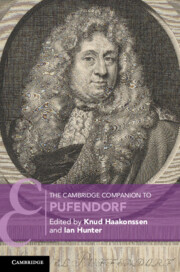
BOOK: Knud HAAKONSSEN & Ian HUNTER (eds.), The Cambridge Companion to Pufendorf [Cambridge Companions to Law] (Cambridge: Cambridge University Press, 2022), 350 p. ISBN 9781108460149, 29,99 GBP


(image source: CUP)

Abstract:

In the same intellectual league as Grotius, Hobbes and Locke, but today less well known, Samuel Pufendorf was an early modern master of political, juridical, historical and theological thought. Trained in an erudite humanism, he brought his copious command of ancient and modern literature to bear on precisely honed arguments designed to engage directly with contemporary political and religious problems. Through his fundamental reconstruction of the discipline of natural law, Pufendorf offered a new rationale for the sovereign territorial state, providing it with non-religious foundations in order to fit it for governance of multi-religious societies and to protect his own Protestant faith. He also drew on his humanist learning to write important political histories, a significant lay theology, and vivid polemics against his many opponents. This volume makes the full scope of his thought and writing accessible to English readers for the first time.

 Table of contents:

Preface
System of references and abbreviations
1. Introduction: life, work and historical context Ian Hunter
2. Politics and the constitution of the Empire Joachim Whaley
3. Pufendorf's composite method Michael Seidler
4. The metaphysics of moral entities
5. Human nature, the state of nature and natural law Ian Hunter
6. Pacts, language and property Pärtel Piirimäe
7. Family and marriage Simone Zurbuchen
8. Pacts, sovereignty and forms of government Ian Hunter and Knud Haakonssen
9. The civil order: law, punishment, and social value Knud Haakonssen
10. The law of nations Mads Langballe Jensen
11. Polemics and controversies: regarding the Eris Scandica Fiammetta Palladini
12. State, church, toleration, reconciliation Walter Sparn
13. Political histories Sebastian Olden-Jørgensen
14. Receptions, contestations and confusions Knud Haakonssen
Bibliography.

Read more here. 

19 November 2019

BOOK: Wim DECOCK, Le marché du mérite. Penser le droit et l'économie avec Léonard Lessius (Paris: Zones Sensibles, 2019), 245 p. ISBN 9782930601410, € 19

(image source: Zones Sensibles)

Book abstract:
Comprendre la genèse de l’économie moderne nécessite un retour à ses fondements théologiques. Plus d’un siècle après la parution de L’Éthique protestante et l’esprit du capitalisme, l’enquête de Max Weber reste en effet inachevée. Le Marché du mérite revisite l’héritage de l’un des protagonistes de l’histoire de la pensée économique tout en élucidant ses origines juridico-théologiques. Dans un contexte marqué par la mondialisation des échanges, l’essor des places boursières et de profonds bouleversements politico-religieux, le jésuite Léonard Lessius (1554-1623) fera figure d’« Oracle des Pays-Bas » parmi les marchands, banquiers et princes qui cherchaient à s’orienter dans ce Nouveau Monde. Son principal ouvrage, Sur la justice et le droit, deviendra rapidement un livre de référence en raison de sa fine maîtrise de la technique juridique et de la lucidité de ses analyses économiques (spéculation, subprimes, assurances, information et marché, monopoles, investissements, prêts, risques…). Si le marché n’a pas pour vocation de transformer le monde en marchandises ni l’homme en esclave d’une soif matérialiste, Lessius, comme ses collègues théologiens de l’École de Salamanque, encourage néanmoins l’effort, la prudence et l’industrie, autant de vertus aptes à libérer un marché basé sur le mérite.
Table of contents:
 1. L’« Oracle des Pays-Bas » 2. L’ombre de Max Weber 3. Pactum serva 4. Usure et marché 5. Information et spéculation 6. Risques, assurances et subprimes 7. Monopoles et industrie 8. Le salut de l’économie 9. L’économie du salut 10. Occupation et ascétisme Notes Index Remerciements
On the author:
Wim Decock est professeur d’histoire du droit aux universités de Leuven (KU Leuven) et de Liège (ULiège). Il est également l’auteur de Theologians and Contract Law. The Moral Transformation of the Ius Commune, ca. 1500-1650 (Brill/Nijhoff, 2013).
More information with the publisher.

27 March 2019

BOOK: Laura GAFFURI & Rosa Maria PARRINELLO (eds.), Verbum e ius: predicazione e sistemi giuridici nell'Occidente medievale = preaching and legal frameworks in the Middle Ages [Reti Medievali. E-books 32] (Firenze: Firenze UP, 2019), ISBN 978-88-6453-809-9 [OPEN ACCESS]

(image source: Unina)

Book abstract:
The crucial relationship between faith (“verbum”) and law (“ius”) has been intensively debated all throughout the Middle Ages. Such a debate was far from being secret and locked in the learning centers. It was quite used by the pastoral care of the medieval Church in order to influence the drafting and/or amendment of legislation, both civil and religious. The texts published in this volume devote special attention to that debate, by focusing on the role of medieval preachers in converting scholars' words on law, community and faith into a public communication addressed to ordinary secular people.
Download the full book for free here.

07 June 2018

PHD DEFENSE: Paolo ASTORI, Lutheran theology and contract law in Early Modern Germany (ca. 1520-1720) (Leuven: KULeuven, 13 Jun 2018)


(image source: KULeuven)

On Wednesday 13 June 2018, drs. Paolo Astori (KULeuven) will publicly defend his doctoral dissertation  Lutheran theology and contract law in Early Modern Germany (ca. 1520-1720) (supervisor: Prof. dr. Wim Decock/KULeuven-ULiège).

The examination board will consist of Prof. dr. Emmanuele Conte (Roma III) (co-supervisor), Prof. dr. Laurent Waelkens (KULeuven), Prof. dr. dr. Alain Wijffels (UCLouvain/Leiden/KULeuven/CNRS) and Prof. Dr. John White jr. (Emory School of Law)

09 May 2018

CALL FOR PROPOSALS: Sources in Early Modern Economics, Ethics, and Law (Second Series) (Christian's Library Press Series)

(image source: Acton Institute)
Continuing in the line of its predecessor, this series publishes original English translations and editions of early modern religious texts in the disciplines of economics, ethics, and law. Representing a variety of confessional traditions and methodological approaches, these texts uncover the foundations of the development of these and related disciplines.
General Editors
Andrew M. McGinnis, Acton Institute, USA
Wim Decock, KU Leuven, Belgium
Editorial Board
Jordan J. Ballor, Acton Institute, USA
Christiane Birr, Max Planck Institute for European Legal History, Germany
Stephen Bogle, University of Glasgow, Scotland
Alejandro Chafuen, Acton Institute, USA
Ricardo Crespo, Universidad Austral and CONICET, Argentina
Virpi Mäkinen, University of Helsinki, Finland
Richard A. Muller, Calvin Theological Seminary, USA
Herman Selderhuis, Theological University Apeldoorn, The Netherlands
John Witte Jr., Emory Law School, USA
Zhibin Xie, Tongji University, China

Call for proposals

CLP ACADEMIC, AN IMPRINT OF THE ACTON INSTITUTE FOR THE STUDY OF RELIGION LIBERTY, is pleased to announce a call for proposals for works to appear in Sources in Early Modern Economics, Ethics, and Law (Second Series). This series publishes original English translations and editions of early modern religious texts in the disciplines of economics, ethics, and law. In the modern era these disciplines often have been detached from the religious and theological context in which they developed. This series seeks to uncover the early modern religious foundations and contexts of these and related disciplines and to provide access to previously inaccessible texts that will contribute to interdisciplinary research. Proposals must be for either an original English translation of a work from the early modern period (ca. 1450-1725) or an edition of a previously unpublished English work from that period (e.g., a work existing only in manuscript). For the purposes of this series, the disciplines of economics, ethics, and law are broadly understood, and proposed texts may include works in the fields of political economy, moral philosophy, moral theology, social ethics, ecclesiastical law, civil law, and common law, as well as theological works that significantly engage one or more of these fields. Proposals for a translation or edition of a complete, single work are preferred, though proposals for selections of writings by a single author, or for an anthology of related selections from multiple authors, will also be considered. 

Practical details:
SEND PROPOSALS AS AN EMAIL ATTACHMENT TO AMCGINNIS@ACTON.ORG PROPOSALS SHOULD INCLUDE THE FOLLOWING ELEMENTS:
• bibliographic information on the source text and its authoritative early modern edition(s)
• list of any modern editions or translations of the work
• names and contact information for the proposed translator(s) or editor(s)
• word count of the original source text (approximate) brief English summary of the text (approximately 350 words)
• description of the text's significance in its own era andfor students and scholars today

See flyer for more practical details.

03 November 2016

BOOK SERIES: Methodica. Einführungen in die rechtshistorische Forschung, Max Planck Institute for European Legal History

The Max Planck Institute for European Legal History published the series Methodica. Einführungen in die rechtshistorische Forschung. 

Recently, two volumes were added to the collection:

1. Recht und Moral in der Scholastik der Frühen Neuzeit 1500-1750 (Wim Decock & Christiane Birr) (ISBN 978-3-11-037967-9, € 19,65)

(image source: MPI Frankfurt
Die Untersuchungen zur frühneuzeitlichen Scholastik erleben gerade eine Hochkonjunktur. Juristen, Philosophen, Theologen und Wirtschaftswissenschaftler nähern sich je nach eigener Perspektive den Texten der "Spanischen Spätscholastiker" oder "katholischen Naturrechtler" an. Neuanfänger wie auch Experten erhalten in diesem Band neben Hilfsmitteln zur eigenständigen Quellenforschung auch einen fächerübergreifenden Einblick in den Forschungsstand.

Table of contents:
Vorwort der Herausgeber | V

Vorwort | VII
Teil 1: Einführung
1 „Scholastik“ | 3
1.1 Im Dienst der Gesellschaft | 3
1.2 Verdunklung | 4
1.3 Universitätslehrer | 5
1.4 Thomas – Scotus – Rimini | 6
1.5 Denken am Text | 7
1.6 Fragestellung, Dialog, Erkenntnis | 7
1.7 Argumentationsvorgang | 8
1.8 Dialektiker, Aristoteliker, Scholastiker | 9
1.9 Scholastik als Methode | 10
2 „Frühe Neuzeit“ | 11
2.1 Neuland | 11
2.2 Epochenabgrenzung | 11
2.3 Benennungen | 12
2.4 Selbstverständnis | 13
2.5 Protestantische Scholastik | 14
2.6 Eklektizismus | 16
2.7 Scholastischer Humanismus | 16
2.8 Jesuitenpädagogik | 17
2.9 Jesuitenscholastik | 18
2.10 Dominikaner | 19
2.11 Franziskaner | 20
2.12 Religiöse Ordensvielfalt | 21
2.13 Neuscholastik | 21
3 „Recht und Moral“ | 23
3.1 Eine fremde Welt | 23
3.2 Juristen vs Theologen | 23
3.3 Gesetze und Seelenheil | 24
3.4 Gewissensforum | 25
3.5 Kasuistik | 26
3.6 Gelehrte Meinungsvielfalt | 27
3.7 Protestantismus | 29
Teil 2: Quellen, Editionen, Hilfsmittel
4 Quellen | 33
4.1 Auswahl und Begrenzung | 33
4.2 Katholische Autoren | 35
4.2.1 Augustiner-Chorherren | 35
4.2.2 Augustiner-Eremiten | 35
4.2.3 Barnabiten | 36
4.2.4 Benediktiner | 36
4.2.5 Dominikaner | 37
4.2.6 Franziskaner-Kapuziner | 39
4.2.7 Franziskaner-Konventualen | 39
4.2.8 Franziskaner-Observanten | 40
4.2.9 Franziskaner-Reformaten | 41
4.2.10 Franziskaner-Rekollekten | 42
4.2.11 Jesuiten | 43
4.2.12 Karmeliten | 48
4.2.13 Kartäuser | 49
4.2.14 Oratorianer | 49
4.2.15 Prämonstratenser | 50
4.2.16 Redemptoristen | 50
4.2.17 Theatiner-Regularkleriker | 50
4.2.18 Zisterzienser | 50
4.2.19 Nicht-ordensgebundene Autoren | 51
4.3 Protestantische Autoren | 53
4.3.1 Anglikanisch | 53
4.3.2 Evangelisch-lutherisch | 53
4.3.3 Reformiert | 55
4.3.4 Englisch-Puritanisch | 56
5 Editionen und Übersetzungen | 57
5.1 Eine kritische Lücke | 57
5.2 Die großen Namen | 58
5.3 Digitale Sammlungen | 59
6 Praktische Hilfsmittel | 61
6.1 Biographien, Wörterbücher, Lexika | 61
6.2 Lösung von Abkürzungen | 62
6.3 Zitierte Texte: Editionen und Digitalisaten | 65
7 Fallstricke bei der Textauslegung | 67
7.1 Dialog statt Monolog | 67
7.2 Gegenmeinungen, Einwände, Bemerkungen | 67
7.3 Anzeichen für innovatives Denken | 68
Teil 3: Probleme und Perspektiven der Forschung
8 Einführung | 73
9 Wirtschaftliche Perspektive | 74
9.1 Von Salamanca bis Smith | 74
9.2 Geld, Zins und Marktpreis | 74
9.3 Forschungsdesiderate | 75
10 Juristische Perspektive | 77
10.1 Internationales Recht | 77
10.1.1 Ursprünge des Völkerrechts | 77
10.1.2 Grotius und die Scholastiker | 77
10.1.3 Kanonisierungsprozesse | 78
10.1.4 Vitoria und Suárez | 78
10.1.5 Amerindianer und Menschenrechte | 79
10.1.6 Kritische Bewertung | 79
10.2 Privat und Handelsrecht | 80
10.2.1 Zwischen Ius Commune und Naturrecht | 80
10.2.2 Restitutionslehre und Vertragsrecht | 80
10.2.3 Handel und Wirtschaft | 81
10.2.4 Forschungsdesiderate | 82
10.3 Straf und öffentliches Recht | 82
10.3.1 Neuentdeckung | 82
10.3.2 Schuldprinzip und öffentliches Strafen | 83
10.3.3 Sünde und Verbrechen | 83
10.3.4 Alfonso de Castro | 84
10.3.5 Liberale Staatsrechtsphilosophie | 84
10.3.6 Heterogenität des politischen Denkens | 85
10.3.7 Staatliche und kirchliche Gewalt | 86
11 Philosophische Perspektive | 88
11.1 Naturrecht | 88
11.2 Subjektive Rechte | 88
11.3 Säkularisierung | 89
11.4 Ausstrahlung | 89
11.5 Mittelalterliche Verwurzelung | 90
11.6 Probabilismus | 90
11.7 Metaphysik | 91
12 Theologische Perspektive | 92
12.1 Innenansicht | 92
12.2 Moraltheologie | 92
12.3 Missionstheologie | 93
12.4 Salamanca als Erneuerungsbewegung | 93
12.5 Gewissen und Beichte | 94
12.6 Forschungsdesiderate | 95
13 Zukunftsperspektive | 97
Teil 4: Bibliographie und Verzeichnisse
14 Bibliographie | 101
15 Sachregister | 128
16 Personenregister | 133
2. Privat-staatliche Regelungsstrukturen im frühen Industrie und Sozialstaat (Peter Collin) (ISBN 978-3-11-037969-3, € 24,95)

(image source: MPI Frankfurt)

Table of contents:
Vorwort der Herausgeber | VVorwort des Verfassers | VIIAbkürzungen und Kurzbezeichnungen | XITeil 1: Einführung
1 Überblick zur Forschungsgeschichte | 31.1 Bemerkungen zum Forschungsgegenstand | 3
1.2 Ältere Forschungstraditionen | 4
1.3 Neuere konzeptionelle Ansätze | 5
2 Überblick zur Rechtsentwicklung | 82.1 Unmittelbare Vorgeschichte und Ausgangslage (Ende des 18. Jahrhunderts bis zur Reformzeit) | 10
2.1.1 Stimmungslagen | 10
2.1.2 Praxis und Entwicklung von rechtlichen Arrangements | 11
2.1.3 Rechtswissenschaftliche Reflexionen | 15
2.2 Lange Inkubationsphase (Vormärz bis zu den 1870er Jahren) | 16
2.2.1 Stimmungslagen | 16
2.2.2 Praxis und Entwicklung von rechtlichen Arrangements | 20
2.2.3 Rechtswissenschaftliche Reflexionen | 31
2.3 Herausbildung des Interventionsstaates (Mitte der 1870er Jahre bis 1914) | 38
2.3.1 Stimmungslagen | 38
2.3.2 Praxis und Entwicklung rechtlicher Arrangements | 42
2.3.3 Rechtswissenschaftliche Reflexionen | 58
2.4 Kriegszeit (1914–1918) | 66
2.4.1 Stimmungslagen | 66
2.4.2 Praxis und Entwicklung rechtlicher Arrangements | 67
2.4.3 Rechtswissenschaftliche Reflexionen | 76
2.5 Nachkriegsaufbruch und Krise | 80
2.5.1 Stimmungslagen | 80
2.5.2 Praxis und Entwicklung rechtlicher Arrangements | 83
2.5.3 Rechtswissenschaftliche Reflexionen | 93
2.6 Systematisierende Schlussüberlegungen | 100
2.6.1 Zeitabschnitte und Zäsuren | 100
2.6.2 Aktionsfelder | 102
2.6.3 Organisatorische Spielarten | 103
2.6.4 Rechtliche Durchdringung | 105
Teil 2: Quellen, Editionen, Hilfsmittel
3 Quellen und Quelleneditionen | 1093.1 Allgemeines | 109
3.1.1 Beobachtungsperspektiven und Quellenauswahl | 109
3.1.2 Rechtswissenschaftliche Quellen | 110
3.2 Rechtsnormative Quellen | 113
3.2.1 Allgemeines | 113
3.2.2 Sektorübergreifende Quellenbestände | 114
3.2.3 Bereichsspezifische Quellenbestände | 120
4 Hilfsmittel | 1254.1 Bibliographien | 125
4.1.1 Allgemeine Bibliographien | 125
4.1.2 Bibliographien für spezielle Sachbereiche | 127
4.2 Andere Hilfsmittel | 127
4.2.1 Moderne Synthesen und Handbücher | 127
4.2.2 Zeitgenössische Handbücher und Wörterbücher | 129
Teil 3: Probleme und Perspektiven der Forschung
5 Themenfelder gegenwärtiger Forschung | 1335.1 Übergreifende Forschungsfelder | 133
5.2 Einzelne Rechtsgebiete | 136
6 Forschungsperspektiven | 1456.1 Offene Forschungsfelder | 145
6.2 Theoretisch-analytische Ansätze | 146
7 Internationaler Vergleich und Wechselwirkungen | 1537.1 Untersuchungszwecke und Untersuchungsrichtungen | 153
7.2 Untersuchungsfelder | 156
7.2.1 Thematische und disziplinäre Einordnungen | 156
7.2.2 Ausgewählte Untersuchungsfelder | 159
Teil 4: Bibliographie und Verzeichnisse
Bibliographie | 165Sachregister | 206

24 September 2016

BOOK: Martin HECKEL, Martin Luthers Reformation und das Recht [Ius Ecclesiasticum; 114]. Tübingen: Mohr/Siebeck, 2016. XIV + 988 p. ISBN 978-3-16-154211-4; € 69.

(image source: Mohr/Siebeck)

Mohr/Siebeck published an comprehensive study by Prof. em. dr. Martin Heckel (Tübingen) on the influence of Martin Luther's theology on law.

On the book:
Das hier vorgestellte Werk wird zeitgleich als Broschurausgabe ohne Reihenzugehörigkeit erscheinen.
Die Entwicklung des evangelischen Kirchenrechts und des Staatskirchenrechts in Deutschland seit Beginn der Reformation ist nur aus der steten Wechselwirkung der juristischen Probleme und Dynamik mit ihren theologischen und politischen Ursachen und Folgen zu erfassen. Erst durch ihre Umsetzung in Rechtsformen führen die geistigen und gesellschaftlichen Kräfte und Bewegungen zur umwälzenden Veränderung oder beharrlichen Verfestigung ihrer Epoche.
Durch seine rechtshistorischen Aspekte und Analysen will dieses Werk auch den theologischen und historischen Nachbardisziplinen dienen, auf deren Vorarbeiten es fußt. Es ist problemgeschichtlich ausgerichtet. Es sucht die Entstehung und Wandlung der rechtlichen Institutionen aus den geistlichen und weltlichen Ursprüngen, die dem modernen Empfinden fremd geworden sind, verständlich zu machen und zugleich das Bewußtsein der Kontinuität zu stärken, die unsere pluralistische Geisteswelt und Rechtsordnung mit ihren geschichtlichen Wurzeln verbindet und bis heute prägt und bedingt. Es erstrebt keine handbuchartige Vollständigkeit. Manche Phänomene werden daher detailliert in Nahsicht, andere distanziert im Überblick behandelt. Im Aufbau wechselt es zwischen der chronologischen Schilderung des Geschehens und der systematischen Darstellung der Probleme und Institutionen, um weder auf narrative Anschaulichkeit noch auf systematische Exaktheit zu verzichten. Zeitliche Vorgriffe und Rückblenden, auch Wiederholungen, sind deshalb unvermeidlich. Querverweise wollen die abschnittsweise Lektüre erleichtern. Ausblicke auf die Gegenwart wurden nicht gescheut. Die Individualität geschichtlicher Erscheinungen gewinnt durch historische Rechtsvergleichung ohne Nivellierung an Profil. In diesem Buch kommt Luther selbst zu Wort. Mit ausführlichen Zitaten seiner Schriften will es den Theologen, Historikern und Juristen als einschlägiges Luther-Lesebuch dienen.
(Aus dem Vorwort)
On the author:
Martin Heckel Geboren 1929; Studium der Rechtswissenschaft in München; 1955 Promotion; 1960 Habilitation in Heidelberg; 1960–97 o. Professor des öffentlichen Rechts und Kirchenrechts in Tübingen; seit Oktober 1997 emeritiert. 
More information on the publisher's website.

14 April 2015

SEMINAR: "Théologie morale et dynamique des fors. La confessionnalisation catholique et les contradictions de la conscience moderne" (Paris, 15 April 2015)


WHAT Théologie morale et dynamique des fors.  La confessionnalisation catholique et les contradictions de la conscience moderne, seminar

WHEN 15 April 2015, 11:00-13:00

WHERE Ecole des Hautes Etudes en Sciences Sociales, EHESS, CENJ, salle 10 (105, bd Raspail) 

speaker

Jean-Pascal GAY (Université de Strasbourg)