Search

Showing posts with label History of private international law. Show all posts

30 October 2024

MEDAL: George Sarton Medal for Legal History to Prof. Arno DAL RI Jr. (Universidade Federal de Santa Catarina) (Ghent: UFO, 5 DEC 2024)


Department of Interdisciplinary Study of Law, Private Law and Business Law

Ghent Legal History Institute

Sarton Medal 2024 – Sartonmedaille 2024

on Thursday, December 5th at 4 pm


in Auditorium Leon De Meyer of the University Forum

Sint-Pietersnieuwstraat 33, 9000 GENT


The Ghent University Sarton Committee,

Prof. Dr. Michel Tison, Dean of the Faculty of Law and Criminology,

Prof. Dr. Dirk Heirbaut and Prof. Dr. Georges Martyn, Co-Directors of the Ghent Institute for Legal History


have the honour to invite you to the Sarton Lecture,

the laudatio and the handing over of the Sarton Medal to


Prof. Dr. Arno Dal Ri Jr.

(Universidade Federal de Santa Catarina, Brazil)


Programme


- Welcome by dean Michel Tison.


- Laudatio of Prof. Dr. Arno Dal Ri Jr. by Prof. Dr. Georges Martyn.


- Sarton lecture, in French, by Prof. Dr. Arno Dal Ri Jr. on


François Laurent au Brésil.

La diffusion du principe des nationalités outre-Atlantique (1899-1978)

to be published in Sartoniana as:

François Laurent in Brazil.

The Defence of the Principle of Nationalities that Crossed the Atlantic (1899-1978)


- Handing over of the Sarton Medal by Prof. Dr. Guido Van Huylenbroeck, Academic Secretary of the Sarton Committee


- Drink offered by the Faculty of Law and Criminology.

George Sarton (1884-1956), one of the founding fathers of the history of science as an academic discipline, was an alumnus of Ghent University. In 1912, one year after his graduation in physics and mathematics, he wrote to a friend: “J'ai décidé de vouer ma vie à l'étude désintéressée de l'histoire des sciences”. He established two leading journals in the field (Isis in 1912 and Osiris in 1934) and the History of Science Society. In 1984, at the centenary of Sarton's birthday, Ghent University decided to establish a Sarton Chair of History of Science. Each year the Sarton committee, consisting of representatives of the faculties of Ghent University, selects the Sarton chair holder and the Sarton medallists. The Sarton chair holder and the medallists are invited to lecture on the history of science in the faculties of the university.. The lectures are published in the annual journal Sartoniana. (www.sartonchair.ugent.be).

18 July 2024

JOURNAL: Journal of the History of International Law/Revue d'histoire du droit international XXVI (2024), Nr. 2 (July)


(image source: Brill)


A New History for Human Rights: Conflict of Laws as Adjacent Possibility (León Castellanos-Jankiewicz) [OPEN ACCESS]
DOI 10.1163/15718050-bja10095
Abstract:
The pivotal contributions of private international law to the conceptual emergence of international human rights law have been largely ignored. Using the idea of adjacent possibility as a theoretical metaphor, this article shows that conflict of laws analysis and technique enabled the articulation of human rights universalism. The nineteenth-century epistemic practice of private international law was a key arena where the claims of individuals were incrementally cast as being spatially independent from their state of nationality before rights universalism became mainstream. Conflict of laws was thus a vital combinatorial ingredient contributing to the dislocation of rights from territory that underwrites international human rights today. 

International Lawyers as Hope Mongers: How Did We Come to Believe That Democracy Was Here to Stay? (Işıl Aral)
DOI 10.1163/15718050-bja10098
Abstract:

It is common these days to lament the recession of democracy around the world. The way scholars address the issue of democratic backsliding shows that there is a significant gap between the expectation about democracy’s anticipated course of development and the current state of affairs. This article argues that the expectation that democracy would consolidate over time was produced by the progress narrative of democratic governance discourses. Drawing on narratology, it conducts a discourse analysis to demonstrate that today’s dismay about the recession of democracy is due to an unwarranted expectation that was created by the progress narrative of democratic governance discourses. It focuses on the periodisation of history in the construction of these discourses and investigates how scholars used the Cold War – post-Cold War dichotomy to create a progress narrative.


The Twilight of the Law of the Fairs: Inventing International Cooperation on Bankruptcies in Early Modern Europe (Lyon, 1660–1710) (Benoît Saint-Cast)
DOI  10.1163/15718050-bja10094
Abstract:

Bankruptcy was a key institution in the development of markets in Europe. However, the territoriality of jurisdictions and legal systems made international insolvencies difficult to manage. In the middle of the seventeenth century, cities such as Lyon developed networks of cooperation by granting foreign merchants equal rights to local creditors on a reciprocal basis. However, courts were reluctant to give foreign authorities control over assets and creditors on their territory. The article examines how the Lyon commercial court changed its policy towards international insolvencies during the second half of the seventeenth century. Whereas equal treatment of foreign creditors was conditioned on the recognition of an extraterritorial jurisdiction in the medieval fairs system, it now depended on the reciprocity of the legal status granted to merchants abroad. This system of cooperation between equally sovereign courts prefigured in many ways the current situation of private international law in bankruptcy matters.

Book review

The Political Economy of International Commodity Cartels: An Economic History of the European Timber Trade in the 1930s , written by Elina Kuorelahti (Florenz Volkaert) 
DOI 10.1163/15718050-bja10108

Read the full issue here.

12 December 2023

CONFERENCE: The Tangier Statute Centenary Conference (Hybrid, 18 DEC 2023)


(image source: university of Luxemburg)


Abstract:
Bringing together scholars from both sides of the Mediterranean, this conference aims to renew interest in the International Zone of Tangier (1925–56). It will take place 100 years to the day after France, Spain, and the United Kingdom signed the Zone’s constitutive treaty, known as the Tangier Zone Statute. The agreement, which was later joined by Sweden, Belgium, the Netherlands, Portugal, and Italy, subjected Tangier to a special regime: although nominally an integral part of Morocco, the city and its surroundings were to a large extent subject to the joint administration of Western powers. This regime, which has been variously described as ‘shared colonialism’ (Daniela Hettstedt) or ‘unequal federal integration’ (Paul Reuter), was deeply problematic. It shared the discriminatory premise of colonialism, disregarded Moroccans’ aspirations to independence, and even hampered the city’s economic development rather than fostering it. And yet, the Zone’s multinational institutional arrangements, its experience of legal pluralism and treaty-based constitutional rights, as well as its reliance on tax evasion schemes, are certainly worthy of scholarly interest and investigation. Considering that they served as an inspiration for post-WWII endeavours of global and regional integration and governance, they are also of interest to a broader 21th century audience. 

Program here. 

Read more here.


23 November 2023

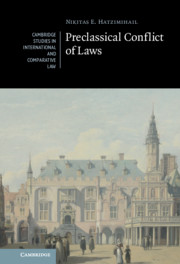
BOOK REVIEW: Jean-Louis HALPÉRIN on Nikitas E. HATZIMIHAIL, Preclassical Conflict of Laws (Cambridge: Cambridge University Press, 2021, 607 p.), Revue critique de droit international privé 2022/4 (N°4)


(image source: cairn)

First sentence:
Nikitas E. Hatzimihail, professeur associé à l’Université de Chypre publie une version développée et révisée de sa thèse de doctorat soutenue en 2003 à Harvard Law School sous la direction de David Kennedy et Charles Donahue Jr.

Read the full review on cairn: DOI 10.3917/rcdip.224.0825.


05 May 2021

BOOK: Nikitas E. HATZIMIHAIL, Preclassical Conflict of Laws (Cambridge: CUP, 2021). ISBN 9780521863025, 85.00 GBP


(Source: CUP)

CUP is publishing a new book on the history of private international law.

ABOUT THE BOOK

To better appreciate present-day private international law and its future prospects and challenges, we should consider the history and historiography of the field. This book offers an original approach to the study of conflict of laws and legal history that exposes doctrinal lawyers to historical context, and legal historians to the intricacies of legal doctrine. The analysis is based on an in-depth examination of Medieval and Early Modern conflict of laws, focusing on the classic texts of Bartolus and Huber. Combining theoretical insights, textual analysis and historical perspectives, the author presents the preclassical conflict of laws as a rich world of doctrines and policies, theory and practice, context and continuity. This book challenges preconceptions and serves as an advanced introduction which illustrates the relevance of history in commanding private international law, while aspiring to make private international law relevant for history.

ABOUT THE AUTHOR

Nikitas E. Hatzimihail, University of Cyprus

Nikitas E. Hatzimihail is Associate Professor of Private Law, Comparative Law and Legal History at the University of Cyprus. His doctoral dissertation received the Addison-Brown commencement prize at Harvard.

TABLE OF CONTENTS

1. Introduction

Part I. History and Historiography:

2. Historical literature and historical consciousness in contemporary private international law

3. Preclassical conflict of laws in modern historical consciousness

Part II. Current Concerns:

4. Conflict of laws as a conceptual battlefield

5. Conflict of laws as a doctrinal exercise

6. Conflict of laws in a world system

Part III. Bartolus da Sassoferrato and Medieval Conflict of Laws:

7. Nunc veniamus ad glossam: Bartolus comments on cunctos populos

8. Bartolus in a world system

9. Bartolan conflicts as a doctrinal exercise

10. Bartolus and the modern consciousness

Part IV. Ulrik Huber (1636–1694) and Conflict of Laws in the Early Modern Era:

11. 'It often happens that transactions...': Huber on the conflict of laws

12. The world system of Huber's conflict of laws

13. Huber's conflict of laws as a doctrinal work

14. Huber and the modern consciousness

Epilogue:

15. Preclassical conflict of laws configured.


More info here

23 September 2019

Jessica M. MARGLIN, La nationalité en procès : droit international privé et monde méditerranéen (Annales. Histoire, Sciences Sociales LXXIII (2018), No. 1)

(source: cairn)

Abstract:
This article uses a single, transnational legal case that played out between Italy and Tunisia in the 1870s and 1880s to tell a truly global history of international law—that is, one that goes beyond the boundaries of the West. Samama v. Samama was a fabulously complicated case that dragged on in Italian courts for almost a decade. The crux of the legal arguments concerned the nationality of Nissim Samama, a Jew born in Tunis; Samama’s nationality, in turn, would determine which legal system regulated his estate. The Italian Civil Code enshrined respect for the national law of a foreigner, but such foreigners were presumed to be Western. A case involving the national law of Tunisia and the status of Jews called the very foundations of the international legal system into question. In putting Samama’s nationality on trial, the case opened up debate over fissures in the emerging theory of international law: How could non-Western states like Tunisia fit into an international legal order? How did Islamic law intersect with international law? What was the status of Jewish nationhood in a world increasingly based on exclusive nationalities? The Samama case offers access to the voices of European international lawyers debating the ambiguities of their field, as well as those of Maghrebis articulating their own vision of international law. The resulting arguments exposed tensions inherent to an international legal system uncomfortably balanced between universalism and Western particularism.
(read more on cairn)

17 July 2019

CALL FOR PAPERS: Mixed Arbitral Tribunals, 1919–1930: An Experiment in the International Adjudication of Private Rights (Luxemburg: MPI, 23-24 APR 2020) (DEADLINE 1 OCT 2019)

(image source: brandsoftheworld)

The creation of a system of Mixed Arbitral Tribunals (MATs) was a major contribution of the post-WWI peace treaties to the development of international adjudication. Numerically speaking, the 36 MATs were undoubtedly the busiest international courts of the interwar period. Taken together, they decided on more than 70,000 cases, mostly covering private rights. This caseload is even more impressive if one considers that their existence generally did not exceed 10 years, as most of the MATs were discontinued pursuant to the 1930 Young Plan. The MATs are similarly remarkable from a procedural point of view. First, their respective rules of procedure were so detailed that contemporaries described them as ‘miniature civil procedure codes’. Second, in a departure from most other international courts and tribunals, they also allowed individuals whose rights were at stake to become involved in the proceedings before them. Although the MATs failed to produce a universally consistent body of case-law, their collection of published decisions was a major source for legal doctrine in the 1920s and 1930s and remains of interest for international lawyers today. The MATs themselves served as a source of inspiration for other international and supranational courts and tribunals, including the European Court of Justice. Their example might similarly inspire potential future negotiations over institutionalized investment tribunals.

And yet, like many other international ‘experiments’ of the interwar period, the MATs are often barely mentioned in post-WWII accounts of international law. Despite (or perhaps because of) the amount of cases they handled and the vastness of archival records they generated, they have not given rise to a single major monograph after 1945.

By organizing a conference specifically dedicated to the MATs and their impact on international adjudication of private rights, the Max Planck Planck Institute Luxembourg for Procedural Law would like to provide researchers with the opportunity to shed new light on this often overlooked chapter in the history of international law.

The call is interested in legal, historical, and sociological research addressing issues such as:
- How the MATs contributed to the development of public international law;
- How the MATs contributed to private international law;
- How the MATs contributed to intellectual property law;
- How the MATs contributed to the foreign legal policies of individual states (both within and outside Europe);
- How the MATs contributed to the professionalisation of international law academics and practitioners;
- The role and sociology of non-state actors before the MATs;
- The relations between the MATs and other international institutions;
- The differences between the MATs and other dispute settlement mechanisms of the interwar period (notably the German–US Mixed Commission);
- The perception of the MATs by the press and the broader public at the time of their operation;
- The subsequent use of case law produced by the MATs by international institutions, legal scholars and practitioners;
- The subsequent impact of the MATs on international adjudication

From a methodological point of view, the call welcomes papers based on archival sources and/or on doctrinal writings and the case law of MATs.

Abstracts of no more than 600 words, written in English or French and including the author’s name, e-mail address and a one-page curriculum vitae, should be submitted to secretariatprof.ruizfabri@mpi.lu by 1 October 2019. Successful applicants will be notified via e-mail by 15 October 2019 and are expected to produce a draft paper by 10 April 2020. The organizers will cover/reimburse travel (economy) and accommodation costs.

(source: ESILHIL Blog)

27 July 2018

BOOK: Roxana BANU, Nineteenth Century Perspectives on Private International Law [The History and Theory of International Law] (Oxford: Oxford University Press, 2018). ISBN 9780198819844, £70.00


(Source: OUP)

Oxford University Press has published a new book on 19th century perspectives to private international law.

ABOUT THE BOOK

Private International Law is often criticized for failing to curb private power in the transnational realm. The field appears disinterested or powerless in addressing global economic and social inequality. Scholars have frequently blamed this failure on the separation between private and public international law at the end of the nineteenth century and on private international law's increasing alignment with private law.

Through a contextual historical analysis, Roxana Banu questions these premises. By reviewing a broad range of scholarship from six jurisdictions (the United States, France, Germany, the United Kingdom, Italy, and the Netherlands) she shows that far from injecting an impetus for social justice, the alignment between private and public international law introduced much of private international law's formalism and neutrality. She also uncovers various nineteenth century private law theories that portrayed a social, relationally constituted image of the transnational agent, thus contesting both individualistic and state-centric premises for regulating cross-border inter-personal relations.

Overall, this study argues that the inherited shortcomings of contemporary private international law stem more from the incorporation of nineteenth century theories of sovereignty and state rights than from theoretical premises of private law. In turn, by reconsidering the relational premises of the nineteenth century private law perspectives discussed in this book, Banu contends that private international law could take centre stage in efforts to increase social and economic equality by fostering individual agency and social responsibility in the transnational realm.

ABOUT THE AUTHOR

Roxana Banu, Assistant Professor, Western Law School, Ontario
Roxana Banu is an Assistant Professor of Law at Western Law School, Ontario, Canada. Prior to joining Western Law School, Banu taught Private International Law at Osgoode Hall Law School in Toronto, Canada and at Fordham Law School in New York City.More information here

TABLE OF CONTENTS

1: Introduction
2: Individual- and State-Centered Perspectives in Nineteenth Century Private International Law
3: . Individual- and State-Centered Perspectives in Nineteenth Century Europe
4: Tracing the Relational Internationalist Perspective in Europe After World War II
5: Individual-centered and State-centered Internationalist Perspectives in American Private International Law Theory
6: Recognition, Rights, and Reasonable Expectations
7: Legitimacy and Autonomy
8: Universalism Versus Uniformity
9: Conclusions

More information here