Search

Showing posts with label arbitration. Show all posts

29 January 2026

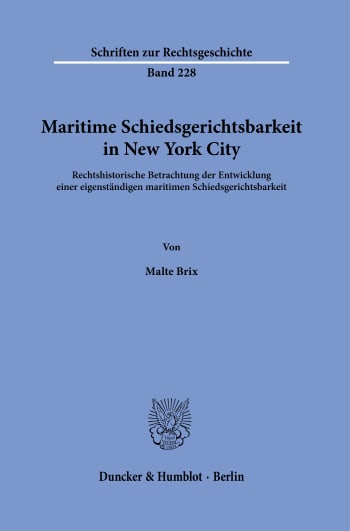
BOOK: Malte BRIX, Maritime Schiedsgerichtsbarkeit in New York City. Rechtshistorische Betrachtung der Entwicklung einer eigenständigen maritimen Schiedsgerichtsbarkeit [Schriften zur Rechtsgeschichte; 228] (Berlin: Duncker & Humblot, 2025), 223 p., ISBN 978-3-428-19344-8

 Cover: Maritime Schiedsgerichtsbarkeit in New York City 

ABOUT THE BOOK:
 
Die private Seehandelsschiedsgerichtsbarkeit hat eine enorme praktische Bedeutung im internationalen Seehandel. Die 1963 gegründete Society of Maritime Arbitrators (SMA) mit Sitz in New York City ist eine bedeutsame Institution in diesem Bereich. Die Arbeit untersucht die Entstehung der eigenständigen maritimen Schiedsgerichtsbarkeit in New York City seit der Kolonialzeit bis heute anhand von bislang noch nicht erforschten Originalquellen und ausgewählten Schiedssprüchen verschiedener Institutionen. Durch die Auswertung des hauptsächlich in den Archiven der New York Historical Society und des New Netherland Institute in Albany aufgefundenen Materials gelingt es, die Zusammenschlüsse von Kaufleuten und die vielfältigen maritimen Handelsbräuche als Ausgangspunkt dieser Entwicklung zu identifizieren. So waren die Arbitration Committees der New York Chamber of Commerce und der New York Produce Exchange die Wegbereiter der Gründung der SMA als eigenständiger Seehandelsschiedsgerichtsbarkeit in New York City.
 
TABLE OF CONTENTS:
 
A. Einführung
Einleitung und Forschungsgegenstand – Quellenlage

B. Die Geschichte des Seehandelsrechts
Erste Überlieferungen des Seerechts und des Seehandels – Das Seehandelsrecht im antiken Griechenland – Das Seehandelsrecht im antiken Rom – Das Seehandelsrecht im Frühmittelalter – Das Seehandelsrecht nach dem Zerfall des Römischen Reiches

C. Die Geschichte der Schiedsgerichtsbarkeit
Das Schiedsgericht im antiken Griechenland – Die Schiedsgerichtsbarkeit und der Zivilprozess im römischen Recht – Die Entwicklung der Schiedsgerichtsbarkeit seit dem Mittelalter

D. Die Entwicklung einer maritimen Schiedsgerichtsbarkeit in New York City
Die niederländische Kolonialzeit – Die englische Kolonialzeit – Die New York Chamber of Commerce – Die New York Produce Exchange – Die Society of Maritime Arbitrators

E. Die gegenwärtige Bedeutung der maritimen Schiedsgerichtsbarkeit
Die gegenwärtige Bedeutung der Schiedsgerichtsbarkeit für den internationalen Seehandel – Die gegenwärtige Bedeutung der SMA im Seehandel

F. Gesamtergebnis
Die Entstehung einer maritimen Schiedsgerichtsbarkeit in New York City – Die Handelsplätze als Ausgangspunkt – Die Bedeutung der Handelsbräuche und die lex mercatoria – Ausblick
 
Find more here. 

22 September 2025

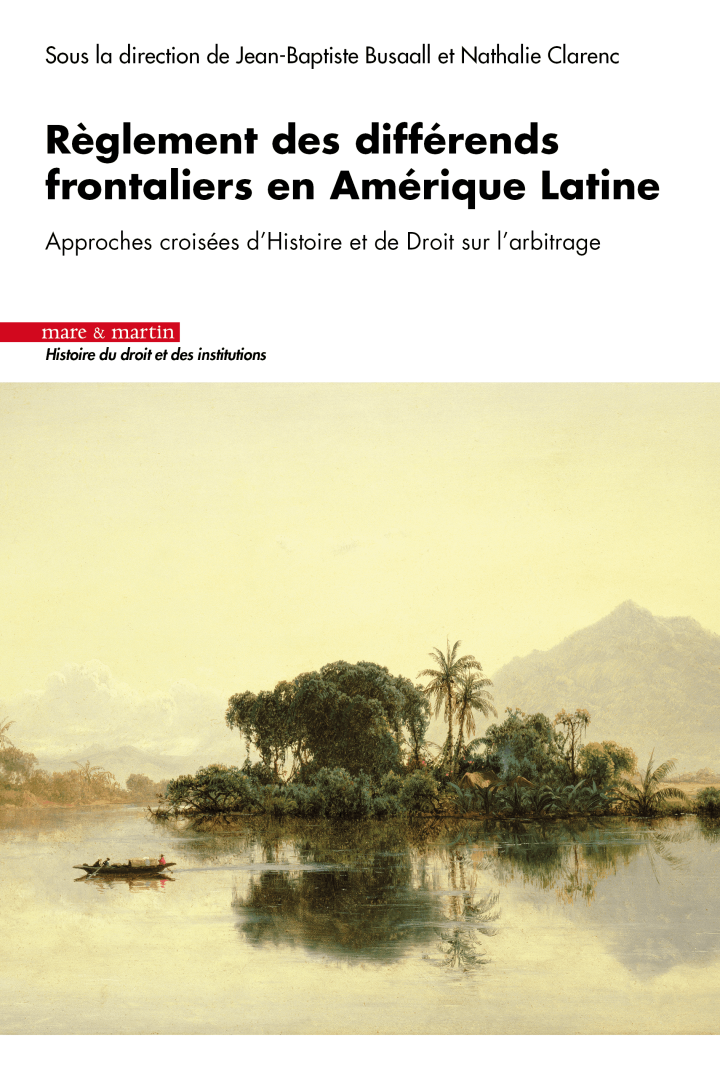
BOOK: Jean-Baptiste BUSAAL & Nathalie CLARENC (dir.), Règlement des différends frontaliers en Amérique Latine. Approches croisées d'Histoire et de Droit sur l'arbitrage [Histoire du droit et des institutions] (Paris: Mare & Martin, 2025), 212 p. ISBN 978-2-38600-061-4, € 27


(image source: Mare & Martin)

Abstract:
Aujourd’hui, le tracé des frontières litigieuses de l’Amérique latine se dessine à La Haye devant la Cour internationale de justice. Il occupe une grande partie de son activité judiciaire : 14 affaires furent introduites seulement depuis le début des années 2000. Mais la question est ancienne et la plupart des différends avaient déjà donné lieu à des procédures d’arbitrage entre le xixe et le début du xxe siècle. Cet ouvrage propose un recueil d’analyses de cas historiques et contemporains d’arbitrages de frontières dans l’espace des anciennes colonies ibériques de l’Époque moderne. L’approche est pluridisciplinaire, car elle allie histoire du droit et droit international. Les contributions des historiens du droit s’inscrivent dans le prolongement d’une historiographie récente qui a montré en quoi l’enjeu de l’intégrité territoriale est l’une des conséquences du double phénomène de construction institutionnelle des États et de la forge d’un discours national, voire nationaliste, au xixe siècle. Les auteurs internationalistes proposent une réflexion sur les modalités juridiques de règlement des disputes territoriales entre États, depuis les arbitrages du xixe siècle jusqu’aux procédures judiciaires du xxie siècle. L’analyse de cette évolution fournit des éclairages utiles sur le droit du contentieux international, et alimente la réflexion lancinante sur l’efficacité de la justice internationale : le règlement judiciaire pourra-t-il réussir là où les tentatives d’arbitrage ont échoué ?

On the editors:

Jean-Baptiste Busaall est Maître de conférences en histoire du droit à l’université Paris Cité. Nathalie Clarenc est Maître de conférences en droit public à l’université Paris Cité.

Read more here.

03 January 2022

BOOK: Mikael SCHINAZI, The Three Ages of Commercial Arbitration [Cambridge Studies in International and Comparative Law, eds. Larissa VAN DEN HERIK & Jean d'ASPREMONT] (Cambridge: CUP, 2021)


(image source: CUP)

Book description:

Drawing on a wide range of previously unpublished sources, this unique history of international commercial arbitration in the modern era identifies three periods in its development: the Age of Aspirations (c. 1780–1920), the Age of Institutionalization (1920s–1950s), and the Age of Autonomy (1950s–present). Mikaël Schinazi analyzes the key features of each period, arguing that the history of international commercial arbitration has oscillated between moments of renewal and anxiety. During periods of renewal, new approaches, instruments, and institutions were developed to carry international commercial arbitration forward. These developments were then reined in during periods of anxiety, for fear that international arbitration might be overstepping its bounds. The resulting tension between renewal and anxiety is a key thread running through the evolution of international commercial arbitration. This book fills a key gap in the scholarship for anyone interested in the fields of international arbitration, legal history, and international law.

On the author:

Mikaël Schinazi is an international dispute resolution lawyer and a visiting lecturer at Sciences Po Law School, Paris. A member of the New York Bar, he holds a BA magna cum laude with highest honours from Harvard University, an LLB from the University of Cambridge (John Eliot Scholar), an LLM from Columbia Law School (Harlan Fiske Stone Scholar), and a PhD in law from the Institut d'Études Politiques de Paris (Sciences Po).

Read more with the publisher. 

17 July 2019

CALL FOR PAPERS: Mixed Arbitral Tribunals, 1919–1930: An Experiment in the International Adjudication of Private Rights (Luxemburg: MPI, 23-24 APR 2020) (DEADLINE 1 OCT 2019)

(image source: brandsoftheworld)

The creation of a system of Mixed Arbitral Tribunals (MATs) was a major contribution of the post-WWI peace treaties to the development of international adjudication. Numerically speaking, the 36 MATs were undoubtedly the busiest international courts of the interwar period. Taken together, they decided on more than 70,000 cases, mostly covering private rights. This caseload is even more impressive if one considers that their existence generally did not exceed 10 years, as most of the MATs were discontinued pursuant to the 1930 Young Plan. The MATs are similarly remarkable from a procedural point of view. First, their respective rules of procedure were so detailed that contemporaries described them as ‘miniature civil procedure codes’. Second, in a departure from most other international courts and tribunals, they also allowed individuals whose rights were at stake to become involved in the proceedings before them. Although the MATs failed to produce a universally consistent body of case-law, their collection of published decisions was a major source for legal doctrine in the 1920s and 1930s and remains of interest for international lawyers today. The MATs themselves served as a source of inspiration for other international and supranational courts and tribunals, including the European Court of Justice. Their example might similarly inspire potential future negotiations over institutionalized investment tribunals.

And yet, like many other international ‘experiments’ of the interwar period, the MATs are often barely mentioned in post-WWII accounts of international law. Despite (or perhaps because of) the amount of cases they handled and the vastness of archival records they generated, they have not given rise to a single major monograph after 1945.

By organizing a conference specifically dedicated to the MATs and their impact on international adjudication of private rights, the Max Planck Planck Institute Luxembourg for Procedural Law would like to provide researchers with the opportunity to shed new light on this often overlooked chapter in the history of international law.

The call is interested in legal, historical, and sociological research addressing issues such as:
- How the MATs contributed to the development of public international law;
- How the MATs contributed to private international law;
- How the MATs contributed to intellectual property law;
- How the MATs contributed to the foreign legal policies of individual states (both within and outside Europe);
- How the MATs contributed to the professionalisation of international law academics and practitioners;
- The role and sociology of non-state actors before the MATs;
- The relations between the MATs and other international institutions;
- The differences between the MATs and other dispute settlement mechanisms of the interwar period (notably the German–US Mixed Commission);
- The perception of the MATs by the press and the broader public at the time of their operation;
- The subsequent use of case law produced by the MATs by international institutions, legal scholars and practitioners;
- The subsequent impact of the MATs on international adjudication

From a methodological point of view, the call welcomes papers based on archival sources and/or on doctrinal writings and the case law of MATs.

Abstracts of no more than 600 words, written in English or French and including the author’s name, e-mail address and a one-page curriculum vitae, should be submitted to secretariatprof.ruizfabri@mpi.lu by 1 October 2019. Successful applicants will be notified via e-mail by 15 October 2019 and are expected to produce a draft paper by 10 April 2020. The organizers will cover/reimburse travel (economy) and accommodation costs.

(source: ESILHIL Blog)

29 May 2018

ARTICLE: Anne-Charlotte MARTINEAU, "A Forgotten Chapter in the History of International Commercial Arbitration: The Slave Trade's Dispute Settlement System" Leiden Journal of International Law XXXI (2018), Nr. 2, 219-241

(image source: Cambridge Core)

Abstract:
This article is part of the ongoing efforts to write a critical history of international arbitration in commercial and investment matters. It examines the ways in which the Spanish crown and its concessionaries set up a mechanism to settle legal disputes pertaining to the transatlantic slave trade. The transformation of asientos de negros from limited royal contracts to large-scale monopolies awarded to foreign chartered companies during the sixteenth, seventeenth and early eighteenth centuries was accompanied by the creation of an international commercial arbitration system. Why was this system set up, how did it work, and what was its faith? The overall aim of the article is to invite international lawyers to rethink the history of international arbitration and pay closer attention to the ‘private’ dimensions of formal and informal imperialism. It also attempts to bridge the historical investigation and contemporary commentary. In the conclusion, I argue that this study allows us, in a mirroring effect, to question the idea that today's dispute settlement mechanism was conceived as a means to ‘depoliticize’ international investment law. What the introduction of arbitration achieves is to place some fundamental questions out of sight. Today, as in the past, arbitrators work from within the system; their work rests on a series of unspoken – and yet highly political – premises about the organization of economic life and the distribution of values.
More information here or https://doi.org/10.1017/S0922156518000158.

(source: ESILHIL blog)

01 October 2015

CALL FOR PAPERS: "Beyond the FAA: Arbitration Procedure, Practice and Policy in Historical Perspective" (Missouri School of Law, 13 November 2015); DEADLINE 14 OCTOBER 2015

(image source: Uni Missouri)

The Legal Scholarship Network (SSRN) has the following announcement:

The Center for the Study of Dispute Resolution at the University of Missouri School of Law is hosting a symposium on arbitration history, "Beyond the FAA: Arbitration Procedure, Practice and Policy in Historical Perspective", to be held at the School of Law on November 13, 2015. The purpose of the symposium is to explore the broader histories of arbitration in America, considering not only what arbitration procedure, practice, and policy looked like in early America (and in the earlier legal, cultural, or religious systems from which American arbitration was adopted), but also how those broader histories might contribute to important discussions and developments in arbitration procedure, practice, and policy today. For more information on the program and speakers, please visit our symposium website at http://law.missouri.edu/csdr-symposium

WORKS-IN-PROGRESS CONFERENCE: The main program will be preceded on Thursday, November 12, 2015 by a Works-in-Progress conference, facilitated by the University of Missouri School of Law and the Center for the Study of Dispute Resolution. The purpose of the Works-in-Progress conference is to provide an opportunity for junior and senior scholars to workshop anything from early-stage article ideas to fully-fledged article drafts. Individuals who write on the history of dispute resolution, including, but not limited to, the history of negotiation, mediation, conciliation and arbitration, should consider participating in the Works-in-Progress conference.
PAPER SUBMISSIONS/FURTHER INFORMATION: For more information about the WIP or to submit an abstract, please contact Professor Carli N. Conklin at conklinc@missouri.edu. The deadline for submitting abstracts is Wednesday, October 14, 2015. All participants will be notified of selection by 5:00 p.m. CST on Thursday, October 15, 2015.