Search

Showing posts with label history of commercial law. Show all posts

11 September 2026

BOOK: Maximilian MAYER, Die Südseeblase und der Bubble Act aus dem Jahr 1720 als Beginn einer gesellschaftsrechtlichen und kapitalmarktrechtlichen Regulierung [Schriften zur Rechtsgeschichte; 236] (Berlin: Duncker & Humblot, 2026), 256 p., ISBN ISBN 978-3-428-19764-4

Cover: Die Südseeblase und der Bubble Act aus dem Jahr 1720 als Beginn einer gesellschaftsrechtlichen und kapitalmarktrechtlichen Regulierung 

ABOUT THE BOOK:

Spekulationsblasen sind seit Jahrhunderten ein fester Bestandteil der Wirtschafts- und Finanzgeschichte. Beginnend mit der Tulpenblase über die Südseeblase und den Gründerkrach bis hin zur Dotcom- und Kryptoblase lassen sich immer wieder vergleichbare Marktphasen erkennen. Die Südseeblase sticht hierbei besonders hervor, steht jedoch bis heute – zu Unrecht, wie die vorliegende Arbeit darlegt – sowohl in der Wissenschaft als auch in der breiten Öffentlichkeit im Schatten der bekannteren Tulpenblase. Die Südseeblase stellt nicht nur ein einschneidendes Ereignis für die gesellschaftsrechtliche und kapitalmarktrechtliche Entwicklung in Großbritannien dar, sondern ist auch ein Paradebeispiel für die Gier und menschliche Psychologie im Wirtschaftssystem. Daneben lässt sich an der Südseeblase in beeindruckender Weise die politische Lage der damaligen Zeit sowie die Herausforderungen der noch jungen parlamentarischen Monarchie nachzeichnen – es verwundert insoweit nicht, dass mit Robert Walpole der erste Premierminister Großbritanniens aus der Südseeblase hervorgegangen ist. Die vorliegende Arbeit versucht dabei die Vorgänge um die Südseeblase in einen juristischen, aber auch interdisziplinären Kontext zu setzen, ohne dabei aktuelle Bezüge – die es reichlich gibt – zu vernachlässigen.

TABLE OF CONTENT:

1. Einleitung

2. Definition und interdisziplinäre Betrachtung von Spekulationsblasen

3. Die wirtschaftlichen und gesellschaftlichen Rahmenbedingungen als Wegbereiter der Südseeblase

4. Englisches Kapitalgesellschaftsrecht und Kapitalmarktrecht vor der Südseeblase

5. Die Südseegesellschaft und ihre Blase

6. Gesellschaftsrechtliche Regulierung durch den Bubble Act 1720

7. Kapitalmarktrecht während und nach der Südseeblase

8. Langfristige gesellschaftliche und wirtschaftliche Folgen der Südseeblase

9. Fazit

Find more here. 

20 August 2026

YOUTUBE: Micoll ERC (Podcast/Conference Videos)

Description:

MICOLL aims at analyzing the development of commercial law between the 11th and 17th centuries, in the geographical area comprising Northern Italy and present-day Germany, through the tools of historical linguistics. The borrowing and transfer of legal terms will be carried out through a comprehensive and systematic survey of medieval and early modern legal sources, in particular commercial letters, contracts and statutes. The analysis of technical-legal words used in commercial transactions will allow to verify the impact of merchants’ migrations on the development of law as well as on social and economic history. The archival research will focus in the first instance on the following archives: Archivio di Stato di Venezia, Archivio di Stato di Genova, Stadtarchiv Nürnberg and Archiv der Hansestadt Lübeck. The project foresees the creation of a "Glossary of Medieval Commercial Law Terms" and of interactive digital maps of the routes that connected Venice with Northern Europe.

Click here to see all videos, includint the recordings  of the International Conference organised by ERC MICOLL.

02 June 2026

PRIZE: Jean Stengers Prize 2023-2025 to Dave DE RUYSSCHER (Brussels: Académie Royale, 22 MAY 2026)

Prof. Dr. Dave De ruysscher has been awarded the Jean Stengers Prize of the Académie Royale de Belgique for the triennial period 2023–2025. 

He received this distinction in recognition of his study A Political Economy Imparted: Trade, Law, and Institutions in Antwerp c. 1400–1680, a work that sheds new light on the interplay between legal frameworks and economic development in the early modern Low Countries. 

More information at VUB CORE.   

21 May 2026

CALL FOR PROPOSALS: International Conference on Risk and Insurance in History (ICRIH) [HOSTING PROPOSALS FOR 2028–2029]

(image source: RKD Research)

The Scientific Committee of the International Conference on Risk and Insurance in History (ICRIH) has issued a call for proposals to organize and host the next edition of the conference in the summer of 2028 or, at the latest, 2029.

Since its inaugural meeting in Seville in 2019, followed by conferences in Basel (2022) and Warsaw (2025), the ICRIH has established itself as a major interdisciplinary forum for scholars working on the historical and long-term dimensions of risk and insurance. Previous editions brought together researchers from across the world and covered topics ranging from marine insurance and maritime law, insurance and the Atlantic slave trade, and micro-insurance, to modern financial instruments and alternative risk transfer mechanisms.

The Scientific Committee invites proposals from institutions interested in hosting the next conference. The selected organizing committee will work closely with the Scientific Committee, which will provide support regarding conference structure, call for papers, keynote speakers, paper evaluation, awards, and fundraising. A dedicated conference website is also being developed by the University of Basel.

The ICRIH welcomes interdisciplinary engagement from fields including economic, business, financial, legal, social, and cultural history, as well as economics, sociology, anthropology, management studies, and legal studies. The conference has also traditionally included participation from professionals in the insurance industry alongside established and early-career researchers.

The Scientific Committee of the ICRIH consists of: Lars Fredrick Andresson (Sweden), Gustavo de Angel (Mexico), Sabine Go (Netherlands), Phillip Hellwege (Germany), Sebastian Kohl (Germany), Jean Kwon (USA), Martin Lengwiler (Switzerland), Jeronia Pons (Spain), and Grietjie Verhoef (South Africa).

Hosting proposals and enquiries should be addressed to: Prof. Robin Pearson, Professor Emeritus of Economic History, University of Hull (UK)

Email: ehsrp70@gmail.com 

The full Call for Proposals is available in PDF format here: Full Call PDF.

05 May 2026

PODCAST: Wim DECOCK, "Le marché du mérite: la morale du capitalisme" (France Culture: Entendez-vous l'éco, 6 APR 2026)


(image: Illustration du jésuite allemand Athanasius Kircher (1601/1602–1680) datant de 1667. ©Getty; source: France Culture)

Abstract:

Justifier les profits à l'heure où le commerce fait la richesse des nations a constitué, à la fin du XVIème siècle, une petite révolution juridique et théologique. A la tête de ce renversement intellectuel, on trouve le théologien jésuite Leonardus Lessius (1554-1623). S'il n'est pas économiste à proprement parler, la tâche principale de Lessius "en tant que théologien et en tant que prêtre" est finalement d'"accompagner les individus, d'accompagner les âmes. Il va essayer de donner des conseils à des individus par rapport à des transactions, des contrats particuliers", explique Wim Decock. Ainsi, "il va régulièrement faire le lien entre son approbation de certains contrats et le bien-être général de l'économie, le bien commun, l'utilité publique de certaines pratiques individuelles. Donc même s'il ne résonne pas comme un Antoine de Montchrestien ou autres premiers protoéconomistes qui pensent vraiment à développer et accroître la richesse nationale, (..) il va indirectement essayer de penser la prospérité à l'échelle de la société dans son entièreté". Historien du droit, Wim Decock nous emmène au cœur des Pays-Bas, à une époque où marchands, hommes d'affaires et jésuites posent les bases mêmes de notre économie actuelle.

 Listen to the conversation here.

26 November 2025

BOOK: Michela BARBOT, Les règles de la valeur. Les prix et l'estimation au prisme du droit (XVIIe-XVIIIe siècle) [Études d’histoire du droit et des idées politiques, ed. Florent GARNIER; 36] (Toulouse: Presses de l'Université Toulouse Capitole, 2025), 235 p. ISBN 9782379281396 [OPEN ACCESS]

(image source: OpenEdition)


Abstract:

Comment les prix et la valeur étaient-ils appréhendés par les juristes de l’époque moderne ? Et quel était le statut juridique accordé aux opérations d’estimation ? Alors que ces questions ont été essentiellement abordées sous le prisme des notions forgées par les canonistes de la Seconde Scolastique espagnole, cet ouvrage se concentre sur un terrain d’étude très peu exploré dans cette perspective : il s’agit du droit civil français et italien du XVIIe et XVIIIe siècle. Menée à partir de sources documentaires de nature différente (ouvrages, traités, dictionnaires, recueils de jurisprudence, procès-verbaux d’expertise, règlements, ordonnances, manuels d’estimation), cette enquête croise l’histoire de la pensée, des normes et des pratiques pour s’intéresser, à la fois, aux qualifications juridiques élaborées en matière de prix et de contrats, aux procédés d’évaluation formalisés et adoptés par les estimateurs, aux règles législatives et coutumières qui encadraient ces opérations, ainsi qu’aux conditions institutionnelles qui en assuraient la légitimité. En adressant la question des prix et de l’estimation à partir de leur dimension contractuelle et procédurale, cette analyse comparée permet non seulement de questionner la prétendue universalité du lexique économique néo-scolastique, mais aussi, et surtout, d’observer la pluralité des solutions légales et politiques qui ont été apportées à un même défi : celui de réduire les incertitudes sur les prix afin de favoriser la correcte formation et exécution des engagements juridiques dans lesquels ils sont fixés.

On the author:

Historienne de l’économie et du droit, Directrice de Recherche au CNRS et Professeure attachée en sciences humaines et sociales à l’École normale supérieure Paris-Saclay.

Read more here DOI 10.4000/14r35.

20 November 2025

BOOK: Maurits DEN HOLLANDER, Court, Credit, and Capital. Amsterdam's Insolvency Legislation in the Dutch Golden Age [Studies in Legal History] (Cambridge: Cambridge University Press, 2025), 312 p. ISBN 9781009631051, 95 GBP


(image source: CUP)


Abstract:
Seventeenth-century Amsterdam was a city of innovations. Explosive economic growth, the expansion of overseas trade, and a high level of religious tolerance sparked great institutional, socioeconomic and legal changes, a period generally known as 'the Dutch Golden Age.' In this book, Maurits den Hollander discusses how insolvency legislation contributed to the rise of a modern commercial order in seventeenth-century Amsterdam. He analyzes the procedure and principles behind Amsterdam's specialized insolvency court (the Desolate Boedelskamer, 1643) from a theoretical perspective as well as through the eyes of citizens whose businesses failed. The Amsterdam authorities created a regulatory environment which solved insolvency more leniently, and thus economically more efficiently, than in previous times or places. Moving beyond the traditional view of insolvency as a moral failure and the debtor as a criminal, the Amsterdam court recognized that business failure was often beyond the insolvent's personal control, and helped restore trust and credit among creditors and debtors.

Read more on Cambridge Core. 


17 October 2025

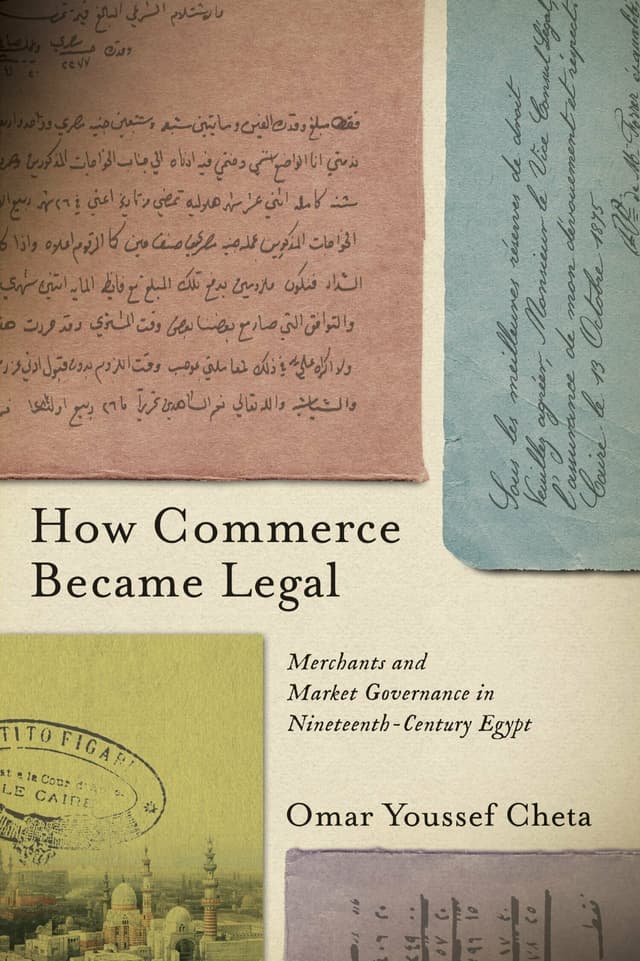
BOOK: Omar Youssef CHETA, How Commerce Became Legal. Merchants and Market Governance in Nineteenth-Century Egypt (Stanford: Stanford University Press, 2025), 268 p. ISBN 9781503643390, 70 USD


(image source: Stanford UP)

Abstract:

When Egypt's markets opened to private capital in the 1840s, a new infrastructure of commercial laws and institutions emerged. Egypt became the site of profound legal experimentation, and the resulting commercial sphere reflected the political contestations among the governors of Egypt, European consulates, Ottoman rulers, and a growing number of private entrepreneurs, both foreign and local. How Commerce Became Legal explores the legal and business practices that resulted from this fusion of Ottoman, French, and Islamic legal concepts and governed commerce in Egypt. Focusing on the decades between the formalization of Cairo's practical autonomy within the Ottoman Empire in the 1840s and its incorporation into the British Empire in the 1880s, Omar Cheta considers how modern laws redefined the commercial sphere, shaping a mode of market governance that would persist for decades to come. He highlights the demarcation of a new law-defined commercial realm separate from the land regime and from civil or family-centered exchanges, and reconstructs these changes through both legal codes and state orders, as well as individual merchant voices preserved in court documents. As this book documents both individual experiences and structural explanations, it offers a rare perspective on the scope and reach of market governance over the mid nineteenth century, revealing changes simultaneously from within and without state institutions.

On the author:

 Omar Youssef Cheta is Assistant Professor of History at Syracuse University.

Read more with the publisher. 

08 September 2025

VACANCIES: PhD positions on FWO Senior Fundamental Research Projects “Cities as breeding grounds: legal change in financial law (ca. 1620-ca. 1750)” and “Collective negotiations in sovereign default and corporate insolvency (1890-1920)” (Prof. Dave DE RUYSSCHER, DEADLINE 15 OCT 2025)


Prof. Dave De ruysscher advertises two vacancies for PhD candidates on FWO Senior Fundamental Research Projects. 

1. Cities as breeding grounds: legal change in financial law (ca. 1620-ca. 1750)

More information here.

2. Collective negotiations in sovereign default and corporate insolvency (1890-1920)

More information here.

(source: VUB CORE)

13 March 2025

BOOK: Victor LE BRETON-BLON, L'évolution de la lettre de change pendant la seconde modernité. Étude conjointe des actes de la pratique, des règlementations royales et des discours à travers le port de Bordeaux (1673-1789) [Etudes d'Histoire du Droit et des Ideés Politiques; 35] (Toulouse: Centre Toulousain d'Histoire du Droit et des Idées Politiques, 2025), 978-2-36170-299-1, € 40 [OPEN ACCESS]


On the author:

Victor Le Breton-Blon, docteur en histoire du droit de l'Université de Bordeaux, enseignant-chercheur contractuel à l'Université Bretagne-Sud. Ses thèmes de recherche portent sur l'Histoire du droit des affaires, l'Histoire de la vie économique, financière et monétaire de l'Ancien Régime et l'Histoire de la pensée économique.

On the series:

Le Centre Toulousain d'Histoire du Droit et des Idées Politiques (EA 789) publie depuis 20 ans des travaux individuels et collectifs au sein de la collection Études d'Histoire du Droit et des Idées Politiques. Elle accueille les travaux d'historiens du droit mais aussi d'autres historiens et de juristes publicistes et privatistes.

Read more here.

This book is available in open access: 10.4000/14r36.

25 October 2024

PHEDRA WINTER SCHOOL: Corporate and mercantile bankruptcy, insolvency and debt: approaches from legal and economic history (Venice, 29-31 OCT 2024)


PHEDRA WINTER SCHOOL 

Corporate and mercantile bankruptcy, insolvency and debt: 

approaches from legal and economic history 

Venice, 29-31 October 2024 

Palazzi Minelli e Contarini - Sestiere Cannaregio, 3536 

Free entry 

Program 

October 29th 

12h00-13h15 Lunch 

13h15 Welcome words, introduction – Dave De ruysscher – Vrije Universiteit Brussels-Tilburg 

University  and Luisa Brunori – Cnrs/École Normale Supérieure. 

13h30-14h10 Albrecht Cordes – Goethe-Universität Frankfurt: The debtor's coat. Provisions on 

insolvency, bankruptcy and debtor protection in the law of Lübeck in the XIIIth century 

14h10-14h50 Giuseppe Speciale – Università di Catania: The relationship between ius commune and 

statutory law: bankruptcy procedures and the revocatory action 

14h50-15h10 Coffee 

15h10-15h50 Alarico Barbagli – Università della Magna Grecia: The "consilia" about insolvency and 

bankruptcy in the XIVth-XVth centuries 

15h50-16h30 Fleur Stolker – University of Cambridge: The forgotten history of bankruptcy, 1543- 

1624 

16h30-17h10 Jérôme Sgard – SciencesPo Paris: Insolvency proceedings in England (XVIIth-XVIIIth 

centuries) 

Drink at Centro Tedesco di Studi Veneziani 

20h30 Dinner 


October 30th 

9h00-9h40 Ron Harris – Tel Aviv University: The corporate attribute of limited liability in the XIXth 

century and its interaction with bankruptcy law 

9h40-10h20 Pierre-Cyrille Hautcœur – Paris School of Economics/EHESS: Bankruptcy history from 

the point of view of economic history 

10h20-10h40 Coffee 

10h40-11h20 Annamaria Monti – Università Statale di Milano: Insolvency and bankruptcy in 

XIXth and early XXth-century Italian legal doctrine 

11h20-12h00 Cristina Ciancio – Università del Sannio: Insolvency and bankruptcy in the Kingdom 

of Italy. Codes and commercial courts (XIX-XXth centuries) 

12h00-12h40 Justine Chauvel – Université Paris Est Créteil Val de Marne: The landlord's pledge over 

the commercial tenant's goods. A comparative study of its influence on tenant's bankruptcy in French, 

German, and English territories (XVIIIth-XIXth centuries) 

12h40-14h00 Lunch 

14h00-14h40 Thomas Max Safley – University of Pennsylvania – Law and institutions in early modern 

bankruptcy 

14h40-15h20 Maurits den Hollander – Tilburg University: Early modern insolvency legislation in 

Amsterdam 

15h20-15h40 Coffee 

15h40-16h20 Roberto Ganau – New York University: Imprisonment for debt and bankruptcy in 

Revolutionary England 

16h20-17h00 Mona Bouquin – Université de Dijon: Insolvency Law in the XIXth and XXth centuries: 

a Franco-German comparison 

17h00-17h40 Rodrick Van der Smissen – Vrije Universiteit Brussels: Roman law and the formative 

interpretation of history in the nineteenth-century insolvency law 

19h00 Dinner 


October 31st 

9h00-9h40 Francesca Fusco – Università di Padova: Italian insolvency and bankruptcy terms from the 

Middle Ages to the XXIst  century 

9h40-10h20 Emanuela Fugazza – Università di Pavia: A crime in search of definition: The bankruptcy 

of the merchant from the Ordonnance du Commerce to the Bankruptcy Law of 1942 

10h20-11h00 Thomas Telfer – Western University: Justifying a provincial bankruptcy and 

insolvency power for municipalities:  An analysis of Ladore v Bennett (1939) and its divergence from 

twentieth century federalism jurisprudence in Canada 

11h00-11h20 Coffee 

11h20-12h00 Virginia Torrie – Western University: The influence of Saskatchewan and Alberta in 

the development of the Canadian bankruptcy and insolvency law 

12h00-12h40 Juma Noah Omollo – Max Planck Institute for Legal History and Legal Theory: 

Legal transfer of the English fraud doctrine for the regulation of bank failure to the Uganda Protectorate 

c. 1885-1965 

12h40-13h20 Máté Pétervári – University of Szeged: The compulsory non-bankruptcy settlement 

procedure in the practice of the Royal Regional Court of Kalocsa (1915-1929) 

13h30 Lunch 


https://phedraproject.wordpress.com/ 


Scientific committee: 

Dave De ruysscher – University of Tilburg/VUB     dave.de.ruysscher@vub.be 

Luisa Brunori – École Normale Supérieure / CNRS     luisa.brunori@ens.psl.eu


05 September 2024

VACANCY: Postdoctoral researcher legal history (Tilburg: Tilburg University, DEADLINE 1 OCT 2024)

(image: view on Tilburg; Source: Wikimedia Commons)

 Department:                 Public Law and Governance (PLG)

Location:                 Tilburg
Contract size:                 1.0 FTE (40 hours per week)
Full-time gross monthly salary:    €4,492 – €6,148
Contract duration:             24 months
Desired starting date:             1 February 2025


Are you a PhD graduate in (legal) history with a passion for archival research? Then we are looking for you!


Tilburg University is hiring a postdoctoral researcher in legal history for the project ‘Multilevel Governance in Late Medieval and Early Modern Cities of Commerce’. The project consists of two major work packages: ‘Professionals and the People’ and ‘The Rhine as Legal Entity? Exploring Multilevel Governance and Intercity Relations in the 16th-century Wine Trades across the Rhine Region.’ As part of the second work package, you will conduct research on regulations relevant to the wine trade in several German cities along the Rhine. You will join a team of enthusiastic (legal) historians who are studying various aspects of urban institutions in the late medieval and early modern periods.


Your position
As postdoctoral researcher, you will conduct archival and literature research within the aforementioned project. Together with the principal investigators, Dr. Marco in ’t Veld (wp 2) and Dr. Maurits den Hollander (wp 1), you will dive into the history of the wine trade in cities such as Wesel, Cologne, Bonn, Koblenz, Mainz, and/or Worms. What expectations did wine merchants have of the urban institutions? Did cities meet these expectations? And if so, how exactly? Did cities collaborate with each other, or did they rather compete?


You will inventorize the available archival material in the relevant cities and produce academic publications, both independently and in collaboration with the principal investigators, to report the research findings. You will also be co-responsible for organizing an international scientific conference. There is ample opportunity to contribute your own ideas and to take initiatives. This way, we develop the project and shape it further collectively. At your request, opportunities to gain teaching experience can be explored. This position allows you to take the next step in your academic career.


The project team
The project team consists of two principal investigators and two postdoctoral researchers, and is embedded in the theme ‘Urban Constitutionalism’ of the faculty’s research program ‘Global Law and Governance’. Our department has approximately twelve legal historians. Many of them work on closely related topics, for instance, as part of the ERC-project CaPANES, which investigates the economic sovereignty of several medieval and early modern cities.


To maintain a lively and active community, it is important that we see each other regularly and maintain strong connections. The project team meets at least once a month to exchange literature and research findings. Additionally, you will also have informal and other organized meetings with colleagues. There is ample opportunity to work independently. As a project team, we are present on our beautiful, green campus in Tilburg about two days a week. On other days, you can also work from home. The department regularly organizes team-building and social events, allowing you to get to know colleagues from other specializations better and to feel quickly at home within the Department of Public Law and Governance.


Your profile
Tilburg University is curious about how you can contribute to our research, education, impact, and the team you will be joining. Therefore, we would like to get the best possible picture of your knowledge, skills, and personality. Below you will find a number of qualifications that we consider important for the position.


•    You have written a (legal) historical dissertation on a related medieval or early modern topic.
•    You have demonstrable experience in independently conducting archival research with handwritten sources from this period.
•    You are interested in the institutional, economic, and legal history of the relevant period.
•    You possess excellent oral and written communication skills, preferably evidenced by relevant academic publications and conference contributions.
•    You have an excellent proficiency of the English and German language, both spoken and written. Proficiency in Dutch and/or Latin is a plus.


Personal competencies:

•    You demonstrate scientific integrity and personal leadership, take responsibility for your work and career, and have good self-awareness.
•    You have team spirit. You feel part of a team and express this through collaboration, sharing knowledge and experience, and contributing to an open and inclusive work environment.


What do we offer?

Tilburg University offers excellent terms of employment with attention to flexibility and room for (personal) development. We recognize and reward our employees and encourage the use of talents and strengths.


For this position, we offer:
•    A position based on 1.0 FTE (40 hours per week);
•    It is a vacancy for which the work is temporarily funded on the basis of project funding in accordance with Article 2.3 paragraph 7(b) of the CLA for Dutch Universities, namely ‘The Rhine as Legal Entity?’. You will be given a temporary employment contract for the duration of 24 months. Continuation of this position depends on the availability of financial resources.
•    A salary of minimum €4,492 and maximum €6,148 gross per month for full time employment, based on UFO profile Postdoctoral Researcher and salary scale 11 of the Collective Labour Agreement for Dutch Universities. Tilburg University uses a neutral remuneration system for salary scaling that is based on relevant education and work experience;
•    Vacation allowance (8%) and a year-end bonus (8.3%);
•    Vacation days (41 days for a 40-hour work week);
•    The opportunity to work partly on campus and partly from home with a home office allowance of €2 per day.
•    Reimbursement for sustainable commuting: walking, cycling, and public transportation;
•    A monthly internet fee of €2;
•    An Options Model in which you exchange benefits for things such as additional leave, more pension, a bicycle or personal training at our Sports Center.
•    A moving allowance (subject to conditions).
•    Employees from outside the Netherlands may be eligible for the 30/20/10% tax facility. We will apply for this reimbursement for you;
•    A pension with ABP; the most sustainable Dutch pension fund.
•    Training in personal development, career development, leadership, education, and research or a language course at our Language Center.
•    A work culture in which we embrace differences, everyone is welcome and given equal opportunities.
•    A vibrant campus in green surroundings that is easily accessible by public transport.


Information and application 
Would you like to know more before applying? Feel free to contact dr. Marco in ‘t Veld, Assistant Professor of Legal History, c.m.intveld@tilburguniversity.edu.


We cordially invite you to apply before 1 October 2024; this can only be done online. Address your cover letter to dr. Marco in ‘t Veld and attach your CV. In order to make a good selection, we also ask you to provide the following documents: 


  •     Cover letter
  •     CV
  •     An official copy of your university degree 
  •     Grades list 
  •     (Link to) digital version of your dissertation
  •     Publication list and your best publication 
  •     Contact details of at least two referees (name, phone number, and e-mail address)


The selection interviews will take place on 8 October 2024. 


The selection committee consists of: 
1.    Dr. Marco in ‘t Veld, Assistant Professor of Legal History
2.    Dr. Maurits den Hollander, Assistant Professor of Legal History
3.    Prof. dr. Dave De ruysscher, Professor of Legal History
4.    Ing. Gaby Coenen, Manager of Department


You will ideally start working for Tilburg University on 1 February 2025. 


This job posting has been published simultaneously internally and externally. In case of equal suitability, our preference is for an internal candidate. 


Tilburg Law School

Since its founding in 1963, Tilburg Law School has become one of the leading law schools in Europe. Through top research and the provision of high-quality university education, the School contributes to society. Tilburg Law School is organized into five Departments: Public Law and Governance; Law, Technology, Markets and Society; Private, Business and Labour Law; the Fiscal Institute Tilburg; and Criminal Law. The mission of the School is to understand and improve the role of law and public administration in addressing the social problems of today and tomorrow. Through research and education, our scholars contribute to that mission. 

More than 4,000 students pursue a Bachelor's, pre-Master's or Master's degree at Tilburg Law School. Through this education, we train students in law, public administration, and data science. The Tilburg Educational Profile (TEP) is unique in the Netherlands. Central to it are three core concepts: knowledge, skill and character. A university education provides students with the latest substantive knowledge and trains them to be critical thinkers and resilient professionals. In addition, the School is committed to innovative educational concepts and, partly in response to the coronavirus crisis, has invested heavily in the quality of online education and in innovative didactic tools to make and keep students inquisitive. 

Tilburg Law School's research is highly regarded nationally and internationally. The Tilburg Law School Departments work closely together in their research in four signature research programs: 1) Global Law and Governance; 2) Law and Security; 3) Connecting Organizations; and 4) Regulating Socio-Technical Change. 


Recruitment code

Tilburg University applies the recruitmentcode of the Dutch Association for Personnel Management & Organization Development (NVP).


Disclaimer
The text of this vacancy advertisement is copyright-protected property of Tilburg University. Use, distribution and further disclosure of the advertisement without express permission from Tilburg University is not allowed, and this applies explicitly to use by recruitment and selection agencies which do not act directly on the instructions of Tilburg University. Responses resulting from recruitment by non-contractors of Tilburg Universities will not be handled.


More information here.

13 August 2024

REMINDER CALL FOR APPLICATIONS: PHEDRA Winter School, 'Corporate and mercantile bankruptcy, insolvency and debt: approaches from legal and economic history' (Venice, 29-31 OCT 2024)[DEADLINE 20 AUG 2024]


Corporate and mercantile bankruptcy, insolvency and debt: approaches from legal and economic history


Venice, 29-31 October 2024


Call for applications


In October 2024, the PHEDRA network will organize a workshop on the history of insolvency and bankruptcy (Middle Ages-19th century). This workshop has the aim to delve into these themes and to explore the combined legal and economic aspects of phenomena connected to insolvency and bankruptcy. From the vantage point of economic history, insolvency is linked to credit, private and public ordering. Legal historians have emphasized the cultural aspects of insolvency regulations and the transplanting of remedies and proceedings.  The hybridity of the problem of insolvency, which touches upon both economic and legal questions, also in their combination, invites further reflection.


The workshop consists of a series of lectures by specialists on the topic and presentations by doctoral candidates on their research. 


PhD students working on a topic that is connected to the theme of the workshop are invited to apply. Accommodation will be provided and costs of travel will be reimbursed. 


The IRN PHEDRA project aims at developing a concerted approach to European research on the history of business law, from antiquity to the present day, apprehended in its « European ecosystem ». This theme remains little explored by historiography, which nevertheless underlines the extent to which commercial norms and practices constitute a fundamental element in the study of issues related to the historical transformation of our societies.


How to Apply
Applicants are requested to send a CV and an abstract of their PhD thesis (maximum 1 page) to the email address phedravenice@gmail.com before 20 August 2024.


If you have further queries, please do not hesitate to contact us.


Best regards,


Prof. L. Brunori

Prof. D. De ruysscher


17 July 2024

CALL FOR APPLICATIONS: PHEDRA Winter School, 'Corporate and mercantile bankruptcy, insolvency and debt: approaches from legal and economic history' (Venice, 29-31 OCT 2024) [DEADLINE 20 AUG 2024]


Corporate and mercantile bankruptcy, insolvency and debt: approaches from legal and economic history


Venice, 29-31 October 2024


Call for applications


In October 2024, the PHEDRA network will organize a workshop on the history of insolvency and bankruptcy (Middle Ages-19th century). This workshop has the aim to delve into these themes and to explore the combined legal and economic aspects of phenomena connected to insolvency and bankruptcy. From the vantage point of economic history, insolvency is linked to credit, private and public ordering. Legal historians have emphasized the cultural aspects of insolvency regulations and the transplanting of remedies and proceedings.  The hybridity of the problem of insolvency, which touches upon both economic and legal questions, also in their combination, invites further reflection.


The workshop consists of a series of lectures by specialists on the topic and presentations by doctoral candidates on their research. 


PhD students working on a topic that is connected to the theme of the workshop are invited to apply. Accommodation will be provided and costs of travel will be reimbursed. 


The IRN PHEDRA project aims at developing a concerted approach to European research on the history of business law, from antiquity to the present day, apprehended in its « European ecosystem ». This theme remains little explored by historiography, which nevertheless underlines the extent to which commercial norms and practices constitute a fundamental element in the study of issues related to the historical transformation of our societies.


How to Apply
Applicants are requested to send a CV and an abstract of their PhD thesis (maximum 1 page) to the email address phedravenice@gmail.com before 20 August 2024.


If you have further queries, please do not hesitate to contact us.


Best regards,


Prof. L. Brunori

Prof. D. De ruysscher


25 June 2024

PROGRAM: PHEDRA’s Summer School (Palos de la Frontera: Universidad Internacional de Andalucía, 25-28 JUN 2024)


(Source: Phedra)

Summer school of the international research network PHEDRA: Pour une Histoire Européenne du DRoit des Affaires

25th June 2024

18.00-20.00 – Plenary session – AULA MAGNA

Lecture 1. Roman Law in the Sources of Commercial Law – Prof. Dario Mantovani and prof. Guido Rossi

§§§

26th June 2024

9.00-11.30 Parallel sessions

AULA 2 Antiquity – Discussants: prof. Luisa Brunori, prof. Olivier Descamps, prof. Carlos Petit                                      

Albert Gómez Jordán – Las cripto monedas como precio del contrato de compraventa/Los bienes con elemento digitales como objeto del contrato de compraventa/ La negotiorum gestio: casos dudosos.

Carlota Hernández García – El estudio de la multa en el derecho romano y el análisis del comercio marítimo en la Antigüedad.

Julio Romano Cabello – Reconstrucción del derecho privado constantiniano a partir de los rescriptos de la época.

Vid Žepič – Favor debitoris and Factors of Its Evolution in the Imperial Legislation between the 4th and 6th Centuries.

AULA 6 Early Modern Period – Discussants: prof. Giovanni Chiodi, prof. Florent Garnier

Femke Gordijn – Law and Trade in Late Medieval Bruges and Southhampton (c. 1400-1520).

Alexis Audemar – The legal treatment of labour by the early modern scolastics.

Paola Iezzone – The saffron trade in Rome during the Renaissance: archive sources and trade routes from Abruzzo.

AULA MAGNA Contemporary Period  – Discussants: prof. Albercht Cordes, prof. Dave De ruysscher

Damian Baçzkiewicz – A Tsunami or a Gentle Tide? The Influence of the French Commercial Code of 1807 on the Formation of Belgian Legal Discourse.

Aurelia Ghetivu – Le rôle de la coutume jurisprudentielle devant le Tribunal de commerce de la Seine sous la Second Empire (1852-1870).

Jérôme Hecker – L’importance du cadre juridique dans le développement économique au Grand-Duché de Luxembourg. Une perspective historique (1929-1990).

Break

12.00-13.30 – Plenary session – AULA MAGNA

Lecture 2. Long Distance Trade – Prof. Ron Harris

Lunch

15.30-18.00 – Parallel sessions

AULA 2 – Middle Ages – Discussants: prof. Luisa Brunori, prof. Olivier Descamps, Prof. Ana Belem Fernández Castro

David De Concilio – The Ecclesiastical Stance on Just Price in the Thirteenth Century

Niels Fieremans – Law, Leverage and Litigation. Legal strategies of foreign merchants in late medieval Bruges.

Daniele Tinterri – The Liber Gazarie

Ana Cláudia Silveira – Setúbal, a rising Portuguese sea port in the international trade of the Late Middle Ages.

AULA 6 – Early Modern – Discussants: prof. Giovanni Chiodi, prof. Albercht Cordes; Prof. Florent Garnier

Andriws González Barrera – Florence and Toulouse (1450-1550): Early Modern Examples of Economic Sovereignty and Legal Drafting in Commercial Policies.

Daniel Bökenkamp – A Tale of Two Cities: sovereignity, diplomacy and commerce in early modern Lübeck and Rouen.

Stefano Cattelan – In the Shadow of the Great Powers: Freedom of the Sea and Neutrality in the Long Eighteenth-Century.

Francesca Fusco Italian terms of commerce in German: the entries of the MICOLL glossary

AULA MAGNA – Contemporary Period Discussants: Prof. Anja Amend-Traut, Prof. Dave De ruysscher, prof. Carlos Petit

Greta Spineti – New Forms of Cultural Tourism in Adriatic: The Potential Role of Ancient Maritime Wine Routes.

Christian Magaling – Private Colonialism and Island Diplomacy: Germany’s Company Rule in Pacific Politics.

Hélène Hu – La concession française de Shanghai : aspects juridiques et juridictionnels.

Carolina Argiroffi – Commercial law goes to the countryside: Association and labour subordination in the 19th-20th century Italian legal discourse.

Break

18.30-20.00 – Plenary session – AULA MAGNA

Lecture 3. – Early-modern archival sources on foreign commercial nations’ judicial competences, and their relations to the local, regional and central jurisdictions (illustrated by Antwerp cases) – Prof. Georges Martyn

§§§

27th June 2024

9.00-10.30 – Plenary session – AULA MAGNA

Lecture 4. The Sources of Northern European Commercial Law – Prof. Heikki Pihlajamäki

Break

11.00-13.30 – Parallel sessions

AULA 2 – Early Modern Discussants: prof. Anja Amend-Traut, prof. Dave De ruysscher, prof. Olivier Descamps

Roberto Ganau – Sovranità e commercio nella Francia del XVI secolo. Verso una storia intellettuale della bancarotta

Gilles Hebben – The Levant Company (1592-1825).

Victor Le Breton-Blon – A transnational history of commercial paper in Europe (16th-18th century)

Laurine Manac’h – Incorporating business: merchants, law and the regulation of business organizations in the age of liberalism. Barcelona and Buenos Aires, 1778-1840.

AULA 6 – 18th-19th c. – Discussants: prof. Albrecht Cordes, prof. Florent Garnier, prof. Ana Belem Fernández Castro

Matthieu Mraizika – Modélisation mathématique et impôt dans la France du XVIIIe siècle.

Luca Jacopo Salvadori – Mutual Aid in Eighteenth Century.

Manon Séréni – Le crédit dans les répertoires de droit, d’une crise à l’autre (1715-1789).

Alexandre Valverde – L’idée de codification du droit privé à l’échelle européenne et internationale (fin XVIIIe s-début XXe).

AULA MAGNA – Contemporary Period – Discussants: prof. Luisa Brunori, Prof. Giovanni Chiodi, Prof. Carlos Petit

Andrea Raffaele Amato – Tra Progresso e Innovazione: Il lungo itinerario della scienza giuridica italiana verso la socializzazione dell’ordine familiare.

Marjorie Carvalho de Sousa – A General Law out of a Special Jurisdiction: Commercial Law of Labor in Nineteenth-Century Brazil.

Justine Chauvel – Le bail immobilier du local commercial-Histoire comparée des droits européens (XVIIIe-XXe siècle).

Rodrick Van Der Smissen – Roman law and the formative interpretation of history in nineteenth-century insolvency law (c. 1850-c. 1900)”. 

Lunch

15.30-17.30 – Plenary session – AULA MAGNA

Lecture 5. Reading the Sources of Commercial Law Doctrine – Prof. Annamaria Monti and prof. Xavier Prévost

Break

18.00-20.00 – Plenary session – AULA MAGNA  

Lecture 6. Lexicon and Translation of Commercial Law Sources – Prof. Jake Dyble and Prof. Stefania Gialdroni

§§§


Practical information

Universidad Internacional de Andalucía (UNIA)

Paraje de La Rábida s/n, 21819 Palos de la Frontera – Huelva – Spain

Phone +34 959350452

Breakfast 8.00h – 9.00h
Lunch 14h-15h
Dinner 20.30h-21.30h

Luisa Brunori +33 6 37 79 23 70 / +39 331 77 33 230
Ana Belem Fernández Castro +33 7 77 33 66 71
Carlos Petit +34 666 41 86 3