Search

16 October 2019

BOOK: Renaud MORIEUX, The Society of Prisoners: Anglo-French Wars and Incarceration in the Eighteenth Century (Oxford University Press, 2019). ISBN 9780198723585, £85.00


(Source: OUP)

Oxford University Press has published a new book on war captivity in the 18th century.

ABOUT THE BOOK

In the eighteenth century, as wars between Britain, France, and their allies raged across the world, hundreds of thousands of people were captured, detained, or exchanged. They were shipped across oceans, marched across continents, or held in an indeterminate limbo. The Society of Prisoners challenges us to rethink the paradoxes of the prisoner of war, defined at once as an enemy and as a fellow human being whose life must be spared. Amidst the emergence of new codifications of international law, the practical distinctions between a prisoner of war, a hostage, a criminal, and a slave were not always clear-cut. Renaud Morieux's vivid and lucid account uses war captivity as a point of departure, investigating how the state transformed itself at war, and how whole societies experienced international conflicts. The detention of foreigners on home soil created the conditions for multifaceted exchanges with the host populations, involving prison guards, priests, pedlars, and philanthropists. Thus, while the imprisonment of enemies signals the extension of Anglo-French rivalry throughout the world, the mass incarceration of foreign soldiers and sailors also illustrates the persistence of non-conflictual relations amidst war. Taking the reader beyond Britain and France, as far as the West Indies and St Helena, this story resonates in our own time, questioning the dividing line between war and peace, and forcing us to confront the untenable situations in which the status of the enemy is left to the whim of the captor.

ABOUT THE AUTHOR

Renaud Morieux, Senior Lecturer, Faculty of History, University of Cambridge

Renaud Morieux has been a lecturer in British history at Cambridge since 2011, before which he lectured in modern history at Lille for five years. His career, spanning the Channel, exemplifies his attempts to cross the intellectual and academic borders between France and Britain.

TABLE OF CONTENTS

Introduction
1: Defining the prisoner of war in international law: a comparative approach
2: Hate or love thy enemy? Humanitarian patriotism
3: The multiple geographies of war captivity
4: The anatomy of the war prison
5: The reinvention of Society?
6: War captivity and social interactions
Conclusion
Epilogue: Napoleon the prisoner of peace

More info here

VIDEO: Travail - Salaire - Profit (interdisciplinary perspectives on labour and the economy, Arte/Le Monde)


arte and Le Monde created a documentary series wherein various established academics from sociology, philosophy, history, law and economics explain the basic theoretical concepts of work, salary and profit.

More information with arte.

WORKSHOP: Non-Consequential Theories of Strict Liability in Historical Perspective (Madrid, 10 January 2020)


(Source: IE Law School)

We learned of a workshop at IE Law School on the concept of strict liability and early modern jurists.
Together with: The Grotiana Foundation. We would like to invite you to the workshop “Non-consequential theories of strict liability in historical perspective”.

Early modern jurists have struggled to come to terms with the concept of strict liability, as they thought primarily in terms of fault and culpability. Even today, when lawgivers and jurists reflect on the concept – for instance in the present debate on the liability for artificial-intelligence based robots – strict liability is hard to explain from a non-consequentialist perspective. In preparation of the quattrocentenary of the publication of the De Jure Belli ac Pacis, the workshop takes the ideas of Hugo Grotius as its starting point, to look at his sources and his influence on seventeenth and eighteenth century authors.

At this workshop, hosted at IE University, IE Law School on January 10, 2020 in Madrid, academic scholars will come together to discuss these topics.

Please confirm your attendance through the registration link. Registration is free.

Featuring:

Dr. James Gordley, W.R. Irby Professor of Law at Tulane Law School, with a paper on “The Natural Law Schools and the Passing of Strict Liability”.
Dr. Joe Sampson, Associate Professor of Law at the University of Oxford, with a paper on “The Place of Fault in Grotius’ Analysis of Delict”.
Dr. Wouter Druwé, Assistant Professor of Roman Law and Legal History at the KU Leuven Faculty of Law, with a paper on “Qualitative liability in the early modern Low Countries”.
Dr. Bart Wauters, Assistant Professor of Legal History and Legal Theory at IE Law School – IE University, with a paper on “Strict liability in Grotius, Smith, Kant and beyond”.

More information here

VIDEO: Eminent Scholars. Audio and Video Archives of Eminent Legal Scholars (Melbourne: Institute for International Law and the Humanities)

(image source: Wikimedia Commons)

The Eminent Scholars-audio and video archive (Prof. Sundhaya Pahuja & Adil Hasan Khan, Institute for International Law and the Humanities, Melbourne Law School) has uploaded material on the following scholars:
- Ratna Kapur
- Muthucumaraswamy Sornarajah
- Mohammed Bedjaoui
- Peter Fitzpatrick
- Upendra Baxi

Read, watch and listen here.

(source: ESILHIL Blog)

BOOK: Jennifer JAHNER, Literature and Law in the Era of Magna Carta (Oxford: Oxford University Press, 2019). ISBN 9780198847724, £65.00


(Source: Wildy & Sons)

Oxford University Press is publishing a book on literature and law in the era of the Magna Carta.

ABOUT THE BOOK

Oxford Studies in Medieval Literature and Culture showcases the plurilingual and multicultural quality of medieval literature and promotes work that not only focuses on the whole array of subjects medievalists now pursue—in literature, theology, philosophy, social, political, jurisprudential, and intellectual history, the history of art, and the history of science—but also work that combines these subjects productively. It offers innovative and interdisciplinary studies of every kind, including but not limited to manuscript and book history, linguistics and literature, post-colonial and global studies, the digital humanities and media studies, performance studies, the history of affect and the emotion, the theory and history of sexuality, ecocriticism and environmental studies, theories of the lyric, of aesthetics, of the practices of devotion, and ideas of medievalism.

Literature and Law in the Era of Magna Carta traces processes of literary training and experimentation across the early history of the English common law, from its beginnings in the reign of Henry II to its tumultuous consolidations under the reigns of John and Henry III. The period from the mid-twelfth through the thirteenth centuries witnessed an outpouring of innovative legal writing in England, from Magna Carta to the scores of statute books that preserved its provisions. An era of civil war and imperial fracture, it also proved a time of intensive self-definition, as communities both lay and ecclesiastic used law to articulate collective identities. Literature and Law in the Era of Magna Carta uncovers the role that grammatical and rhetorical training played in shaping these arguments for legal self-definition. Beginning with the life of Archbishop Thomas Becket, the book interweaves the histories of literary pedagogy and English law, showing how foundational lessons in poetics helped generate both a language and theory of corporate autonomy. In this book, Geoffrey of Vinsauf's phenomenally popular Latin compositional handbook, the Poetria nova, finds its place against the diplomatic backdrop of the English Interdict, while Robert Grosseteste's Anglo-French devotional poem, the Château d'Amour, is situated within the landscape of property law and Jewish-Christian interactions. Exploring a shared vocabulary across legal and grammatical fields, this book argues that poetic habits of thought proved central to constructing the narratives that medieval law tells about itself and that later scholars tell about the origins of English constitutionalism.

ABOUT THE AUTHOR

Jennifer Jahner’s research focuses on the interaction of literary, legal, and textual cultures in the high and later Middle Ages, especially in Britain and France. She is the author of Literature and Law in the Era of Magna Carta, forthcoming from Oxford University Press, which explores the ways that literary training shaped political vocabularies and legal communities in twelfth- and thirteenth-century England. With Emily Steiner and Elizabeth Tyler, she is the editor of Historical Writing in Britain and Ireland, 500–1550, forthcoming from Cambridge University Press. Her current research considers how multilingual book production in later medieval England made use of the burgeoning concept of the “experiment.” Research for this project is currently supported by a Graves/ACLS Award in the Humanities (2018–2019).

At Caltech, Jahner teaches courses on Geoffrey Chaucer, on poetry and theories of justice, on premodern sexualities, and on medieval romance. She is recipient of the ASCIT Teaching Award (2013) and the HSS Division Teaching Award (2015). In January 2019, she will join Studies in the Age of Chaucer as the book review editor.

TABLE OF CONTENTS

Introduction: The Poetics of Jurisdiction
1: The Grammar of Sacrifice: Becket, Learning, and Libertas
2: Classroom Historicisms: Interdict and the Poetria nova
3: Inventing Magna Carta
4: Jurisdictional Formalism: Robert Grosseteste and the Pastoral Model of Governance
5: Conjuring England: Crusade, Violence, and Communitas
Coda: The Jurisdictions of Form
Bibliography

More info here

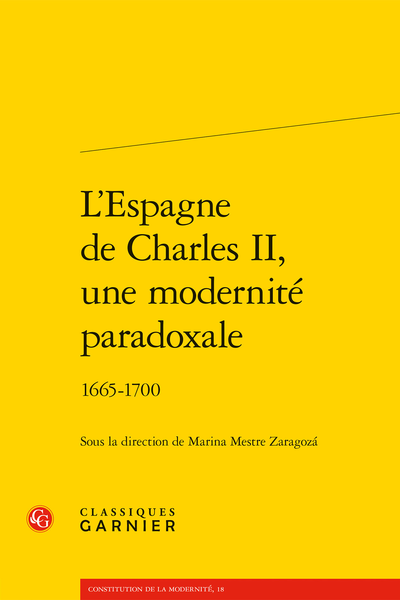
BOOK: Marina MESTRE ZARAGOZÁ, L'Espagne de Charles II, une modernité paradoxale 1665-1700 [Constitution de la mondernité, 18] (Paris: Classiques Garnier, 2019), 293 p., ISBN 978-2-406-09373-2

(image source: Classiques Garnier)

Book abstract:
Ce volume participe au renouveau historiographique d’une période où l’Espagne, loin d’être paralysée par la décadence et par sa prétendue incapacité à s’adapter aux nouveaux temps, affronte avec détermination, audace et pragmatisme un tournant dynastique décisif pour son histoire.
Table of contents here.

CALL FOR SUBMISSIONS: Journal on European History of Law (DEADLINE: 1 March 2020)


(Source: H/Soz/Kult)

Via H/Soz/Kult, we learned of a call for papers for the Journal on European History of Law.

“The Journal on European History of Law is published 2x per year. It is assigned for law-historians and Romanists that want to share with their colleagues the results of their research in this field“ […]

The full call can be found here

15 October 2019

COLLOQUIUM: Imperialiter. L'eschatologie impériale du souverain (Paris, 16-18 October 2019)


We learned of a colloqium at the Collège de France on “l'eschatologie impériale du souverain”.

L’histoire des Empires connaît un engouement récent qui a fait émerger un champ spécifique, « l’impériologie ». En revanche, la question de l’« impérialité », c’est-à-dire de l’Empire comme horizon des possibles, n’a pas bénéficié d’une approche complète. Or, comme l’ont montré de récentes études, le succès de l’idéologie impériale se mesure aussi à sa marque dans des monarchies non impériales (France, Sicile, Angleterre, Castille, États pontificaux...). Le programme Imperialiter (2017-2021) vise ainsi à mener de manière exhaustive l’analyse des réappropriations de l’Empire au Moyen Âge et à l’époque moderne par le biais de rencontres scientifiques régulières. 

Quatre d'entre elles se sont tenues successivement à Rome (deux rencontres, en octobre 2017), Oxford (juin 2018), Madrid (octobre 2019). Le colloque accueilli au Collège de France est donc le cinquième de la série. Le thème de « l'eschatologie impériale du souverain » que ce colloque explore s'est dégagé lors des précédentes journées, qui ont mis en lumière dans les discours, les représentations, les modèles associés aux rois impérialisants, l’importance du thème de l’eschatologie et de ses diverses manifestations (le messianisme, le prophétisme, la croisade et la libération des villes saintes, l'Antéchrist, le « roi des trois religions »), lesquelles permettent au souverain d’amplifier les manifestations de sa souveraineté par l’association de traits qui le lient à la seconde Parousie, celle, définitive, du retour du Christ (modèle royal par excellence) qui abrogera toute souveraineté terrestre et impériale.

More info, including the full program, can be found here

CALL FOR PAPERS: Space and Governance: Towards a New Topography of Roman Administration (Rome, 3-4 April 2020) (DEADLINE: 1 December 2019)


We learned of a call for papers on the topography of power in Republican and Imperial Rome. Here the call:

Call for pa­pers

The purpose of the conference is to explore the transformation of public space and administrative activities in Republican and Imperial Rome through an interdisciplinary exploration of the topography of power. The emergence of the Roman Republic produced a reorganization of the administrative structures, leading to the emergence of various entities and institutions responsible for organization and governance of Rome, its civic life and public spaces. In different ways, this spatial model was exported to the colonies with the expansion of the Republic. Throughout the Roman world, building projects created spaces, the topography of the city, for different civic purposes: for the meetings of assemblies, senate meetings, the administration of justice, the public treasury, and the management of the city through different magistracies, offices and even archives. These administrative spaces –open and closed– characterized the Roman life throughout the Republic and High Empire, until the profound administrative and judicial transformations of the Dominate. This conference aims to study the public and private spaces related to administration through the urban development, the existing interrelation between the different administrative bodies, the analysis of the architecture of the spaces already discovered and the study of the written sources. We will try to find an answer to the dilemmas such as where did the administration work? Were there offices and where were they located? Were there social class differences between the different levels of administration?
Themes:

•    Urban development and dynamics related to the expansion of the administration
•    New discoveries on the institutions and spaces of Roman administration
•    Architecture of spaces for public meetings and trials: Assemblies, Senate, courtrooms, basilicas
•    Private spaces in the administration: Residences of magistrates and the elite
•    Magistracies, offices and archives
•    Epigraphy related to the Roman administration
•    Development of institutions between early Republic and Late Antiquity
•    New methodologies in Roman topography
•    Gender, intersectionality and public space

Keynote speakers: Paolo Liverani (Università degli Studi di Firenze), Elena Isayev (University of Exeter) and Pier Luigi Tucci (Johns Hopkins University).

The conference is organized by the ERC-funded project Law, Governance and Space: Questioning the Foundations of the Republican Tradition (SpaceLaw), based at the University of Helsinki. There is no conference fee. The organizers are unfortunately unable to aid in either travel or accommodation arrangements or the cost of travel or accommodation.

Abstracts should be 300 words maximum, for 20-minute papers to be delivered in English. Abstracts should be sent to lawgovernanceandspace@gmail.com. The deadline for abstracts is 1 December 2019.

Questions may be sent to Antonio Lopez Garcia (antonio.lopezgarcia@helsinki.fi).

More info with the University of Helsinki

BOOK: Dan PORAT, Bitter Reckoning Israel Tries Holocaust Survivors as Nazi Collaborators (Cambridge: Harvard University Press, 2019). ISBN 9780674988149, €27.00


(Source: HUP)

Harvard University Press has published a new book on the kapo trials in Israeli legal history.  

ABOUT THE BOOK

Beginning in 1950, the state of Israel prosecuted and jailed dozens of Holocaust survivors who had served as camp kapos or ghetto police under the Nazis. At last comes the first full account of the kapo trials, based on records newly declassified after forty years.

In December 1945, a Polish-born commuter on a Tel Aviv bus recognized a fellow rider as the former head of a town council the Nazis had established to manage the Jews. When he denounced the man as a collaborator, the rider leapt off the bus, pursued by passengers intent on beating him to death. Five years later, to address ongoing tensions within Holocaust survivor communities, the State of Israel instituted the criminal prosecution of Jews who had served as ghetto administrators or kapos in concentration camps.

Dan Porat brings to light more than three dozen little-known trials, held over the following two decades, of survivors charged with Nazi collaboration. Scouring police investigation files and trial records, he found accounts of Jewish policemen and camp functionaries who harassed, beat, robbed, and even murdered their brethren. But as the trials exposed the tragic experiences of the kapos, over time the courts and the public shifted from seeing them as evil collaborators to victims themselves, and the fervor to prosecute them abated.

Porat shows how these trials changed Israel’s understanding of the Holocaust and explores how the suppression of the trial records—long classified by the state—affected history and memory. Sensitive to the devastating options confronting those who chose to collaborate, yet rigorous in its analysis, Bitter Reckoning invites us to rethink our ideas of complicity and justice and to consider what it means to be a victim in extraordinary circumstances.

ABOUT THE AUTHOR

Dan Porat is the author of The Boy: A Holocaust Story, which the New York Times called “a gripping, harrowing Holocaust story” and Elie Wiesel praised as “a poignant and riveting investigation.” Porat is a teacher and researcher at The Hebrew University of Jerusalem.

TABLE OF CONTENTS

Introduction
1. From Revenge to Retribution in Post-Nazi Europe
2. Tensions among Survivors in Mandatory Palestine
3. The Nazis and Nazi Collaborators Punishment Law
4. Preliminary Court Examinations
5. Weighing the Actions of Jewish Collaborators
6. Can a Jewish Kapo Commit a Crime against Humanity?
7. The First Doubts about the Kapo Trials
8. Judging a Nazi and Reframing Collaboration
9. Absolving Ordinary Functionaries
Epilogue
Notes
Acknowledgments
Illustration Credits
Index

More info here

BOOK: Rande W. KOSTAL, Laying Down the Law : The American Legal Revolutions in Occupied Germany and Japan (Cambridge: Harvard University Press, 2019). ISBN 9780674052413, €49.50


(Source: HUP)

Harvard University Press has published a new book on the legal transformation of Occupied Japan and Germany.

ABOUT THE BOOK

A legal historian opens a window on the monumental postwar effort to remake fascist Germany and Japan into liberal rule-of-law nations, shedding new light on the limits of America’s ability to impose democracy on defeated countries.

Following victory in World War II, American leaders devised an extraordinarily bold policy for the occupations of Nazi Germany and imperial Japan: to achieve their permanent demilitarization by compelled democratization. A quintessentially American feature of this policy was the replacement of fascist legal orders with liberal rule-of-law regimes.

In his comparative investigation of these epic reform projects, noted legal historian R. W. Kostal shows that Americans found it easier to initiate the reconstruction of foreign legal orders than to complete the process. While American agencies made significant inroads in the elimination of fascist public law in Germany and Japan, they were markedly less successful in generating allegiance to liberal legal ideas and institutions.

Drawing on rich archival sources, Kostal probes how legal-reconstructive successes were impeded by German and Japanese resistance on one side, and by the glaring deficiencies of American theory, planning, and administration on the other. Kostal argues that the manifest failings of America’s own rule-of-law democracy weakened U.S. credibility and resolve in bringing liberal democracy to occupied Germany and Japan.

In Laying Down the Law, Kostal tells a dramatic story of the United States as an ambiguous force for moral authority in the Cold War international system, making a major contribution to American and global history of the rule of law.

ABOUT THE AUTHOR

R. W. Kostal is Professor in the Faculty of Law at Western University, Ontario, and author of Law and English Railway Capitalism, 1825–1875, and A Jurisprudence of Power: Victorian Empire and the Rule of Law.

TABLE OF CONTENTS

Introduction: Laying Down the Law in Occupied Germany and Japan
1. The “Destruction of Philosophies”: Planning the Legal Reconstruction of Germany and Japan
2. Occupying the Legal Other: The Subjugation of the German and Japanese Legal Systems
3. Captive Constitutions: Remaking Constitutional Law in Occupied Germany and Japan
4. Crafting Liberal Courts: Reconstituting the German and Japanese Judiciaries
5. Clearing the Spiritual Rubble: Reforming Criminal Justice in Occupied Germany and Japan
6. Twilight of the Gods: The Rise and Fall of Civil Liberties in Occupied Germany and Japan
Conclusion: Laying Down the Law: Americans as Legal Revolutionaries
Abbreviations
Notes
Acknowledgments
Index

More information here

14 October 2019

CALL FOR PAPERS: Law and Policy in European Integration (1960s-1990s) (Max Planck Institute for European Legal History, 9-10 June 2020) (DEADLINE: 1 December 2019)


The fourth annual conference of the Research Field ‘Legal History of the European Union’ to be held at the Frankfurt Max Planck Institute on 9 and 10 June 2020, will focus on the relationship between law and policy in European integration from the 1960s to the 1990s.

From its beginnings, European integration involved legal solutions to very concrete policy issues. Since the 1960s, the European Economic Community (EEC) developed policies and set legal rules, for example on agriculture, competition, trade and the internal market. New policies, including fisheries, regional, social, environmental and cultural issues followed in the 1970s and 1980s, while other policies such as transport did not move forward. Policy and rule making intensified and changed further in the 1990s, in the context of Economic and Monetary Union.

European policy making involved the build-up of a growing body of European law on a wide range of policy-relevant issues. This so-called acquis communautaire deeply influenced the law and policies of the member states. At the same time, political scientists and lawyers have highlighted the weakness of actual implementation of EU law. In the face of this contradictory evidence – between formal strength and informal weakness – this conference will take a closer look at how the relationship between law and policy in European integration developed over time. This relationship goes both ways, and raises various questions.

First, how did European law shape European policy making? How did the various Treaty bases and decision making rules and ECJ judgements enable or limit the development of various policies? How did legal doctrines and principles shape the issues of EC/EU law making and the legal instruments chosen? What was the role of lawyers, legal scholarship and expertise in policymaking? How did advocates or opponents of certain policies use the law to influence policy?

Secondly, how did European policy shape European law – through legislation and court cases? How did changing visions of effective policy making, for instance, economic instruments, change the shape of European legislation? How did transfers of policy knowledge and policy principles from international organisations and (member) states change European law?

This call invites contributions that seek to help us better understand the link between European law and policy in a historical perspective. All contributions should at least address one policy area, and should relate to at least one of the questions raised above, making explicit which part of the relation between law and policy (and which direction of this relation) they are most interested in. Topics may include issues of

- Policy making, legal bases and law making
- Policy implementation and the role of law therein
- Policy relevant jurisdiction – ECJ and national courts
- Legal doctrines and policy principles
- Legal expertise and policy expertise
- Transfer of legal and policy knowledge
- Policy advocacy and opposition in legislation and in the courts

The objective of the conference is to enhance our understanding of what integration through law means with a view to European policies. By bringing together case studies from a range of policy areas, we will be able to (1) flag up the varying roles of different actors involved, (2) compare the relations between policy and law across policy areas old and new, and (3) assess change over time, including potential path dependencies. We will thus get a better understanding of why and how European policy, which increasingly influences citizens’ lives, has come to address problems the way it does.

We welcome proposals for contributions of not more than 150 words by 1st December 2019. Please email your proposal and a short CV (100 words) to jmeyer@rg.mpg.de.

Stefan Vogenauer & Jan-Henrik Meyer
Max Planck Institute for European Legal History
Hansaallee 41
60323 Frankfurt am Main

More info here

ONLINE TEXT EDITION: The Balliol Glanvill: a draft edition (By Prof. John HUDSON/St Andrews)


First paragraph:
The text here edited is preserved in Oxford, Balliol College MS. 350. It was probably written c. 1200. The main hand has been taken to suggest that this manuscript is unusual as a Glanvill with an ‘official’ origin in the Exchequer, but the hand’s characteristics are in fact not unique to Exchequer scribes. A different hand wrote the prefatory capitula. The presence of these capitula, together with division into books and chapters and the presence of rubricated headings, are characteristics of the so-called beta version of Glanvill, but the text itself is clearly in the alpha tradition; therefore we have what has been called a ‘hybrid’ version.*
Read more here.

BOOK: Emily HASLAM, The Slave Trade, Abolition and the Long History of International Criminal Law The Recaptive and the Victim (London: Routledge, 2019). ISBN 9781138348899, £92.00


(Source: Routledge)

Routledge is publishing a new book on the slave trade, abolition, and the link with the history of international criminal law.

ABOUT THE BOOK

Modern international criminal law typically traces its origins to the
 20th century Nuremberg and Tokyo trials, excluding the slave trade and abolition.  Yet, as this book shows, the slave trade and abolition resound in international criminal law in multiple ways. Its central focus lies in a close examination of the often-controversial litigation, in the first part of the nineteenth century, arising from British efforts to capture slave ships, much of it before Mixed Commissions.  With archival-based research into this litigation, it explores the legal construction of so-called ‘recaptives’ (slaves found on board captured slave ships). The book argues that, notwithstanding its promise of freedom, the law actually constructed recaptives restrictively. In particular, it focused on questions of intervention rather than recaptives’ rights.  At the same time it shows how a critical reading of the archive reveals that recaptives contributed to litigation in important, but hitherto largely unrecognized, ways. The book is, however, not simply a contribution to the history of international law. Efforts to deliver justice through international criminal law continue to face considerable challenges and raise testing questions about the construction – and alternative construction – of victims. 

By inscribing the recaptive in international criminal legal history, the book offers an original contribution to these contentious issues and a reflection on critical international criminal legal history writing and its accompanying methodological and political choices.

ABOUT THE AUTHOR

Dr Emily Haslam is Senior Lecturer in International Law at Kent Law School. Her research interests lie in the field of international criminal law, international legal history and civil society. She has extensive experience teaching international law, international criminal law and transnational criminal law.

TABLE OF CONTENTS

1 Rethinking International Criminal Legal History;
2 Where It All Began: Prize;
3 The Piracy Analogy and the Slave Trade;
4 Mixed Commissions and the Expansion of Intervention;
5 After Seizure: The Hazards of Recaptivity;
6 Prize, Property and the Economies of Slave Trade Repression;
7 Back to the Present: Recaptives, Victims and Creditors;
8 Conclusion;

More info here

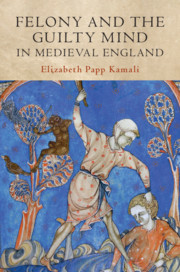
BOOK: Elizabeth P. KAMALI, Felony and the Guilty Mind in Medieval England [Studies in Legal History] (Cambridge: Cambridge University Press, 2019).


(Source: CUP)

Cambridge University Press has published a new book on the role of mens rea during the first two centuries of the English criminal trial jury.

ABOUT THE BOOK

This book explores the role of mens rea, broadly defined as a factor in jury assessments of guilt and innocence from the early thirteenth through the fourteenth century - the first two centuries of the English criminal trial jury. Drawing upon evidence from the plea rolls, but also relying heavily upon non-legal textual sources such as popular literature and guides for confessors, Elizabeth Papp Kamali argues that issues of mind were central to jurors' determinations of whether a particular defendant should be convicted, pardoned, or acquitted outright. Demonstrating that the word 'felony' itself connoted a guilty state of mind, she explores the interplay between social conceptions of guilt and innocence and jury behavior. Furthermore, she reveals a medieval understanding of felony that involved, in its paradigmatic form, three essential elements: an act that was reasoned, was willed in a way not constrained by necessity, and was evil or wicked in its essence.

ABOUT THE AUTHOR

Elizabeth Papp Kamali, Harvard Law School, Massachusetts
Elizabeth Papp Kamali is Assistant Professor of Law at Harvard Law School, Massachusetts.

TABLE OF CONTENTS

List of figures
Acknowledgments
List of abbreviations
Introduction
The history of Mens Rea
Methodology
The trial jury and its predecessors: Anglo-Saxon and Angevin Antecedents
A brief chapter summary
The essentials of medieval English felony procedure
Part I. Felonia Felonice Facta: Felony and Intentionality:
1. The meaning of felony
1.1 Felonia Felonice Facta and the question of non-felonious felonies
1.2 The etymology of felony
2. Felony in the archives
2.1 Words of felony in law and literature
2.2 Accomplice liability and the nexus between actus reus and mens rea
2.3. A felonious state of mind
2.4 Conclusion to Part I
Part II. Þe Deuylys Doghtyr of Hellë Fyre: Felony and Emotion:
3. The language of anger
3.1 An elite emotional episode: the Warenne-Zouche Incident
3.2 The history of law and emotion
3.3 The language of anger
3.4 Anger and the common law: an overview
3.5 Passion in the plea rolls
3.6 Melancholic felony in Gower's Tale of Canace and Machaire
4. Cultural understandings of anger
4.1 Anger and the judgment day
4.2 Positive manifestations of the passion
4.3 Anger in the confessional
4.4. Slights, affronts, and provocations
4.5 Anger, provocation, and the medieval English jury
4.6 Conclusion to Part II
Part III. Handlyng Synne: Guilt and Innocence:
5. Confession and circumstantial inquiry
5.1 Confessions of a horse thief
5.2 A confessing society
5.3 Inquiry into the circumstances
5.4 The role of confession in felony adjudication
6. Guilt assessment in medieval England
6.1 Handlyng Synne and crime
6.2 Sins of thought, speech, deed
6.3 Rankings of sins and crimes
6.4 Conclusion to Part III
Part IV. Dies Iræ: Judge and Jury:
7. Tales of judging
7.1 The perils and prosaic nature of judging
7.2 Pontius Pilate and deference to jury verdicts
7.3 The misjudging of Christ and its resonance
8. The mind and comportment of judge and jury
8.1 Erkenwald and the Pagan judge
8.2 Harsh justice tempered by mercy
8.3 The proper comportment of those who judge
8.4 Judicial states of mind
8.5 Conclusion to Part IV
Conclusion
Looking back
Looking forward
Legal literacy and the medieval English jury
Bibliography
Index.

More information here

BOOK: Hans Petter GRAVER (Melanie HACK Transl.), Der Krieg der Richter Die Deutsche Besetzung 1940-1945 und der norwegische Rechtsstaat,. (Baden-Baden: Nomos , 2019). ISBN 978-3-8487-5475-5, €84.00


(Source: Nomos)

Nomos has published a new book (translated to German from Norwegian) on the German and Norwegian courts during the time of Nazi occupation.

ABOUT THE BOOK

Hans Petter Graver, Seines Zeichens Ordinarius am Institut für Privatrecht der Universität Oslo, arbeitet in seinem Buch „Richter im Krieg“ die Rolle der deutschen und norwegischen Gerichte während der Besatzungszeit von 1940 bis 1945 auf. „Furchtbare Juristen“ verrichteten während des Zweiten Weltkriegs auch in Norwegen ihren „Dienst“, allen voran jene des Reichskriegsgerichts, des SS- und Polizeigerichts Nord sowie diverser Sondertribunale und Standgerichte. Während die Nazifizierung nicht zuletzt durch den Nasjonal Samling fast das gesamte Rechtswesen erfasste, gab es auch Protest in der Richterschaft. Wie ist jedoch der relativ geringe Widerstand zu erklären? Wie ließen sich „nationalsozialistischer Geist“ mit richterlichem Selbstverständnis und professionellem Berufsethos vereinbaren? Hans Petter Graver gibt nun auch für die Leserschaft im deutschsprachigen Raum einen spannenden Einblick in eine Zeit voller Gewissensfragen.

More info here

11 October 2019

PODCAST: Pierre-Anne FORCADET (Orléans) on Étendre la justice du roi, construire l’État (Canal Académie)

(image source: Canalacademie)

Abstract:
Le « siècle de saint Louis » est celui du déploiement nouveau d’une justice royale hiérarchisée et professionnelle. Plusieurs réformes successives permettent aux sujets du royaume d’avoir accès à la justice. L’appel judiciaire au parlement royal se systématise contre les jugements de justices concurrentes et scelle la supériorité de la justice royale, que l’on commence à qualifier de « souveraineté ». Les recours sont alors portés, pour une large part, contre le roi lui-même et ceux de ses agents qui commettent des exactions, mais également par les hommes contre leurs seigneurs laïcs ou ecclésiastiques. La justice royale apparaît de manière croissante comme un régulateur des relations féodales. Étendant son influence, elle participe à l’instauration d’un État de droit.
On the laureate:
La 1ère médaille de la commission des Antiquités de la France, a été décernée en 2019 à Pierre-Anne Forcadet, maître de conférences en histoire du droit à l’université d’Orléans, sur approbation de l’Académie des inscriptions et belles-lettres, pour son ouvrage Conquestus fuit domino regi. Le recours au roi d’après les arrêts du Parlement de Paris (1223-1285), paru chez De Boccard en 2018 
Listen here.

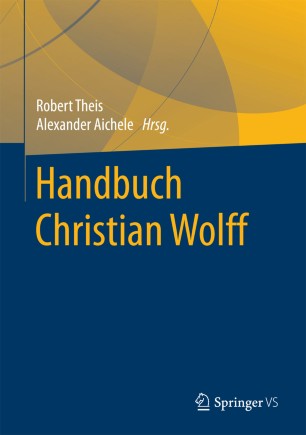
BOOK: Robert THEIS & Alexander AICHELE (Hrsg.), Handbuch Christian Wolff (Heidelberg: Springer, 2018), ISBN 978-3-658-14736-5 € 86,99

(image source: Springer)

Book abstract:
Mit diesem Buch wird erstmals ein umfassendes und systematisches Referenzwerk zu Christian Wolff vorgelegt, das alle wichtigen Aspekte zu Leben und Werk des Philosophen behandelt. Das Handbuch ist von international renommierten Experten verfasst und behandelt die Biographie, das philosophische und naturwissenschaftlich-mathematische Werk sowie die philosophiegeschichtliche Rolle von Christian Wolff.
On the editors:
 Prof. em. Dr. Robert Theis lehrte Philosophie an der Universität Luxemburg. PD Dr. Alexander Aichele lehrt Philosophie an der Universität Halle.
Read more on SpringerLink.

(source: ESILHIL Blog)

BOOK: Jean-Pierre DIENY, Le Droit Mongol dans l’État Sino-Mandchou (1644-1911) (Paris: Editions de Boccard, 2019). ISBN 978-2-85757-079-0, 35,00 €


Editions De Boccard has published a new book on Chinese Ming dynasty laws in the Mongol sphere.

ABOUT THE BOOK

Partant d’une description complète de la législation impériale promulguée par le gouvernement des Qing pour la Mongolie, l’auteur examine dans ce livre les problèmes nés de l’introduction de cette législation aux Mongols et de l’application de celle-ci. L’étude d’un large éventail de documents juridiques — incluant les codes mongols antérieurs aux Qing, la législation impériale, les règlements administratifs et les jugements rendus à la fois aux niveaux local et central — lui permet d’analyser les interactions entre le droit et diverses questions relatives à l’autonomie locale, au pluralisme juridique, à l’assimilation politique et aux relations entre le centre et la périphérie. L’auteur défend l’idée que les Qing tendirent à mettre en valeur l’approche et les principes du droit chinois lors de l’élaboration de la législation propre aux Mongols. Ils transférèrent progressivement une grande partie de concepts étrangers à la tradition juridique mongole, sinon leur totalité. Malgré les efforts importants mis en œuvre pour contrôler et normaliser l’administration des régions périphé-riques jusqu’à en faire une extension de la Chine intérieure plutôt qu’un protectorat gouverné par l’aristocratie locale, et malgré les effets de l’immigration Han en Mongolie, les principes du droit mongol ne disparurent cependant pas complètement, ainsi qu’en témoignent les jugements rendus par les juges des niveaux inférieurs de l’administration Qing en Mongolie.

More info here

10 October 2019

JOB: Chef de travaux, doctor in contemporary History (CEGESOMA, Brussels)


Le CegeSoma (Centre d'Études et de Documentation Guerre et Sociétés contemporaines) recrute un chef de travaux de la carrière scientifique. Cet emploi est accessible aux candidats pouvant être affectés au rôle linguistique néerlandais.

Davantage d'informations sur le site.

(source: Standen & Landen/Anciens Pays et Assemblées d'États)