Search

Showing posts with label transitional justice. Show all posts

19 November 2024

BOOK: Paolo CAROLI, Transitional Justice in Italy and the Crimes of Facism and Nazism [Routledge Research in Legal History] (London: Routledge, 2024), 280 p., ISBN 9781032226231, 31,99 GBP


(image: Routledge)

Abstract:
This book presents a comprehensive analysis of the Italian experience of transitional justice examining how the crimes of Fascism and World War II have been dealt with from a comparative perspective. Applying an interdisciplinary and comparative methodology, the book offers a detailed reconstruction of the prosecution of the crimes of Fascism and the Italian Social Republic as well as crimes committed by Nazi soldiers against Italian civilians and those of the Italian army against foreign populations. It also explores the legal qualification and prosecution of the actions of the Resistance. Particular focus is given to the Togliatti amnesty, the major turning point, through comparisons to the wider European post-WWII transitional scenario and other relevant transitional amnesties, allowing consideration of the intense debate on the legitimacy of amnesties under international law. The book evaluates the Italian experience and provides an ideal framework to assess the complexity of the interdependencies between time, historical memory and the use of criminal law. In a historical moment marked by the resurgence of racism, neo-Fascism, falsifications of the past, as well as the desire to amend the faults of the past, the Italian unfinished experience of dealing with the Fascist era can help move the discussion forward. The book will be an essential reading for students, researchers and academics in International Criminal Law, Transitional Justice, History, Memory Studies and Political Science.

Table of contents:

1. Historical, legal and judicial context of the transition 2. The Togliatti amnesty 3. The Togliatti amnesty within the framework of transitional justice 4. The Italian experience within the framework of transitional justice 5. The legacy of the Italian transitional justice 

On the author:

Paolo Caroli is Lecturer of Criminal Law in the Faculty of Law at the University of Turin, Italy. Previously, he was Fellow of the Alexander von Humboldt Foundation in the Faculty of Law at the Humboldt University of Berlin, Germany. 

Read more here.


09 April 2024

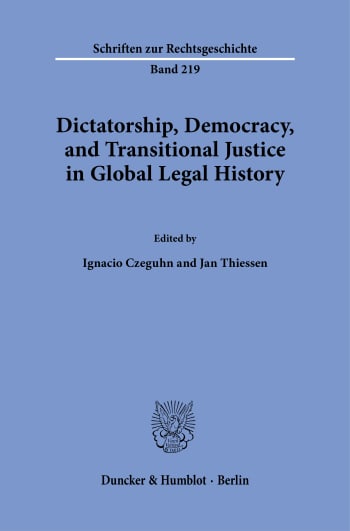
BOOK: Ignacio CZEGUHN & Jan THIESSEN (eds.), Dictatorship, Democracy, and Transitional Justice in Global Legal History [Schriften zur Rechtsgeschichte; 219] (Berlin: Duncker & Humblot, 2023), 214 p., ISBN 978-3-428-18579-5

Cover: Dictatorship, Democracy, and Transitional Justice in Global Legal History

Book abstract:

The anthology presents the lectures given on the symposium »From Dictatorship to democracy« at the House of the Wannsee Conference on 13–14 September 2021. The aim of the organizers was to show what problems existed during the transition from dictatorship to democracy in several countries around the world. They all enacted laws or other measures to ensure that fundamental rights and the rule of law would resist anti-democratic ideologies, anti-Semitism, racism, and war crimes in the future. However, the legal system and law in these countries themselves often had their origins in dictatorship. Thus, there were and are obvious and hidden anti-democratic continuities that influence law and the legal system up to the present. Scientifics and jurists from Italy, Japan, Poland, Spain, South Africa, and Germany examine these continuities in their contributions.

Table of contents:

Ignacio Czeguhn and Jan Thiessen
Introduction

Ignacio Czeguhn
The Berlin Administration of Justice after 1945 – Factual and Personnel Continuities with the Nazi Justice System. Presentation of the Project and State of Research

Vittoria Calabrò
Continuità e discontinuità nel passaggio dalla dittatura alla democrazia: la vicenda del giurista

Gaspare Ambrosini
Bronisław Sitek and Albert Pielak: From Sovietization to Democratization of Justice in Poland (1944–1997)

Miho Mitsunari
Wartime Sexual Violence and War Responsibility: The »Comfort Women Issue« in Japan

José Antonio Pérez Juan
The Amnesty Measures of the Spanish Transition

Antonio Sánchez Aranda
Franco’s Regime. From Totalitarism to Authoritarism in its Repressive Model (April 1936–November 1975)

Ramón M. Orza Linares
La transición a la democracia en los países de América Central

Gerhard Kemp
From Dictatorship to Democracy in South Africa

Claudia Vanoni
Drei Jahre Antisemitismusbeauftragte der Generalstaatsanwaltschaft Berlin – ein Erfahrungsbericht

Samuel Salzborn
Kontinuität, Tradierung und Transformation des Antisemitismus

Jan Thiessen
The Treatment of the Nazi Past in Contemporary German Legal Education

Benjamin Lahusen
Learning from History? Current Developments in the Restitution of Nazi-Confiscated Property

Read more here. 


27 February 2024

CALL FOR PAPERS: Conference: Transitional Justice in the Early Modern World (Groningen: University of Groningen, 3–5 APR 2025); DEADLINE 15 MAY 2024


(image source: histj)

Abstract:

How to reconcile former enemies in the wake of civil conflict and prevent a return to violence? Transitional justice, defined by the United Nations as ‘the full range of processes and mechanisms associated with a society’s attempts to come to terms with a legacy of large-scale past abuses, in order to ensure accountability, serve justice, and achieve reconciliation’, has become a ubiquitous concept for understanding peacebuilding in the modern world. Transitional justice mechanisms typically include prosecution, reparations, restitution, amnesty, the purging of state officials, truth and reconciliation commissions, and communal remembrance. Most scholarship has focused on recent theaters of conflict, such as the former Yugoslavia, South Africa, and countries affected by the Arab Spring.

Mechanisms associated with transitional justice have a much older history, however, stretching at least as far back as the early modern period. Because the Reformation had split Christendom into competing Protestant and Catholic communities, early modern Europe experienced civil conflict on an unprecedented scale – yet the Wars of Religion at the same time forced societies to develop new peacebuilding strategies. Healing the scars of civil conflict also became a key objective after the Atlantic revolutions, as political opponents had to be reintegrated into the emerging nation state. Nor were peacebuilding efforts exclusive to Europe: post-war societies in Asia and Africa also relied on formal strategies to reconcile former opponents. The Tokugawa Shoguns had to contend with how to make peace after the wars of the Warring States Era, while King Pedro IV Nusamu a Mvemba had to find a way to make peace after four decades of civil war had ravaged the Kingdom of the Kongo, to name but two examples. This conference thus approaches the early modern period as a particularly productive field for the wider study of peacebuilding and transitional justice. How exactly did post-war societies before the modern age deal with the challenge of peacebuilding? What particular transitional justice strategies did they develop? And how effective were they in achieving peace and reconciliation, either on a local or national level? As such, this conference aims to evaluate how the study of transitional justice can reshape our understanding of the early modern world – not just as a period of incessant conflict, but also a laboratory for peacebuilding efforts.

Instructions:

We welcome proposals covering any aspect of peacebuilding and transitional justice in the early modern world, both in Europe and beyond. PhDs and early career researchers are especially encouraged to submit; we have funding available to help cover their transport and accommodation. All proposals should include a brief CV and an abstract of no more than 300 words. Please submit your documents by email before 15 May 2024 to buildingpeaceconference@gmail.com. Applicants shall be informed by 17 June 2024. It is our intention to publish a selection of the conference papers. 

Read more here. 

27 October 2023

LECTURE CYCLE: Forme dello straordinario tra giustizia, politica e diritti. Modelli e pratiche a confronto (Brescia/Milano: University of Brescia/University of Milan, OCT-NOV 2023)

(Image source: event flyer)


Il ciclo di incontri si propone quale occasione di riflessione intorno alle forme della giustizia straordinaria (e alle forme straordinarie della giustizia), attraverso un ideale dialogo fra l’esperienza giuridica italiana e quella brasiliana nel XX secolo. Due esperienze accomunate da profili di importanti discontinuità costituzionali e politiche, stati d’eccezione, transizioni. 

Con attenzione alla costante dialettica tra teoria e prassi, si cercherà di osservare la risposta del diritto, attraverso i suoi interpreti, in una cornice che vede compresenti esigenze, spesso fra loro confliggenti: quelle della politica e ella giustizia, quelle dell’ordine e della libertà.  

Le due sessioni, nelle quali si articola il progetto, si svolgeranno tra le Università di Milano e Brescia e saranno rispettivamente dedicate, la prima, ai processi per collaborazionismo celebrati in Italia tra il 1945 e il 1947 nella transizione dal fascismo alla Repubblica; la seconda ad alcuni peculiari strumenti di tutela dei diritti fondamentali in Brasile, durante gli stati d’assedio e poi nelle fasi di transizione, fra la Prima Repubblica e l’Estado Novo.


PROGRAMME

I SESSIONE - Esperienze della giustizia di transizione nell’Italia del secondo dopoguerra. I processi avanti le Corti d’Assise Straordinarie

30 ottobre 2023 ore 14.00-15.30; Università degli Studi di Brescia, via S. Faustino 41
RAFFAELLA BIANCHI RIVA (UniMI): I ‘ragazzi di Salò’ davanti alla giustizia di transizione italiana: propaganda fascista e responsabilità penale

15 novembre 2023 ore 14.00-15.30; Università degli Studi di Brescia, via S. Faustino 41
CECILIA NUBOLA (FBK ISIG): Fasciste di Salò alla sbarra

21 Novembre 2023 ore 10.30-12.00; Università degli Studi di Milano, via Festa del Perdono 7
FEDERICA PALETTI (UniBS): ‘Prender parte’. Dinamiche processuali tra norma e interpretazione  nei processi per collaborazionismo

28 novembre 2023 ore 10.30-12.00; Università degli Studi di Milano, via Festa del Perdono 7
LEONARDO POMPEO D’ALESSANDRO (UniMI): Un caso di studio: la Corte d’assise straordinaria di Milano tra giustizia e politica


II SESSIONE - Discontinuità e transizioni: diritti e giustizia nel Brasile contemporaneo

Aprile 2024 – Maggio 2024; Università degli Studi di Brescia, via S. Faustino 41

ELISABETTA FUSAR POLI (UniBS)
 in dialogo con
  • TATIANA DE SOUZA CASTRO (PhD UniMC e UFRuralRJ): Gli stati d’eccezione in Brasile e la tutela dei diritti: la giurisprudenza fra 1889 e 1930
  • GABRIEL FAUSTINO SANTOS (PhD UniMC): La tutela dei diritti fondamentali nella transizione: il Brasile dell’Era Vargas (1930-1945)

More information can be found here.

27 July 2020

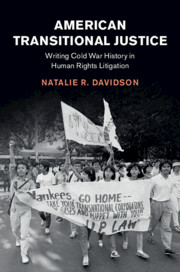
BOOK: Natalie R DAVIDSON, American Transitional Justice - Writing Cold War History in Human Rights Litigation (Cambridge: Cambridge University Press, 2020). ISBN 9781108477703, 75.00 GBP


(Source: CUP)

Cambridge University Press is publishing a new book on Alien Tort Statute litigation (US) during the Cold War.

ABOUT THE BOOK

Natalie Davidson offers an alternative account of Alien Tort Statute litigation by revisiting the field's two seminal cases, Filártiga (filed 1979) and Marcos (filed 1986), lawsuits ostensibly concerned with torture in Paraguay and the Philippines, respectively. Combining legal analysis, archival research and ethnographic methods, this book reveals how these cases operated as transitional justice mechanisms, performing the transition of the United States and its allies out of the Cold War order. It shows that US courts produced a whitewashed history of US involvement in repression in the Western bloc, while in Paraguay and the Philippines the distance from US courts allowed for a more critical narration of the lawsuits and their underlying violence as symptomatic of structural injustice. By exposing the political meanings of these legal landmarks for three societies, Davidson sheds light on the blend of hegemonic and emancipatory implications of international human rights litigation in US courts.

ABOUT THE AUTHOR

Natalie R. Davidson, Tel-Aviv University
Natalie Davidson is a Lecturer in the Faculty of Law at Tel-Aviv University. She has published about Alien Tort Statute litigation, feminist interventions in international law, the prohibition of torture, and interdisciplinary methodology.

TABLE OF CONTENTS

1. Introduction. Revisiting the Gilded Age of transnational human rights litigation in US courts
2. Alien tort statute litigation in legal practice and the legal imagination
3. 'Foreign torture, American justice': Filártiga in the United States
4. Filártiga in Paraguay
5. Narrating the Marcos regime in US courts
6. The Marcos case and transitional justice in the Philippines
7. Conclusion.

More info here

15 April 2019

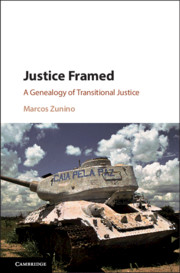
BOOK: Marcos ZUNINO, Justice Framed : A Genealogy of Transitional Justice (Cambridge: Cambridge University Press, 2019). ISBN 9781108475259, £ 85.00


(Source: CUP)

Cambridge University Press has published a book dealing with the history of transitional justice.

ABOUT THE BOOK

Why are certain responses to past human rights violations considered instances of transitional justice while others are disregarded? This study interrogates the history of the discourse and practice of the field to answer that question. Zunino argues that a number of characteristics inherited as transitional justice emerged as a discourse in the 1980s and 1990s have shaped which practices of the present and the past are now regarded as valid responses to past human rights violations. He traces these influential characteristics from Argentina's transition to democracy in 1983, the end of communism in Eastern Europe, the development of international criminal justice, and the South African truth commission of 1995. Through an analysis of the post-World War II period, the decolonisation process and the Cold War, Zunino identifies a series of episodes and mechanisms omitted from the history of transitional justice because they did not conform to its accepted characteristics.

ABOUT THE AUTHOR

Marcos Zunino, British Institute of International and Comparative Law

TABLE OF CONTENTS

1. Introduction
Part I. History:
2. The discourse of transitional justice: objects, concepts, actors and characteristics
3. The birth of transitional justice: emergence
Part II. Prehistory:
4. The myth of Nuremberg: origin
5. The Cold War impasse: descent
6. Conclusion
Bibliography
Index.

More information here

18 March 2019

CALL FOR PAPERS: 8th Annual Conference of the Historical Dialogues, Justice & Memory Network – Prevention Activism: Advancing Historical Dialogue in Post-Conflict Settings (New York, 12-14 December 2019) (DEADLINE: 20 June 2019)


We learned of a call for papers for the 8th Annual Conference of the Historical Dialogues, Justice & Memory Network. Here the call:

8th Annual Conference of the Historical Dialogues, Justice & Memory Network
Columbia University
New York City
December 12-14, 2019
Call for Papers
Deadline for submissions: June 20, 2019

Prevention activism—that is, the effort to record, acknowledge, address and redress the violent past— seeks to counter nationalist myths and identities that are central ingredients of ethnic and political violence. Its goal is to deny the propensity for the future escalation of violence by acknowledging the role that the misuse of history has played in dividing societies. In other words, by enhancing public discussions about the past, prevention activism has become a central part of the efforts in post-conflict societies, as well as in democratic societies, to come to terms with their violent past.
This conference seeks to explore activities that can be defined as “prevention activism”, and their academic analysis. What forms do projects and initiatives take to address past violence, and what impact have they had? These projects often range from civil society initiatives, to government-instated commissions, to the work of international bodies. We are particularly interested in the study of how a specific body has worked to address past violence. Other topics include evaluating the success and failures of such initiatives; exploring the challenges faced by prevention activism; understanding the ways in which pressures, from funding resources to political developments, affect, suppress or inform activism.

Prevention activism and the ways in which it has been implemented on the ground inspired the Mapping Historical Dialogue Project (http://historicaldialogues.org/mhdp/), and papers that take up this resource, or a discussion of the projects mapped therein are also welcome.

The Historical Dialogues, Justice and Memory Network (http://historicaldialogues.org/), which is coordinated by an international Steering Committee, the Alliance for Historical Dialogue and Accountability (AHDA) at the Institute for the Study of Human Rights, will hold its annual conference on December 12-14, 2019 at the Columbia University in New York City, USA.

In addition to papers that specifically address prevention activism, priority will be given to papers that explore the relationship between memory (individual, societal or international) and historical dialogue, and empirical approaches to historical dialogue, with a particular focus on the issue of the efficacy of justice, accountability and reconciliation mechanisms.

If you are interested in participating, please e-mail a 300-500 word abstract, a 2-3 sentence bio, and contact information to email: ahda.conference.2019@gmail.comno later than June 20th, 2019. The documents should be sent in a single e-mail attachment. The conference is open to the scholars and activists from around the world. The conference language is English, no translation available. There is no conference registration fee, and no funding for participation is provided. Applications for panels or roundtables are also welcome.

Panel Submissions

Panels consist of a chair and 3-4 panelists. Panelists should plan to speak for 15 minutes each; the chair is expected to start the panel in a timely manner, to introduce each panelist, to ensure that speakers keep to their allotted time, and to moderate the Q and A. Panelists are not asked to circulate their papers in advance. If you are interested in submitting a panel, please provide a title for the panel and a brief overview of the theme or question that the panel will explore. Participants should also provide a title and abstract for their presentation. They should also include a brief, 2-3 sentence bio and their contact information. These materials should be submitted as a single document to email: 
ahda.conference.2019@gmail.com

Roundtables

Roundtable sessions consist of 4-5 discussants and a moderator, who participates more fully in the session than a panel chair would in a traditional panel. Participants in roundtables do not present or read formal papers, but rather engage in a discussion or exchange about a specific question, text, or issue. The focus of discussion must be clearly articulated in the abstract, and participants are expected to prepare their remarks in advance, even if the nature of a roundtable is less formal than a traditional panel. If you are interested in submitting a roundtable abstract, please include the title of the roundtable, a description (300-500 words) of the issue or question to be discussed, and a list of participants with a brief bio for each person listed, including contact information for each participant. These materials should be submitted as a single document to email 
ahda.conference.2019@gmail.com.


More information here

28 August 2018

BOOK: Roldán Jimeno ARANGUREN, Amnesties, Pardons and Transitional Justice : Spain’s Pact of Forgetting (London: Routledge, 2017). ISBN 9781138091603, £115.00


(Source: Routledge)

Last year, Routledge published a book on amnesty and pardons in the wake of Francoist Spain

ABOUT THE BOOK

In a consolidated democracy, amnesties and pardons do not sit well with equality and a separation of powers; however, these measures have proved useful in extreme circumstances, such as transitions from dictatorships to democracies, as has occurred in Greece, Portugal and Spain. Focusing on Spain, this book analyses the country's transition, from the antecedents from 1936 up to the present, within a comparative European context. The amnesties granted in Greece, Portugal and Spain saw the release of political prisoners, but in Spain amnesty was also granted to those responsible for the grave violations of human rights which had been committed for 40 years. The first two decades of the democracy saw copious normative measures that sought to equate the rights of all those who had benefitted from the amnesty and who had suffered or had been damaged by the civil war. But, beyond the material benefits that accompanied it, this amnesty led to a sort of wilful amnesia which forbade questioning the legacy of Francoism. In this respect, Spain offers a useful lesson insofar as support for a blanket amnesty – rather than the use of other solutions within a transitional justice framework, such as purges, mechanisms to bring the dictatorship to trial for crimes against humanity, or truth commissions – can be traced to a relative weakness of democracy, and a society characterised by the fear of a return to political violence. This lesson, moreover, is framed here against the background of the evolution of amnesties throughout the twentieth century, and in the context of international law. Crucially, then, this analysis of what is now a global reference point for comparative studies of amnesties, provides new insights into the complex relationship between democracy and the varying mechanisms of transitional justice.

ABOUT THE AUTHOR

Roldán Jimeno is a Senior Lecturer in Legal History at the Public University of Navarre, Spain.

TABLE OF CONTENTS

Introduction
1 Background to Francoist Spain: Granting pardons to the defeated in the war and enemies of the regime
2 The beginnings of the transition
3 The 1977 Amnesty Law and subsequent clemency measures
4 Amnesty during the post-transition years (1982–2007)
5 Amnesty after the Historical Memory Law (2007–2016)
Conclusion

More information here

23 June 2018

PODCAST: Histoire de la justice [La Fabrique de l'Histoire] (France Culture)

(image source: France Culture)

La Fabrique de l'Histoire, France Culture's flagship academic history podcast, welcomed a series of colleagues to discuss the history of justice.

Themes:

  • Medieval justice
  • Epuration and Vichy
  • When the population demands justice...
  • Social sciences and international criminal justice


More information here.

23 September 2015

JOBS: One Ph.D.-Student and One Postdoctoral Researcher "Law of Truth and Truth of Law. Impunity of Mass Atrocities and Transitional Justice" (University of Geneva); DEADLINE 1 OCTOBER 2015

(image: Geneva University; source: Wikimedia Commons)

The Research Project "Droit à la vérité et vérité du droit. Impunité des crimes de masse et justice transitionnelle", funded by the FNRS (Switzerland) at the University of Geneva, under promotorship of Prof. dr. Sévane Garibian, advertises two vacancies.

1. Ph.D.-student

Cahier des charges

Le cahier des charges comprend les tâches suivantes :
  • Rédaction d'une thèse de doctorat dans le domaine de la justice transitionnelle (en particulier : enquête et établissement des faits)
  • Soutien à l'organisation de manifestations à caractère scientifique en la matière
  • Participation à activités de recherche collective

Conditions de candidature

  • Maîtrise universitaire en droit (Master), avec une bonnne moyenne générale
  • Maîtrise du français (ou de l'anglais)
  • Maîtrise au moins passive de l'anglais (ou du français)
  • Maîtrise d'une autre langue étrangère souhaitable (l'espagnol, notamment, constitue un atout)
  • Ouverture au travail d'équipe et à l'interdisciplinarité

Contrat

Durée du contrat : 4 ans à partir du 1er février 2016 (ou à convenir)
Salaire annuel brut de départ : CHF 47'040.-

Composition du dossier de candidature

  • Un curriculum vitae
  • Une lettre de motivation
  • Une copie des PV d'examens
  • Une copie du mémoire de Master
  • Deux lettres de recommandation

Modalités de candidature

Les dossiers complets doivent être déposés exclusivement en ligne en cliquant sur le bouton "postuler/apply now" du site https://jobs.unige.ch

au plus tard le 1er octobre 2015.

Aucune candidature par email ou par envoi postal ne sera prise en considération.
Pré-sélection des dossiers courant octobre 2015, puis entretiens avec les candidat-e-s "shortlisté-e-s

Modalités de sélection

Les présélections auront lieu courant octobre. Les entretiens avec les candidats présélectionnés se dérouleront avec la professeure Sévane Garibian en charge du projet scientifique accompagnée par un ou deux chercheurs extérieurs. Leurs noms seront communiqués aux candidats présélectionnés.


2. Postdoctoral Researcher

Cahier des charges

Le cahier des charges comprend les tâches suivantes :
  • Travail de recherche postodoctorale dans le domaine de la justice transitionnelle (en particulier : exhumations et expertise médico-légale)
  • Organisation de manifestations et activités à caractère scientifique en la matière
  • Participation active à recherche collective

Conditions de candidature

  • Doctorat depuis moins de 5 ans (en droit ou autres disciplines)
  • Maîtrise du français (ou de l'anglais)
  • Bonne connaissance de l'anglais (ou du français)
  • Maîtrise au moins passive d'une autre langue étrangère souhaitable
  • Ouverture au travail d'équipe et à l'interdisciplinarité

Contrat

Durée du contrat : 4 ans à partir du 1er février 2016 (ou à convenir)
Rémunération : sur demande

Composition du dossier de candidature

  • Un curriculum vitae
  • Une liste des publications
  • Une lettre de motivation
  • Une copie de trois travaux scientifiques publiés (ou acceptés pour publication), dont la thèse de doctorat
  • Deux à trois lettres de recommandation

Modalités de candidature

Les dossiers complets doivent être déposés exclusivement en ligne en cliquant sur le bouton "postuler/apply now" du site https://jobs.unige.ch

au plus tard le 1er octobre 2015.

Aucune candidature par email ou par envoi postal ne sera prise en considération.
Pré-sélection des dossiers courant octobre 2015, puis entretiens avec les candidat-e-s "shortlisté-e-s

Modalités de sélection

Les présélections auront lieu courant octobre. Les entretiens avec les candidats présélectionnés se dérouleront avec la professeure Sévane Garibian en charge du projet scientifique accompagnée par un ou deux chercheurs extérieurs. Leurs noms seront communiqués aux candidats présélectionnés.

More information on Calenda.org (Ph.D.-student, Postdoctoral Researcher)