Search

25 April 2019

BOOK: Christabelle SETHNA and Gayle DAVIS, eds., Abortion Across Borders : Transnational Travel and Access to Abortion Services (Baltimore: Johns Hopkins University Press, 2019). ISBN 9781421427294, $59.95


Johns Hopkins University Press has published a book on transnational travel and access to abortion services, which includes many contributions with a legal-historical angle.

ABOUT THE BOOK

Safe, legal, and affordable abortion is widely recognized as an essential medical service for women across the world. When access to that service is denied or restricted, women are compelled to carry unwanted pregnancies to term, seek backstreet abortionists, attempt self-induced abortions, or even travel to less restrictive states, provinces, and countries to receive care.

Abortion across Borders focuses on travel across domestic and international boundaries to terminate a pregnancy. Christabelle Sethna and Gayle Davis have gathered a cadre of authors to examine how restrictive policies force women to move both within and across national borders in order to reach abortion providers, often at great expense, over long distances and with significant safety risks. Taking historical and contemporary perspectives, contributors examine the situation in regions that include Texas, Prince Edward Island, Ireland, Australia, the United Kingdom, and Eastern Europe. Throughout, they take a feminist intersectional approach to transnational travel and access to abortion services that is sensitive to inequalities of gender, race, and class in reproductive health care.

This multidisciplinary volume raises challenging logistical, legal, and ethical questions while exploring the gendered aspects of medical tourism. A noticeable rollback of reproductive rights and renewed attention to border security in many parts of the world will make Abortion across Borders of timely interest to scholars of gender and women's studies, health, medicine, law, mobility studies, and reproductive justice.

Contributors: Barbara Baird, Niklas Barke, Anna Bogic, Hayley Brown, Lori A. Brown, Cathrine Chambers, Ewelina Ciaputa, Gayle Davis, Mary Gilmartin, Agata Ignaciuk, Sinéad Kennedy, Lena Lennerhed, Jo-Ann MacDonald, Colleen MacQuarrie, Jane O'Neill, Clare Parker, Christabelle Sethna, Sally Sheldon

TABLE OF CONTENTS

Acknowledgments
Introduction
Christabelle Sethna
Part I. Flight Risks
1. Sherri Finkbine Flew to Sweden: Abortion and Disability in the Early 1960s
Lena Lennerhed
2. From Heathrow Airport to Harley Street: The ALRA and the Travel of Nonresident Women for Abortion Services in Britain
Christabelle Sethna
3. The Trans-Tasman Abortion Travel Service: Abortion Services for New Zealand Women in the 1970s
Hayley Brown
Part II. Domestic Transgressions
4. All Aboard the "Abortion Express": Geographic Variability, Domestic Travel, and the 1967 British Abortion Act
Gayle Davis, Jane O'Neill, Clare Parker, and Sally Sheldon
5. A Double Movement: The Politics of Reproductive Mobility in Ireland
Mary Gilmartin and Sinéad Kennedy
6. Tales of Mobility: Women's Travel and Abortion Services in a Globalized Australia
Barbara Baird
7. Don't Mess with Texas: Abortion Policy, Texas Style
Lori A. Brown
8. Trials and Trails: The Emergence of Canada's Abortion Refugees in Prince Edward Island
Cathrine Chambers, Colleen MacQuarrie, and Jo-Ann MacDonald
Part III. Democratic Transitions
9. Abortion Travel and the Cost of Reproductive Choice in Spain
Agata Ignaciuk
10. "The Import Problem": The Travels of Our Bodies, Ourselves to Eastern Europe
Anna Bogic
11. Abortion and the Catholic Church in Poland
Ewelina Ciaputa
12. Beyond the Borders of Brexit: Traveling for Abortion Access to a Post-EU Britain
Niklas Barke
Contributors
Index

ABOUT THE EDITORS

Christabelle Sethna is a professor in the University of Ottawa's Institute of Feminist and Gender Studies. She is the coauthor of Just Watch Us: RCMP Surveillance of the Women's Liberation Movement in Cold War Canada and a coeditor of Animal Metropolis: Histories of Human-Animal Relations in Urban Canada. Gayle Davis is a senior lecturer in the history of medicine at the University of Edinburgh. She is a coauthor of The Sexual State: Sexuality and Scottish Governance, 1950–80 and a coeditor of The Palgrave Handbook of Infertility in History: Approaches, Contexts and Perspectives.

More information here

BOOK CHAPTER: Luigi DELIA, " Le droit naturel à la lumière des encyclopédies (1751-1791)", in: Martine GROULT & Luigia DELIA (dir.), Panckoucke et l'Encyclopédie méthodique. Ordre de matières et transversalité [Rencontres; 385] (Paris: Classiques Garnier, 2019), pp. 219-243 ISBN 978-2-406-07472-4

(image source: Classiques Garnier)

Book abstract:
Occultée par l’Encyclopédie des Lumières, l’Encyclopédie méthodique composée de Dictionnaires spécialisés a été longtemps sous-estimée dans sa globalité. Ce livre analyse les Dictionnaires à travers la notion de transversalité, notion qui a permis d’éclairer le sens d’un ordre sans système.
Table of contents and downloadable separate chapters here.

24 April 2019

FREE MOOC: Introduction to Digital Humanities (Harvard)

(image source: Harvard)

Course description:
As primary sources of information are more frequently digitized and available online than ever before, how can we use those sources to ask new questions? How did Chinese families organize themselves and their landscapes in China’s past? How did African slaves from different cultures form communities in the Americas? What influences informed the creation and evolution of Broadway musicals? How can I understand or interpret 1,000 books all at once? How can I create a visualization that my students can interact with? The answers to these questions can be explored using a wide variety of digital tools, methods, and sources. As museums, libraries, archives and other institutions have digitized collections and artifacts, new tools and standards have been developed that turn those materials into machine-readable data. Optical Character Recognition (OCR) and the Text Encoding Initiative (TEI), for example, have enabled humanities researchers to process vast amounts of textual data. However, these advances are not limited just to text. Sound, images, and video have all been subject to these new forms of research. This course will show you how to manage the many aspects of digital humanities research and scholarship. Whether you are a student or scholar, librarian or archivist, museum curator or public historian — or just plain curious — this course will help you bring your area of study or interest to new life using digital tools.
More information here.

CONFERENCE: Citizenship in Classical Antiquity: Current Perspectives and Challenges (London, 1-3 July 2019)


(Source: UCL)

UCL (in cooperation with the Jagiellonian University) is organizing an international congress on citizenship in classical antiquity.

International conference

The Department of Greek and Latin, University College London, in co-operation with the Department of Classical Philology, Jagiellonian University in Kraków.

1-3 July 2019

University College London
What did citizenship mean in the ancient world, why was it important, and why should it matter to us today? Citizenship has been defined as 'both a set of practices cultural, symbolic and economic) and a bundle of rights and duties (civil, political and social) that define an individual's membership in a polity' (Isin & Wood 1999, Citizenship & Identity), and has existed in various forms since antiquity, holding complex resonances up to the present day. Depending on the socio-political context, a person's citizenship may be a matter of territorial belonging or blood descent; it may offer privileged or exclusive access to resources or participation in communal decision-making; it may provide a sense of group belonging that can be productive and rewarding, but such identification may also be open to discursive redefinitions and manipulation, primarily in public political debate. Citizenship may be connected to certain civic values, though how these are realised in practice may not always be simple. There are those for whom a society's emphasis on citizenship may cause serious problems, such as stateless persons and migrants.

The immediacy of issues surrounding the concept and practice of citizenship in the modern world calls for a re-investigation of the notion in its ancient contexts. Topics of discussions include but are not limited to:

- similarities and differences across Greek, Roman, Near-Eastern, or broader Mediterranean ideas of citizenship;
- insiders' and outsiders' perspectives in considering what citizenship entails (emic vs etic);
- the semantics and varying definitions of 'citizen' and 'citizenship';
- the self-presentation of citizens as a privileged social group;
- citizenship, social change, and social conflict;
- citizenship and the control of resources;
- interactions between citizenship and other (group) identities;
- creating and exploiting citizen identities in discourse;
- the importance and limits of legal definitions;
- civic training and education;
- political participation and majoritarianism;
- the topicality or inapplicability of classical paradigms.

This three-day conference is intended to promote discussion among scholars across different disciplines working on the theme of citizenship in classical antiquity in any capacity. It will include keynote lectures by Prof. Clifford Ando (Chicago), Prof. John Davies FBA, FSA (Liverpool), Prof. Engin Isin (QMUL), Dr Catherine Neveu (CNRS-EHESS), and Prof. Josiah Ober (Stanford), and will also include a public discussion event on the evening of Tuesday 2nd July.

We expect to be able to offer bursaries to assist graduate students in attending the conference.

For any enquires related to the Conference, please email: Jakub Filonik(jakub.filonik@uj.edu.pl) or Christine Plastow (christine.plastow@open.ac.uk)

The full program, as well as more information, can be found here

LECTURE: Dan EDELSTEIN (Stanford), "Enlightenment Human Rights Between Liberty and Equality" [George Rousseau Lecture] (Oxford: Magdalen College, 29 APR 2019)

(image source: Voltaire Foundation)

On the speaker and the event:
Thanks to a gift by George Rousseau, a scholar of eighteenth-century culture with strong links to Magdalen College, the first George Rousseau Lecture will take place on 29 April at Magdalen. It will be delivered by Professor Dan Edelstein of Stanford University, whose publications include The Terror of Natural Right (2009), The Enlightenment: A Genealogy (2010), and On the Spirit of Rights (2019). Professor Edelstein will also participate in the preceding afternoon colloquium on human rights and the Enlightenment.
On the lecture:
 Towards the end of the eighteenth century, two emblematic documents took for granted the view that all human beings were entitled to basic universal rights (usually within clearly demarcated political communities). In August 1789, the French Declaration of the Rights of Man and the Citizen began with a reference to ‘the natural, inalienable, and sacred rights of man’; 13 years earlier, the Founding Fathers of the nascent United States held ‘these truths to be self-evident, that all men are created equal, that they are endowed by their Creator with certain unalienable Rights, that among these are Life, Liberty and the pursuit of Happiness’. In both cases reality did not match the universalist thrust of the celebratory Declarations. Moreover, eighteenth-century concepts of human rights should not be conflated with modern ideas and documents bearing similar titles. Even while avoiding such a presentist perspective, significant questions remain to be answered concerning, in the first place, the origins of the rights discourse so manifest in the American and French Declarations of the late eighteenth century; and, secondly, the intellectual genealogy of human rights from the Enlightenment onwards. These questions will stand at the centre of the first George Rousseau Lecture and the colloquium on Monday 29 April at Magdalen. All welcome: please register free of charge below.
Program of the preceding colloquium:
What are Enlightenment human rights? (Summer Common Room, Magdalen) 13:45 – Greetings 14:00 – Annelien de Dijn (Utrecht), Natural rights and liberty; Mark Philp (Warwick), Thomas Paine and the limits of equal rights; 15:00 – Refreshments 15:30 – Céline Spector (Sorbonne, Paris), The post-colonial critique of human rights; Dan Edelstein (Stanford), Response/comments

More practical information here.

23 April 2019

SSRN PAPER: Thomas MOHR, "Irish Home Rule and Constitutional Reform in the British Empire, 1885-1914"

(image source: UCD School of Law/Twitter)

Abstract:
This article examines the meaning of Irish “home rule” as a constitutional experiment and its relationship with other proposals for constitutional change in the British Empire of the late 19th and early 20th centuries. The concept of Irish home rule was seen as a major constitutional experiment and the United Kingdom had little experience of devolution or federal settlements. This article will examine the model that was finally selected for this constitutional experiment which was inspired by the constitution of the Dominion of Canada. The article will also examine the relationship between Irish home rule and other constitutional experiments. These included proposals to create a federal United Kingdom, a concept known as “home rule all round” and even a federal British Empire, a concept known as “Imperial federation”. The conclusion will assess the significance of these constitutional experiments in influencing the campaign for Irish home rule.
More information on SSRN.

CONFERENCE: Pour une histoire européenne du droit des affaires : comparaisons méthodologiques et bilans historiographiques (Paris: IHD, 21 JUN 2019)

(image source: PHAEDRA Project)

Summary:
La journée a pour objet de s’interroger sur les manières dont sont menées les recherches en histoire du droit des affaires à travers l’Europe, afin de lancer le programme PHEDRA sur des bases historiographiques et méthodologiques solides.
Programme:
Sous la présidence de Jean Hilaire – Université Paris Panthéon-Assas
9.30h. «Propos introductifs», Olivier Descamps – Université Paris Panthéon-Assas
10.00h. « L’Italie », Ferdinando Mazzarella – Università di Palermo
discutant Victor Simon – Université de Reims Champagne-Ardennes
 10h45. « L’Espagne », Margarita Serna Vallejo – Universidad de Cantabria
discutant Florent Garnier – Université de Toulouse 1 Capitole
11.30 « Le Benelux », Alain Wijffels – Cnrs/Université de Lille
discutant Alexis Mages – Université de Bourgogne
12h15-13h45. Déjeuner
13h45. « Le Royaume-Uni »,  Guido Rossi – University of Edimburgh
discutant Olivier Serra – Université de Rennes 1
14h30. « L’Allemagne », Mathias Schmoeckel – Universität Bonn
discutant Nicolas Laurent-Bonne – Université Clermont-Auvergne
15h15. «La France», Carine Jallamion – Université de Montpellier
Discutant: David Deroussin – Université de Lyon III Jean Moulin
16h. « Propos conclusifs »
Luisa Brunori – Cnrs/Université de Lille et Xavier Prévost – Université de Bordeaux

(more information on the PHAEDRA website)

CALL FOR APPLICATIONS: New co-Editor for the American Journal of Legal History


(Source: OUP)

The American Journal of Legal History is recruiting a new co-editor, with special expertise in the legal history of the United States. Here the call:

Oxford University Press (OUP) is seeking to recruit a new co-Editor for the American Journal of Legal History (AJLH) with special expertise in the legal history of the United States. Professor Al Brophy, who currently co-edits the AJLH with Professor Stefan Vogenauer, is planning to step down due to ongoing health issues. Professor Brophy has been a key figure in the successful relaunch of the journal after it joined forces with OUP. The publishers are now seeking to appoint his successor for an initial term of three years, with effect from 1 September 2019.

About the AJLH

The AJLH was founded in 1957 and was the first English-language periodical in the field. It was relaunched as an OUP publication at the beginning of 2016 with new editors, Professors Al Brophy (University of Alabama School of Law, Tuscaloosa) and Stefan Vogenauer (Max Planck Institute for European Legal History, Frankfurt).

The new AJLH aims to publish outstanding scholarship on all facets and periods of legal history. While retaining its focus on American legal history, it accommodates the enormous broadening of the intellectual horizon of the discipline over the past decade and is particularly interested in contributions of a comparative, international or transnational nature. Book reviews are a regular feature. The new AJLH is a quarterly, peer-reviewed journal. For more information please visit the journal website.

AJLH co-Editor Roles and Responsibilities

The AJLH team currently consists of two co-Editors (one with a US focus and one with a focus on the rest of the world, particularly Europe), two Book Review Editors (again, one with a focus on the US and one with a focus on the rest of the world), a Managing Editor, and an Associate Editor. The editorial office is based at the Max Planck Institute in Frankfurt.

AJLH articles are submitted online via Scholar One. After an initial screen by the Managing Editor and the Associate Editor, the co-Editors read the submissions in their respective fields of geographical expertise and agree which should go forward through the peer review process. Each article is usually reviewed by two anonymous independent reviewers who are experts in the field. The co-Editors then communicate to make the final decision on whether the article should be accepted. Once an article is accepted, it goes through a footnote check, a copy editing and language editing process in Frankfurt. It is then sent to OUP. At this point, the co-Editors take part in page proof corrections.

The Editors are responsible for the following, in association with the Publisher:

  • Setting the editorial direction of the journal
  • Obtaining high quality content for the journal and delivering it to the Publisher on schedule
  • Coordinating the peer review process and supervising the proof correction process
  • Promoting the journal to authors and subscribers
  • Meeting with the Publisher, either in person or via phone/Skype, at least once per year
Candidates will be leaders in the field of US legal history, with significant experience of publishing in legal history, ideally with experience of editing a journal or similar publication.

Appointment procedure

We will begin reviewing applications on June 1, and continue until the position is filled. Interested parties are invited to apply with a CV and a statement (no more than two pages) detailing their interest in the post and their relevant experience. Please email Grace Ranola for more information, or to make a formal application.

Informal enquiries may also be directed to 
Stefan Vogenauer. Applicants should expect to be interviewed by both OUP and the current editor, via telephone or Skype if need be, so please supply relevant contact information.

More information with OUP

JOB: Two PhD Positions: project BELGADVOCATES 1811-1920 (ULB/UCLouvain, DEADLINE 3 MAY 2019)

APPEL A RECRUTEMENT DE DEUX DOCTORANT.E.S
PROJET FNRS BELGADVOCATES 1811-1920

L’objectif du projet Belgadvocates est d’élargir la recherche sur les élites judiciaires belges et leur rôle dans la formation du droit, le fonctionnement de la justice et l’animation de la vie politique, en s’intéressant au monde des avocats comme corps socio-professionnel en Belgique.

Le coeur de ce projet est d’étudier sous le double angle de la prosopographie (biographies de groupe) et de l’analyse des réseaux sociaux, des trajectoires individuelles et sociales (dynasties) afin de mettre en évidence comment les élites issues des Révolutions (1780-1830) se sont structurées et ont contribué à structurer et tisser les réseaux du pouvoir dans le nouvel Etat belge jusqu’au choc de la première guerre mondiale, de l’occupation et de la sortie de guerre (1914-1920). Le fil conducteur de la recherche est donc double : d’une part, étudier la professionnalisation de la défense en justice et l’intégration d’une élite en formation dans un Etat neuf ; d’autre part, mesurer les recompositions de ce groupe et de ses membres à travers l’évolution socio-économique et démographique que connaît le 19e siècle ainsi qu’à travers le choc d’une occupation de guerre.

Dans ce cadre : les promoteurs recrutent deux boursie.re.s de doctorat pour 48 mois.

  • L’un.e sera plus particulièrement chargé de l’étude de la composition du barreau de Bruxelles de sa création sous Napoléon à la sortie de la première guerre mondiale. Elle/il sera titulaire d’un master 120 en histoire ou dans une autre discipline de sciences sociales avec intérêt pour les méthodes d’analyse des réseaux sociaux et des trajectoires individuelles et sociales.
  • L’autre consacrera la recherche à l’étude d’une sélection de barreaux durant la Première guerre mondiale et la sortie de guerre et s’attachera aux multiples fonctions exercées par les avocats durant l’occupation. Il/elle sera titulaire d’un master en histoire ou en en droit, avec des compétences en recherche et traitement d’archives.

La connaissance de l’anglais et du néerlandais sont des atouts, de même que la capacité de travailler en équipe sur l’application de bases de données ‘Prosopographie’.
Les deux candidat.e.s travailleront en équipe dans le cadre du Centre d’histoire du droit et de la justice (UCLouvain) et du Centre d’histoire du droit et d’anthropologie juridique (ULB).
Le contrat débutera au plus tard au 1er juillet 2019 pour une durée de 48 mois.

Si vous êtes intéressé.e, veuiller envoyer une lettre de motivation et un cv à jerome.de.brouwer@ulb.ac.be et xavier.rousseaux@uclouvain.be pour le vendredi 3 mai 2019.


CALL FOR ARTICLES: Journal "Considérant. Revue du droit imaginé"; thematic issue Les Élus (Classiques Garnier); DEADLINE 21 JUN 2019

(image source: Nomôdos)

Call text:
Le prochain numéro de Considérant, à paraître au printemps 2020, est consacré aux élus.
Processus de sélection, de choix, plus ou moins organisé, plus ou moins réglementé, l’élection aboutit à la désignation d’individus ayant un statut particulier : les élus.
Le dossier concernera bien évidemment les élus politiques, auxquels on pense immédiatement (Président de la République, parlementaires, élus locaux…), mais cherchera aussi à examiner, dans un sens plus large, voire métaphorique, ce (ou ceux) que l’on désigne comme des « élus ». A titre d’exemple, et sans exclusive : les élus professionnels, au sens du Code du travail et de la fonction publique ; les membres d’une juridiction choisis, désignés ou tirés au sort (magistrats, juges, jurés…) ; les élus au sens religieux, désignés par la divinité, et même les êtres exceptionnels (« choisis » en raison de leurs caractéristiques, qualités, missions…).
Les contributions pourront ainsi explorer les représentations des élus. Toutes les représentations, individuelles ou collectives, de l’écrit à l’écran, de la littérature au cinéma et aux séries télévisées, des arts visuels à l’architecture. Tout le droit imaginé.
Les réflexions pourront notamment s’organiser autour de deux séries d’interrogations, susceptibles de se croiser, de se combiner, de s’associer.
D'une part, autour de la représentation du processus de sélection des « élus », en interrogeant tout à la fois les critères de sélection et l’organisation du processus : pour quelles raisons l’élu est-il choisi ? Ces raisons sont-elles identifiables, mesurables ? Transparaissent-elles dans les représentations de l’élection ?  Varient-elles en fonction du type d’élection et de ses enjeux ? Comment le processus de sélection est-il représenté ? Que voit-on de l’élection, ses parties visibles ou ses coulisses, ce qui est connu et ce qui l’est moins ? Ces représentations font-elles écho à la réalité pour s’en inspirer ou s’en éloigner ?
D'autre part, autour des représentations du statut, du rôle ou de la fonction des « élus ». Bénéficient-ils d’un statut particulier ? Cette singularité existe-t-elle ? Est-elle gommée ou assumée ? Quels en sont les ressorts et les manifestations ? Quel(s) rôle(s) jouent les élus et comment sont-ils mis en scène ou représentés ? Quelles fonctions assument-ils, consciemment ou inconsciemment ? Qu’est-ce que ces représentations nous disent des fonctions qui leur sont assignées ?
Source: Nomôdos.

CONFERENCE: Les pionniers du droit - Pioniere des Rechts (Strasburg/Frankfurt, 25-27 APR 2019)

(image source: Nomôdos)

Programme


12h13 : Arrivée gare de Strasbourg
14h20-15h40 : Visite du Parlement européen

Jeudi 25 avril 2019


17h00 : Ouverture du séminaire soutenu par l’UFA
17h30 : Robert Schuman (1886-1963), pionnier du droit local et « Père de l’Europe » Monsieur Emilien Rhinn
17h50 : Gustav Radbruch (1878-1949) und die Begründungder historischen Kriminologie Herr Kabala Mbaluku
18h10 : Discussion
18h30 : Accompagnement à l’Hôtel de L’Ill (8 rue des Bateliers)
20h00 : Dîner (Restaurant « Les Chauvins » 3 rue du Faisan)

Vendredi 26 avril 2019


9h00 : William Garrow (1760-1840) und die Unschuldsvermutung im englischen Recht Herr Anestis Adamidis
9h20 : Faustin Hélie (1799-1884), un pionnier de la procédure et du droit criminel en France Madame Morgane Xardel
9h40 : François de Bigorie de Laschamps (1815-1885), un magistrat de la Cour impériale de Colmar Madame Sabine Massing
10h00 : Discussion
10h30 : Pause
11h00 : Robert von Mohl (1799-1875) und die Lehrevom Rechtsstaat Frau Selina Brose
11h20 : Paul Pic (1862-1944), un pionnier dans l’enseignement du droit du travail Madame Ornella Eyeghe Obame
11h40 : Paul Johann Anselm Ritter von Feuerbach (1775-1833) und die deutsche Strafrechtslehre Frau Ayse Kocao
12h00 : Discussion

13h00 : Déjeuner au restaurant universitaire 
(Restaurant « Le 32 », 32 bd. de la Victoire)

14h30 : « Le Code Hays ». Chronologie d’une forme d’autocensure pionnière à Hollywood (1930-1968) Monsieur Mathieu Perrin
14h50 : Emilie Kempin-Spyri (1853-1901) die erste Juristin Europas Frau Natascha Heidenreich
15h10 : L’Office du travail (1891-1914), administration pionnière en droit social Madame Marie-Charlotte Sanchez
15h30 : Discussion
15h50 : Pause
16h10 : Eike von Repgow (1180/90-1233) und das erstedeutsche Rechtsbuch Frau Nadine Julia König
16h30 : Jacques Savary (1622-1690), le pionnier des jurisconsultes du droit commercial français Monsieur Adriano Totaro
16h50 : Friedrich Carlvon Savigny (1779-1861) und die Begründung des Internationalen Privatrechts Frau Eva Maria Holter
17h10 : Discussion
19h30 : Dîner 
(Restaurant « Au Pont du Corbeau » 21 quai St Nicolas)

Samedi 27 avril 2019


9h00 : Écrire l’histoire d’un pionnier du droit en 1908, l’exemple de Charles Dumoulin (1500-1566) Monsieur Joseph Mann
9h20 : Johann Jacob Moser (1701-1785) der « Vater » des deutschen Staatsrechts Herr Ziejar Zaher
9h40 : Elisabeth Selbert (1896-1986) und die Gleichberechtigung der Frau Frau Johanna Otten
10h00 : Discussion
10h20 : Pause
10h50 : Theo von Boven(1934-...) une vie pour la protection des droits internationaux de l’Homme Monsieur Thomas Zingle
11h10 : Cesare Beccaria (1738-1794) und die Abschaffung der Todesstrafe Frau Tabea Miriam Leidinger
11h30 : Discussion
12h00 : Retour à la Gare de Strasbourg
12h50 : Départ du train gare de Strasbourg
(source: Nomôdos)

BOOK: Edward G. WHITE, Law in American History, Volume III (Oxford: Oxford University Press, 2019). ISBN 9780190634940, $49.95


(Source: OUP)

Oxford University Press has published the 3rd and final volume of Professor White’s “Law in American History”.

ABOUT THE BOOK

In Law in American History, Volume III: 1930-2000, the eminent legal scholar G. Edward White concludes his sweeping history of law in America, from the colonial era to the near-present. Picking up where his previous volume left off, at the end of the 1920s, White turns his attention to modern developments in both public and private law. One of his findings is that despite the massive changes in American society since the New Deal, some of the landmark constitutional decisions from that period remain salient today. An illustration is the Court's sweeping interpretation of the reach of Congress's power under the Commerce Clause in Wickard v. Filburn (1942), a decision that figured prominently in the Supreme Court's recent decision to uphold the Affordable Care Act.

In these formative years of modern American jurisprudence, courts responded to, and affected, the emerging role of the state and federal governments as regulatory and redistributive institutions and the growing participation of the United States in world affairs. They extended their reach into domains they had mostly ignored: foreign policy, executive power, criminal procedure, and the rights of speech, sexuality, and voting. Today, the United States continues to grapple with changing legal issues in each of those domains. Law in American History, Volume III provides an authoritative introduction to how modern American jurisprudence emerged and evolved of the course of the twentieth century, and the impact of law on every major feature of American life in that century. White's two preceding volumes and this one constitute a definitive treatment of the role of law in American history.

ABOUT THE AUTHOR

G. Edward White is David and Mary Harrison Distinguished Professor of Law and University Professor at the University of Virginia. His seventeen previous books include The American Judicial Tradition, The Marshall Court and Cultural Change,and Justice Oliver Wendell Holmes: Law and the Inner Self, all of which have won major prizes. White is also the editor of the John Harvard Library edition of Oliver Wendell Holmes, Jr., The Common Law.

TABLE OF CONTENTS

Preface and Acknowledgments
Introduction
1. The American Legal Academy and Jurisprudence I: The Emergence of Legal Realism
2. Conundrums of War and Law
3. The Emergence of Agency Governance: The First Half Century
4. The Statutorification of Common Law Fields: Torts, Contracts and Commercial Law, Civil Procedure, and Criminal Law
5. The Laws of Mass Media
6. The American Legal Academy and Jurisprudence II: From Process Theory to "Law And"
7. The Supreme Court in the Era of Bifurcated Review I: The Court's Internal Work
8. The Supreme Court in the Era of Bifurcated Review II: Foreign Relations Cases
9. The Supreme Court in the Era of Bifurcated Review III: Due Process Cases
10. The Supreme Court in the Era of Bifurcated Review IV: Equal Protection Cases
11. The Supreme Court in the Era of Bifurcated Review V: Free Speech Cases
12: Law and Politics: The Journey to Bush v. Gore
Notes
Index

More information here
SPECIAL ISSUE: Marx et le droit, Droit et Philosophie X (2019), € 42

(image source: Dalloz)

Contents:
  • Présentation (J. Couillerot, E. Djordjevic, M. Plouviez & S. Tortorella)
  • Section I: Genèse de la pensée marxienne du droit: le droit au crible de la critique
    • Les sources hégéleiennes de la pensée juridique de Marx (Jean-Baptise Vuillerod)
    • Hegel, Marx, et la relative (non-)autonomie du droit: la place systématique du droit chez Hegel et Marx (Michalis Skomvoulis)
    • Sur la Critique du droit politique hégélien (Paolo Vinci)
    • L'évolution des conceptions marxiennes du droit entre la Gazette rhénane et le Manuscrit de Kreuznach (Pauline Clochec)
    • Sur la Question juive (Philippe Raynaud)
  • Section II: Vers une conception marxienne "positive" du droit ?
    • Marx par-delà la critique des droits de l'homme (Stefano Petrucciani)
    • Une lecture des "Débats sur le vol de bois" (Mélanie Plouviez)
    • Marx et le vol de bois. Du droit coutumier au droit de classe (Jamila Mascat)
    • Sur les Factory Acts dans le Capital (Claude Didry)
    • La question du dépérissement du droit chez Marx et Engels (Yohann Douet)
  • Section III: Marx chez les juristes
    • Sur l'analyse du développement de la théorie de Marx chez E. Pasukanis (Amnon Lev)
    • La réception de Marx chez des juristes 'critiques' du droit (Heller, Kirchheimer, Neumann) (Isabelle Aubert)
    • Marx et le droit du travail: contradictions, postérité et actualité (Alexis Cukier)
    • Kelsen et la théorie marxienne du droit (Elie Aslanoff)
  • Section IV: 'Usages' de la conception marxienne du droit
    • Gramsci et le droit (Geminello Preterossi)
    • Ernst Bloch et le droit (Franck Fischbach)
    • Le marxisme et la critique de la pénalité (Olivier Chassaing)
    • De la critique de l'économie politique à la possibilité d'un droit social chez Marx (Clotilde Nouët)
    • Le droit et la vie même des hommes: norme juridique et norme vitale selon Marx (Eric Marquer)
    • Marx et la démocratie (Stéphane Haber)
More information with Dalloz.

22 April 2019

PRELIMINARY PROGRAMME: LXXIIIᵉ Session de la Société Internationale Fernand de Visscher pour l’Histoire des Droits de l’Antiquité, Edinburgh, 2–7 September 2019


(Source: SIHDA 2019)

We have learned of the provisional program for the next session of the Société Internationale Fernand de Visscher pour l’Histoire des Droits de l’Antiquité in Edinburgh. All new updates are also shared on SIHDA 2019’s Twitter page.

Preliminary Programme

Monday, 2 September 2019
Arrival
Tuesday, 3 September 2019
Arrival
19.00 Opening Reception (drinks and canapés) at the National Museum of Scotland
The reception will take place among the collection of Roman artefacts
Wednesday, 4 September 2019
09:00 Registration
10.00 Opening session – The Playfair Library, Old College
11.00 Conference Sessions (coffees, teas, refreshments and lunch provided)
18:00 Concert and Reception in Old College (drinks and canapés – performance by The Copper Cats)
Thursday, 5 September 2019
09:00 Conference Sessions (coffees, teas, refreshments and lunch provided)
18.00 Reception and Scottish Country Dancing at Ghillie Dhu (dinner provided)
Friday, 6 September 2019
09.00 Conference Sessions (coffees, teas, refreshments and lunch provided)
14.00 Conclusion of Conference/Plenary Session
19.45 Conference Dinner at The Balmoral Hotel Edinburgh
With music provided by The West Coast Jazz Quartet
Saturday, 7 September 2019
08.30 Excursion to Housesteads and Vindolanda (transport, coffees, teas, refreshments and lunch provided)

More info here


BOOK: Guido ROSSI, Representation and Ostensible Authority in Medieval Learned Law [Studien zur europäischen Rechtsgeschichte; 319] (Frankfurt: Vittorio Klostermann, 2019), XII + 598 p. ISBN 978-3-465-04390-4, € 98

(image source: Klostermann)

Book abstract:
When is it possible to hold valid an act done unlawfully? To answer the question, medieval civil lawyers focused mainly on the case of a slave elected praetor in the mistaken belief that he was a Roman citizen. Most jurists argued that the validity of an act should depend on the validity of its source. But whilst early civil lawyers thought that the source was the person vested with some specific powers (such as the judge, the notary, etc.), later on they began to think of the person as representative of an office, and to ascribe the acts directly to the office itself. This evolution – and so, the foundations of the concept of ostensible authority – was due to the influence of canon lawyers, who had to deal with a similar problem: what if a bishop was secretly heretical?
More information with the publisher.

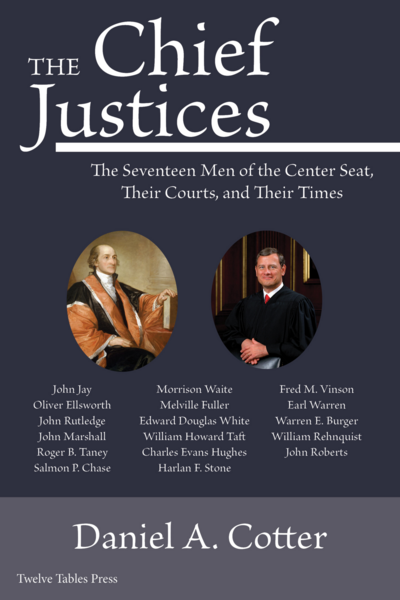
BOOK: Daniel A. COTTER, The Chief Justices - The Seventeen Men at the Center Seat, Their Courts, and Their Times (Northport: Twelve Tables Press, 2019). ISBN 978-1-94607-425-6, $26.95


(Source: CAP Press)

Twelve Tables Press has published a new book on the Chief Justices of the USSC.

ABOUT THE BOOK

Since the beginning of the Supreme Court of the United States in 1789, seventeen men have held the Chief Justice position. The first three held the position for a total of eleven years, and the next two (Marshall and Taney) held the Chief Justice position for the next sixty-three years (the two longest chiefs in our history). This book seeks to examine the position of Chief Justice more closely, to describe the position's origins and duties, and to explore the court under each of the seventeen chiefs. Discussions cover the background and careers of the chiefs before becoming Chief Justice as well as the cultural times, in order to put their rise and tenure in our nation's context, while discussing some of the key associate justices who sat with each of the seventeen. Each chapter also focuses on some key decisions of the Chief Justices' courts.

ABOUT THE AUTHOR

Daniel A. Cotter is a lawyer who practices corporate, transactional, privacy, and insurance, regulatory law in Chicago. He is a Past President of the Chicago Bar Association and an Adjunct Professor at the John Marshall Law School, where he teaches a course on SCOTUS and judicial biography.

TABLE OF CONTENTS

Can be found here

More information here

CALL FOR PAPERS: Law, Difference and Healthcare (Princeton, 6-7 June 2019) (DEADLINE: 1 MAY 2019)


Via Legal History blog, we learned of a call for papers for a conference and workshop in the field of medico-legal history at Princeton. Here the call:

The Shelby Cullom Davis Center for Historical Studies and the Department of History at Princeton University are hosting a conference and workshop on “Law, Difference, and Healthcare: Making Sense of Structural Racism in Medico-Legal History,” organized by George Aumoithe (Davis Center postdoctoral research associate). Our gathering will be 1-1/2 days long to be held from Thursday to Friday afternoon of June 6—7, 2019. Our keynote speakers will be author of Medical Bondage: Race, Gender, and the Origins of American Gynecology Deirdre Cooper Owens and author of Just Medicine: A Cure for Racial Inequality in American Health Care Dayna Bowen Matthew.

This workshop shall convene graduate students, post-doctoral researchers, and faculty who employ historical methodologies in their work. Our focus will be to examine the qualities and conditions that have produced the spaces, laws, and legalities that structure racism in medicine, healthcare, public health, and related social policy. In recent decades, many of these areas have been addressed through studies of the construction of “race” and genomics, specific diseases, clinical medicine, and medical institutions.

Much work remains, however, to historicize the sociological concept of structural racism. Our workshop will remix approaches in the history of medicine and legal history. What does a medico-legal history that accounts for both individual and collective racism in medicine, space, law and its legalities look like? What historiographical interventions are today’s scholarship making? What new methodologies and archives are emerging?

Despite extensive work on structural determinants of health and the history of medical racism, racialized health disparities persist in the United States and globally. We will consider structural dimensions of health that have long been relegated to the margins of the field. Some oft-neglected sites of care in the medico-legal historiography include: adult education, affordable child care, bias in medical education, corporatization of healthcare, disaster management, drug treatment, food pantries, health promotion, housing advocacy, insurance navigation, job (re-)training, neighborhood health clinics, mental health, medical intern and nurses unions, migrant health, prisoner re-entry, pre-natal care, “safety-net” hospitals, syringe exchange, and welfare bureaus.

By connecting and comparing different approaches, our workshop will be geared toward solidifying the state of the field via an edited volume composed of original history essays. With an unforeseeable range of possibilities for illustrating law, difference, and structural racism in healthcare, we are open to a wide range of proposals. As such, possible papers might:

· Describe the historiography of medicine & law with regards to racism
· Account for the interplay of racism with sexual, gender, and other social differences
· Consider the instantiation of structural racism in the built environment
· Define “structural racism” vis-vis medical, public health, or social policy history
· Offer unique archival, oral history, and social science perspectives & methodologies
· Account for geographies of health and differential access to sites of care
· Deconstruct the tenets of value-neutrality and “objectivity” of medical science
· Consider the deployment of “race” in medical and scientific practice
· Apply Critical Race Theory, Black Radical Tradition, or other frameworks to history
· Address the medico-legal histories of Latinx and other underrepresented groups
· Explain the inscription of racialized social difference through law and policy
· Elucidate the racialized political economy of healthcare
· Propose new ways of seeing social difference in law and healthcare
· Historicize the tensions between layperson expertise and medical education
· Conduct critical analyses of the logics and epistemologies of “race” in medicine

There are a limited number of presentation slots available before the program is finalized. This is an opportunity for scholars with works-in-progress to workshop their material and find a venue for future publication in an edited volume. If interested, please send a paper proposal abstract of no more than 500 words and a two-page CV to Dr. George Aumoithe (aumoithe [at] princeton.edu) by May 1, 2019. If accepted, pre-circulated paper drafts of at least 5,000 words are due by Friday, May 17. Final drafts for the edited volume are projected to be no more than 8,500 words.

A group of pre-registered observers and attendees are also welcome to attend. Conference registration information will be forthcoming and distributed to networks in late April.

Organized by Dr. George Aumoithe, postdoctoral research associate, Shelby Cullom Davis Center for Historical Studies and Department of History, Princeton University

All information can be found here