Search

Showing posts with label trade. Show all posts

12 May 2026

BOOK: Laury SARTI, Mediterranean Connections: The Frankish Kingdoms and the Roman Empire (476–756) [The Medieval Mediterranean, 145, eds. Frances ANDREWS, Paul MAGDALINO, Jo Van STEENBERGEN, Larry SIMON, Daniel Lord SMAIL, Corisande FENWICK & Maria G. PARANI] (Leiden/Boston: Brill, 2026), 240 p., ISBN: 978-90-04-74607-7, € 153.7

(image source: Brill)

Abstract:
This monograph challenges the idea that Roman imperial authority in the West ended in 476. It shows how the Frankish realm maintained ties to the empire, with real separation only emerging in the late sixth century. Tracing enduring Frankish-Byzantine diplomacy, shared identities, religious controversy, and trade into the seventh century, it reveals a landscape of continued exchange rather than abrupt decline. Including previously overlooked sources, the study offers a new perspective on Frankish identity, imperial affiliation, and the evolving relationship between Rome, the empire, and the Merovingians from the fifth to the eighth century.
On the author:
Laury Sarti, Ph.D. (2012), University of Hamburg, is Heisenberg Fellow at Heidelberg University.
Table of contents:
1. Introduction
     1.1 Outline and Questions
     1.2 Prior Research
     1.3 Approach and Methods
2. The Empire's Western Territories
     2.1 Odoacer and Theodoric
     2.2 One Empire
     2.3 476 in Retrospective
     2.4 The Empire and the West
     2.5 Results
3. Kings of the Empire
     3.1 Clovis and Theudebert I
     3.2 Romans and Franks in Gaul
     3.3 The Empire's Kingdom
     3.4 Franko-Byzantine Exchanges
     3.5 Factors of Alienation
     3.6 Results
4. Christian Community 
     4.1 The Pope between East and West
     4.2 The Tree Chapters Controversy 
     4.3 The Monothelite Controversy
     4.4 Results
5. Mediterranean Connectivity
     5.1 Diplomatic Exchange in a 'Dark Age'
     5.2 Pilgrimages to the East
     5.3 Travel Routes and Trade
     5.4 Language and Knowledge Exchange
     5.5 Results
6. Conclusions
Find more on Brill.

21 March 2024

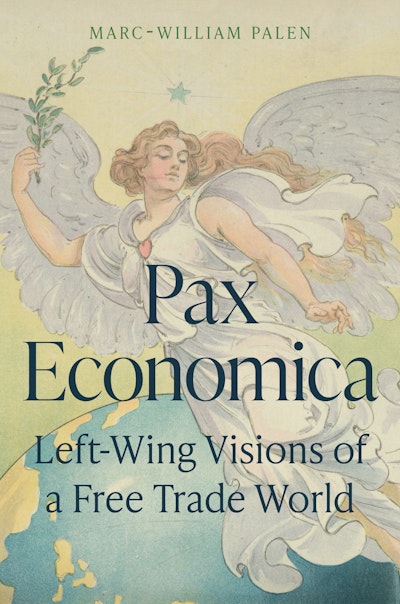
BOOK: Marc-William PALEN, Pax Economica: Left-Wing Visions of a Free Trade World (Princeton: Princeton University Press, 2024), 328 p. ISBN 9780691199320


(image source: Princeton)

Book abstract:

Today, free trade is often associated with right-wing free marketeers. In Pax Economica, historian Marc-William Palen shows that free trade and globalisation in fact have roots in nineteenth-century left-wing politics. In this counterhistory of an idea, Palen explores how, beginning in the 1840s, left-wing globalists became the leaders of the peace and anti-imperialist movements of their age. By the early twentieth century, an unlikely alliance of liberal radicals, socialist internationalists, feminists, and Christians envisioned free trade as essential for a prosperous and peaceful world order. Of course, this vision was at odds with the era’s strong predilections for nationalism, protectionism, geopolitical conflict, and colonial expansion. Palen reveals how, for some of its most radical left-wing adherents, free trade represented a hard-nosed critique of imperialism, militarism, and war. Palen shows that the anti-imperial component of free trade was a phenomenon that came to encompass the political left wing within the British, American, Spanish, German, Dutch, Belgian, Italian, Russian, French, and Japanese empires. The left-wing vision of a “pax economica” evolved to include supranational regulation to maintain a peaceful free-trading system—which paved the way for a more liberal economic order after World War II and such institutions as the United Nations, the European Union, and the World Trade Organization. Palen’s findings upend how we think about globalisation, free trade, anti-imperialism, and peace. Rediscovering the left-wing history of globalism offers timely lessons for our own era of economic nationalism and geopolitical conflict.

On the author:

Marc-William Palen is a historian at the University of Exeter and the author of The “Conspiracy” of Free Trade: The Anglo-American Struggle over Empire and Economic Globalisation, 1846–1896. 

Read more here. 

15 June 2020

BOOK: Francisco APELLANIZ, Breaching the Bronze Wall: Franks at Mamluk and Ottoman Courts and Markets (Leiden: Brill, 2020). ISBN: 9789004382749, €105.00

Cover Breaching the Bronze Wall: Franks at Mamluk and Ottoman Courts and Markets
(Source: Brill)

ABOUT THE BOOK

Breaching the Bronze Wall deals with the idea that the word of honorable Muslims constituted proof and with the concept that written documents and the word of non-Muslims were inferior. Foreign merchants in cities like Istanbul, Damascus or Alexandria could barely prove any claim, as neither their contracts nor their words were of any value if countered by Muslims. Francisco Apellániz explores how both groups labored to overcome these ‘biases against non-Muslims’ in the courts and markets of Mamluk Egypt and Syria of the 14th and 15th centuries, and how the Ottoman conquest (1517) imposed a new, orthodox view on the problem. The book dives into the Middle Eastern archive and the Ottoman Dīvān, and scrutinizes the intricacies of sharia and the handling of these intracacies by consuls, dragomans, qaḍīs and other legal actors.

ABOUT THE AUTHOR

Francisco Apellániz, Ph.D. (2009) European University Institute, is a lecturer in Islamic and Ottoman History at the University of Naples L'Orientale (and previously at the University of Aix-Marseille). He is the author of Pouvoir et finance en Méditerranée pré-moderne : le deuxième Etat mamelouk et le commerce des épices (1389-1517) (CSIC 2009).

More information here

19 March 2020

CALL FOR PAPERS: The Institutional Foundations of pre-modern long-distance trade (Oldenburg, 24-25 July 2020) (DEADLINE: 1 May 2020)


(Source: Hsozkult)

Via H-Soz-Kult, we learned of a call for papers for a conference on the institutional foundations of pre-modern long distance trade.

“In pre-industrial societies, long-distance trade constituted the most dynamic sector of the economy. Trade expansion increased the demand for goods, incentivizing growth of the manufacturing and service sectors. It facilitated social mobility and brought prosperity in its wake. For trade to expand, institutions need to develop that enforce contracts and secure property rights. In order to understand why trade flourished in some places, during some periods, and not in others, we need to understand how institutions develop and work” […]

The full call can be found here

27 February 2020

BOOK PRESENTATION : Wim DECOCK, Le marché du mérite, (Université de Lille, 13 March 2020).

(Source : Zones-sensibles)

BOOK PRESENTATION : is on 13 March 2020, 10:30. At the Law faculty, Université de Lille. Luisa BRUNORI (HDR CNRS, U.Lille) and Alexis AUDEMAR (Phd candidate, U.Lille) will introduce the author.

Wim DECOCK will present his book Le marché du mérite, Penser le droit et l’économie avec Léonard Lessius.  Published by : Zones sensibles, 248p. ISBN 978 293 0601 40 0. 

ABOUT THE AUTHOR : Wim DECOCK is a legal history Professor in KU Leuwen and the University of Liege. He also intervenes in various European universities and institutions. 

ABOUT THE BOOK : It aims to understand the origin of modern economy by its theological foundations. More information can be found here : http://www.zones-sensibles.org/wim-decock-le-marche-du-merite/

CONTENTS :
  • 1. L’« Oracle des Pays-Bas »
  • 2. L’ombre de Max Weber
  • 3. Pactum serva
  • 4. Usure et marché
  • 5. Information et spéculation
  • 6. Risques, assurances et subprimes
  • 7. Monopoles et industrie
  • 8. Le salut de l’économie
  • 9. L’économie du salut
  • 10. Occupation et ascétisme


23 April 2019

CONFERENCE: Pour une histoire européenne du droit des affaires : comparaisons méthodologiques et bilans historiographiques (Paris: IHD, 21 JUN 2019)

(image source: PHAEDRA Project)

Summary:
La journée a pour objet de s’interroger sur les manières dont sont menées les recherches en histoire du droit des affaires à travers l’Europe, afin de lancer le programme PHEDRA sur des bases historiographiques et méthodologiques solides.
Programme:
Sous la présidence de Jean Hilaire – Université Paris Panthéon-Assas
9.30h. «Propos introductifs», Olivier Descamps – Université Paris Panthéon-Assas
10.00h. « L’Italie », Ferdinando Mazzarella – Università di Palermo
discutant Victor Simon – Université de Reims Champagne-Ardennes
 10h45. « L’Espagne », Margarita Serna Vallejo – Universidad de Cantabria
discutant Florent Garnier – Université de Toulouse 1 Capitole
11.30 « Le Benelux », Alain Wijffels – Cnrs/Université de Lille
discutant Alexis Mages – Université de Bourgogne
12h15-13h45. Déjeuner
13h45. « Le Royaume-Uni »,  Guido Rossi – University of Edimburgh
discutant Olivier Serra – Université de Rennes 1
14h30. « L’Allemagne », Mathias Schmoeckel – Universität Bonn
discutant Nicolas Laurent-Bonne – Université Clermont-Auvergne
15h15. «La France», Carine Jallamion – Université de Montpellier
Discutant: David Deroussin – Université de Lyon III Jean Moulin
16h. « Propos conclusifs »
Luisa Brunori – Cnrs/Université de Lille et Xavier Prévost – Université de Bordeaux

(more information on the PHAEDRA website)

10 October 2018

CALL FOR PAPERS: A Global History of Free Ports. Capitalism, Commerce and Geopolitics (Venice/Helsinki, APR/JUN 2019) (DEADLINE 31 OCT 2018)

(image source: University of Helsinki)
The history of free ports research network is organising a number of conferences in the next years, in order to work towards a standard publication and interactive research platform for the history of free ports from the 16th to the early 20th century. Please check our website (www.helsinki.fi/a-global-history-of-free-ports) for an impression.
The first two meeting will take place in Venice (April 2019) and in Helsinki (June 2019).
For the call for papers of both the Venice and Helsinki meetings, see:
We are looking for case studies that engage with the transformations of the various functions of free ports over time and the spread of free ports from Italy and the Mediterranean to the Atlantic, Asia and the global level. The research may open up to the wider international development of trade and its institutions by taking a perspective that can be long-term, comparative or comprehensive (involving a combination of intellectual, policy, and economic angles). Papers may also address cultural, religious, diplomatic and network perspectives.
Texts that are presented at conferences may be published as a ‘dossier’/ special issue in the Intellectual History Archive open access working paper series of the Helsinki Centre for Intellectual History. A selection of revised papers will be included in a book publication.
Abstracts (of ca. 500 words) and titles may be sent by email tokoen.stapelbroek@helsinki.fi and ctazzara@scrippscollege.edu by 31 October 2018. Invited speakers are subsequently requested to provide short papers (ca. 5,000 words) that will be pre-circulated among participants. For further information, see the ‘Call(s) for papers’. For those who do not possess their own research budgets or travel funds, we can try to contribute towards your travel and accommodation costs.

(source: ESILHIL Blog)

17 October 2017

Eric SCHNAKENBOURG (ed.), Neutres et neutralité dans l'espace atlantique durant le long XVIIIe siècle (1700-1820)/Neutrals and Neutrality in the Atlantic World during the Long Eighteenth Century (1700-1820). Une approche totale/A Global Approach (Bécherel: les Perséides, 2015), 491 p. ISBN 9782371250147

(image source: AHMUF)


Book abstract:
L’étude de la neutralité révèle les tensions entre les logiques de guerre et les logiques négociantes qui manifestent, autant l’une que l’autre, l’intensité des relations au sein du monde atlantique. C’est pourquoi la neutralité doit être étudiée comme une réalité transversale inscrite dans un espace marqué par la fluidité des circulations. Elle impose de dépasser les cadres nationaux pour promouvoir une approche ouverte des interconnections afin d’envisager à nouveaux frais les questions relatives à la neutralité et au rôle des neutres au cours du long XVIIIe siècle. Cette approche, qui participe du décloisonnement spatial et thématique de l’histoire atlantique, permet d’embrasser dans une même perspective aussi bien « les » Amériques, septentrionale, intertropicale et méridionale, que l’Europe. La neutralité atlantique est une arène au sein de laquelle se nouent des relations entre Européens, entre Américains, et entre Européens et Américains. Elle peut être envisagée comme une entrée dans la réflexion sur la formation d’un espace euroaméricain économique,juridique et diplomatique.

Table of contents:
Introduction :
Neutralité atlantique et atlantique de la neutralité
Atlantic neutrality and the neutrality of the Atlantic
Partie 1 : Les circulations et réseaux du commerce neutre / circulation and networks of neutral commerce
Ana Crespo Solana, Madrid, Cooperation or Neutrality? How the war affects business strategies: The case of Cadiz (1700-1740)
Holger Weiss, Turku, Trade and neutrality during times of war: An analysis of the Danish-European and Danish-African relationships on the Gold Coast during the second half of the eighteenth century
Eric Schnakenbourg, Nantes, Substitution aux échanges des temps de paix ou modalité de l’interlope ? Le commerce neutre et les colonies françaises des Antilles pendant la guerre de Sept Ans
Boris Deschanel, Paris I Panthéon-Sorbonne, Les neutres dans les stratégies négociantes : l’exemple des sociétés Chauvet à Marseille (1785-1802)
Silvia Marzagalli, Nice, La navigation américaine pendant les French Wars (1793-1815) : une simple reconfiguration des circuits commerciaux par neutres interposés ?

Partie 2 : Les acteurs de la neutralité atlantique / The actors of Atlantic neutrality
Barry Stiefel, Charleston, Jews as Neutral Middlemen in the Long XVIIIth century Atlantic World
Manuel Covo, Warwick, Droit de la neutralité, pratiques de mobilité marchande et catégorisation politique à l’ère des révolutions : entre Antilles et États-Unis (années 1790)
Dominique Goncalvès, Toulouse, Le commerce de Cuba avec les neutres à travers les Actes de sessions du Consulat royal, 1797-1807.
Clément Thibaud, Nantes, América libre : les Neutres et la naissance du premier républicanisme hispano-américain (1793-1820)

Partie 3 : Les poles du commerce neutre / the centers of neutral commerce
Victor Enthoven, Amsterdam, ‘‘The unlimited cupidity of the Dutch merchants’’: St. Eustatius and Anglo-Dutch controversy over neutral rights, 1680-1780
François Antoine, Bruxelles, La guerre d’Indépendance américaine et la tentative de relance du commerce international des Pays-Bas méridionaux
Miguel Dantas da Cruz, Lisbonne, The Lisbon international trade and the ambiguities of the Portuguese Neutrality (1795-1807)
Ale Pålsson, Stockholm, Common Ground: Swedish neutrality and transit trade in S:t Barthélemy 1800-1820

Partie 4 : La neutralité dans les rivalités entre états / Neutrality in the interstate rivalry
François Ternat, Rouen, La neutralisation de la frontière. Un essai de solution diplomatique en Amérique du Nord à la veille de la guerre de Sept Ans
Marc Belissa, Paris Ouest Nanterre La Défense, Faire la guerre pour avoir le droit d’être neutre ? Les enjeux politiques de la neutralité américaine (1776-1812)
Nicolas Terrien, Nantes, Les neutres, la course maritime et l’effondrement de l’empire atlantique de la monarchie espagnole (1810-1824)

CONCLUSION French
CONCLUSION English
More information here (publisher's website).