Search

Showing posts with label history of procedural law. Show all posts

01 June 2026

SEMINAR: “Le rite réalise le droit“? – Rituals and the Law in the Ancient World (Marburg: Universität Marburg, 12–13 JUN 2026)

(image source: Universität Marburg)

“Le rite réalise le droit“? – Rituals and the Law in the Ancient World

Marburg University&Marburg Center for the Ancient World (MCAW)

In person participation: Marburg University, Room 00A26, Deutschhausstraße 12, 35032 Marburg

12–13 June 2026 (Friday–Saturday)

Program:

Friday, 12 June 2026
14:00. Introduction: Nils Heeßel (Marburg) and Constantin Willems (Marburg)

14:30. The Legal Value of Contractual Rites in Mesopotamia: Sophie Démare Lafont (Paris)

16:00. The Performative Nature of Sealing Clay Tablets: Steffen Jauß (Frankfurt)

17:00. In Search of the Lost Ritual. Ritual(s) and the implementation of Assyrian adê: Lionel Marti (Paris)

Saturday, 13 June 2026
09:00. The Role of Ritual in the Roman Legal Process: Grzegorz Blicharz (Cracow)

10:30. Formal Contracts in Roman Law and in the New Belgian Civil Code: Jean-François Gerkens (Liège)

11:30. Final Discussion, Conclusions: Nils Heeßel (Marburg) and Constantin Willems (Marburg)

The full Program is available in PDF format here: ProgramMCAW.

25 September 2025

BOOK: Andrzej DZIADZIO & Franciszek LONGCHAMPS DE BÉRIER (eds.), Five Centuries of Civil Procedure: The Polish Experience in a European Context (16th to 21st Centuries) [Legal History Library, eds. Dirk HEIRBAUT, Michelle MCKINLEY, Matthew C. MIROW & C.H. VAN RHEE, 76] (Leiden/Boston: Martinus Nijhoff/Brill, 2025), ISBN 978-90-04-73666-5


(image source: Brill)

Abstract:

The first codification of Polish court proceedings was made in 1523. Half a millennium later, the jurists in this volume have carefully analyzed the transformation of Polish civil procedure from then to the present day against the historical background of the development of modern European legal orders and institutions. This study is the result of the work of a research group established at the Jagiellonian University in Kraków, consisting of historical and modern jurists and scholars of civil procedure and private law.

Contributors:

Grzegorz J. Blicharz, Andrzej Dziadzio, Radosław Flejszar, Krzysztof Fokt, Kacper Górski, Jan Halberda, Vincent R. Johnson, Izabela Lewandowska-Malec, Martin Löhing, Franciszek Longchamps de Bérier, Dorota Malec, Maciej Mikuła, Andrzej Olaś, Grzegorz Smyk, Kamila Staudigl-Ciechowicz, and Abdoul Yatera.

On the editors:

 Andrzej Dziadzio, Ph.D. (1994), is Professor of Law and the Head of the Department of Common History of the State and the Law at the Faculty of Law and Administration of the Jagiellonian University in Kraków, Poland. Franciszek Longchamps de Bérier, Ph.D. (1997), is Professor of Law and the Head of the Department of Roman Law at the Faculty of Law and Administration of the Jagiellonian University in Kraków. He also teaches at the Faculty of Law and Administration of the University of Warsaw, Poland.

More information here: DOI 10.1163/9789004736672. 

02 June 2025

BOOK: Luca von BOGDANDY, Christoph RESCH, Julius SCHUMANN (eds.), Konflikte um Wahrheit. 1. Tagung des Jungen Netzwerks Rechtsgeschichte [Junges Netzwerk Rechtsgeschichte; 1] (Baden-Baden: Nomos, 2024), 348 p. ISBN 978-3-7560-1361-6

 Konflikte um Wahrheit
 
Abstract:
Der Tagungsband „Konflikte um Wahrheit“ vereint Beiträge der ersten Tagung des jungen Netzwerks Rechtsgeschichte, die im Juni 2023 in Frankfurt stattfand. Mit Bezug auf das interdisziplinär angelegte Generalthema diskutierten Nachwuchswissenschaftler:innen ihre Forschung zur rechtshistorischen Methodik, Prozessrechtsgeschichte, Wissenschaftsgeschichte und antiken Rechtsgeschichte.
Die Beiträge nähern sich dem in verschiedenen Kontexten erhobenen „Wahrheitsanspruch“ und erörtern dabei Fragen der Gerichtspraxis, des „Wahrheitsgehalts“ rechtshistorischen Quellen und auch Probleme „alternativer Fakten“ in der Antike. Der Band gibt dadurch Einblicke in aktuelle Forschungsvorhaben von Nachwuchswissenschaftler:innen aus Deutschland, Österreich und der Schweiz.

Table of contents:
 
Hubert Rottleuthner - Wahrheit – Perspektiven aus Rechtsgeschichte und Rechtssoziologie 
 
Renato Sedano Onofri - Methode und Wahrheit: Gedanken zum Anspruch auf rechtswissenschaftliche Wahrheit im 19. Jahrhundert am Beispiel der Werke Julius Hermann von Kirchmanns (1802–1884) und Augusto Teixeira de Freitas’ (1816–1883)
 
Sascha Ohlenforst - Expertise als Machtressource. Die Epistemisierung von Rechtskonflikten zwischen Kalibergbau und Gewässerschutz 
 
Raphael Dummermuth - Alternative Fakten in der Spätantike
 
Caterina M. Mitwalsky - Unsittlich gekleidete Römerinnen und andere historische „Wahrheiten“ – ein kritischer Blick auf Interpretationsansätze zum Ehrenschutz der Frau im römischen Recht 
 
Rhonda-Marie Lechner - „Ob diese oder jene umbstände waar sind, kommen auf deß ordentl[ichen] richters untersuchung an“ – Mögliche Erkenntnisse über Wahrheit in den handelsrechtlichen Streitigkeiten der Nürnberger Pareres
 
Nora Bertram - Open Science – Inhaltliche Aspekte und Chancen für die Rechtsgeschichte
 
Tania Ixchel Atilano - The search for truth in the trial against Maximilian of Habsburg (1867)
 
Merle Iffert - Historische Wahrheit und koloniales Wissen zum „Eingeborenenstrafrecht“: Ansätze zum Umgang mit einer asymmetrischen Quellenlage 
 
Magdalena Gebhart - Zwischen Wahrheit und Erinnerung. Die Anwendung des Bundesentschädigungsgesetzes (BEG) auf die Verfolgung der Astrologen
 
Malte Dücker - Glaube, Normen, Tatsachen? Historische Wahrheitsfragen zwischen Theologie, Geschichte und Rechtswissenschaft 
 
Miriam Gassner - „The Oath“. Der Eid als Gegenstand eines Transfers „österreichischen“ Rechtsdenkens?
 
Franziska Niedrist - „Das Eingeständniß ist in SüdTyrol eine Rarität.“ Richterliche Beurteilung und strafrechtliche Praxis im vormärzlichen Österreich 
 
Anne Bittner - Haushaltspflichten und Arbeitsfreude. Die Scheidungspraxis in der SBZ/frühen DDR

Find more here. 


23 May 2023

CALL FOR PAPERS : Le Juge et l'Expert : en quête de vérité (18-20 October 2023, Lille) (DEADLINE : 1 July 2023)

The University of Lille has a call for papers for a colloquium on the role of experts in the judicial system.

La pratique contemporaine a placé l’avis scientifique au cœur des processus de décision. L’expertise judiciaire, définie comme le « recours à un technicien consistant à demander à un spécialiste (…) d’éclairer le tribunal sur certains aspects du procès nécessitant l’avis d’un homme de l’art » (Termes juridiques, Dalloz, 1995, v° Expertise), occupe de nos jours une place centrale dans le domaine de la justice. Ce constat traverse plus généralement les disciplines et les époques : de l’authentification de documents à l’expertise psychiatrique, les conclusions apportées par les experts constituent un recours indispensable pour la justice. Le rôle de ceux, depuis le médecin jusqu’au cyber-analyste, à qui elle est confiée s’est cependant étendu depuis le XIXe siècle, précisément au moment où les portes des tribunaux leur ont été plus largement ouvertes. Depuis, il semble évident que si les conclusions d’une analyse ne lient pas le magistrat, elles sont toutefois de nature à peser sur la décision judiciaire.

Cela rend légitime l’intérêt porté, dans le cadre de cet appel à communication, à l’évolution des relations entre experts et magistrats, un thème qui constituera l’axe majeur du colloque organisé à l’automne 2023 à l’Université de Lille. Comment ces différents acteurs, s’ils restent tournés vers la manifestation de la vérité, se répartissent pouvoirs et responsabilités ? Cette manifestation scientifique offre l’opportunité de croiser les regards, de questionner l’équilibre entre les apports de l’expert et la décision rendue par le juge, et d’explorer toutes les dimensions de l’expertise, au passé comme au présent.

Afin de pouvoir utilement guider les personnes intéressées par la thématique du colloque, les organisateurs mettent à leur disposition plusieurs pistes de réflexion qui pourront constituer les différents axes développés dans le cadre de cet évènement (I). Dans le même temps, une sélection bibliographique a été constituée afin d’orienter les choix qui pourront être faits dans la détermination des propositions de communication (II). Il est enfin proposé que ces dernières puissent être déposées en ligne sur le site du congrès afin de pouvoir finaliser, dans les meilleurs délais, les propositions d’intervention de même que les échanges avec les organisateurs. A cette fin, des recommandations et instructions sont fournies dans la rubrique vade-mecum (III).


More info as well as the link to submit a proposal can be found here. 

12 April 2023

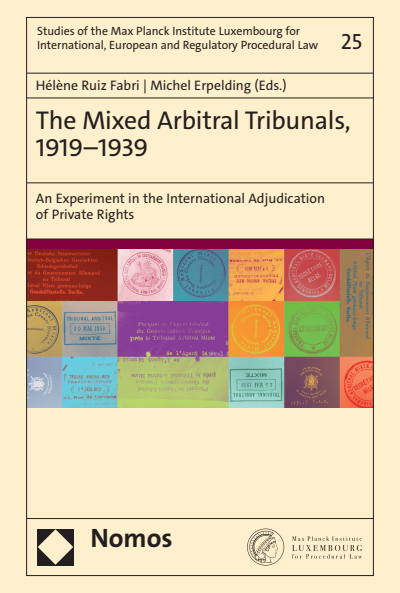
BOOK: Hélène RUIZ FABRI & Michel ERPELDING (eds.), The Mixed Arbitral Tribunals, 1919-1939. An Experiment in the International Adjudication of Private Rights [Studies of the Max Planck Institute Luxembourg for International, European and Regulatory Private Law, eds. Burkhard HESS & Hélène RUIZ FABRI, vol. 25] (Baden-Baden: Nomos, 2023), 582 p. ISBN 9783748939719 [OPEN ACCESS]


(image source: Nomos)

Abstract:

The creation of 39 Mixed Arbitral Tribunals (‘MATs’) was a major contribution of the post-World War I peace treaties to the development of international adjudication. With over 90 000 claims handled, the MATs were the busiest international courts of the interwar period. Moreover, in a departure from most other international courts and tribunals at that time, they allowed individuals to file claims against sovereign states before them. After 1945, they inspired the creators of the European Court of Justice before disappearing into quasi-oblivion. Relying on legal and historical research, including new archival findings, this volume is specifically dedicated to these pioneering institutions.

 Read the whole volume for free (DOI 10.5771/9783748939719).

28 June 2021

BOOK: Peter COLLIN (Ed.), Konfliktlösung im 19. und 20. Jahrhundert (Cham: Springer, 2021). ISBN 978-3-662-56075-4, 109.99 EUR


(Source: Springer)

Springer is publishing a new volume of its 4 volume-collection on the history of conflict resolution in Europe.

ABOUT THE BOOK

Das vierbändige „Handbuch zur Geschichte der Konfliktlösung in Europa“ beschäftigt sich mit rechtlichen und außerrechtlichen Wegen der Entscheidung von Konflikten zwischen einzelnen Menschen sowie zwischen Personen und ihren Obrigkeiten. Das von Expertinnen und Experten aus vielen europäischen Ländern geschriebene Handbuch soll als zentrales Referenzmedium für die historische Dimension aller Aspekte der Streitentscheidung dienen.

Der Aufbau des Werks orientiert sich an den vier Epochen Antike, Mittelalter, Frühe Neuzeit und 19./20. Jahrhundert.

Nach einer Einführung in die jeweilige Epoche werden die für den Zeitabschnitt kennzeichnenden Akteure, Verfahren und Institutionen vorgestellt sowie Kernfragen und Zentralprobleme der Streitentscheidung in zeittypischen Konfliktfeldern behandelt. Die europäische Perspektive des Handbuchs schlägt sich in Überblicken zu einzelnen Ländern, Regionen und Rechtskulturen nieder. Ausführliche Hinweise auf die weiterführende Literatur runden die Darstellung ab. Band 4 umfasst Beiträge zum 19. und 20. Jahrhundert.


More info here

23 December 2020

JOURNAL: Clio@Themis, nº 19, 2020, OPEN ACCESS


(Source: https://www.google.com/search?q=clio%40themis&safe=off&sxsrf=ALeKk02RXZEFHqd9n9TSZ6wJRLom6-lA0Q:1607943167871&source=lnms&tbm=isch&sa=X&ved=2ahUKEwibytuKp83tAhUQGewKHRObCIQQ_AUoAnoECAoQBA&biw=1242&bih=516#imgrc=9MvrcddjcJG5SM)

The French Journal Clio@Themis has published a new number in its new site.


Dossier : Vérité Judiciaire

Soazick Kerneis
Introduction

Christophe Archan
Ordalies et lutte contre la criminalité dans l’Angleterre des xe-xie siècles

Corinne Leveleux-Teixeira
Un conflit des interprétations ? Vérité judiciaire et expertise médicale (xiiie-xive siècles)

Sofiane Yahia Cherif
L’autorité de la chose jugée, présomption légale de vérité

Alexandre Frambéry‑Iacobone
Vérité judiciaire, vérité factuelle et élément moral : Perspectives d’histoire pénale contemporaine

Christiane Besnier
Le travail de la vérité en cour d’assises

Sylvette Guillemard
Vérité judiciaire et stare decisis en droit privé québécois


Traduction

Alain Pottage
Le droit d’après l’anthropologie : objet et technique en droit romain


17 March 2020

BOOK: Alessandra BASSANI, Angela SANTANGELO CORDANI & Marina BENEDETTI (a cura di ), Tra storia e diritto. Giustizia laica e giustizia ecclesiastica dal Medioevo all'età moderna (Milano: Giuffrè, 2019). ISBN 9788828812371, 35 €, pp. 345

Tra storia e diritto


TABLE OF CONTENTS

Introduzione

Giovanni Minnucci
Diritto e processo penale nel XII secolo fra dottrina e legislazione 

Marina Benedetti
Condanne e riabilitazioni nei processi inquisitoriali medievali. Alcune riflessioni

Igor Salomão Teixeira
Giustizia ecclesiastica e le parole delle persone “giuridiche” nei processi di canonizzazione di Luigi d’Angiò e Tomaso d’Aquino

Alessandro Sala
L’origine dell’Inquisizione nelle lettere papali 

Enrique de León Rey
« La ‘aequitas canonica’: proceso sumario o “brevior” en el derecho canónico matrimonial clásico » 

Roberta Mucciarelli
Storie di debiti e di conflitti tra procedure di giustizia e prassi politica (Siena e il suo territorio, fine XIII-inizio XIV secolo) 

Silvia Bertolin
Publica vox et fama. I testes nei processi inquisitoriali del Quattrocento in Valle d’Aosta 

Alessandra Bassani
La deposizione del testimone nel processo di diritto comune fra dottrina e prassi

Maria Gigliola di Renzo Villata
La ‘crisi’ della vita coniugale tra giustizia civile e ecclesiastica (dal Medioevo alla Milano secentesca)

Andrea Errera
Concorrenza e conflitto tra giurisdizione laica e giurisdizione ecclesiastica nella persecuzione dell’eresia secondo la dottrina processualistica del XVI e XVII secolo

Gianclaudio Civale
L’effimera esistenza della ‘Inquisición de la Mar’. Un tribunale peculiare del Sant’Uffizio spagnolo (1571-1574) 

Angela Santangelo Cordani
Ricerca della verità e garanzie della difesa nel processo inquisitoriale di età moderna

Indice dei nomi


More information here


21 November 2019

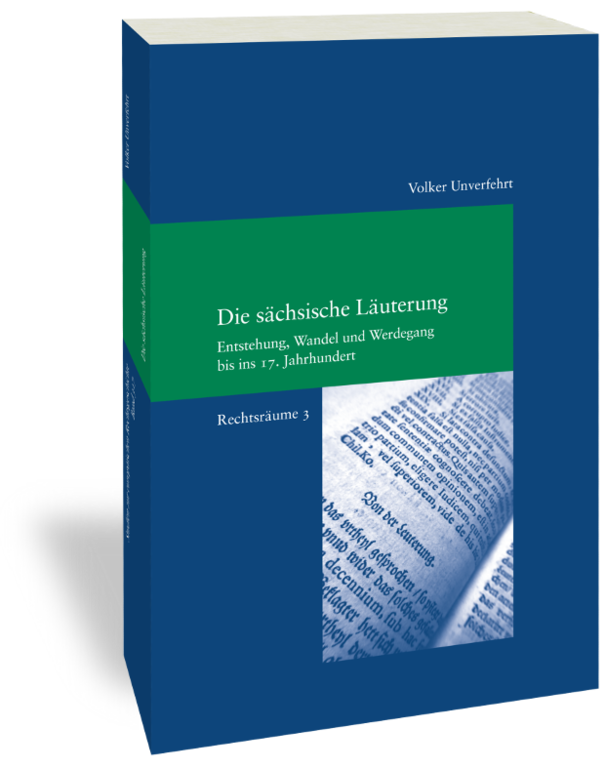
BOOK: Volker UNVERFEHRT, Die Sächsische Läuterung : Entstehung, Wandel Und Werdegang Bis Ins 17. Jahrhundert [Studien Zur Europäischen Rechtsgeschichte 317] (Frankfurt am Main: Klostermann, 2019). ISBN 978-3-465-04388-1, 79 EUR


Klostermann is publishing a new book on the institution of 'Läuterung' in Saxon courts.

ABOUT THE BOOK

The operation of and role played by legal institutions in the past is often not clear at first glance. This applies even more to those institutions no longer extant today, such as the Saxon 'Läuterung' (clarification review), which can be traced back to medieval German legal practice and ends only in 1877/1879 with the German Reichsjustizgesetze. Last used as a legal remedy, earlier forms of 'Läuterung' still point to their predominant use as a mere declaration of judgment. This study is devoted to showing the reasons for the emergence, change and longevity of the institution of 'Läuterung', which was practiced in the Saxon courts over the course of several centuries.

TABLE OF CONTENTS

Vorwort | IX
A. Einleitung
B. Forschungsstand
C. Gegenstand der Bearbeitung; Methode und Zielsetzung
D. Entwicklungen des gerichtlichen Verfahrens /geschichtlicher Hintergrund
I. Prozess und Gerichtsverfassung im hoch- bis spätmittelalterlichen Sachsen | 22
II. Die Entwicklung des frühneuzeitlichen sächsischen Prozesses | 35
III. Der Prozess nach dem römisch-kanonischen Recht | 41
IV. Besonderheiten des gemeinen sächsischen Prozesses | 63
E. Die Läuterung ca. ab der Mitte des 16. und im 17. Jahrhundert
I. Voraussetzungen für die Einlegung der Läuterung | 70
II. Die Wirkung der Läuterung und das Verfahren nach ihrer Einlegung | 73
III. Inhalt des Läuterungsbegehrens / Begründung der Läuterung | 74
IV. Die Entscheidung über die Läuterung | 121
V. Die »Erklärung« als Resultat der Läuterung | 123
VI. De abusu leuterationum – Vom Missbrauch der Läuterung | 146
VII. Zusammenfassung | 152
F. Die Läuterung ca. ab der Mitte des 15. bis zum Beginn
I. Die Läuterung des Schöffenspruchs | 159
II. Die Läuterung des Parteivorbringens | 180
III. Zulässigkeit der Läuterung / prozessuale Wirkung | 197
IV. Allgemeine Charakterzüge der Läuterung | 202
V. Zeitliche Einordnung / Entwicklungslinien | 206
VI. Gründe für die Entwicklung der Läuterung zum Rechtsmittel | 217
VII. Zusammenfassung | 239
G. De origine leuterationis – Vom Ursprung der Läuterung
I. Mögliche Gründe für die spärliche Quellenlage zur Läuterung vor 1450 | 243
II. Bisherige Theorien zum Ursprung der Läuterung | 249
III. Weitere Überlegungen zum Ursprung der Läuterung | 263
IV. Zusammenfassung | 284
H. Gesamtbetrachtung
I. Erste Phase: Etwa bis in die erste Hälfte des 15. Jahrhunderts | 287
II. Zweite Phase: Erste Hälfte bis Ende des 15. Jahrhunderts - die Läuterung als Auslegungsstreit über den Inhalt des Erstspruchs | 288
III. Dritte Phase: Ca. Ende des 15. Jahrhunderts bis zum Ende des Untersuchungszeitraums – die Läuterung als Rechtsmittel | 289
Abkürzungsverzeichnis
Quellen
Literatur
Lexika / Wörterbücher / Nachschlagewerke
Gerichts-, Prozess- und Landesordnungen (chronologisch)


More info here