Search

Showing posts with label canadian legal history. Show all posts

15 November 2023

BOOK: George PAVLICH, Thresholds of Accusation: Law and Colonial Order in Canada (Cambridge: Cambridge University Press, 2023), 265 pp., ISBN 9781009334044, £95


(image courtesy: Cambridge University Press)

Book description: 
This critical socio-legal history probes pretrial accusations through which colonial criminal law forged social orders for settler-colonialism across western Canada, focusing on Alberta, 1874–1884. Following military intelligence, a Northwest Mounted Police force was established to compel Dominion law. That force began by deploying accusatory theatres to receive information about crimes, arrest suspects, and decide via preliminary examination who to send to trial. George Pavlich draws on exemplary performances of colonial accusation to show how police officers and justices of the peace translated local social lore into criminal law. These performances reflected intersecting powers of sovereignty, disciplinarily, and biopolitics; they held accused individuals legally culpable for crimes and obscured social upheavals that settlers brought. Reflecting on colonial legacies within today's vast and unequal criminalizing institutions, this book proposes that we seek new forms of accusation and legality, learning from Indigenous laws that tackle individual and collective responsibilities for societal disquiet. 

Table of contents: 
1. Grammars of critique and colonial accusation
2. Reconnaissance discourses for colonial law
3. Sovereign spectacles and criminal accusation
4. Justices of the peace at accusatory theatres
5. Training police accusers
6. Moulding accused individuals
7. Biopolitics and colonial accusation
8. Denouements and turned spades

About the author:
George Pavlich is H. M. Tory Chair and Professor in the Department of Sociology and the Faculty of Law at the University of Alberta. He has authored many books, co-edited several collections, and is widely published in leading journals. In 2022, he received the James Boyd Whyte Award from the Association of the Study of Law, Culture, and the Humanities.

More information can be found here. 

08 December 2020

BOOK: Heidi BOHAKER, Doodem and Council Fire: Anishinaabe Governance through Alliance (Toronto: University of Toronto Press, 2020). ISBN 9781442647312, USD 48.75


The University of Toronto Press is publishing a book on the Anishinaabe and clan identification markings on treaties and legal documents during the 17th-19th centuries.

ABOUT THE BOOK

Combining socio-legal and ethnohistorical studies, this book presents the history of doodem, or clan identification markings, left by Anishinaabe on treaties and other legal documents from the seventeenth through the nineteenth centuries. These doodems reflected fundamental principles behind Anishinaabe governance that were often ignored by Europeans, who referred to Indigenous polities in terms of tribe, nation, band, or village – classifications that failed to fully encompass longstanding cultural traditions of political authority within Anishinaabe society.


Making creative use of natural history, treaty pictographs, and the Ojibwe language as an analytical tool, Doodem and Council Fire delivers groundbreaking insights into Anishinaabe law. The author asks not only what these doodem markings indicate, but what they may also reveal through their exclusions. The book also ooutlines the continuities, changes, and innovations in Anishinaabe governance through the concept of council fires and the alliances between them. Original and path-breaking, Doodem and Council Fire offers a fresh approach to Indigenous history, presenting a new interpretation grounded in a deep understanding of the nuances and distinctiveness of Anishinaabe culture and Indigenous traditions.


ABOUT THE AUTHOR

Heidi Bohaker is an associate professor in the Department of History at the University of Toronto.

TABLE OF CONTENTS

Preface

Introduction

1. The Doodem Tradition

2. Family in All Four Directions

3. Anishinaabe Constitutionalism

4. Governance in Action

5. Doodem in the Era of Settler Colonialism

Conclusion

Bibliography


More info here

02 December 2020

BOOK: Carolyn STRANGE, The Death Penalty and Sex Murder in Canadian History (Toronto: University of Toronto Press, 2020). ISBN 9781487508371, 60.00 USD


The University of Toronto Press has published a new book on the history of the death penalty and sex murder in Canada.

ABOUT THE BOOK

From Confederation to the partial abolition of the death penalty a century later, defendants convicted of sexually motivated killings and sexually violent homicides in Canada were more likely than any other condemned criminals to be executed for their crimes. Despite the emergence of psychiatric expertise in criminal trials, moral disgust and anger proved more potent in courtrooms, the public mind, and the hearts of the bureaucrats and politicians responsible for determining the outcome of capital cases.


Wherever death has been set as the ultimate criminal penalty, the poor, minority groups, and stigmatized peoples have been more likely to be accused, convicted, and executed. Although the vast majority of convicted sex killers were white, Canada’s racist notions of "the Indian mind" meant that Indigenous defendants faced the presumption of guilt. Black defendants were also subjected to discriminatory treatment, including near lynchings. In debates about capital punishment, abolitionists expressed concern that prejudices and poverty created the prospect of wrongful convictions.


Unique in the ways it reveals the emotional drivers of capital punishment in delivering inequitable outcomes, The Death Penalty and Sex Murder in Canadian History provides a thorough overview of sex murder and the death penalty in Canada. It serves as an essential history and a richly documented cautionary tale for the present.

ABOUT THE AUTHOR

Carolyn Strange is a professor in the School of History at the Australian National University.

TABLE OF CONTENTS

Acknowledgments


Introduction


1. The Politics of the Death Penalty and the Problem of Sex Murder

2. Sex Fiends and the Death Penalty at the Turn of Canada’s Century

3. Contesting Convictions and Questioning Culpability: Sex Murder between the Wars

4. Sexual Psychopathy and Penal Severity in the Post-War Era

5. Sexual Psychopathy, Insanity, and the Death Penalty under Scrutiny in the 1950s

6. Sex Murder in the Sixties and the Demise of the Death Penalty


Epilogue: The Problem of Sex Murder in the Shadow of Abolition


Note on Sources and Methods


More info here

07 July 2020

BOOK: Donald F. BUR, Laws of the Constitution - Consolidated (Alberta: University of Alberta Press, 2020). ISBN 978-1-77212-528-3, USD250.00


The University of Alberta Press is publishing a consolidated collection of all historical and contemporary constitutional documents pertaining to Canada, its provinces, and its territories.

ABOUT THE BOOK

Laws of the Constitution: Consolidated gathers all of the historical and contemporary constitutional documents pertaining to Canada, its provinces, and its territories, organized thematically and topically for ease of reference and supported by comprehensive lists and a thorough index. The volume excludes overridden and irrelevant documents, making it a comprehensive yet focused and precise reference that presents the words, ideas, and documents that have brought the constitution into being. A must for academic libraries, Bur’s compilation is an indispensable resource for lawyers and scholars in Canadian constitutional law, as well as historians, political scientists, policy makers, and anyone interested in constitution-making.

ABOUT THE AUTHOR

Donald F. Bur. Donald F. Bur has practiced law in three provinces and holds several degrees. Throughout his extensive career, he has focused on public law issues, and in particular issues of federalism. He is the author of Law of the Constitution: The Distribution of Powers and editor of Canadian Constitutional Law: Cases, Notes and Materials (3rd ed.).

More info here

11 June 2020

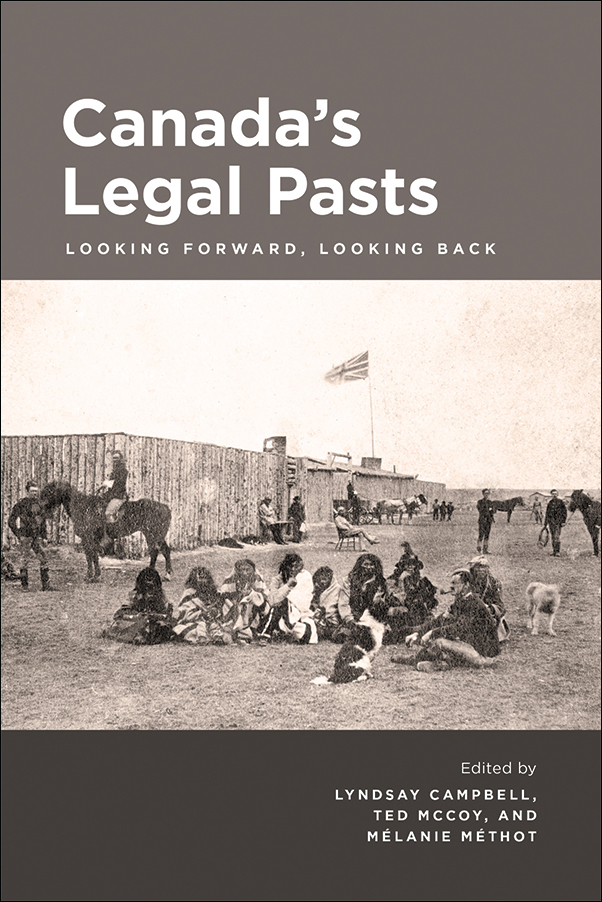
BOOK: Lyndsay CAMPBELL, Ted MCCOY, and Mélanie MÉTHOT, eds., Canada’s Legal Pasts: Looking Forward, Looking Back (Calgary: University of Calgary, 2020). ISBN 978-1-77385-118-1, OPEN ACCESS


The University of Calgary Press is publishing a new, open-access book on Canadian legal history.

ABOUT THE BOOK

Canada’s Legal Pasts presents new essays on a range of topics and episodes in Canadian legal history, provides an introduction to legal methodologies, shows researchers new to the field how to locate and use a variety of sources, and includes a combined bibliography arranged to demonstrate best practices in gathering and listing primary sources. It is an essential welcome for scholars who wish to learn about Canada’s legal pasts—and why we study them.

Telling new stories—about a fishing vessel that became the subject of an extraordinarily long diplomatic dispute, young Northwest Mounted Police constables subject to an odd mixture of police discipline and criminal procedure, and more—this book presents the vibrant evolution of Canada’s legal tradition. Explorations of primary sources, including provincial archival records that suggest how Quebec courts have been used in interfamilial conflict, newspaper records that disclose the details of bigamy cases, and penitentiary records that reveal the details of the lives and legal entanglements of Canada’s most marginalized people, show the many different ways of researching and understanding legal history.

This is Canadian legal history as you’ve never seen it before. Canada’s Legal Pasts dives into new topics in Canada’s fascinating history and presents practical approaches to legal scholarship, bringing together established and emerging scholars in collection essential for researchers at all levels.

ABOUT THE EDITORS

Lyndsay Cambell is an associate professor at the University of Calgary, cross-appointed between the Faculty of Law and the Department of History. She is the co-editor of Freedom’s Conditions in the U.S.-Canada Borderlands in the Age of Emancipation.

Ted McCoy is an assistant professor in Sociology at the University of Calgary. He is the author of Hard Time: Reforming the Penitentiary in Nineteenth-Century Canada and Four Unruly Women: Stories of Incarceration and Resistance from Canada’s Most Notorious Prison.

Mélanie Méthot is an associate professor of History at the University of Alberta, Augustana Campus and the recipient of a SSHRC Grant for her research on bigamy in Canada. She is the founder of the Augustana Conference on Undergraduate Research and Innovative Teaching.

With Contributions By: Nick Austin, Dominique Clément, Angela Fernandez, Jean-Philippe Garneau, Shelly A.M. Gavigan, Alexandra Havrylyshyn, Louis A. Knafla, Catherine McMillan, Eric A. Reiter, and Christopher Shorey

TABLE OF CONTENTS

Foreword: A Student’s Take on Canada’s Legal Pasts
Nick Austin
Introduction: Canada’s Legal Pasts: Looking Forward, Looking Back
Ted McCoy, Lyndsay Campbell, Mélanie Méthot
Part I: Illuminating Cases
Family Defamation in Quebec: The View from the Archives
Eric H. Reiter
Writing Penitentiary History
Ted McCoy
Analyzing Bigamy Cases without Archival Records: It Is Possible
Mélanie Méthot
Trial Pamphlets and Newspaper Accounts
Lyndsay Campbell
The Last Voyage of the Frederick Gerring, Jr
Christopher Shorey
The Textbook Edition of Kent’s Commentaries Used in the Gerring
Angela Fernandez
Part II: Exploring Systems
Empire’s Law: Archives and the Judicial Committee of the Privy Council
Catharine MacMillan
Practising Law in the “Lawyerless” Colony of New France
Alexandra Havrylyshyn
Poursuivre son mari en justice au Bas-Canada: femmes mariées et coutume de Paris devant la cour du Banc du roi (1795-1830)
Jean-Philippe Garneau
Getting Their Man: The NWMP as Accused in the Territorial Criminal Court in the Canadian North-West, 1876-1905
Shelley A.M. Gavigan
Part III: Writing Legal History: Past, Present and Future
Sex Discrimination in Law: From Equal Citizenship to Human Rights Law
Dominique Clément
Legal-Historical Writing for the Canadian Prairies: Past, Present, Future
Louis A. Knafla
Primary source bibliography
Secondary source bibliography
Contributors
Index

More info here

12 November 2019

BOOK: Eric H. REITER, Wounded Feelings: Litigating Emotions in Quebec, 1870–1950 (Toronto: University of Toronto Press, 2019). ISBN 9781487506551, $67.50


The University of Toronto Press is publishing a new book on the legal history of emotions in Quebec.

ABOUT THE BOOK

Wounded Feelings is the first legal history of emotions in Canada. Through detailed histories of how people litigated emotional injuries like dishonour, humiliation, grief, and betrayal before the Quebec civil courts from 1870 to 1950, it explores the confrontation between people’s lived experience of emotion and the legal categories and terminology of lawyers, judges, and courts. Drawing on archival case files, supplemented by newspapers and contemporary legal writings, it examines how individuals narrated their claims of injured feelings, and how the courts assessed those claims, using legal rules, social norms, and the judges’ own feelings to validate certain emotional injuries and reject others.

The cases reveal both contemporary views of emotion as well as the family, gender, class, linguistic, and racial dynamics that shaped those understandings and their adjudication. Examples include a family’s grief over their infant son’s death due to a physician’s prescription error, a wealthy woman’s mortification at being harassed by a conductor aboard a train, and the indignation of two Black men at being denied seats at a Montreal cinema. The book also traces an important legal change in how moral injury was conceptualized in Quebec civil law over the period, as it came to be linked to the developing idea of personality rights. By 1950, the subjective richness of stories of wounded feelings was increasingly put into the language of violated rights, a development with implications for both social understandings of emotion and how individuals presented their emotional injuries in court.

ABOUT THE AUTHOR

Eric H. Reiter is an associate professor in the Department of History at Concordia University and a member of the Quebec Bar.

TABLE OF CONTENTS

Illustrations
Foreword
Acknowledgments
Introduction
1. Feelings and the Law in Nineteenth-Century Quebec
2. Shame, Mortification, Disgrace, Dishonour
3. Family Dishonour
4. Bodily Intrusion
5. Betrayal
6. Grief and Mourning
7. Indignation, Anger, Fear
8. Conclusion: From Wounded Feelings to Violated Rights
Abbreviations
Case Citations
Notes
Bibliography
Index

More info here

23 August 2019

WORKSHOP: Osgoode Society Legal History Workshop, Fall Term 2019-2020


Via the Canadian Legal History Blog, we learned of the Osgoode Society’s upcoming workshop series.

OSGOODE SOCIETY LEGAL HISTORY WORKSHOP, 2019-2020:

FALL TERM 2019

Wednesday September 11: Nancy Wright, University of Victoria: “The Laphroaig
Leasehold:  Popular Interpretations of Feudal Tenures.”

Wednesday September 25: Jim Phillips, University of Toronto: ‘The Canadian
Court System, 1867-1914’

Wednesday October 9 – Yom Kippur

Tuesday October 15: Note the Tuesday. Donal Coffey, Max Planck Institute:
‘Newfoundland and Dominion Status.’

Wednesday October 30  (new date): Philip Girard, Osgoode Hall Law School: ‘The
Contrasting Fates of French-Canadian and Indigenous Constitutionalism: British
North America, 1763-1867.’

Wednesday November 6: Eric Adams, University of Alberta: ‘Constitutional
Wrongs: A Legal History of Japanese Canadians’

Wednesday November 13 (new date): Joseph Kary, Kary and Kwan: Sonderkommando in
Canada: Montreal's first World War II War Crimes Trial, 1951-1956

Wednesday November 27: Patricia McMahon, Torys: ‘Radioactive: The Life and
Lies of Boris Pregel’

14 June 2019

BOOK: Elizabeth MANCKE et al., eds., Violence, Order, and Unrest: A History of British North America, 1749–1876 (Toronto: University of Toronto Press, 2019). ISBN 9781487523701, $41.25


Toronto University Press has published an edited collection on the history of British North America between 1749-1876, and which includes several legal-historical contributions.

ABOUT THE BOOK

This edited collection offers a broad reinterpretation of the origins of Canada. Drawing on cutting-edge research in a number of fields, Violence, Order, and Unrest explores the development of British North America from the mid-eighteenth century through the aftermath of Confederation. The chapters cover an ambitious range of topics, from Indigenous culture to municipal politics, public executions to runaway slave advertisements. Cumulatively, this book examines the diversity of Indigenous and colonial experiences across northern North America and provides fresh perspectives on the crucial roles of violence and unrest in attempts to establish British authority in Indigenous territories. In the aftermath of Canada 150, Violence, Order, and Unrestoffers a timely contribution to current debates over the nature of Canadian culture and history, demonstrating that we cannot understand Canada today without considering its origins as a colonial project.

ABOUT THE EDITORS

Elizabeth Mancke is Canada Research Chair in Atlantic Canada Studies in the Department of History at the University of New Brunswick.

Jerry Bannister teaches History and Canadian Studies at Dalhousie University.

Denis McKim teaches in the History Department at Douglas College.

Scott W. See is Libra Professor Emeritus and former chair of the University of Maine’s History Department.

TABLE OF CONTENTS

Preface
Notes on Contributors
Maps
Introduction
Elizabeth Mancke, Jerry Bannister, Denis McKim, and Scott W. See
Section I: Loyalty, Liberty, and Visions of Order
1. Aspirations and Limitations: "Peace, Order, and Good Government" and the Language of Violence and Disorder in British North America
    Scott W. See
2. Loyalty, Order, and Quebec’s Catholic Hierarchy, 1763–1867
    D.C. Bélanger
3. Anxious Anglicans, Complicated Catholics, and Disruptive Dissenters: Christianity and the Search for Social Order in the Age of Revolution
    Denis McKim
4. Liberty, Loyalty, and Sentiment in Canada’s Founding Debates, 1864–1873
    Jerry Bannister
Section II: From Tory Imperialism to Liberal Settler Colonialism
5. Revolution Expected: The Invasion of Quebec and American Independence
    Jeffers Lennox
6. Empire, Settler Colonialism, and the Role of Violence in Indigenous Dispossession in British North America, 1749–1830
    John G. Reid
7. Space, Race, and Violence: The Beginnings of Civilization in Canada
    E.A. Heaman
8. Worthy and Industrious or a Burden? Managing Migration in Upper Canada, 1815–1845
Section III: Resisting Dispossession
9. Searching for Order in a Settlers’ World: Wendat and Mississauga Schooling, Politics and Networks at the Turn of the Nineteenth Century
    Thomas Peace
10. Runaway Advertisements and Social Disorder in the Maritimes: A Preliminary Study
      Harvey Amani Whitfield
11. The Mobile Village: Metis Women, Bison Brigades, and Social Order on the Nineteenth-Century Plains
      Émilie Pigeon and Carolyn Podruchny
12. "We are men not Buffalos": Louis Riel and the Gendering of the Red River Public Sphere
      M. Max Hamon
Section IV: Legitimating and Contesting the Public Sphere
13. Discontents and Dissidents: Unrest amongst Loyalist Freemasons in the 1780s and 90s
      Bonnie Huskins
14. Of Bludgeons and Ballots: Political Violence, Municipal Enfranchisement, and Local Governance in Mid-Nineteenth- Century Montreal
      Colin Grittner
15. Boys, Young Men, and Disorder in a Mid-Victorian City
      Ian Radforth
16. "To muse within these peaceful portals": Urban Space, Public Order, and the Makings of Montreal’s Viger Square, 1818–1870
      Dan Horner
Section V: Tools of Social Order: The Law and the Press
17. The Spectacle of State Violence: Executions in Quebec, 1759–1872
      Donald Fyson
18. Making a Patriot Order: Violence, Respectability, and the Patriot Press in Exile, 1838–1847
      Stephen R.I. Smith
19. The Ambivalence of Order: Jurisdiction in the Disputed Northeast
      Bradley Miller
20. For the Better Administration of the Town’s Affairs: Civic Engagement, Local Governance, and Grassroots Activism in Canada West/Ontario, 1849–1870
      Darren Ferry
21. The Role of Newspapers in Halifax during the Confederate and the Repeal Movements, 1865–69
      Mathias Rodorff
Epilogue
Elizabeth Mancke, Jerry Bannister, Denis McKim, and Scott W. See

More information here

09 October 2018

BOOK: Jim PHILLIPS, Philip GIRARD, and R. BLAKE BROWN, A History of Law in Canada, Vol. 1 - Beginnings to 1866 (Toronto: University of Toronto Press, 2018). ISBN 9781487504632, $90.00


The University of Toronto Press is publishing the first of two volumes on the legal history of Canada.  

ABOUT THE BOOK

This book is the first of two volumes devoted to the history of law in Canada. This volume begins at a time just prior to European contact and continues to the 1860s, while volume two will start with Confederation and end at approximately 2000. The history of law includes substantive law, legal institutions, legal actors and legal culture. The book assumes that since 1500 there have been three legal systems in Canada – the Indigenous, the French, and the English. At all times, these systems have co-existed and interacted, with the relative power and influence of each being more or less dominant in different periods.

The history of law cannot be treated in isolation, and this book examines law as a dynamic process, shaped by and affecting other histories over the long term. The law guided and was guided by economic developments, was influenced and moulded by the nature and trajectory of political ideas and institutions, and variously exacerbated and mediated by inter-cultural exchange and conflict. These themes are apparent in this examination, and through most areas of law including family law, constitutional, commercial, land settlement and tenure, and criminal.

ABOUT THE AUTHORS

Jim Phillips is a professor in the faculty of law at the University of Toronto.


Philip Girard is a professor at Osgoode Hall Law School, York University.


R. Blake Brown is a professor in the Department of History and Atlantic Canada Studies at Saint Mary’s University. 

More information here

03 July 2018

BOOK: Taylor HOLLANDER, Power, Politics, and Principles : Mackenzie King and Labour, 1935-1948 (Toronto: University of Toronto Press, 2018). ISBN 9781487521936, $33.71


University of Toronto Press just published a book on the creation of P.C. 1003, a seminal piece of wartime labour law legislation in Canada.

ABOUT THE BOOK

Set against the backdrop of the U.S. experience, Power, Politics, and Principles uses a transnational perspective to understand the passage and long-term implications of a pivotal labour law in Canada. Utilizing a wide array of primary materials and secondary sources, Hollander gets to the root of the policy-making process, revealing how the making of P.C. 1003 in 1944, a wartime order that forced employers to the collective bargaining table, involved real people with conflicting personalities and competing agendas.

Each chapter of Power, Politics, and Principles begins with a quasi-fictional vignette to help the reader visualize historical context. Hollander pays particular attention to the central role that Mackenzie King played in the creation of P.C. 1003. Although most scholars describe the Prime Minister’s approach to policy decisions as calculating and opportunistic, Power, Politics, and Principles argues that Mackenzie King’s adherence to moderate principles resulted in a less hostile legal environment in Canada for workers and their unions in the long run, than a more far-reaching collective bargaining law in the United States.

ABOUT THE AUTHOR

Taylor Hollander is a Middle School History Teacher at Orchard House School in Richmond Virginia.

TABLE OF CONTENTS

Illustrations
Preface
Acknowledgments
Introduction
The Unity of Our Country, Fall 1935-Fall 1939
The Prime Minister
The Labour Movement
The Employers
Other Groups
The Breastplate of Righteousness, Fall 1939-Fall 1941
More of the Same
Incongruities
Fine-Tuning
Plant Committees
The Task that Lies Ahead, Fall 1941-Fall 1942
The Campaign
Intransigence
Respect and Dignity
Adherence
A Code of Labour Relations, Fall 1942-Spring 1944
The Impetus
The Experts
The Code
A Fine Conclusion, Spring 1944-Summer 1948
Tempering
The Rand Formula
Postwar Tumult
The Middle of the Road
Afterword
Reference
Index

More information here

27 June 2018

CALL FOR PUBLICATIONS: Canadian State Trials Volume 5 (DEADLINE 15 SEPTEMBER 2018)


Via H-Announce, we have a call for publications for Canadian State Trials Volume 5, which will focus on 20th century Canadian legal history. Here the call 

Type:
Call for Publications

Date:
June 1, 2018 to September 15, 2018

Location:
Canada

Subject Fields:
Canadian History / Studies, Labor History / Studies, Law and Legal History, Military History, Native American History / Studies

Editors Susan Binnie, Eric Tucker and Barry Wright are planning the fifth volume of the Canadian State Trials series and invite expressions of interest and proposals for chapter contributions. Volume 5 will examine Canadian political trials, national security measures and related legal developments and proceedings for the period c.1939 to the 1980s or early 1990s. We seek scholarly studies that balance historical and legal analyses. Context for these studies may include a comparative perspective that refers to other jurisdictions. Collaborative work is welcome.

We anticipate that the volume will include chapters on the following topics or on related matters: the administration of the Canadian War Measures Act and military justice in the second World War; developments during the Cold War including the Gouzenko Affair, the Official Secrets Act and the Emergency Powers Act 1951; organized labour and the resort to political policing and criminal proceedings; indigenous assertions of rights and resistance to continuing Canadian state impingement; national unity and Felquiste trials (Front de Libération du Québec) 1962-72; and the aftermath of the October Crisis 1970, and the McDonald Royal Commission.

The editors welcome expressions of interest from academics including doctoral students. Please contact one of the editors directly at sbinnie@gmail.com or barry.wright@carleton.ca or e.tucker@yorku.ca to obtain a full version of the Call for Expressions of Interest and/or Chapter Proposals. The shape of the volume will be settled immediately after the deadline of September 15, 2018.

Contact Info:
Dr. Susan Binnie, P.O.Box 100, Pontypool, Ontario, Canada L0L 2H0, or Professor Eric Tucker, Osgoode Hall Law School, York University, 4700 Keele Street, Toronto, Ontario, Canada M3J 1P3, or Professor Barry Wright, Associate Dean and Director - Arthur Kroger College of Public Affairs, Loeb Building Room D119, 1125 Colonel By Drive, Ottawa, Ontario, Canada K1S 5B6

Contact Email:

(Source: H-Announce)