Search

Showing posts with label Law and Emotions. Show all posts

29 September 2025

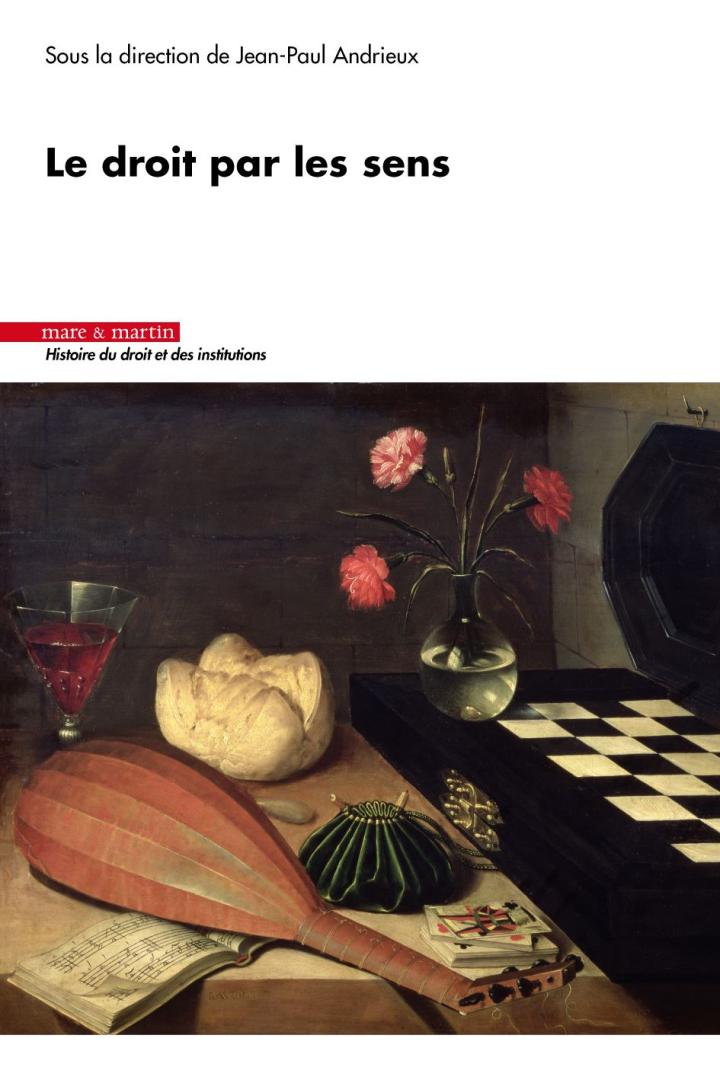
BOOK: Jean-Paul ANDRIEUX (dir.), Le droit par les sens [Histoire du droit et des institutions] (Paris: Mare & Martin, 2024), 312 p. ISBN 9782386000713


(image source: Mare & Martin)

Abstract:

Comment les sens définissent, évaluent et interrogent-ils le droit ? Le présent ouvrage collectif invite à rechercher et à découvrir le droit par les sens. À leur capacité de mettre en évidence des aspects inattendus du droit, les sens ajoutent, par une expérience originale et inédite, une modification singulière de notre rapport au droit. La distance habituellement induite par l’objet juridique s’efface avec la vue, le goût, le toucher, l’odorat ou l’ouïe, offrant soudain une proximité troublante. La justice, traditionnellement représentée les yeux bandés, n’illustre pas une conscience perceptive en échec. L’oeil de la loi, de la même manière, ne doit pas rester une image métaphorique solitaire. Les sens, au miroir du droit, révèlent, au-delà de représentations édifiantes, quelque chose de fondamental : ils signifient que le droit se vit dans une expérience sensorielle ininterrompue. Comme la bonne vue fait la meilleure publicité, le bon goût, la meilleure valeur, le toucher, la meilleure garantie, le bon sens fait le bon droit. Le droit par les sens propose ainsi, dans l’Antiquité, la Modernité et l’Actualité, quelques exemples éclai

On the editor:

Jean-Paul Andrieux est Professeur d’histoire du droit à l’université Paris-Panthéon-Assas et membre de l’Institut d’Histoire du droit Jean Gaudemet.

Read more here. 

12 November 2019

BOOK: Eric H. REITER, Wounded Feelings: Litigating Emotions in Quebec, 1870–1950 (Toronto: University of Toronto Press, 2019). ISBN 9781487506551, $67.50


The University of Toronto Press is publishing a new book on the legal history of emotions in Quebec.

ABOUT THE BOOK

Wounded Feelings is the first legal history of emotions in Canada. Through detailed histories of how people litigated emotional injuries like dishonour, humiliation, grief, and betrayal before the Quebec civil courts from 1870 to 1950, it explores the confrontation between people’s lived experience of emotion and the legal categories and terminology of lawyers, judges, and courts. Drawing on archival case files, supplemented by newspapers and contemporary legal writings, it examines how individuals narrated their claims of injured feelings, and how the courts assessed those claims, using legal rules, social norms, and the judges’ own feelings to validate certain emotional injuries and reject others.

The cases reveal both contemporary views of emotion as well as the family, gender, class, linguistic, and racial dynamics that shaped those understandings and their adjudication. Examples include a family’s grief over their infant son’s death due to a physician’s prescription error, a wealthy woman’s mortification at being harassed by a conductor aboard a train, and the indignation of two Black men at being denied seats at a Montreal cinema. The book also traces an important legal change in how moral injury was conceptualized in Quebec civil law over the period, as it came to be linked to the developing idea of personality rights. By 1950, the subjective richness of stories of wounded feelings was increasingly put into the language of violated rights, a development with implications for both social understandings of emotion and how individuals presented their emotional injuries in court.

ABOUT THE AUTHOR

Eric H. Reiter is an associate professor in the Department of History at Concordia University and a member of the Quebec Bar.

TABLE OF CONTENTS

Illustrations
Foreword
Acknowledgments
Introduction
1. Feelings and the Law in Nineteenth-Century Quebec
2. Shame, Mortification, Disgrace, Dishonour
3. Family Dishonour
4. Bodily Intrusion
5. Betrayal
6. Grief and Mourning
7. Indignation, Anger, Fear
8. Conclusion: From Wounded Feelings to Violated Rights
Abbreviations
Case Citations
Notes
Bibliography
Index

More info here

18 September 2014

CFP: "Criminal Law and Emotions in European Legal Cultures: From 16th Century to the Present" (Berlin, 21-22 May 2015)


WHAT: Criminal Law and Emotions in European Legal Cultures: From 16th Century to the Present, Call for Papers

WHERE: Max Planck Institute for Human Development, Center for the History of Emotions, Berlin

WHEN:   21-22 May 2015

Deadline 1 October 2014
All information here

Legal institutions and jurists have often perceived themselves and promoted an image of their role and activity as essentially 'rational'.
Yet, emotions have always been integral to the law, particularly in the case of criminal law. Emotions were and are taken explicitly or implicitly into consideration in legal debates, in law-making, in the codified norms and in their application, especially in relation to paramount categories such as free will, individual responsibility and culpability, or the aggravating and mitigating circumstances of a crime.

Emotions could directly or indirectly play a role in defining what conduct was legally relevant, worthy of legal protection or in need of legal proscription; in why and how it was necessary to punish, and what feelings punishment was meant to evoke. 

Legal scholars in the past did not shun the complex relationship between law and emotions. Yet it is in the last two decades that specialists from different disciplines, from law theory to psychology, from philosophy to history, have shown an increasing and lively interest in unravelling the role played by passions, feelings and sentiments in criminal law. Special attention has been focused on three key areas: norms, practices and people.