Search

Showing posts with label Russia. Show all posts

20 March 2026

BOOK PRESENTATION: Lauri MÄLKSOO, "Russia, the Soviet Union, and Imperial Continuity in International Law" (Cambridge: Lauterpacht Centre for International Law, 2 FEB 2026) [YOUTUBE]

(source: Youtube)

Abstract:

Empire is a big theme in international law. At the same time, the historical discussion on imperialism and international law had focussed primarily on the West European Empires. This presentation examines Russian and Soviet historical engagements with international law through imperial ideas and practices. Of the doctrines of international law, the ideas of state identity (continuity) and also termination of treaties via the doctrine of clausula rebus sic stantibus are examined, and how their use has served the imperial construction and practice of international law in Russia. Understanding the history of international law in Russia through the lens of Empire helps us inter alia to situate Russia's war against Ukraine.

On the speaker:

Lauri Mälksoo is Professor of International Law at the University of Tartu in Estonia. He is member of the Institut de Droit International, of the Venice Commission of the Council of Europe and of the Estonian Academy of Sciences. He has published two monographs on the history and theory of international law in Russia and the Soviet Union at the Oxford University Press.

 See here.

03 October 2017

CONFERENCE: A legal history conference: Russian Revolution in the Nordic perspective (7 Nov 2017, Oslo, Oslo University)

This conference aims at discussing the history, legal implications, and legacy of the 1917 Russian Revolution.
Illustration: Reidar Aulie: Tendens (copyright BONO).
In February and October 1917 Revolutions took place in Russia, bringing about dramatic changes in the society and the legal system. Did the Russian Revolution(s) have any impact on the Nordic countries? What legal transformations did the Revolution(s) bring about for Russia and for the Nordic countries?
Without understanding the legal and political transformations which occurred in Russia 100 years ago, we may not fully understand the legal system of Russian law in the later Soviet and post-Soviet period, and the implications for the Nordic countries.
This conference will be of interest not only for legal historians. We invite legal scholars, practitioners, students and everyone interested in history of Russia and the Nordic states, international and comparative law and Russian law.

PROGRAM

9:00-9:15 Coffee
9:15-9:30 Welcome: Professor Dag Michalsen, Dean of the Law Faculty / Professor Alla Pozdnakova
9:30 Professor William E. Butler (Penn State University): Key note speech

Chair: Professor Marit Halvorsen
10:00 History of 1917 Russian Revolution(s): Professor Emeritus Åsmund Egge (UiO)
10:25 Young Marx and why Revolutionists did not like him: Professor Christoffer Conrad Eriksen (UiO)
11:50 Coffee break
11:15 Comparative Law in Russia: Historical traces of influence: Irina Fodchenko, PhD candidate (UiO)
11:15 Revolutionary Law in Russia: Continuity and change: Dr. Tatiana Borisova (HSE St. Petersburg)
11:30 Questions and discussion
          12:15-13:00 Lunch break

Chair: Professor Gentian Zyberi
          13:00 Fisheries in Finnmark – relationship with Russia in legal history perspective: Professor Emeritus Kirsti Strøm Bull (UiO)
13:20 Right to state and other property  after the revolution and/or recognition of new government in Russia, contra Russian recognition of the Norwegian government in 1905: Professor Ola Mestad (UiO)
13:40 Real property law in pre- and post-soviet Russia: Has the Revolution altered Russia's legal regime? Professor Tina Hunter (University of Aberdeen)
14:00 How Russia became a market economy - or did it? Professor Kaj Hobér (University of Uppsala; Stockholm Chamber of Commerce)
14:30 Questions and discussion
14:50 Commentary/ Professor William E. Butler
15:00 - 15:15 Coffee break

Chair: Professor Alla Pozdnakova
15:15 The Martens Clause and Its Importance for the Development of International Humanitarian Law, Professor Gentian Zyberi (NCHR)
15:35 The Soviet Union and the negotiation of the UN Charter and universal human rights, 1941-1948: Professor Emeritus Åsbjørn Eide
15:50 Turbulent times: Finnish independence and civil war in a comparative context: Professor Jukka Kekkonen (University of Helsinki)
16:20 "Latvian Socialist Soviet Republic or so called "Stuchka’s Republic" (December 1918 – January 1920) as a Latvian statehood alternative and social experiment": Dr.iur. Elīna Grigore-Bāra (University of Latvia)
16:40 Commentary / Professor William E. Butler
17:00 Questions and round-up

07 September 2017

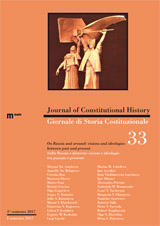
JOURNAL: Giornale di Storia costituzionale n° 33 (2017/1): On Russia and around: visions and ideologies between past and present

(image source: University of Macerata)

The Giornale di Storia costituzionale published its 33th issue (2017, first Semester), featuring a theme issue "On Russia and around: visions and ideologies between past and present".

Table of contents:
Sommario / Contents:
Luigi Lacchè, Sulla Russia e dintorni / On Russia and aroundFONDAMENTI
Roberto Valle, Genealogie del costituzionalismo in Russia dal XVIII al XX secolo / The Genealogies of Russian constitutionalism from the 18th to the 20th centuriesRenata Gravina, Teorie e prassi delle costituzioni sovietiche e della costituzione post-sovietica del 1993: dall’URSS alla Federazione Russa / Theories and Practices of Soviet Constitutions and of the 1993’s Post-Soviet Constitution: from the USSR to the Russian FederationEvgeniy M. Kozhokin, Olga N. Zherelina, The nation at the change of epochs. Russian state and society at the turn of the XX century / La nazione nel mutamento di epoche. Lo Stato russo e la società al volgere del XX secoloTatyana Yu. Ampleeva, Julia A. Karaulova, Constitutional Control in Russia: issues of evolvement, theory and practice / Controllo costituzionale in Russia: elementi di evoluzione, teoria e prassiInna Vladimirovna Logvinova, Constitutional bases of the Russian Federation subjects’ international activity: historical context / Basi costituzionali dell’attività internazionale degli Stati federali della Federazione russa: il contesto storicoOlga Grigorieva, Constitutional basis for international cooperation of the Union of Soviet Socialist Republics / Basi costituzionali per la cooperazione internazionale dell’Unione delle Repubbliche Socialiste SovieticheElena V. Voevoda, Anatoliy Yu. Belogurov, Lidiya P. Kostikova, Nadezhda M. Romanenko, Margarita V. Silantyeva, Language policy in the Russian Empire: legal and constitutional aspect / Politica della lingua nell’Impero russo: aspetti legali e costituzionaliStanislav Surovtcev, Historical aspects and the meaning of lobbying from a legal perspective / Aspetti storici e significato del lobbismo da una prospettiva giuridicaITINERARI
Genri T. Sardaryan, Dzerassa Eleeva , Post-revolutionary catholic social teaching: Risorgimento, Syllabus and the failed liberalization / L’insegnamento sociale cattolico post-rivoluzionario: Risorgimento, Sillabo e la liberalizzazione fallitaIgor Okunev, Capitals and capitalness: institutional and symbolic dimensions (comparative analysis of Russian and Italian cases) / Capitali e “capitalità”: dimensioni istituzionali e simboliche (analisi comparativa di casi russi e italiani)Igor Levakin, Juridification of freedom in Europe: legal history / Giuridicizzazione della libertà in Europa: storia legaleRobert Yengibaryan, The Institution of Presidency in the USA / L’istituzione della Presidenza negli USASergey G. Kamolov, Digital public governance: trends and risks / Governo pubblico digitale: tendenze e rischiMarina M. Lebedeva, Maxim V. Kharkevich, Elena S. Zinovieva, Ekaterina N. Koposova, The impact of information technologies on development of archaic state structures / L'impatto delle tecnologie dell’informazione sullo sviluppo di strutture statali arcaicheRICERCHE
Cristina Bon, Immaginare una nazione. Origini e contraddizioni del nation-building americano/ Imagining a nation. Origins and contradictions of the American nation-buildingMatteo Frau, L’equilibrio originario dei poteri di guerra nella Costituzione americana / The original balance of war powers in the US ConstitutionAlessandra Petrone, Carré de Malberg e l’eredità della Rivoluzione: sovranità nazionale versus sovranità del popolo / Carré de Malberg and the heritage of the Revolution: national sovereignty versus sovereignty of the people
LIBRIDO
Primo piano / In the foregroundGiuseppe Mecca legge / reads Romano Ferrari Zumbini, Tra norma e vita. Il mosaico costituzionale a Torino 1846-1849Venti proposte di lettura / Twenty reading proposals
More information on the journal's website, where certain articles are available in open access (cf. green links above).

02 December 2014

REVIEW: International conference: «The Judicial Reform in Russia: Past, Present, and Future» (Moscow, 25–28 November 2014)

«The Judicial Reform in Russia: Past, Present, and Future»
(Moscow, 25–28 November 2014)

reviewed by Dmitry Poldnikov (dpoldnikov@hse.ru)

The conference was organized by the Moscow Subdivision of the Association of Lawyers of Russia during the 4th Moscow legal week (25 November to 5 December 2014) and hosted jointly by two leading centres of legal education in Russia — the Faculty of Law of Lomonosov Moscow State University and Kutafin Academy of Law. It commemorated the 150th anniversary of the Judicial Reform of 1864 in the Russian Empire, one of the turning points in Russian legal history. In the aftermath of the defeat of Russia in the Crimean War (1853–56) this reform became a crucial part of the modernization of Russia as it set out to replace the slow, unpredictable, corrupt judiciary with a «prompt, equitable, humane, and equal to all (classes)» system of justice (to quote the manifesto of 20 November 1864 of Tsar Alexander II).
By its purpose to re-examine the lessons of the past the conference motivated many renowned jurists (including those who usually deal with the contemporary law) to express their statements regarding this part of national legal history. The tone for the whole conference was set during the plenary session at Moscow State University (on 25 November) by the keynote speakers:
Valery Zorkin and Gadis Gadzhiev (the chairman and the judge of the Constitutional Court of the Russian Federation respectively), Sergey Shakhray (the vice-rector of Moscow State University), Igor Isaev (the head of the chair of legal history at Kutafin Academy of Law), Elena Borisova and Leonid Golovko (professors of civil and criminal procedure respectively at Moscow State University).
Talking about the lessons of the Judicial Reform of 1864 for modern day Russia Valery Zorkin (doctor iuris and graduate of Moscow State University) praised the national legal history as «the key to understand the logic of historical development of the law of the land». In his speech he focused on the «living history» which is «alive as long as we are willing to understand it… to look into the well of history in order to discern our own reflection down there». Zorkin went that far to describe all Russian legal history since the 19th century as the sequence of reforms and counter-reforms, the continuous clash of democratic and authoritarian tendencies. Contemplating the preconditions for the success of the former he underlined the duty of the reformers to evaluate the historical necessity of the proposed measures and to build on the continuity with the previous historical experience. Neglect of building the necessary foundation to support the modern liberal judiciary and procedural rules in 1864, according to Zorkin, caused unexpected consequences of this reform: instead of producing the social consensus in Russia it «infected the society with a rebellious psychology» (which led to the assassination of ‘Tsar emancipator’ Alexander II in 1881 and, ultimately, to the Bolshevik revolution of 1917) and pushed Russian authorities to pursue the path of counter-reforms. Hence, the lesson to be learned is that any reform should be designed and carried out to foster social consensus based on shared values and equality of possibilities.
Other keynote speakers draw attention to the role of modern judiciary for establishing and maintaining free-market economy (Gadzhiev), paving the way to checks on the public authorities and separation of powers (Shakhray), breaking ground for civil society and democratic rule (Isaev). Despite various approaches to evaluate the Judicial Reform of 1864, all speakers seemed to underline the crucial importance of its lessons for Russia till now. During the first day of the conference this conclusion was backed up by Shakhray and Krakovsky who presented a new illustrated dictionary on the Judicial Reform of 1864 (with a foreword by Sergey Naryshkin, the chairman of the State Duma of the Russian Federation).
On November 26–27 the participants of the conference split up into 34 sections and workshops (held mostly at Kutafin Academy of Law) dedicated to nearly all branches and academic disciplines of Russian law. The section on legal history met on 26 November. It gathered together presenters from numerous law faculties across Russia who investigated national and foreign experience in matters of reforming the judiciary as well as judicial procedure before and after 1864. Publication of selected conference papers is forthcoming. On 28 November the debating club of the Moscow Subdivision of the Association of Lawyers discussed the current issues of Russian judicial system.
As the joint conference attracted lawyers from all over Russia, the organizers seized this opportunity to hold several other meetings, including the Third Congress of the Academy of Legal Sciences, the Annual Meeting of the Moscow Subdivision of the Association of Lawyers of Russia, the Fourth Chess Tournament of the Faculties of Law in Moscow, even the Fourth Art Festival of Moscow Law Students.
Although the primary focus of discussions during this conference was on the current issues of judicial system in Russia, it undoubtedly fostered the dialogue between contemporary national law, comparative law, and legal history.


The front matter of the official edition the Judicial Statutes of 1864 (the first part), available athttp://civil.consultant.ru/reprint/books/115/
Tsar Alexander II, engraving dated 1880, from http://dlib.rsl.ru/viewer/01003902326
Reproduction of Konstantin Savitsky’s (d. 1905) painting «Awaiting sentencing» (1895) at Tretyakov Gallery, Moscow.