Search

Showing posts with label Prosopographical research. Show all posts

04 March 2024

SEMINAR: Education of Jurists and the Transfer of Legal Knowledge in the Middle Ages and Early Modern Times in the Context of Prosopographical, Biographical, and Textual Database (Krakow: University of Krakow, 8 MAR 2024) [HYBRID]


On behalf of the Coordination Board of the research platform „Hector. Heritage, Culture, Norms”, we would like to invite you to participate in the fifth project seminar entitled "Education of Jurists and the Transfer of Legal Knowledge in the Middle Ages and Early Modern Times in the Context of Prosopographical, Biographical, and Textual Databases". 


The invited guests will be:

Dr Kaspar Gubler (The University of Bern, Switzerland)

Education of Jurists and the Transfer of Legal Knowledge in the Context of Prosopographical and Textual Databases. The example of the Repertorium Academicum Germanicum (1250-1550)

Prof. Martin Holý (Czech Academy of Sciences, Czech Republic)

Law and Jurists at the University of Prague in the Late Middle Ages and Early Modern Period


One of the presented projects will be the Repertorium Academicum Germanicum (RAG) a digital history research project run by the Institute of History at the University of Bern. The data basis of the project is formed by the registers of universities of the old German Empire in the period from 1250 to 1550. The registers usually contain the names and places of origin of the students as well as the date of enrolment. This initial data is enriched with biographical data on subjects studied, professional activities and written works.


Secondly, during the seminar, it will be discussed the history of institutionalized legal education in Prague flourished most in the late 14th century. In 1372, after disputes, the University of Law was independent and enjoyed great student interest, especially in the following three decades, when over 3,500 students enrolled in law. The Hussite era, however, marked a significant turning point in the development of the University of Prague. In addition to law, the Faculty of Theology and Medicine gradually disappeared as a separate institutions. The Faculty of Arts also faced several unfavourable trends, particularly the low number of students and teachers, weakening internationalization, and increasing regionalization. Among the professors of Prague's Utraquist University in the late medieval and early modern period, only a few individuals with a law degree were active - only 3% of the teachers documented between 1458 and 1620. Soon after their return from foreign studies, the law-educated professors of the University of Prague preferred other careers, which were, among other things, more financially secure than their tenure at the Utraquist University of Prague, which was, moreover, limited by celibacy until 1609, a completely atypical relic of the earlier period in the Protestant environment abroad.


The event will be held in a hybrid format: on-site in the conference room at the JU Student Zone (Strefa Studencka UJ) (św. Anny Street 6 in Cracow) and via the MS TEAMS platform - on the 8th March 2023 (Friday) at 15:00 to 17:00.


If you are interested in taking part in this seminar, we would kindly ask you to fill in the registration form:   https://forms.office.com/e/DquW6yDyLd 


The link to the event will be sent the day before the event.

07 July 2023

BOOK: Daniela BUCCOMINO, Ingeniorum delectus. I dottori in diritto dello Studio di Pavia (1525-1796) (Torino: Giappichelli, 2023). ISBN: 9791221103663

(Image source: Giappichelli Editore)


ABOUT THE BOOK

The map of law doctors present in the Studia operating from the 16th to the 18th centuries has been enriched in recent decades, taking on increasingly defined contours. However, at this date, there is not comprehensive research on the graduate population of the University of Pavia during this chronological period that could help at investigating the user base of this Studium, its ability to absorb and meet the demand for professionals within the Duchy of Milan, and consequently, its impact in relation to the local cultural context and the magnitude of migratory flows to other locations. This present work, which represents the concluding phase of a long and complex archival research project initiated during the doctoral program at Alma Mater and perfected with the skills acquired at the Vatican School of Archival Studies, adopts a methodological perspective aimed at overcoming the "separation" between strictly historical-social analysis and historical-legal analysis.

In this perspective, it pursues a dual objective: firstly, to compile, by navigating through a vast sea of unpublished sources, a catalog of all those who obtained a doctoral degree in civil law, canon law, or both laws (utroque iure) at Pavia. The second objective, which is a direct consequence of the first, is to provide scholars with a comprehensive overview of the educational journey of some of the future protagonists of Italian and European life, while offering insights that paint a detailed picture of the academic and social context and the complex relationship maintained by the University with competing institutions and the central power of the "Milanese State". Within this framework, particular emphasis is given to the techniques of registration and the mechanisms of control over the student body of the Studium.

The chosen chronological range is limited to 1525-1796, that is, the Spanish and Austrian domination in the Lombard territory. Such a broad time span corresponds to a diverse documentary heritage, preserved in significant archival complexes, waiting to be explored.


ABOUT THE AUTHOR

Daniela Buccomino obtained her Ph.D. degree from the University of Bologna and is currently a research fellow in medieval and modern legal history at the University of Milan. Among her publications it is worth mentioning the monograph titled "Studi sulla transazione penale nell'opera di Alberto da Gandino e Angelo Gambiglioni: prime indagini sulla composizione amichevole delle liti nell'età di diritto comune" (Studies on Criminal Settlement in the Works of Alberto da Gandino and Angelo Gambiglioni: Preliminary Investigations on Amicable Dispute Resolution in the Age of Common Law).


TABLE OF CONTENTS

Introduzione 

CAPITOLO I: DE RE THEORICA. FONTI E METODOLOGIA

1.1. Le fonti per la ricostruzione dei legum doctores pavesi

1.2. Il Doctoratus: possibilità, problemi e limiti del principale fondo per lo studio degli atti di laurea in età moderna

1.2.1. Itinerario storico-archivistico di un patrimonio documentale articolato

1.2.2. Elementi costitutivi e formulario degli instrumenta laureationis

1.2.3. Stato della questione storico-prosopografica e metodologia adottata

CAPITOLO II: DALLA FORMAZIONE. ALLA DIGNITÀ DOTTORALE IN LEGE. SPUNTI DALLE FONTI GIURIDICHE E LETTERARIE PAVESI

2.1. Gli studi legali per arrivare alla perfetta «professione di gentilhuomo»

2.1.1. La visione pedagogica pavese nell’età spagnola. Lo scolare di Annibale Roero

2.1.2. «Fiacco l’insegnamento, rilassata la disciplina»: la formazione universitaria nella prima età austriaca

2.1.3. «Ingeniorum delectus, praeceptorum doctrina, studiorum ordo, scholarium disciplina»: i punti cardinali della ripartenza

2.2. Per aspera ad astra: l’esame di dottorato

2.2.1. «L’esame va ad essere…un esperimento di memoria». Formalismo e cerimonialità secondo Madrid

2.2.2. «Il rigore degli esperimenti» secondo Vienna

CAPITOLO III: DISCORDANZE E INTEGRAZIONI AL DETTATO NORMATIVO E GIURISPRUDENZIALE. L’OFFICINA DELLA PRASSI

3.1. Le matricole e la certificazione del cursus studiorum

3.2. Meccanismi di controllo sui titoli di studio 

3.2.1. Dispersione dello ius doctorandi in età spagnola. Istituzioni educative concorrenti nel conferimento dei gradi 

3.2.2. Le dispense in età moderna. Una prima campionatura 

CAPITOLO IV: I DOTTORI DELL’ALMUM STUDIUM PAPIENSE

4.1. I laureati dello Studio sino ai primi del Cinquecento 

4.2. Analisi quantitativa dei graduati in età moderna. Alcuni contesti a confronto 

4.2.1. Dalla paura alla grande crescita (1525-1619) 

4.2.2. Ancora instabilità nello Stato di Milano e conseguente repentino declino delle lauree (1620-1649) 

4.2.3. Interventi senatori e riflessi sui laureati (1650-1709) 

4.2.4. Situazione ondivaga e cristallizzazione (1710-1764) 

4.2.5. «Così utile e tanto desiderata»: la realizzazione della riforma universitaria asburgica e gli effetti sulle lauree (1772-1796) 

4.3. Provenienza geografica dei laureati: una prospettiva comparativa 

4.4. I doctores Collegiali 

Conclusioni 

Fonti d’archivio e manoscritte

Fonti a stampa antiche e moderne

Bibliografia

Avvertenze

Catalogo 

Indice dei nomi

Indice dei luoghi


More information can be found here.

06 December 2022

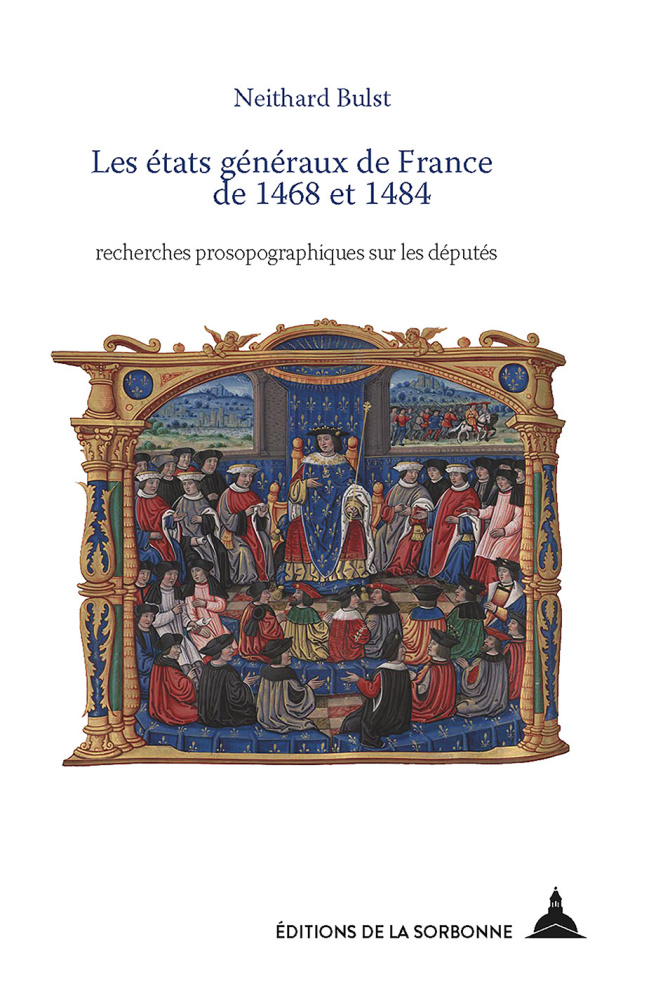
BOOK: Neithard BULST, Les états généraux de France de 1468 et 1484. Recherches prosopographiques sur les députés (Paris: Éditions de la Sorbonne, 2022). ISBN: 9791035108038

(Image source: Editions de la Sorbonne)


ABOUT THE BOOK

La thèse de Neithard Bulst sur les états généraux réunis à Tours par Louis XI, en avril 1468, et ceux, réunis par les Beaujeu en janvier-mars 1484 a profondément renouvelé l'histoire des institutions à caractère représentatif en France.

Grâce à un travail archivistique minutieux sur des sources départementales, municipales, voire privées, dispersées et inédites, ce livre offre pour la première fois une liste fiable des délégués des deux assemblées, comblant ainsi les lacunes de ceux connus par le seul Journal des États de Masselin de 1484.

La méthode prosopographique mise en œuvre donne une vision neuve du profil des délégués en mettant en évidence leur enracinement familial, professionnel et social, sans perdre de vue les membres les plus influents de chaque région. Pour chaque élection, scrutant la procédure, ce livre analyse les liens de clientélisme, de patronage, de partenariat ou de protection qui structurent les sociétés locales, donnant ainsi à voir une sorte de bastard feudalism à la française.

En privilégiant une approche sociale plutôt qu'institutionnelle et corporatiste, cet ouvrage révèle l’importance des représentants du tiers état, mais aussi la place des officiers royaux, favorisée par le changement de procédure électorale en 1484 (manœuvre habile et réussie des Beaujeu pour neutraliser les clientèles des princes).

Au-delà des assemblées représentatives, ce livre questionne le concept de « représentation » dans sa définition médiévale et éclaire sous un aspect plus large les problèmes économiques, sociaux et politiques de la société française de la deuxième moitié du XVe siècle.


ABOUT THE AUTHOR

Neithard Bulst fut professeur à l'université de Bielefeld (1978-2008), et à plusieurs reprises directeur associé à l’EHESS, professeur associé à Paris 7, ainsi qu’à l’Eastern European University de Budapest et membre de l’Advanced Center de Princeton. Il a largement participé aux programmes du Lamop sur l’État moderne et la prosopographie (coéditant La ville, la bourgeoisie et la genèse de l’État moderne) ainsi qu’au projet de la European Science Foundation « Origins of the Modern State ».


TABLE OF CONTENTS

Préface

Avant-propos de l'édition allemande publiée en 1992

Introduction

  • 1. L'état de la recherche
  • 2. L'objet de recherche
  • Remarques concernant la compréhension des termes importants, des dénominations de fonctions, de titres et des indications monétaires

Première partie - Les états généraux de 1468 et 1484

  • Chapitre 1. 1468 : les états généraux sous Louis XI
  • Chapitre 2. 1484 : les états généraux sous Charles VIII, pendant la régence

Deuxième partie - Recherches sur les députés de 1468 et 1484

  • Note liminaire
  • Les délégations de 1468
  • Les délégations de 1484

Troisième partie - Les députés aux états généraux de 1468 et 1484 : une comparaison

  • Chapitre 1. Les élections des députés et leur mandat
  • Chapitre 2. L’attitude des députés aux états généraux : le problème de leur marge de manœuvre
  • Chapitre 3. La rémunération des députés
  • Chapitre 4. Analyses prosopographiques des députés aux états généraux de 1468 et 1484
  • Chapitre 5. La procédure électorale aux états généraux de 1484 : une manœuvre tactique ?

Conclusion


More information can be found here.