Search

Showing posts with label Positivism. Show all posts

26 August 2024

BOOK: Rodrigo Borges VALADÃO, Rechtspositivismus und Nationalsozialismus. Entstehung, Widerlegung und Überwindung der Positivismuslegende [Schriften zur Rechtstheorie, vol. 310] (Berlin: Duncker & Humblot, 2024), 396 p., ISBN 978-3-428-18768-3

 Cover: Rechtspositivismus und Nationalsozialismus

ABOUT THE BOOK: 

Ziel des Buches ist es, eine breite historische Analyse dessen anzubieten, was die deutsche Rechtskultur herkömmlich als Positivismuslegende bezeichnet hat – eine irreführende Wahrnehmung ihrer jüngeren Geschichte, die den Rechtspositivismus im Allgemeinen und Hans Kelsens Reine Rechtslehre im Besonderen in einem rechtstheoretischen Ansatz für den Niedergang der demokratischen Institutionen in der Weimarer Republik und die Legitimation der NS-Diktatur verantwortlich machte. Das Werk ist in drei Kapitel unterteilt, die nacheinander der Entstehung, Überwindung und Widerlegung der Positivismuslegende gewidmet sind, sowie in einen Epilog, der versucht, die enge Verbindung zwischen Rechtspositivismus und liberaler Demokratie aufzuzeigen. Darüber hinaus enthält das Buch auch eine Originalstudie über die Einführung der Legende des Positivismus in Brasilien.

ABOUT THE AUTHOR:

Staatsanwalt von Rio de Janeiro, Brasilien. Präsident der brasilianischen Vereinigung für die Verwaltung persönlicher Daten. Master in Verfassungsrecht (Pontifícia Universidade Católica do Rio de Janeiro, Brasilien). Master in Privacy, Cybersecurity, Data Management, and Leaderschip (Maastricht University, Niederlande). Doktor der öffentlichen Rechtswissenschaften (Universidade de São Paulo, Brasilien). Doktor der Rechtswissenschaften (Albert-Ludwigs-Universität Freiburg, Deutschland).

Read more here. 

12 December 2023

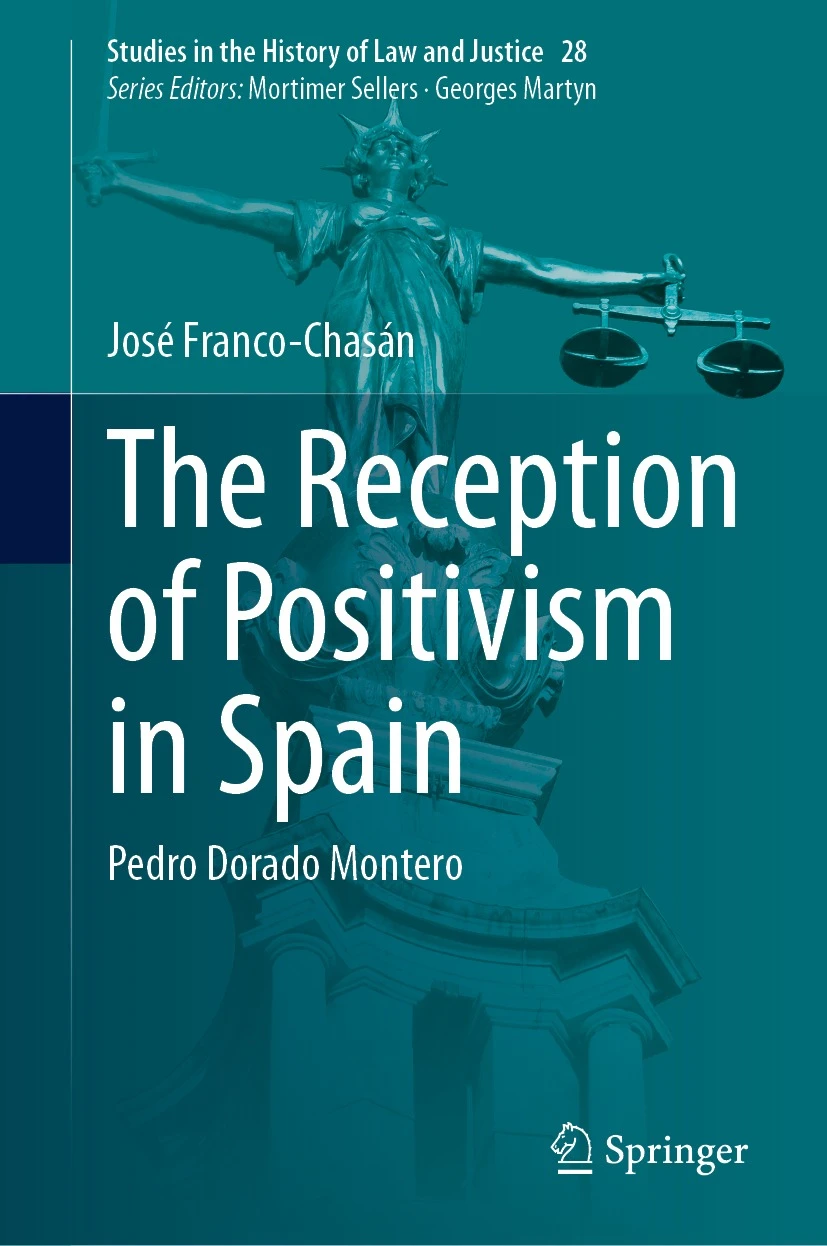
BOOK: José FRANCO-CHASÁN, The Reception of Positivism in Spain. Pedro Dorado Montero [Studies in the History of Law and Justice, vol. 28; Eds. Mortimer SELLERS & Georges MARTYN] (Heidelberg: Springer, 2023), 226 p. ISBN 978-3-031-46434-8, € 148,39


(image source: Springer)

Abstract:

Pedro Dorado Montero was one of Spain’s most relevant authors. He contributed to modern Criminal law and Penology with a very unique theory: the Protective Law for Criminals. In a time when neoclassical penal theories and new positivist theories clashed, Dorado Montero’s proposal served as a bridge between the criminal law conceptions of the 19th and 20th centuries. In order to explore his role in the introduction of positivism within Spain and the subsequent success of this trend, this book addresses several aspects. The first three analyzed are his scholarly career, the historical and international context in which he lived, and the various European and other international influences he was exposed to. On this basis, two major points are then discussed. Firstly, Dorado Montero has been traditionally included within the movement known as correccionalismo. However, his legal-philosophical and criminal thought indicates otherwise. It seems to lie closer to positivism than to neoclassical positions. This research aims at challenging the accuracy of the ‘eclectic’ label which traditional historiography has applied to him. In turn, Dorado Montero described a reality in which every moral value and legal representation was a mere product of mankind’s imagination. Man is responsible for the elaboration of morals, law and culture in his own mind. Thus, for him, there were as many moral and legal orders as there were human beings on the planet. Such a claim is polemic even today. Unsurprisingly, the author received criticism from both neoclassical and positivist schools. Thus, the existence of a ‘Doradian positivism’ is explored. Despite the growing interest in these topics over the last few decades, Dorado Montero has somehow been overlooked – even though his Derecho protector de los criminales described the criminal law of the future as well, one that will have to face the new neurological, medical, psychological and genetic challenges of our time.

On the author:

José Franco-Chasán is Professor of Legal History at the University Rey Juan Carlos (Madrid). He obtained his PhD at the University of Valencia (cum laude and an international honour), where he obtained as well his Master in Human Rights. He worked as a researcher at the University of Augsburg (Germany) for three years. He has carried out several international research stays in Lausanne (Switzerland), Princeton (USA) and the Max-Planck-Institut (Frankfurt am Main, Germany). He worked at the University CEU Cardenal Herrera where he led the Department of Roman Law. Currently, he is working at the “Emerging Research Group in Spain and Spanish America: Five Centuries of Historical and Legal Relations” (University Rey Juan Carlos, EHCSRHJ) and in “The Alan Watson Group: the Making of the Western Law” (University of Valencia, WESTLAW).

More information here: DOI  10.1007/978-3-031-46435-5.

04 May 2022

BOOK: Michele PIFFERI (Ed.), The Limits of Criminological Positivism. The Movement for Criminal Law Reform in the West, 1870-1940 (London: Routledge, 2022). ISBN: 9780367340599, pp. 202, £96.00

ABOUT THE BOOK

The Limits of Criminological Positivism: The Movement for Criminal Law Reform in the West, 1870-1940 presents the first major study of the limits of criminological positivism in the West and establishes the subject as a field of interest.

The volume will explore those limits and bring to life the resulting doctrinal, procedural, and institutional compromises of the early twentieth century that might be said to have defined modern criminal justice administration. The book examines the topic not only in North America and western Europe, with essays on Italy, Germany, France, Spain, the United Kingdom, Belgium, and Finland but also the reception and implementation of positivist ideas in Brazil. In doing so, it explores three comparative elements: (1) the differing national experiences within the civil law world; (2) differences and similarities between civil law and common law regimes; and (3) some differences between the two leading common-law countries. It interrogates many key aspects of current penal systems, such as the impact of extra-legal scientific knowledge on criminal law, preventive detention, the ‘dual-track’ system with both traditional punishment and novel measures of security, the assessment of offenders’ dangerousness, juvenile justice, and the indeterminate sentence. As a result, this study contributes to a critical understanding of some inherent contradictions characterizing criminal justice in contemporary western societies. Written in a straight-forward and direct manner, this volume will be of great interest to academics and students researching historical criminology, philosophy, political science, and legal history.

ABOUT THE EDITOR

Michele Pifferi is Professor of Legal History at the University of Ferrara, Law Department. He has been Visiting Researcher at the Max-Planck-Institute for Legal History and Legal Theory in Frankfurt am Main; Emil Noël Fellow at NYU School of Law; Robbins Fellow at Berkeley UC—School of Law; Academic Visitor at the Oxford Centre for Criminology; and Alexander von Humboldt Research Fellow at the University of Hamburg, Faculty of Law. He is currently Alexander von Humboldt Research Fellow at the Humboldt Universität zu Berlin, Faculty of Law as well Principal Investigator of a research project on Legal History and Mass Migration: Integration, Exclusion, and Criminalization of Migrants in the 19th and 20th Century. Member of the Editorial Board of the series Rechtsgeschichte und Rechtsgeschehen —Italien (LIT Verlag), and of Quaderni fiorentini per la storia del pensiero giuridico moderno. His research interests focus on history of late medieval to late modern criminal justice, history of criminology, and history of migration law.

TABLE OF CONTENTS

Introduction. An Historiographical Reassessment of Criminological Positivism

Michele Pifferi


Scientist Utopia and Reactionary Nostalgia: Criminal Procedure and the Early Positivist School

Marco Nicola Miletti


Penal Reform in Imperial Germany: Conflict and Compromise

Richard F. Wetzell


The French Judicial and Political Origins of Raymond Saleilles’ Individualization of Punishment

James M. Donovan


The Influence of Positivism in Belgium: An Eclectic Compromise Between Adhesion and Resistance

Yves Cartuyvels


The Limits of Positivism: Finnish Criminal Law Scholarship and the European Context at the Turn of the Twentieth Century

Heikki Pihlajamäki


From the Sacred Springtime of Criminal Law to the Limits of Criminological Positivism in Spain

Enrique Roldán Cañizares


Fascist Italy’s Juvenile Courts in Their Infancy: First Impressions

Paul Garfinkel


Responding to the Problem of Crime: English Criminal Law and the Limits of Positivism, 1870-1940

Lindsay Farmer


Positivism’s Humbugs: Criminology and its Cranks in Progressive America

Susanna Blumenthal


Limits and displacements in the adoption of criminological positivism in Brazil (1890-1940)

Ana Lucia Sabadell and Dimitri Dimoulis


From Responsibility to Dangerousness? The Failed Promise of Penal Positivism

Michele Pifferi


Index


More information with the publisher.

10 January 2022

BOOK: Badouin DUPRET & Jean-Louis HALPÉRIN (Eds.), State Law and Legal Positivism. The Global Rise of a New Paradigm (Leiden: Brill, 2021). ISBN: 978-90-04-49865-5, € 103.00

(Source: Brill)

ABOUT THE BOOK

Series: Legal History Library, Volume: 55
 
This volume formulates the hypothesis of a truly global revolution that reflected a Great Divide between ancient and new legal regimes. The volume brings together several case studies of transition from an ancient to a new legal regime characterized by the positivization of the law. This was an effect of Western imperialism, but also of local elites’ conviction that positive law was an efficient instrument of governance. The contributors emphasize the depth and scale of the positivist legal revolution and explore the phenomenon whether it was the outcome of either direct colonialism (Morocco, Egypt, India) or indigenous reformism (Ottoman empire, China, Japan). 

ABOUT THE EDITORS

Baudouin Dupret is Directeur de Recherche at the French National Centre for Scientific Research (CNRS), based at the institute Les Afriques dans le Monde, Bordeaux (France), and guest lecturer at the University of Louvain (Belgium). He has published extensively in the field of the sociology and anthropology of law in the Muslim world. He (co-)edited numerous volumes, the most recent one being Legal Rules in Practice (with J. Colemans and M. Travers, Routledge, 2020), and single-authored several books, including Positive Law from the Muslim World (Cambridge University Press, 2021). 

Jean-Louis Halpérin, Ph. D. (1985), University Paris II, is currently Professor of legal history at the Ecole Normale supérieure - Paris Siences Lettres. He has published monographs and many articles on European and Asian legal history, including Five Legal Revolutions since the 17th Century. A Analysis of Global Legal History(Springer, 2014). 

Contributors are: Léon Buskens, Jean-Philippe Dequen, Baudouin Dupret, Jean-Louis Halpérin, Béatrice Jaluzot, Gianluca Parolin, Avi Rubin, and Tzung-Mou Wu.

TABLE OF CONTENTS

Notes on Contributors 

Introduction 
   Baudouin Dupret 

1 The Great Divide in Legal Discourse: Towards a Global Historical Ontology of the Concept of Positive Law 
   Baudouin Dupret and Gianluca Parolin 

2 Historical Landmarks in Mapping the Spread of Positive Law Teaching 
   Jean-Louis Halpérin 

3 Writing Customs: Three Episodes in the Process of Positivization of Berber Customary Law in Morocco 
   Léon Buskens 

4 Ambiguities and Interdependencies: The Relationship between Legal Positivization and Islamic Law in Colonial India, 1765–1909 
   Jean-Philippe Dequen 

5 The Positivization of Ottoman Law and the Question of Continuity 
   Avi Rubin 

6 How Government Jurists and Lawyering Approached the “Positivizing” of the Law in China 
   Tzung-Mou Wu 

7 The Meiji Era: When Japanese Law Became Positivized 
   Béatrice Jaluzot 

Conclusion 
   Jean-Louis Halpérin 

Index 


More information with the publisher.

09 June 2020

BOOK: Alessia Maria DI STEFANO, Il corso di diritto penale (1840-1843) di Emerico Amari, un maestro della penalistica civile tra illuminismo e positivismo (Torino: Giappichelli, 2018). ISBN: 9788892115262, pp. 328, € 41,00

Il corso di diritto penale (1840-1843) di Emerico Amari, un maestro della penalistica civile tra illuminismo e positivismo


ABOUT THE BOOK

Nel corso di lezioni di «dritto penale e procedura» tenuto nell’Università di Palermo a partire dal 1840, Emerico Amari filtra con la sua sensibilità i risultati più significativi della riflessione dei giuristi intorno ai problemi principali del diritto penale quali il metodo, il fondamento del potere di punire e la funzione della pena.
Cattolico e liberale, figura di spicco del Risorgimento siciliano, saldamente ancorato ai capisaldi della cultura illuminista e attento alle novità del positivismo, Amari combatte le sue battaglie per la libertà politica ed economica soprattutto dalle pagine dei più importanti periodici isolani, convinto che l’intellettuale debba contribuire attivamente al progresso sociale mettendo a disposizione della collettività in generale e dei governanti in particolare i propri studi e le proprie conoscenze, al fine di far emergere le criticità dei sistemi sociopolitici e di suggerire le riforme più utili per favorire il progresso. La battaglia per l'abolizione della pena di morte, che coinvolge e affascina gli studenti palermitani e spaventa le gerarchie, la partecipazione alla rivoluzione del ’48, non sono che alcuni tra i tanti tratti che segnano la personalità di Amari, un protagonista di quella stagione della cultura giuridica che Sbriccoli ha definito penalistica civile.

ABOUT THE AUTHOR

Alessia Maria Di Stefano dal dicembre 2018 è ricercatore a tempo determinato presso il Dipartimento di Giurisprudenza dell’Università degli Studi di Catania. Ha conseguito il titolo di Dottore di ricerca in Storia del Diritto presso l’Università di Macerata (2010); già assegnista di ricerca presso il Dipartimento di Giurisprudenza dell’ateneo catanese (2012), ha svolto periodi di ricerca all’estero presso la School of Law – UC Berkeley e il Max-Planck-Institut für europäische Rechtsgeschichte di Frankfurt am Main.Ha insegnato Storia del diritto medievale e moderno all’Università degli Studi di Palermo, corso di Laurea Magistrale in Giurisprudenza di Trapani .

TABLE OF CONTENTS

A pdf version of the the table of contents can be downloaded here

More information here