Search

Showing posts with label Globalization. Show all posts

26 November 2025

BLOG: New Global Legal History Blog ANT.E (Areas – Norms – Time, Entangled) (Wien: Universität Wien)

 We received the following announcement:

We are happy to announce the launch of our blog ANT.E at ante-blog.univie.ac.at.

ANT.E is Areas – Norms – Time, Entangled.

ANT.E is a blog and an international platform for discussion and scientific exchange.

ANT.E looks at processes of the globalization of law from a historical perspective, focusing on the experiences of the Global South.

ANT.E wants to bridge the past and the future and to challenge Western, post-/semi-colonial narratives.

ANT.E discusses topics from different perspectives in brief essays by researchers from various fields, tying them together in colloquies.

Our first colloquy on “Unseen Agencies of Transformation” features contributions by Ivelina Masheva, Surutchada and Adam Reekie, Hailegabriel Gedecho Feyissa, and an introductory comment by Makiko Hayashi.

Join us as a reader and/or contributor – contact us at ante.rg@univie.ac.at.

We look forward to hearing from you!


The ANT.E publishers and team


20 February 2019

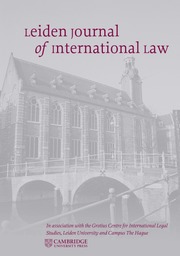
JOURNAL: Leiden Journal of International Law XXXII (2019), no. 2

(image source: Cambridge Core)

Arthur Dyèvre, "Uncertainty and international adjudication"
Abstract:
In deciding whether to rule against a state party, international courts regularly confront a compliance dilemma: declare the state in breach of the international regime but with the risk that it will defy the court’s authority; or defer to the state but at the price of acquiescing to an unjust or undesirable outcome. Specifically, international adjudicators must solve this dilemma in a context of uncertainty, that is, without knowing with exactitude whether or not the state will prefer complying with an adverse ruling over overt defiance. I use a simple strategic model to cast light on this aspect of the compliance dilemma. Building off from the model’s insights, I then discuss the practices, doctrinal tactics and institutional mechanisms apt to reduce uncertainty and minimize state defiance. I highlight, in particular, the advantages of defiance avoidance mechanisms that help create informational feedback loops like test-the-water dicta and double-tier review. I illustrate how these mechanisms have been deployed by two of the world’s most powerful international courts, the European Court of Justice and the European Court of Human Rights. Finally, I consider the limitations of these mechanisms along with the possibility for other international dispute settlement bodies to replicate them.

Isha Jain & Bhavesh Seth, "India’s nuclear force doctrine: Through the lens of jus ad bellum"
Abstract:
Nearly three decades after the Cold War, the present-day hostilities between India and Pakistan have shifted the focus of the threat of nuclear escalation to South Asia. It is in this context that this article seeks to assess the legality of India’s military nuclear doctrine under international law. Academic literature on the use of nuclear weapons has largely shied away from discussing the legality of specific military doctrines or ‘policies of deterrence’ of the nuclear weapon states, treating them as issues of military strategy that are beyond the realm of international law. This article hopes to challenge that dichotomy. Though several branches of international law are relevant to any discussion on nuclear weapons, this article shall only examine India’s nuclear doctrine through the lens of jus ad bellum. Specifically, this article shall focus on whether India’s nuclear doctrine constitutes a threat to use force, and if so, whether such threat is lawful. The article concludes that India’s nuclear doctrine can be construed to be a specific threat to use force against Pakistan, and that such threat may be unlawful for contemplating the disproportionate use of force.
Richard Clements, "From bureaucracy to management: The International Criminal Court’s internal progress narrative"
Abstract:
Within international institutions such as the International Criminal Court (ICC), lawyers increasingly encounter managerial practices which are designed to improve organizational efficiency and cost-effectiveness. Charting this trend, scholars have analyzed these practices with a view to make them more legitimate. However, this scholarly focus overlooks the role of managerial practices in legitimizing and thus sustaining the institutions in which they are embedded. In this article, I ask how managerial practices operate to boost the ICC’s reputation among its global audience. I find the answer in the Court’s use of the juxtaposed images of bureaucracy and management, with all their negative and positive associations. The Court uses these images to narrate a story of its own internal evolution from inefficient bureaucracy to efficient and well-managed organization. This hidden narrative of institutional progress functions rhetorically to frame, focus and distract the attention of the Court’s global constituencies. 

Dimitri Van Den Meerssche, "Performing the rule of law in international organizations: Ibrahim Shihata and the World Bank’s turn to governance reform"
Abstract:
In recent years, the academic field of international institutional law has taken a clear ‘constitutional’ turn. In this normative endeavour, liberal ‘rule of law’ ideals are being reinvigorated, translated and projected onto international organizations. This article trades this well-trodden path for a socio-legal inquiry into how the ‘rule of law’ is produced, practiced and performed in the everyday political and operational life of one specific international organization (the World Bank) during one contentious historical episode. To grasp what it means for ‘law to rule’, I argue, we need to expand our archives to the daily praxis of legality: the actors that embody it; the consciousness that drives it; the politics that rely on it; and the fragile institutional balances that give it meaning. Grounded in this pragmatist perspective, I retrace the intervention of legal expertise during the Bank’s turn to state reform in the wake of the Cold War. Descending from principles to practices, from norms to acts, from abstract heights to situated performances, the article not only strives for an enhanced understanding of the ‘rule of law’ within the World Bank, but also aims at a critical methodological intervention in the field of international institutional law.
Erika de Wet, "The invocation of the right to self-defence in response to armed attacks conducted by armed groups: Implications for attribution"
Abstract:
The right to self-defence in Article 51 of the United Nations Charter is increasingly being invoked in response to armed attacks conducted by armed groups located in a territory of another state, with or without the (direct) assistance of such a state. This article examines the implications of the invocation of the right to self-defence under these circumstances for the principles of attribution within the jus ad bellum paradigm. First, it illuminates how the threshold requirements for indirect armed attacks (that is, the state acting through a private actor) have been lowered since the 1986 Nicaragua decision of the International Court of Justice. In so doing, the article suggests that in order to prevent a complete erosion of the benchmarks of an indirect armed attack, the notions of ‘substantial involvement’ in an armed attack, ‘harbouring’, and ‘unwillingness’ should be interpreted as manifestations of due diligence. Thereafter, the article illustrates that there is also an increasing attribution of armed attacks directly to non-state actors, notably those located in areas over which territorial states have lost control. Such states could be depicted as being ‘unable’ to counter the activities of non-state actors. The article further submits that particularly in these instances, the principle of necessity within the self-defence paradigm can play an important role in curbing the potential for abuse inherent in the vague notion of ‘inability’, if interpreted in light of Article 25 of the Articles on State Responsibility for Internationally Wrongful Acts.
Dire Tladi, "The international law commission’s recent work on exceptions to immunity: Charting the course for a brave new world in international law?"
Abstract:
In the summer of 2017, the International Law Commission adopted a draft article on exceptions to immunity. The Draft Article adopted provides that immunity ratione materiae does not apply with respect to certain international crimes, namely crimes against humanity, the crime of genocide, war crimes, the crime of apartheid, torture, and enforced disappearances. These exceptions do not apply to immunity ratione personae. The Draft Article was adopted after a vote and was severely criticized by some members of the Commission. It has also received mixed reaction from states, with some supporting its content while others have opposed it. In the aftermath of the adoption of the Draft Article, there has also been academic commentary, some of which has been critical. The (main) criticism levelled against the Draft Article is that it does not represent existing law and has no basis in the practice of states. This article seeks to evaluate the criticism by considering whether there is any state practice in support of the Draft Article proposed by the Commission.
Geraíd Ó Cuinn & Stephanie Switzer, "Ebola and the airplane – securing mobility through regime interactions and legal adaptation"
Abstract:
This article concentrates on a particular controversy during the 2014 Ebola outbreak in West Africa; the mass cancellation of flights to and from affected countries. This occurred despite authoritative advice against such restrictions from the World Health Organization (WHO). During a public health emergency such as Ebola, the airplane sits at a site of regulatory uncertainty as it falls within the scope of two specialist and overlapping domains of international law; the WHO International Health Regulations (2005) and the Convention on International Civil Aviation. We explore how legal technicalities and objects, by promoting functional interactions between these two specialized regimes of law, were utilized to deal with this uncertainty. We show how the form and function of these mundane tools had a significant impact; assimilating aviation further into the system of global health security as well as instrumentalizing the aircraft as a tool of disease surveillance. This encounter of regimes was law creating, resulting in new international protocols and standards designed to enable the resumption of flights in and out of countries affected by outbreaks. This article therefore offers significant and original insights into the hidden work performed by legal techniques and tools in dealing with regime overlap. Our findings contribute to the wider international law literature on fragmentation and enrich our understanding of the significance of relational regime interactions in international law. 
Mohammad Shahabuddin, "The ‘standard of civilization’ in international law: Intellectual perspectives from pre-war Japan"
Abstract:
This article establishes the normative connection between Japan’s responses to regional hegemonic order prior to the nineteenth century and its subsequent engagement with the European standard of civilization. I argue that the Japanese understanding of the ‘standard of civilization’ in the nineteenth century was informed by the historical pattern of its responses to hegemony and the discourse on cultural superiority in the Far East that shifted from Sinocentrism to the unbroken Imperial lineage to the national-spirit. Although Japanese scholars accepted and engaged with the European standard of civilization after the forced opening up of Japan to the Western world in the mid-nineteenth century, they did so for instrumental purposes and soon translated ‘civilization’ into a language of imperialism to reassert supremacy in the region. Through intellectual historiography, this narrative contextualizes Japan’s engagement with the European standard of civilization, and offers an analytical framework not only to go beyond Eurocentrism but also to identify various other loci of hegemony, which are connected through the same language of power.
More information on Cambridge Core.

06 December 2018

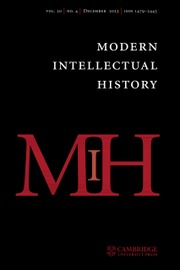
JOURNAL: Journal of Modern Intellectual History, Forum "Law, Empire and Global Intellectual History" (July 2018)

(image source: Cambridge Core)

Introduction (Mililnda Banerjee & Kersten Von Lingen, "Law, Empire and Global Intellectual History: An Introduction"):
In recent years, there has been a deepening convergence between scholarship on global intellectual history and on legal history. To take just one example, a recent book on international law, by Arnulf Becker Lorca (2014), carries “global intellectual history” in its subtitle—a stance related to the author's emphasis on the constitutive role in the field of non-European legal actors.1 A sustained reflection on the convergence between legal studies and global intellectual history, however, still remains a desideratum, at least in the sense that we do not yet have even a basic platform where scholars with different space/time and (trans-) cultural specialization come together to reflect on how studying legal concepts gains from global intellectual history. This forum, which results from a conference organized at Heidelberg University in 2016, attempts a preliminary intervention here. The introductory remarks are not meant to be conclusive; they invite responses.

"Property and Political Norms: Hanafi Juristic Discourse in Agrarian Bengal" (Andrew Sartori)
This article explores the reception of discourses about land and property in Islamic jurisprudence in colonial Bengal. I argue that Hanafi fiqh provided a sophisticated conceptual repertoire for framing claims to property that agrarian political actors in Muslim Bengal drew upon. Yet the dominant framework for understanding property claims in postclassical jurisprudence was ill-fitted to claims of the kind that agrarian movements in colonial Bengal were articulating. As a result, twentieth-century agrarian movements in the region spoke the language of fiqh, but nonetheless inhabited the ideological landscape of a much broader twentieth-century world of political aspirations and norms.

"Sovereignty as a Motor of Global Conceptual Travel: Sanskritic Equivalents of “Law” in Bengali Discursive Production" (Milinda Banerjee)
How may one imagine the global travel of legal concepts, thinking through models of diffusion and translation, as well as through obstruction, negation, and dialectical transfiguration? This article offers some reflections by interrogating discourses (intertextually woven with Sanskritic invocations) produced by three celebrated Bengalis: the nationalist littérateur Bankimchandra Chattopadhyay (1838–94), the Rajavamshi “lower-caste” peasant leader Panchanan Barma (1866–1935), and the international jurist Radhabinod Pal (1886–1967). These actors evidently took part in projects of vernacularizing (and thereby globalizing through linguistic–conceptual translation) legal–political frameworks of state sovereignty. They produced ideas of nexus between sovereignty, law, and “divine” lawgiving activity, which resemble as well as diverge from notions of political theology associated with the German jurist Carl Schmitt. Simultaneously, these actors critiqued coercive impositions of state-backed positive law and sovereign violence, often in the name of globally oriented concepts of “ethical”/natural law, theology, and capacious forms of solidarity, including categories like “all beings,” “self/soul,” “humanity,” and “world.” I argue that “sovereignty,” as a metonym for concrete practices of power as well as a polyvalent conceptual signifier, thus dialectically provoked the globalization of modern legal intellection, including in the extra-European world.

"Legal Flows: Contributions of Exiled Lawyers Toward the Concept of ‘Crimes Against Humanity’ During the Second World War" (Kerstin Von Lingen)
This article addresses the normative framework of the concept of “crimes against humanity” from the perspective of intellectual history, by scrutinizing legal debates of marginalized (and exiled) academic–juridical actors within the United Nations War Crimes Commission (UNWCC). Decisive for its successful implementation were two factors: the growing scale of mass violence against civilians during the Second World War, and the strong support and advocacy of “peripheral actors,” jurists forced into exile in London by the war. These jurists included representatives of smaller Allied countries from around the world, who used the commission's work to push for a codification of international law, which finally materialized during the London Conference of August 1945. This article studies the process of mediation and the emergence of legal concepts. It thereby introduces the concept of “legal flows” to highlight the different strands and older traditions of humanitarian law involved in coining new law. The experience of exile is shown to have had a significant constitutive function in the globalization of a concept (that of “crimes against humanity”).

"Liberalism, Cultural Particularism, and the Rule of Law in Modern East Asia: The Anti-Confucian Essentialisms of Chen Duxiu and Fukuzawa Yukichi Compared" (Kiri Paramore)
How and why are universalist modes of political thought transformed into culturally essentialist and exclusionary practices of governance and law? This article considers this question by analyzing the interaction between Confucianism and liberalism in East Asia. It argues that liberalism, particularly as it was used in attacking Confucianism, was instrumental in embedding ideas of cultural particularism and cultural essentialism in the emergence of modern political thought and law in both China and Japan. Both Confucianism and liberalism are self-imagined as universalist traditions, theoretically applicable to all global societies. Yet in practice both have regularly been defined in culturally determined, culturally exclusivist terms: Confucianism as “Chinese,” liberalism as “British” or “Western.” The meeting of Confucian and liberal visions of universalism and globalism in nineteenth-century East Asia provides an intriguing case study for considering the interaction between universalism and cultural exclusivism. This article focuses on the role of nineteenth-century global liberalism in attacks upon the previous Confucian order in East Asia, demonstrating the complicity of liberalism in new, culturally essentialist and particularist constructions of governance and law in both China and Japan.

"Autonomy and Decentralization in the Global Imperial Crisis: The Russian Empire and Soviet Union in 1905–1924" (Ivan Sablin & Alexander Semyonov)
This article brings the case of imperial transformation of the Russian Empire/Soviet Union into global discussions about empire, nationalism, and postimperial governance, and highlights the political and legal imaginaries that shaped this transformation, including their global and entangled character. This article argues that the legal and political discourses of decentralization, autonomism, and federalism that circulated at the time of the imperial crisis between the Revolution of 1905 and the adoption of the Soviet Constitution in 1924 contributed to the formation of an ethno-national federation in place of the Russian Empire, despite both the efforts of the Bolsheviks to create a unitary state, and the expectations of a different future among contemporary observers. At the same time, the postimperial institutional framework became a product of political conjunctures rather than the legal discourse. Its weakness before the consolidating party dictatorship made the Soviet Union a showcase of sham federalism and autonomism.

"Jewish Modern Law and Legalism in a Global Age: The Case of Rabbi Joseph Karo" (Roni Weinstein)
During the late sixteenth and early seventeenth centuries, Rabbi Joseph Karo composed two major Jewish codes of law: the Beit Yosef, and its abridged version, Sulchan ‘Aruch. Though several centuries of legal discussion and scholarship have passed since their publication, these double codes of law were never superseded. This codification project defined the axial place of law in Jewish tradition. I argue that it responded to changes in legal processes and the enforcement of law that simultaneously transformed early modern Europe and the Ottoman world. Transcontinentally connected changes in political institutions—the formation of a centralized Islamic empire in the Ottoman case, and the formation of centralized states in Europe—dramatically redefined the role of law and legal codification in the forging of state power and community identities. The resultant belief among Sephardi rabbis, including Karo, that changes in Jewish legal tradition were now needed, prompted a redefinition of Jewish legal culture, whereby law (a gradually centralized conception of it) began to be seen as the foundation of Jewish religious heritage and ethnic identity. Despite the absence of state backing, early modern transformations in Jewish law were thus part of comparable changes taking place in the European and Islamic legal worlds.

Find the full issue on Cambridge Core.

(source: ESILHIL Blog)

09 November 2018

BOOK: Jaakko HUSA, Advanced Introduction to Law and Globalisation [Elgar Advanced Introductions series] (Cheltenham; E. Elgar, 2018), 192 p. ISBN 9781788974158, 12,76 GBP


(Image source: Elgar)

Book abstract:
This Advanced Introduction offers a fresh critical analysis of various dimensions of law and globalisation, drawing on historical, normative, theoretical, and linguistic methodologies. Its comprehensive and multidisciplinary approach spans the fields of global legal pluralism, comparative legal studies, and international law.
Contents:
Preface PART I FOUNDATIONS
1. Defining law and globalisation
2. Globalisations in time
PART II LEGAL GLOBALISATIONS
3. Comparative law and global law
4. Globalising legalities
PART III THEORY AND METHODOLOGY
5. Theorising globally
6. Methodological views
PART IV EDUCATION AND LANGUAGE
7. Educating lawyers
8. Language of law and legal globalisation
9. Conclusion Index 
More information with the publisher.

04 July 2016

COLLOQUIUM & CFP: "Ius dicere in a globalized world” (Naples, June 15-17, 2017)


WHAT Ius dicere in a globalized world, the XXIV Biennial Colloquium of the Italian Association of Comparative Law (AIDC), Colloquium and Call for papers

WHEN June 15-17 2017

WHERE Naples, Suor Orsola Benincasa University

Call for papers

The colloquium intends to put the focus, from a comparative perspective, on some of the following topics: 1. Can one agree on the statement that in the Western world the notion of jurisdiction is considerably fragmented and is no longer limited to the national State (or expression of public sovereignty) courts, and is dispersed in a multiplicity of experiences? Private jurisdictions (such as ADR, arbitration, sport courts etc.); and trans-national jurisdictions, set by international treaties, or by lex mercatoria).
2. What do we mean today, in the western world, by “jurisdiction”? What are its essential features? Can the resolution of disputes still be considered the main function of courts of law or should the traditional model of jurisdiction be enriched to encompass the new role of courts in many social settings (e.g. transitional justice and its emphasis on reconciliation)? Should one look essentially at the formal elements [such as independence of the decisionmaker(s) and adversary procedures], or at the functional role [e.g. adjudication which imitates traditional court jurisdiction], or a legal-realist approach [jurisdiction is what is perceived as such]?
3. To what extent can/are Western models exportable/transposable in non-Western contexts? To what extent have Western models of jurisdiction imported ideas from non-Western traditions?
4. The traditional notion of rule-of-law is strongly related to the control by the courts and the enforceability of their decisions. Should the notion be adapted to a changing reality?
5. What is the effect of the fragmentation of jurisdiction on the traditional court system? Are there consequences on the traditional (in continental Europe) distinction between civil, criminal and administrative jurisdictions?
6. What, if any, are the effects, both theoretical and practical, on the apportionment of powers and functions with regard also to the branches of the legislative and government? Is jurisdiction encroaching on Parliament and Government?
7. What are the implications of those forms of jurisdiction directly challenging the role of national States, e.g. those connected to international investment treaties (Investor-state dispute settlement)? Do they represent a conditioning of State prerogatives able to weigh upon State obligations towards their citizens?
8. Increasingly contemporary societies are concerned with the administrative costs related to providing access to justice, and jurisdictional procedures are seen as a service dependent on budget allocations. What are the emerging models, and to what extent are they circulating and hybridized? Is a global market for judicial services feasible? Are “digital jurisdictions” an appropriate alternative?
9. Can numbers and statistics help us to compare jurisdictions and jurisdictional models? And how?
10. Jurisdiction is intimately associated with effectiveness: can/should one compare/classify models according to the degree of compliance, whether spontaneous or forced?

07 January 2015

CONFERENCE: "Globalization & the Law in Historical Perspective" (Bloomington, June 4-5, 2015)

WHAT: Globalization & the Law in Historical Perspective

WHERE: Maurer School of Law, Indiana University – Bloomington

WHEN: June 4-5, 2015

In recent years, there has been an explosion of new scholarship on the legal history of globalization. This rapidly growing body of literature has encompassed diverse topics, including international social movements, the transnational flow of capital, human rights, diplomacy, and border control. However, as historians have demonstrated, globalization is not a new phenomenon. We invite junior scholars to submit proposals that offer fresh understandings on the historical relationships between law, legal institutions, and globalization. Our intention is to host a conference with a wide range of papers chronologically, geographically, and across disciplines. The conference, part of a series begun in 2007, will provide junior scholars with a forum to showcase their previously unpublished work and to connect with senior scholars in the field. The "Globalization & the Law in Historical Perspective" conference is sponsored by the Indiana University Maurer School of Law, Indiana University Department of History, University of Illinois College of Law, University of Michigan Law School, University of Minnesota Law School, University of Pennsylvania Law School, and American Society for Legal History. Interested participants should submit a 300-word abstract and their cv to Bridget Gross (bregross@indiana.edu). Please place "Legal History Conference" in the subject line of your e-mail submission. The deadline for all proposals is Monday, February 16, 2015. Applicants will be notified by email no later than Monday, March 30th. Accepted participants will be required to submit their final papers by May 10, 2015. Papers should not exceed 10,000 words, will be pre-circulated on a password protected website, and read by all conference participants. Conference organizers will provide modest support for presenters' travel to Bloomington, Indiana and lodging during the conference