Search

Showing posts with label Genealogy. Show all posts

29 April 2022

BOOK: Guillaume GRÉGOIRE & Xavier MINY (Eds.), The Idea of Economic Constitution in Europe Genealogy and Overview (Leiden: Brill, 2022). ISBN: 978-90-04-51933-6, € 188.00

(Source: Brill)

ABOUT THE BOOK 

Series: Legal History Library, Volume: 61

Behind the controversies that have marked the history of the idea of Economic Constitution emerges the highly political issue of the room for manoeuvre left to public authorities in the economic sphere. The notion thus encapsulates a fundamental tension: between democracy and rule of law, which model of legal ordering of the economy should prevail?
From physiocrats to neo-liberals, from the Weimar Republic to European integration, from national constitutions to Global Governance, this collective book invites us to explore the genealogy of the controversial concept of Economic Constitution. The result of this interdisciplinary dialogue is a comprehensive reflection on the legal and political issues at stake in the current constitutionalization of the market order in Europe.

Contributors are: Philippe Steiner, Guillaume Grégoire, Hugues Rabault, Peter C. Caldwell, Thomas Biebricher, Werner Bonefeld, Serge Audier, Vincent Valentin, Pieter van Cleynenbreugel, Xavier Miny, Frédéric Marty, Claire Mongouachon, Hans-Wolfgang Micklitz, Francesco Martucci, Michael Wilkinson, Hjalte Lokdam, Susanna Maria Cafaro, Peter Lindseth, Cristina Fasone, Pierre Nihoul, François Colly, Peter-Christian Müller-Graff, Tony Prosser, Damien Piron, Mahmoud Mohamed Salah, Stephen Gill, Thibault Biscahie, Sebastien Adalid, and Christian Joerges.

ABOUT THE EDITORS

Guillaume Grégoire is pursuing a doctoral research in Economic Law and Legal Theory at the Université de Liège. He was invited as visiting scholar at the Université Paris-Panthéon-Assas and at the Max Planck Institute for Innovation and Competition of Munich. He is the author of L’économie de Karlsruhe. L’intégration européenne à l’épreuve du juge constitutionnel allemand (CRISP, 2021).

Xavier Miny is pursuing a doctoral research in public law at the Faculty of Law of the University of Liege. He was awarded a FRESH grant from the Belgian Fund for Scientific Research (F.R.S.-FNRS) from 2018 to 2021. He is the co-author of the handbook Introduction au droit public. Considérations générales et particularités belges (Larcier, 2021).


More information with the publisher.


06 March 2019

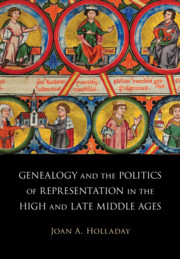
BOOK: Joan A. HOLLADAY, Genealogy and the Politics of Representation in the High and Late Middle Ages (Cambridge: University of Cambridge Press, 2019). ISBN 9781108470186, £90.00

(Source: CUP)

Cambridge University Press has published a new book on image cycles with genealogical content in the high and later Middle Ages, and the ways in which they were used to legitimize rulers.

ABOUT THE BOOK

Images and image cycles with genealogical content were everywhere in the high and later Middle Ages. They represent families related by blood as well as successive office holders and appear as family trees and lineages of single figures in manuscripts, on walls and in stained glass, and in sculpture and metalwork. Yet art historians have hardly remarked on the frequency of these images. Considering the physical contexts and functions of these works alongside the goals of their patrons, this volume examines groups of figural genealogies ranging across northern Europe and dating from the mid-twelfth to the mid-fourteenth century. Joan A. Holladay considers how they were used to legitimize rulers and support their political and territorial goals, to reinforce archbishops' rights to crown kings, to cement relationships between families of founders and their monastic foundations, and to commemorate the dead. The flexibility and legibility of this genre was key to its widespread use.

ABOUT THE AUTHOR

Joan A. Holladay, University of Texas, Austin

Joan A. Holladay is Professor of Art History at the University of Texas, Austin. Author of Illuminating the Epic: The Kassel Willehalm Codex and the Landgraves of Hesse in the Early Fourteenth Century (1997) and Co-Editor of Gothic Sculpture in America, volume 3 (2016), she has held positions as Visiting Senior Fellow at Center for Advanced Study in the Visual Arts (CASVA), National Gallery of Art; Hohenberg Chair of Excellence, University of Memphis; and NEH Professor of the Humanities, Colgate University. In 2008, she received the Distinguished Teaching Award of the University of Texas's College of Fine Arts.

TABLE OF CONTENTS

1. Rivalling/reviving Rome: environmental genealogies in palace halls
2. Structuring the past: history and genealogy in thirteenth-century England
3. Crowning the king: coronation rights at Cologne and Reims
4. Advertizing allegiances: tombs and tomb cycles
5. Flattering founders: genealogical imagery in cloister chronicles.

More information here

12 July 2018

BOOK: Jean-Claude FARCY, Archives Judiciaires et Généalogie (Paris: LGDJ, 2018). ISBN 978-2-35077-326-1, €12.00


(Source: LGDJ)

LGDJ has just published a book on the usage of court archives for genealogy.

ABOUT THE BOOK

On peut hésiter, en faisant l'histoire de sa famille, à fouiller dans les archives des tribunaux. Ne risque-t-on pas de retrouver un ancêtre jugé pour vol ou homicide, condamné à la prison, déporté à Cayenne, voire guillotiné, illustrant de fâcheuse manière une branche morte de l'arbre généalogique? Au-delà de cette réticence, rentrer dans les papiers du monde de la chicane, c'est aussi craindre de s'égarer dans le maquis des procédures et d'actes aux noms peu compréhensibles.

Ce livre a pour objet de vaincre ces appréhensions en présentant les documents utiles à la connaissance de l'état civil et de la vie des personnes qui ont fréquenté les tribunaux: leur personnel bien sûr, mais surtout les justiciables, nombreux à faire valoir leurs droits devant les tribunaux civils. Une partie des fonds de la justice porte d'ailleurs directement sur l'état des personnes (état civil, nationalité) et la famille dont la justice protège les membres les plus faibles (mineurs n'ayant pas la capacité juridique, par exemple).

Au-delà de l'éclairage donné aux rapports familiaux, l'intérêt majeur des archives judiciaires est de faire revivre, dans le règlement des différends civils comme dans les instructions criminelles, la vie quotidienne des hommes des siècles passés, dans leurs relations sociales inhérentes à leur famille, à leur travail et à leur cadre de vie, village rural ou quartier de grande ville. Pour une telle découverte, pas besoin d'être juriste. À condition de connaître les lieux où ont vécu les ancêtres, on peut tenter de retrouver leur trace tant dans les archives d'une cour d'assises - comme témoins, victimes et pas seulement accusés ! - que dans celles d'une justice de paix, d'un tribunal de première instance ou d'un conseil de guerre.

ABOUT THE AUTHOR

Jean-Claude Farcy est chercheur associé au Centre Georges Chevrier (Université de Bourgogne). Il a écrit de nombreux articles sur les sources judiciaires et le fonctionnement de la justice. Il est l'auteur de L'histoire de la justice française de la Révolution à nos jours. Trois décennies de recherches (PUF, 2001). Il est aussi à l'origine de la base de données nominatives Annuaire rétrospectif de la magistrature, XIXe-XXe siècles, sur le personnel judiciaire.

More information here