The book edited by Giovanni Rossi and Pietro Schirò (opening the 'Immagini, Diritto e Storia' series directed by Rossi himself) is a collaborative effort that owes its overall value first of all to its editors drawing on their long-standing academic background in the Law and Humanities field. Notably, they sought to explore the intertwining of law, power, and images in the nineteenth century, sparking a broad international debate through the conference (held in Verona, 19-21 October 2022) which gave rise to the book and nurtured its truly appreciable diversity of contents and perspectives.
This plurality has been appropriately structured by the editors into four sections: ‘The Representation of Power', 'Revolutions, Laws, Art', 'The Force of Law and the Tyranny of Power’, and ‘Tangible Forms of Law'. Rossi's introduction ('A proposito di immagini e di diritto. Un percorso tra visual culture e storia legale', 9-31) helps clarify this inner structure and is, at the same time, an integral part of the volume, serving as both a 'map for sailors' and a toolbox for the reader: It is indeed a substantial introduction, which can also be considered partly programmatic. According to Rossi's introduction, the image (artistic or not) takes on an important heuristic value, as a vehicle, a medium of ideas, concepts, and values connected to law and power, if not also an essential part of an affirmative or negative narrative of power itself. The 'gamble' that animates the scientific and editorial project of the conference and book is that of 'guaranteeing depth and historical interpretation to an aspect as pervasive as it is often underestimated, such as that of the translation into images of the values and myths of law and power. In other words, the aim is 'laying bare the colossal operation of […]
To read the full review, please click here. Online access is free for members of the European Society for Comparative Legal History.
DOI: https://www.tandfonline.com/doi/full/10.1080/2049677X.2026.2671634
Search
Showing posts with label legal iconography. Show all posts
02 October 2026
BOOK REVIEW: Elisabetta FUSAR POLI, Law and art in the 19th century. Power in images, eds. Giovanni ROSSI and Pietro SCHIRÒ (Pisa: Pacini, 2024) (Comparative Legal History, XIV (2026), nr. 1 (June), pp. 158-161)
(image source: Taylor&Francis)
14 October 2025
BOOK: Frédéric ROLIN, Mettre en scène le Conseil d'État. Iconographie et scénographie juridiques du Palais Royal 1875-2025 (Paris: MDD, 2025), 290 p.
(image source: MDD)
Abstract:
En 1871 le Conseil d’État est en mauvaise posture. Il a été « suspendu » par la République et les locaux qu’il occupait au Palais d’Orsay ont été incendiés par les Communards. La décision est cependant prise de la rétablir et de lui attribuer les locaux du PalaisRoyal où il siège encore aujourd’hui. Dans ce livre, Frédéric Rolin emprunte des chemins nouveaux pour raconter l’histoire de cette installation et des cent cinquante années qui l’ont suivie et montrer la relation à la fois profonde et complexe qui va se nouer entre l’institution et les murs qui l’entourent. Il s’agit d’une histoire des images, des symboles, de la scénographie des espaces et des réseaux de significations qui les entourent. L’utilisation de l’iconographie et de la scénographie juridiques permet de pénétrer certains des ressorts intimes de l’institution : les difficultés de sa républicanisation au moment où elle s’installe au Palais, la manière dont elle va progressivement secouer le joug des administrations qui lui imposent des choix décoratifs qui ne sont pas les siens, mais aussi la manière dont elle va, dans ce palais, construire une politique mémorielle, choisir, par les images et les noms donnés à des salles l’image qu’elle entend donner d’elle-même. Cette évolution continue du PalaisRoyal depuis 1875 devient ainsi l’histoire d’une mise en scène. Mise en scène d’une des institutions les plus importantes de la République, mise en scène de ses rapports avec le pouvoir politique et administratif, mise en scène du droit qu’elle y fabrique. Fondé sur une lecture attentive des sources et une approche transdisciplinaire cet ouvrage intéressera autant les juristes, qui regarderont différemment des lieux qu’ils connaissent ou fréquentent, qu’un public plus large intéressé par les relations entre l’art, le pouvoir et les institutions dans l’histoire des deux derniers siècles.
Read more here.
02 July 2019
YOUTUBE: Dialogos com Georges Martyn (Universidade Santa Catarina)
At the occasion of a lecture tour across South-America, Prof. dr. Georges Martyn (Ghent Legal History Institute) discusses legal history, law and iconography and many other themes with Prof. dr. Diego Nunes.
(source: Youtube)
06 March 2019
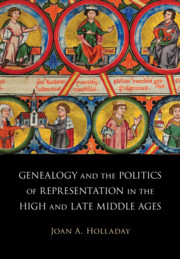
BOOK: Joan A. HOLLADAY, Genealogy and the Politics of Representation in the High and Late Middle Ages (Cambridge: University of Cambridge Press, 2019). ISBN 9781108470186, £90.00
(Source: CUP)
Cambridge University Press has published a
new book on image cycles with genealogical content in the high and later Middle
Ages, and the ways in which they were used to legitimize rulers.
ABOUT THE BOOK
Images and image
cycles with genealogical content were everywhere in the high and later Middle
Ages. They represent families related by blood as well as successive office
holders and appear as family trees and lineages of single figures in
manuscripts, on walls and in stained glass, and in sculpture and metalwork. Yet
art historians have hardly remarked on the frequency of these images.
Considering the physical contexts and functions of these works alongside the
goals of their patrons, this volume examines groups of figural genealogies ranging
across northern Europe and dating from the mid-twelfth to the mid-fourteenth
century. Joan A. Holladay considers how they were used to legitimize rulers and
support their political and territorial goals, to reinforce archbishops' rights
to crown kings, to cement relationships between families of founders and their
monastic foundations, and to commemorate the dead. The flexibility and
legibility of this genre was key to its widespread use.
ABOUT THE AUTHOR
Joan A.
Holladay, University of Texas, Austin
Joan A. Holladay
is Professor of Art History at the University of Texas, Austin. Author of
Illuminating the Epic: The Kassel Willehalm Codex and the Landgraves of Hesse
in the Early Fourteenth Century (1997) and Co-Editor of Gothic Sculpture in
America, volume 3 (2016), she has held positions as Visiting Senior Fellow at
Center for Advanced Study in the Visual Arts (CASVA), National Gallery of Art;
Hohenberg Chair of Excellence, University of Memphis; and NEH Professor of the
Humanities, Colgate University. In 2008, she received the Distinguished
Teaching Award of the University of Texas's College of Fine Arts.
TABLE OF CONTENTS
1. Rivalling/reviving Rome: environmental
genealogies in palace halls
2. Structuring the past: history and
genealogy in thirteenth-century England
3. Crowning the king: coronation rights at
Cologne and Reims
4. Advertizing allegiances: tombs and tomb
cycles
5. Flattering founders: genealogical
imagery in cloister chronicles.
More information here
03 October 2018
BOOK: Stefan HUYGEBAERT, Georges MARTYN, Vanessa PAUMEN, Eric BOUSMAR and Xavier ROUSSEAUX (eds.), The Art of Law: Artistic Representations and Iconography of Law and Justice in Context, from the Middle Ages to the First World War (Ius Gentium: Comparative Perspectives on Law and Justice 66) (Cham: Springer, 2018). Hardcover ISBN 978-3-319-90786-4, €137,79/e-book ISBN 978-3-319-90787-1, € 107,09.
(Source: Springer)
Springer published a new book on legal iconography.
About
the book
The contributions to this volume were written by
historians, legal historians and art historians, each using his or her own
methods and sources, but all concentrating on topics from the broad subject of
historical legal iconography. How have the concepts of law and justice been
represented in (public) art from the Late Middle Ages onwards? Justices and
rulers had their courtrooms, but also churches, decorated with inspiring
images. At first, the religious influence was enormous, but starting with the
Early Modern Era, new symbols and allegories began appearing. Throughout
history, art has been used to legitimise the act of judging, but artists have
also satirised the law and the lawyers; architects and artisans have engaged in
juridical and judicial projects and, in some criminal cases, convicts have even
been sentenced to produce works of art. The book illustrates and contextualises
the various interactions between law and justice on the one hand, and their
artistic representations in paintings, statues, drawings, tapestries, prints
and books on the other.
- Features over one hundred colour photographs
of well-known and less well-known works of art
- Includes contributions on western iconology,
from Scandinavia to Italy, and even India
- Written by top scholars in the interdisciplinary
field of ‘law and art’
- Allows jurists to broaden their horizons, and
art historians to gain new perspectives on law and justice
About
the editors
Stefan Huygebaert is a Research Foundation Flanders (FWO) PhD Fellow at
the Ghent Legal History Institute and Department of Art History, Musicology and
Theatre Studies (Ghent University). His dissertation, entitled Visual Ideals of
Law and Justice, is an iconological study of legal imagery in
nineteenth-century Belgium. In 2014-2015, and again in 2016-2017, Stefan was a
PhD fellow (Stipendiat) within the Minerva Research Group ‘The Nomos of Images:
Manifestation and Iconology of Law’ at the Kunsthistorisches Insitut in Florenz
(Max-Planck-Institut). He publishes and teaches on legal iconography and
nineteenth-century art, and recently co-edited the catalogue for the exhibition
The Art of Law: Three Centuries of Justice Depicted (Groeningemuseum, Bruges).
Georges Martyn studied Law (1984-89) and Medieval Studies (1989-91)
in Leuven (Belgium) and obtained a PhD degree in Law at the Catholic University
of Leuven in 1996, with a dissertation on private law legislation in the early
modern Netherlands. He has been an ‘advocaat’ (barrister/lawyer) between 1992
and 2008 at the bar of Kortrijk, is now honorary member of the Ghent bar, and
is a substitute justice of the peace. He is full professor at the Law Faculty
of Ghent University, teaching ‘History of Politics and Public Law’, ‘General
Introduction to Belgian Law’ and ‘Law & the Humanities’. His publications
deal with legal history in the Netherlands in the Early Modern Era, the
reception of Roman law, the legal professions, the evolution of the sources of
the law in the nineteenth and twentieth centuries and legal iconography and
iconology. He is a member of the Belgian Royal Commission for the Edition of
the Old Law, the Flemish editor-in-chief of the Belgian-Dutch legal history
review Pro Memorie and co-editor of the series Studies in the History of Law
and Justice.
Vanessa Paumen is an art historian focused on Northern Renaissance
art. Since 2010, she has been the coordinator of The Flemish research centre
for the arts in the Burgundian Netherlands at the Groeningemuseum in Bruges
(Belgium). Its mission is to initiate, facilitate, stimulate and disseminate
research related to Flemish art of the 15th-16th centuries. She was curator of
the exhibition "The art of law. Three centuries of justice depicted"
at the Groeningemuseum (27 October 2016 – 5 February 2017) and author/editor of
the accompanying catalogue, published by Lannoo Publishers, 2016.
Eric Bousmar is full professeur at the Université Saint-Louis in
Brussels, where he is co-director of the Centre de Recherches en Histoire du
Droit et des Institutions. He has got a doctoral degree in history from the
Université catholique de Louvain, and a degree in medieval studies from the
Katholieke Universiteit Leuven. He mainly publishes on power, society and
mentality in the Southern Low Countries, particularly in the Burgundian era
(XV-XVI c.), as well as on the art of history writing throughout the ages,
stressing the interaction of literature and history, especially in relation to
the Burgundian State, Belgium and Brabant.
Xavier Rousseaux is research director at the National Fund for
Scientific Research (FRS-FNRS) and professor at the Université catholique de
Louvain, Louvain-la-Neuve, Centre for Law & Justice History. Working
extensively on of the history of crime and justice, in 2007-2012, he
coordinated the BELSPO Network Justice and Society, and Justice and
Populations. The Belgian experience in international Perspective, 1795-1950.
Table
of contents
Part I Law, Justice and Art in Historical Perspective
Twenty New Contributions
to the Upcoming Research Field of Historical Legal Iconology (pp. 3-24)
Georges Martyn and Stefan Huygebaert
The Exhibition The Art of Law. Three Centuries of
Justice Depicted (pp. 25-41)
Vanessa
Paumen
The Mirror Axiom: Legal Iconology
and The Lure of Reflection (pp. 43-60)
Carolin Behrmann
Part II
Moralising Law and Justice Representations in the Late Middle Ages and Early
Modern Era
Changes in Late-Medieval Artistic Representations of
Hell in the Last Judgment in North-Central Italy, ca. 1300–1400: A Visual
Trick? (pp. 63-87)
Clare Sandford-Couch
Medieval Iconography of
Justice in a European Periphery: The Case of Sweden, ca. 1250–1550 (pp. 89-110)
Mia Korpiola
Justitia, Examples and
Allegories of Justice, and Courts in Flemish Tapestry, 1450–1550 (pp. 111-123)
Guy Delmarcel
The Judgment of
Cambyses: A Rich Iconographical Topic with Multiple Sources and a Long
Tradition (pp. 125-147)
Raf Verstegen
Multi-layered Functions of Early
Modern Courtroom Equipment: Lüneburg for Example (pp. 149-164)
Ann-Kathrin Hubrich
Part III
Lawyers and Justices: Their Books, Their Work, Their Symbols
Civic Bodies and their
Identification with Justice and Law in Early Modern Flemish Portraiture (pp.
167-179)
Beatrijs Wolters van der Wey
Lawyers and Litigants:
The Corrupting Appeal and Effects of Civil Litigation in Hendrick Goltzius’
(pp. 181-199)
Alain Wijffels
The Paradoxes of Lady
Justice’s Blindfold (pp. 201-221)
Valérie Hayaert
Framing the Law: Joos de
Damhouder and the Legal Iconology of the Grotesque (pp. 223-244)
Felix Jäger
The Mechanical Art of Rhetoric in an
Ordinary Sixteenth Century German Formulary (pp. 245-272)
Gustav
Kalm
Liberté, égalité, fraternité ou la mort
(pp. 273-295)
Brecht Deseure
Part IV Criminal Justice: Art, Object and Locus
Works of Art as a Form
of Criminal Punishment in the Low Countries (14th–17th C.) (pp. 299-317)
Paul De Win
“ut experiri et
scire posset”: Pictorial Evidence and Judicial Inquiry in Hans Fries’ Kleiner
Johannes Altar (pp. 319-336)
Tamara
Golan
A Ghostly Corpse in the City?
Spatial Configurations and Iconographic Representations of Capital Punishment
in the ‘Belgian’ Space (16th–20th C.) (pp. 337-368)
Jérôme and Xavier Rousseaux Brouwer
Part V
Justice Architecture and Decorations in the Long Nineteenth Century
Joseph-Jonas Dumont’s Prison Gatehouses: Architecture
Parlante in Neo-Tudor Style (pp. 371-383)
Jozefien Feyaerts
Experiencing Justice in the Cour d’assises of Brabant
(1893–1913): A Place of Education and Entertainment (pp. 385-405)
Gaëlle Dubois and Amandine De Burchgraeve
The Judge, the Artist and the (Legal) Historian:
Théophile Smekens, Pieter Van der Ouderaa, Pieter Génard and the Antwerp cour
d’assises (pp. 407-432)
Huygebaert, Stefan
Depictions of Justice in the
Colonial Courts of British India: The Judicial Iconography of the Bombay High
Court (pp. 433-449)
Rahela Khorakiwala
More information here
18 September 2018
BOOK: Desmond MANDERSON (ed.), Law and the Visual: Representations, Technologies, Critique (Toronto: University of Toronto Press, 2018), 376 p. ISBN 9781442630314, USD 60
(image source: UTorontoPress)
Book abstract:
In Law and the Visual, leading legal theorists, art historians, and critics come together to present new work examining the intersection between legal and visual discourses. Proceeding chronologically, the volume offers leading analyses of the juncture between legal and visual culture as witnessed from the fifteenth to the twenty-first centuries. Editor Desmond Manderson provides a contextual introduction that draws out and articulates three central themes: visual representations of the law, visual technologies in the law, and aesthetic critiques of law. A ground breaking contribution to an increasingly vibrant field of inquiry, Law and the Visual will inform the debate on the relationship between legal and visual culture for years to come.On the editor:
Desmond Manderson is a professor in the ANU College of Law and College of Arts & Social Sciences at the Australian National University. He is founding Director of its Centre for Law, Arts, and the Humanities.
Table of contents:
Introduction: From Visual Evidence to Visual Discourse
Desmond Manderson
Part I
Representations. The origins of legal modernity from the 16th – 19th Centuries
1. Blindness Visible: Law, Time, and Bruegel's Justice
Desmond Manderson
2. Face and Frames of Government
Peter Goodrich
3. An Emblematic Representation of Law: Hogarth and the Engravers' Act
Cristina S. Martinez
4. Law and the Revolutionary Motif after Jacques-Louis David
Morgan Thomas
5. Legal Imagery on the Edge of Symbolism: The Decoration Projects for the Belgian Cour de Cassation
Stefan Huygebaert
6. The Visual Force of Justice in the Making of Liberia
Shane Chalmers
Part II
Technologies. Excesses of legal modernity in the 20th Century
7. 'You Will See My Family Became So American': Race, Citizenship and the Visual Archive
Sherally Munshi
8. From Sentimentality to Sadism: Visual Genres of Asylum Seeking
Honni Van Rijswijk
9. Images of Victims: The ECCC and the Cambodian Genocide Museum
Maria Elander
10. The Exceptional Image: Torture Photographs from Guantánamo Bay and Abu Ghraib as Foucault's Spectacle of Punishment
Connal Parsley
Part III
Critique: Irony and legal modernity in the 21st Century
11. T-Shirt's Guevara: The Visual Jurisprudence of the New Man
Luis Gómez Romero
12. The Art of Bureaucracy: Redacted Ready-mades
Katherine Biber
13. Illicit Interventions in Public Non-Spaces: Unlicensed Images
Alison Young
What Authorizes the Image? The Visual Economy of Post-Secular Jurisprudence
Richard K. Sherwin
More information with the publisher.
Labels:
Book,
Law and Iconography,
legal iconography
10 February 2018
BOOK: M. ANTAKI, A. CONDELLO, S. HUYGEBAERT & S. MARUSEK (eds.), Sensing the Nation's Law. Historical Inquiries into the Aesthetics of Democratic Legitimacy [Studies in the History of Law and Justice, vol. 13, eds. Georges MARTYN & Mortimer SELLERS] (Heidelberg: Springer, 2018), XII + 263 p. ISBN 978-3-319-75495-6, € 121,89. DOI 10.1007/978-3-319-75497-0
(image source: Springer)
Book abstract:
This book examines how the nation – and its (fundamental) law – are ‘sensed’ by way of various aesthetic forms from the age of revolution up until our age of contested democratic legitimacy. Contemporary democratic legitimacy is tied, among other things, to consent, to representation, to the identity of ruler and ruled, and, of course, to legality and the legal forms through which democracy is structured. This book expands the ways in which we can understand and appreciate democratic legitimacy. If (democratic) communities are “imagined” this book suggests that their “rightfulness” must be “sensed” – analogously to the need for justice not only to be done, but to be seen to be done. This book brings together legal, historical and philosophical perspectives on the representation and iconography of the nation in the European, North American and Australian contexts from contributors in law, political science, history, art history and philosophy.On the editors:
Mark Antaki, Ph.D. (University of California, Berkeley 2005) is an Associate Professor in the Faculty of Law at McGill University. His research focuses on the relation of ethics and aesthetics and that of law and language. He is active in the Association for the Study of Law, Culture, and the Humanities, and has been a fellow at the Stellenbosch Institute of Advanced Study and McGill’s Institute for the Public Life of Arts and Ideas. He teaches courses in public and private law as well as legal theory. Angela Condello, PhD (2013, Roma Tre) is Temporary Lecturer at the University of Roma Tre and Adjunct Professor (Jean Monnet Module “Cultures of Normativity” 2017-2010) at the University of Torino, where she also directs LabOnt Law. She cooperates with the Human Rights Committee of the Italian Senate of the Republic. In 2015 she was Fernand Braudel Fellow (EHESS, CENJ) and in 2014 she was a Fellow at the Käte Hamburger Kolleg “Law as Culture”. Until 2016 she was Guest Professor at the Law School of the University of Ghent. She teaches Law and Humanities at Roma Tre. She organizes the International Roundtables for the Semiotics of Law (New York 2017; Torino 2019) and is in the boards of Law Text Culture, Law & Literature, Rivista di Estetica. She is Associate Editor of Brill Research Perspectives in Art and Law and directs a book series on French Philosophy and Law (Westminster University Press). In 2016 she received a Jean Monnet award. Her book Analogica. Il doppio legame tra diritto e analogia in forthcoming with Quodlibet (early 2018). Stefan Huygebaert is a Research Foundation Flanders (FWO) PhD Fellow at the Ghent Legal History Institute and Department of Art History, Musicology and Theatre Studies (Ghent University). His dissertation, entitled Visual Ideals of Law and Justice is an iconological study of legal imagery in nineteenth-century Belgium. In 2014-2015, and again in 2016-2017, Stefan was a PhD fellow (Stipendiat) within the Minerva Research Group The Nomos of Images: Manifestation and Iconology of Law at the Kunsthistorisches Insitut in Florenz (Max-Planck-Institut). He publishes and teaches on legal iconography and nineteenth-century art, and recently co-edited the catalogue for the exhibition The Art of Law: Three Centuries of Justice Depicted (Groeningemuseum, Bruges). Sarah Marusek, Ph.D (University of Massachusetts Amherst 2008), is an Associate Professor of Public Law in the Department of Political Science at the University of Hawai’i at Hilo. Her research interests focus on sites of constitutive law, legal geography, and legal semiotics that engage legal pluralist frameworks of everyday jurisprudence. She teaches courses in U.S. Constitutional law, legal studies, and legal geography.
Labels:
Book,
history of public law,
legal iconography
09 May 2016
CALL FOR ABSTRACTS: The Art of Law: Artistic Representations and Iconography of Law & Justice in Context from the Middle Ages to the First World War (Bruges, 16-18 January, 2017); DEADLINE 01 JUN 2016
The Art of Law
Artistic Representations and Iconography of Law & Justice in Context
from the Middle Ages to the First World War
Date: 16-17-18 January, 2017
Venue: Groeningemuseum, Bruges
Deadline: 1 June, 2016
In his Rechtsboek van Den Briel written in 1405 for the Dutch town of Den Briel, Jan Matthijsen, a court clerk, specified what a proper court or deliberation room should look like. “…[T]he courtroom will be made clean inside and filled with paintings and inscribed with good old wise words, from which one can acquire wisdom and cleverness, as one says: to behold is to be aware”. The phrase convincingly illustrates the link, in the late medieval and early modern Low Countries, between law and the visual arts in general, and the use of court room decorations in particular. From town hall decorations depicting the Last Judgement and so-called exempla iustitiae, via the allegory of justice in the figure of a woman and her depiction on frontispieces of books, to the nineteenth-century Palaces of Justice, time and again it becomes clear how the practitioners of law used art and the visual in order to function and reach their ideal: justice.
From 28 October, 2016 through 5 February, 2017, the Groeningemuseum in Bruges will host the exhibition The Art of Law. Three Centuries of Justice depicted. This art exhibition will feature about 100 artworks from over 30 national and international museums and libraries and will focus on themes related to justice as expressed in artworks of various media from about 1500 through 1800. In 2018, from 23 March until 24 June, the Museum Hof van Busleyden in Mechelen, in collaboration with the Royal Museum of Fine Arts Antwerp, will organize the exhibition Call for Justice. Art and Law in the Burgundian Low Countries. This exhibition will focus on the ways in which artworks from the ‘long’ Burgundian period (1450-1650) have negotiated the concepts of ‘justice’ and ‘injustice’. Both exhibitions will be accompanied by respective academic conferences.
The first conference will be organized on 16, 17 and 18 January, 2017 in Bruges and is entitled The Art of Law. Artistic Representations and Iconography of Law & Justice in Context from the Middle Ages to the First World War. Recent years have witnessed a clear rise in scholarship on law and the visual, mostly originating in the wider field of law and the humanities. The Bruges conference wishes to contribute to this scholarship by focusing on imagery in its legal and art historical contexts. The organizers seek to bring together original and interdisciplinary scholarship that questions the role of art in the practice of law, jurisprudence and justice administration from the Late Middle Ages through the nineteenth century.
The exhibitions and the Bruges conference coincide with the fifth and final year of the Belspo Interuniversity Attraction Pole Justice and Populations: The Belgian experience in international perspective 1795-2015 (2012-2017) and its work package (WP4) Long-term self-representations of Justice. A substantial part of the Bruges conference will be devoted to the 19th and 20th centuries, in order to present the research results of the mentioned WP4 to a critical public of peers. The proceedings of the conference will be published in the IAP subseries of Springer’s Studies in the History of Law and Justice.
Paper proposals in English may deal with – but are not limited to:
- the theological origins of legal imagery and iconography;
- the use of art in the practice of law and jurisprudence;
- the impact of technological and genre evolutions such as the printing device, frontispieces and/or emblemata on legal iconography;
- the presence and function of legal iconography in urban public space;
- spectatorship, art and law;
- imagery as a visual source for legal history.
The second conference, to be held in Mechelen in June 2018, will focus on places where justice was administered as centers of artistic production.
Although equally fascinating as research topics, papers on the history of copyright and art law fall beyond the thematic reach of the conference.
Paper proposals of 20 minutes should be sent as 300 word abstracts including one or two images, together with a short academic CV and publication list, to Stefan.Huygebaert@ugent.be and Vanessa.Paumen@brugge.be by 1 June, 2016 at 17:00. The organizers invite junior and senior scholars from all disciplines involved (art history, legal history, political and/or institutional history, archeology, architectural history and other fields from the humanities) as well as museum professionals.
The authors of the selected papers will be notified by 15 July, 2016. A selection of papers will be peer reviewed and published in the form of an academic book. The conference will take place in the Groeningemuseum (Bruges, Belgium) on 16, 17 and 18 January, 2017. A private visit to the exhibition The Art of Law will be part of the program.
Keynote speaker : Carolin Behrmann (Kunsthistorisches Institut in Florenz – Max-Plank-Institut)
Organized by the Flemish research centre for the arts in the Burgundian Netherlands and Musea Brugge, the Museum Hof van Busleyden and the Royal Museum of Fine Arts Antwerp, the Ghent Legal History Institute, the Belspo IAP Justice & Populations. The Belgian Experience in International Perspective and the Belspo IAP City & Society.
Scientific Committee:
Marc Boone (Ghent University)
Bruno De Wever (Ghent University)
Stefan Huygebaert (Ghent University/FWO)
Samuel Mareel (Museum Hof van Busleyden/Royal Museum of Fine Arts Antwerp/Ghent University)
Georges Martyn (Ghent University)
Vanessa Paumen (Flemish research centre for the arts in the Burgundian Netherlands/ Groeningemuseum)
Xavier Rousseaux (UCL)
Nathalie Tousignant (USL)
Labels:
Call for papers,
Conference,
legal iconography
Subscribe to:
Posts (Atom)