Search

Showing posts with label trade and diplomacy. Show all posts

22 November 2022

CFP: International conference celebrating the 300th anniversary of the Ostend Company (1723-2023) - Ostend, Belgium - 21-24 November 2023 [DEADLINE 31 January 2023]


Call for papers 

International conference celebrating the 300th anniversary of the Ostend Company (1723-2023)

 Location: Ostend, Belgium 

Dates: 21-24 November 2023 

Organisers: Royal Belgian Marine Society, Flanders Marine Institute, City of Ostend 


In 2023, it will be 300 years ago that the General Indian Company, better known as the Ostend Company, was founded. It all started in August 1723, when a considerable financial capital was collected by means of an issue of shares at the Antwerp stock market. Most subscribers belonged to the Austrian Netherlands’ aristocracy, financial and commercial elites in Antwerp, Brussels, Ghent, Bruges and Ostend. With the collected funds silver bullion was acquired, crews were enlisted, ships were bought and equipped in Ostend. Bruges’s outer port thus became the centre of the eighteenth century Habsburg overseas trade expansion. From Ostend, dozens of ships sailed via Brazil to India (Coromandel and Bengal) and China (Canton). Thanks to a number of niche products, such as tea (more than 50% of the European market), the Ostend Company became a major global competitor in the China trade in the 1720s. Its shareholders were rewarded with a net profit of approximately 150%. The port and the city of Ostend flourished and the whole of the Austrian Netherlands reaped the benefits of this newly established maritime trade. Despite its commercial success, the Austrian Netherlands had to put an end to the Ostend Company’s trading activities due to the mounting pressure of their British, Dutch and French neighbours in 1731. 

Even if it only existed for a short period (1723-1731), the importance of the Ostend Company for maritime history cannot be underestimated and reaches far beyond the Belgian context, as it also concerns political, diplomatic, social, commercial, military, intercultural and global aspects of both European and Asian eighteenth-century history. The mixed public-private chartered company can be seen as a Belgium-based multinational corporation avant la lettre, which proved to be an important and innovative global player. But it is also the story of people from different cultures coming together and exchanging views and commodities, highlighting equally the circulation of ideas and practices, and therefore implying knowledge transfers. Although these encounters were generally peaceful, violence did sometimes occur.

The history of the Ostend Company is also one about the economic development of the Austrian Netherlands, the participation of the Habsburg Monarchy in a globalizing world and the opening up of Asian markets to European colonial enterprises. The aim of this international conference is to shed light on a number of as yet unknown aspects, but also to reassess the state of the art from new perspectives or complementary and innovative angles. 

We invite scholars to send in abstracts focusing on the Ostend Company, for instance on the following themes: 

 The juridical aspects of the Ostend Company as a chartered company in a European context (corporate structure, capital base and shareholder involvement, labour relations, trade) 

 Life of the seafarers on board the East Indiamen 

 Intercultural relations between the Ostenders and Indians, Chinese, etc. 

 Military aspects of the Ostend Company at sea and in Asia 

 The impact of the Ostend Company on the economy of the Austrian Netherlands 

 The Ostend Company as focus of European politics and diplomacy in the early eighteenth century, including the legal debate on the freedom of the seas and the establishment of comptoirs 

 Logistic, commercial and financial organisation of the Ostend Company 

 The role of the Ostend Company in globalisation and imperial history

 The Ostend Company compared to other East India Companies, especially with the other smaller companies, e.g. the Danish, Swedish and Prussian companies. 

 The political perception of the Ostend Company in Europe 

 Changes in research topics in historiography with regard to the Ostend Company, especially linked to the Belgian nation-state’s colonial ambitions 

Other themes on the Ostend Company are equally welcome. 


The three day conference will take place at the Flanders Marine Institute in Ostend, Belgium from Wednesday 22 November to Friday 24 November 2023. Travel and accommodation costs will be covered by the hosts. The conference language is English. Participants will be asked to submit an article for a peer-reviewed publication after the conference. 

Participants to the conference are invited to submit an abstract of maximum 400 words with a short CV (5 to 10 lines) to stan.pannier@vliz.be by January 31st, 2023. The applicants will be informed by the conference’s scientific committee by mid-February 2023.


24 June 2020

BOOK: Elisabeth HEIJMANS, The Agency of Empire: Connections and Strategies in French Overseas Expansion (1686-1746) (Leiden: Brill, 2019). ISBN: 9789004409439, €88.00

Cover The Agency of Empire: Connections and Strategies in French Overseas Expansion (1686-1746)
(Source: Brill)

ABOUT THE BOOK

Series: European Expansion and Indigenous Response, Volume: 32

In The Agency of Empire: Connections and Strategies in French Expansion (1686-1746) Elisabeth Heijmans places directors and their connections at the centre of the developments and operations of French overseas companies. The focus on directors’ decisions and networks challenges the conception of French overseas companies as highly centralized and controlled by the state. 
Through the cases of companies operating in Pondicherry (Coromandel Coast) and Ouidah (Bight of Benin), Elisabeth Heijmans demonstrates the participation of actors not only in Paris but also in provinces, ports and trading posts in the French expansion. The analysis brings to the fore connections across imperial, cultural and religious boundaries in order to diverge from traditional national narratives of the French early modern empire.

ABOUT THE AUTHOR

Elisabeth Heijmans, Ph.D. (2018), Leiden University, is post-doctoral researcher in Economic and Social History. She published ‘Investing in French Overseas Companies: A Bad Deal? The Liquidation Processes of Companies Operating on the West Coast of Africa and in India (1664–1719)’ in: Itinerario (43:1).

TABLE OF CONTENTS

Acknowledgements
General Series Editor’s Preface
List of Abbreviations
List of Maps, Tables, Figures and Graphs
Glossary
Introduction
I - When Principals Become Agents
 1. Structure and Continuity
 2. Metropolitan Directors
 3. Upward Social Mobility and the Chamber of Justice
 4. Safe Investment? Institutional Factors
 5. Market Access
II - Overseas Directors as Mediators
 1. Overseas and Company Contexts
 2. Trading Systems and Commercial Actors in Pondicherry and Ouidah
 3. Multiplicity of Interests within Companies
III - Cross-cultural Relations with Rulers
 1. Sovereign Powers
 2. Negotiating Cross-cultural Relations
 3. Competition and Foreign Intermediaries
IV - Inter-imperial Cooperation
 1. European Power Dynamics
 2. Means of Cooperation
 3. Motives of Cooperation
 4. Nuances of Competitive Interactions
V - Attempts at Self-sustainability
 1. Accessing Funds
 2. Integrating Regional Trading Networks
Conclusion
Bibliography
Index


More information here.


17 April 2020

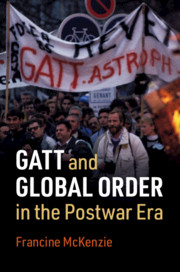
BOOK: Francine MCKENZIE, GATT and Global Order in the Postwar Era (Cambridge: Cambridge University Press, 2020). ISBN 9781108494892, £ 29.99


(Source: CUP)

Cambridge University Press is publishing a new book on the Post-WWII trading system and its role in foreign policy and international relations.

ABOUT THE BOOK

After the Second World War, the General Agreement on Tariffs and Trade (GATT) promoted trade liberalization to help make the world prosperous and peaceful. Francine McKenzie uses case studies of the Cold War, the creation of the EEC and other regional trade agreements, development, and agriculture, to show that trade is a primary goal of foreign policy, a dominant (and divisive) aspect of international relations, and a vital component of global order. She unpacks the many ways in which trade was politicised, and the layers of meaning associated with trade; trade policies, as well as disputes about trade, communicated ideas, hopes and fears that were linked to larger questions of identity, sovereignty, and status. This study reveals how the economic and political dimensions of foreign policy and international engagement intersected, showing that trade was not only instrumentalised in the service of particular policies or relations but that it was also an essential aspect of international relations.

ABOUT THE AUTHOR

Francine McKenzie, University of Western Ontario
Francine McKenzie is a Professor at the University of Western Ontario. She is an international historian who has published extensively on international cooperation, trade, and global order. Her publications include Redefining the Bonds of Commonwealth, 1939-1948 (2002), A Global History of Trade and Conflict since 1500 (2013) and Dominion of Race: Rethinking Canada's International History (2017).

TABLE OF CONTENTS

Introduction: GATT in World Affairs
1. Accidental Organization: Origins and Early Years of GATT
2. 'An Arrow in the Western World's Quiver': The Cold War Challenge to GATT
3. 'Take It or Leave It': The EEC Challenge to GATT
4. 'Spread Like the Plague': The Regional Challenge to GATT
5. 'Rich Man's Club': The Development Challenge to GATT
6. 'Agricultural Anarchy': The Agriculture Challenge to GATT
Conclusion: The Embattled History of GATT.

More info here