Search

Showing posts with label tort law. Show all posts

16 March 2026

SYMPOSIUM: "Connaître la responsabilité aquilienne. Un héritage indispensable au-delà du droit" (Liège: ULiège, 12-13 MAR 2026)

(image source: ULiège)

The university of Liège organised a two-day international symposium on the Lex Aquilia and its heritage on 12 and 13 March.

Program:


Jeudi 12 mars

  • 14h30-15h00: Introduction par Marc BOURGEOIS, Doyen de la Faculté de droit, Science Politique et Criminologie
  • 15h00-16h30: La responsabilité aquilienne dans l’Antiquité : origines et évolutions romaines - Aquilian Liability in Antiquity: Roman Origins and Developments
    • Discussant : Pascal PICHONNAZ (Université de Fribourg)
    • Communications :
      Jean-François GERKENS (Université de Liège)
      Sara GALEOTTI (Università Roma Tre)
  • 16h30-17h00 : Pause-café
  • 17h00-18h30: Au-delà de la responsabilité aquilienne - Beyond Aquilian Liability
    • Discussant : Jean-François GERKENS (Université de Liège)
    • Communications :
      Doris FORSTER (Université de Genève)
      Wouter DRUWÉ (KU Leuven)

Vendredi 13 mars

  • 9h30-11h00: La responsabilité aquilienne entre héritage antique et défis modernes - Aquilian Liability Between Ancient Heritage and Modern Challenges
    • Discussant : Wolfgang ERNST (University of Oxford)
    • Communications :
      Maria Floriana CURSI (Università degli Studi di Roma Tor Vergata)
      Valentina CVETKOVIC-DORDEVIC (Univerzitet u Beogradu)
      Olivier DESCAMPS (Université Paris 2 Panthéon-Assas)
  • 11h00-11h30 : Pause-café
  • 11h30-13h00: Entre antiquité et modernité : une évolution constante - Between Antiquity and Modernity: A Constant Evolution
    • Discussant : Wim DECOCK (Université catholique de Louvain et Université de Liège)
    • Communications :
      Wolfgang ERNST (University of Oxford)
      Wiktoria SARACYN (Uniwersytet Warszawski)
      Francesco Saverio TAVAGLIONE (Université de Liège) 
  • 14h30-15h30: Les enjeux pratiques de la responsabilité aquilienne dans les ordres juridiques actuels - Practical Challenges of Aquilian Liability in Current Legal Systems
    • Discussant : Wouter DRUWÉ (KU Leuven)
    • Communications :
      Elisa SCHILS (Université de Liège)
      Céline JOISTEN (Université de Liège)
      Marie-Sophie BONDON (La Rochelle Université)
  • 15h30 - 16h00: Pause-café
  • 16h00-17h00: Les nouveaux défis de la responsabilité aquilienne : l’intelligence artificielle - The New Challenges of Aquilian Liability: Artificial Intelligence
    • Discussant : Boudewijn SIRKS (University of Oxford)
    • Communications :
      Pascal PICHONNAZ (Université de Fribourg)
      Ljupcho GROZDANOVSKI (Université de Liège
  • 17h00: Conclusions


Read more here. 
  •  

06 May 2024

ARTICLE: Nicholas SANINIS, "Exemplary Damages Practice in late Eighteenth- and Early Nineteenth-Century England" (American Journal of Legal History)


(image source: OUP)

Abstract:

A longer perspective on the modern Anglo-American law of exemplary (or punitive) damages views it as having first begun to emerge after the cases of Huckle v Money and Wilkes v Wood were decided in 1763. This article seeks to further deepen and clarify this perspective. It does so by systematically tracing the evolution of the adjudicative practice according to which English civil juries awarded ‘exemplary damages’ from the period circa 1764 to the early nineteenth century. It shows that this practice scarcely ‘hardened into law’ in the aftermath of the Huckle and Wilkes decisions. In fact, as had been the case long before 1763, for a long time after it, jury determinations as to exemplary damages in common law tort actions remained entirely outside the control of any formal legal doctrine which either of these decisions were taken to have authoritatively recognized.

Read the full article here: DOI  10.1093/ajlh/njae005

04 August 2022

BOOK: Matthew DYSON, Explaining Tort and Crime. Legal Development Across Laws and Legal Systems, 1850–2020 (Cambridge: University Press, 2022). ISBN: 9781107144866, £ 95.00

(Source: CUP)

ABOUT THE BOOK


Tracing almost 200 years of history, Explaining Tort and Crime explains the development of tort law and criminal law in England compared with other legal systems. Referencing legal systems from around the globe, it uses innovative comparative and historical methods to identify patterns of legal development, to investigate the English law of fault doctrine across tort and crime, and to chart and explain three procedural interfaces: criminal powers to compensate, timing rules to control parallel actions, and convictions as evidence in later civil cases. Matthew Dyson draws on decades of research to offer an analysis of the field, examining patterns of legal development, visible as motifs in the law of many legal systems.


The book completes a trilogy of works, along with the edited collections Unravelling Tort and Crime (2014), focused on English law, and Comparing Tort and Crime (2015), focused on modern comparative law, all published with Cambridge University Press.


ABOUT THE AUTHOR


Matthew Dyson is Professor of Civil and Criminal Law at the University of Oxford.


TABLE OF CONTENTS


Table of Contents Part I. Setting the Scene: Introduction and Methods for Explaining: 1. Introduction 2. Organising tort and crime Part II. Mental States and Careless Acts: The Development of Fault Doctrine in Crime and Tort: 3. Fault doctrines in criminal law 4. Fault doctrines in tort law 5. Explaining the criminal and tortious developments in fault doctrine Part III. Procedures Interfacing Tort and Crime: 6. Claims and formats 7. Timing rules 8. Criminal judgments in the civil law Part IV. Conclusions: 9. Patterns of development 10. Conclusions.


https://www.cambridge.org/gb/academic/subjects/law/private-law/explaining-tort-and-crime-legal-development-across-laws-and-legal-systems-18502020?format=HB

06 May 2019

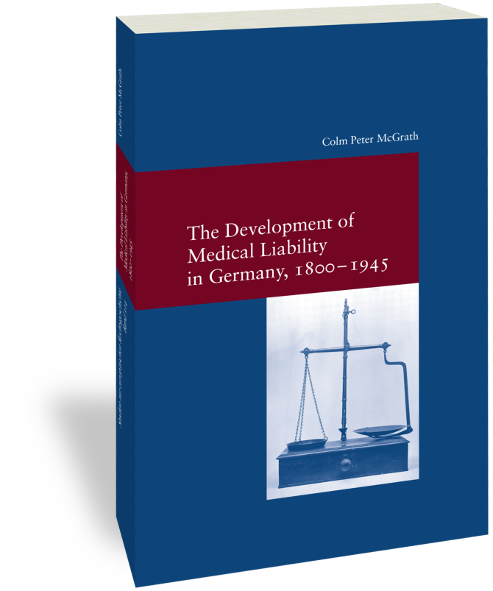
BOOK: Colm Peter MCGRATH, The Development of Medical Liability in Germany, 1800–1945 [Studien zur europäischen Rechtsgeschichte 314] (Frankfurt am Main: Klostermann, 2019). ISBN 978-3-465-04357-6, €69.00


The Max Planck Institute for European Legal History has published volume 314 of its Studien zur europäischen Rechtsgeschichte.

ABOUT THE BOOK

This volume examines the development of medical liability in Germany during its intense formative period from 1800–1945. It focuses on how the fault requirement in civil law was conceptualised and applied to liability for errors in the diagnosis and treatment of a patient. By focusing on the development of the law, and how it related and responded to changes in the nature of medicine, medical practitioners and healthcare over this period, it uncovers a rich interaction between the legal and medical narratives concerning fault. It offers an account of legal development where the law and lawyers were deeply embedded in, and influenced by, the broader social context, identifying a gradual shift towards asserting the independence of courts from accepted medical narrative in the light of technological advances.

TABLE OF CONTENTS

Preface | IX
Introduction | 1
Chapter 1: Medical Organisation, Regulation and Discipline in Germany: 1800–1945 | 11
Chapter 2: Medical Error and the Criminal Law | 55
Chapter 3: Medical Error and Contract Law | 81
Chapter 4: Medical Error and the Law of Delict | 111
Chapter 5: Medical Error and the BGB | 139
Conclusion | 221
List of Abbreviations | 239
Bibliography | 241
Index of terms | 259

More information here

08 November 2018

BOOK: Matt DYSON & Benjamin VOGEL, The Limits of Criminal Law. Anglo-German Concepts and Principles (Cambridge/Antwerp: Intersentia, 2018), XXXII + 598 p. ISBN 9781780686615, € 99

(image source: Intersentia)

Book abstract:
The Limits of Criminal Law shines light from the outer edges of the criminal law in to better understand its core. From a framework of core principles, different borders are explored to test out where criminal law’s normative or performative limits are, in particular, the borders of crime with tort, non-criminal enforcement, medical law, business regulation, administrative sanctions, counter-terrorism and intelligence law. The volume carefully juxtaposes and compares English and German law on each of these borders, drawing out underlying concepts and key comparative lessons. Each country offers insights beyond their own laws. This double perspective sharpens readers’ critical understanding of the criminal law, and at the same time produces insights that go beyond the perspective of one legal tradition. The book does not promote a single normative view of the limits of criminal law, but builds a detailed picture of the limits that exist now and why they exist now. This evidence-led approach is particularly important in an ever more interconnected world in which different perceptions of criminal law can lead to profound misunderstandings between countries. The Limits of Criminal Law builds picture of what shapes the criminal law, where those limits come from, and what might motivate legal systems to strain, ignore or strengthen those limits. Some of the most interesting insights come out of the comparison between German systematic approach and doctrinal limits with English law’s focus on process and judgment on individual questions.
On the authors:
Matthew Dyson is an Associate Professor in the Faculty of Law, University of Oxford. He is an associate member of 6KBW College Hill Chambers, a Research Fellow of the Utrecht Centre for Accountability and Liability Law and Vice President of the European Society for Comparative Legal History. Benjamin Vogel is Senior Research Fellow at the Max Planck Institute for Foreign and International Criminal Law in Freiburg, Germany. He is Assistant Editor of the Foreign Review of the Zeitschrift für die gesamte Straf-rechtswissenschaft. 
A free preview of the table of contents and preliminary pages is accessible here.

More information with the publisher.

28 May 2015

BOOK: Ramses DELAFONTAINE, Historians as Expert Judicial Witnesses in Tobacco Litigation. A Controversial Legal Practice [Studies in the History of Law and Justice, 4; eds. M. Sellers & G. Martyn], Heidelberg/New York: Springer, 2015, 453 p. ISBN 978-3-319-14291-3

(image source: Springer)

Ramses Delafontaine (UGent, Department of History) published Historians as Expert Judicial Witnesses in Tobacco Litigation. A Controversial Legal Practice with Springer [Studies in the History of Law and Justice, 4; eds. M. Sellers & G. Martyn].

Abstract:
Historian Ramses Delafontaine presents an engaging examination of a controversial legal practice: the historian as an expert judicial witness. This book focuses on tobacco litigation in the U.S. wherein 50 historians have witnessed in 314 court cases from 1986 to 2014. The author examines the use of historical arguments in court and investigates how a legal context influences historical narratives and discourse in forensic history. Delafontaine asserts that the courtroom is a performative and fact-making theatre. Nonetheless, he argues that the civic responsibility of the historian should not end at the threshold of the courtroom where history and truth hang in the balance.
The book is divided into three parts featuring an impressive range of European and American case studies. The first part provides a theoretical framework on the issues which arise when history and law interact. The second part gives a comparative overview of European and American examples of forensic history. This part also reviews U.S. legal rules and case law on expert evidence, as well as extralegal challenges historians face as experts. The third part covers a series of tobacco-related trials. With remunerations as high as hundreds of thousands of dollars and no peer-reviewed publications or communication on the part of the historians hired by the tobacco companies the question arises whether some historians are willing to trade their reputation and that of their university for the benefit of an interested party. The book further provides 50 expert profiles of the historians active in tobacco litigation, lists detailing the manner of the expert’s involvement, and West Law references to these cases.
This book offers profound and thought-provoking insights on the post-war forensification of history from an interdisciplinary perspective. In this way, Delafontaine makes a stirring call for debate on the contemporary engagement of historians as expert judicial witnesses in U.S. tobacco litigation.
Table of Contents:
General Introduction
Delafontaine, Ramses
  • Pages 1-5
    $29.95
  • Introductory Theoretical Remarks on the Alleged Problematic Nature of the Interaction of History and Law
    Pages 9-13
  • Clio’s Modern Paradox Unraveled
    Pages 15-27
  • Introduction Part II
    Pages 31-33
  • Modern Interactions of Law and History
    Pages 35-43
  • The Globalization of the Historian as an Expert Witness
    Pages 45-65
  • Litigation-Driven History
    Pages 67-105
  • A Reassessment of Wijffels’ Concept of Forensic History
    Pages 107-116
  • Introduction Part III
    Pages 119-125
  • A History of Tobacco
    Pages 127-141
  • Tobacco and Health: Towards a Contemporary Perspective
    Pages 143-156
  • The Tobacco Industry and Its Tactics
    Pages 157-171
  • Tobacco Litigation
    Pages 173-209
  • United States v. Philip Morris et al.
    Pages 211-259
  • Debates: Reflections in Academic and National Media
    Pages 261-275
  • Historians in Tobacco Litigation, a Conclusion
    Pages 277-296
  • Final Conclusion on the Involvement of Historians in Tobacco Litigation
    Pages 297-301
  • Final Conclusion
    Pages 303-309
 More information on the publisher's website.