Search

Showing posts with label liber amicorum. Show all posts

11 December 2024

BOOK: Kenneth W. MACK & Jacob KATZ COGAN (eds.), In Between and Across: Legal HIstory Without Boundaries (Oxford: OUP, 2024), ISBN 9780197680995


(image source: OUP)

Abstract:

The boundaries between the history of law and the history of everything else are quite blurry nowadays. Whether one is asking questions about the origins of the carceral state, the relationship between slavery and capitalism, the history of migration flows and empires, the longer story of human rights, the building of the straight state, the role of religion in public life, or many other topics, there is a shared belief that law and its history matters. In fact, legal historians have begun to focus on the blurring of boundaries such as those between markets and politics, between identity and state power, as well as between national borders and the flows of people, capital, and ideas around the world. Legal history, broadly conceived, seems to mark much of the most exciting work that is redrawing the boundaries of historical scholarship in many areas of study. In Between and Across: Legal History without Boundaries gathers some of the newest and freshest work by both younger and established scholars who are carrying forward that project and extending it into new areas of historical inquiry. It captures the best of the new and innovative tools and questions that have made law a central plane of inquiry, charts novel directions for the field, and poses broader questions concerning the past, present, and future. Crossing a wide variety of geographic areas (from British-ruled Australia, to colonial India, to the United States), the authors sketch new boundaries for the field to cross—boundaries of time, geography, and method—and claim that legal history provides the language to talk across national borders.

DOI 10.1093/oso/9780197680995.001.0001. 

15 April 2022

BOOK: Aldo Andrea CASSI & Elisabetta FUSAR POLI (Eds.), Jus brixiae et alibi. Scritti scelti offerti ad Alberto Sciumè (Torino: Giappichelli Editore, 2022). ISBN: 9788892121867, pp. 496, € 70,00


ABOUT THE BOOK

Collana: Collana del Dipartimento di Giurisprudenza. Università degli Studi di Brescia. Scritti scelti

L'Università nacque (per inciso: nell'Italia medievale e con lo studio del diritto; molti lo sanno, ma pochi se lo ricordano quando si disquisisce sulla "offerta formativa" per i futuri giuristi e si pretende di ometterne la Storia del diritto medievale) con la straordinaria scintilla irneriana di un insegnamento che stimola allo studio e di uno studio che si fa motu proprio insegnamento: il sinolo di ricerca e didattica ("studendo docere") come cuore dell'Università 1. Poi, recentemente, soprattutto per raccogliere finanziamenti, hanno inventato la "terza missione", una sorta di radicamento sul territorio (una inconscia compensazione localistica, forse, all'esterofilia anglofona che punteggia la mission di ogni università desiderosa di presentarsi smart), che per molte discipline non ha una sana logica. Insomma, il professore universitario si dedica ad una triplice attività, resa sempre più disarticolata dalla burocrazia accademica che ne frantuma l'originaria unitarietà in adempimenti via via più avulsi l'uno dall'altro. Ebbene, ciò che vorrei testimoniare in queste poche righe (che gli sembreranno già troppe, conoscendone l'idiosincrasia ad essere soggetto celebrato) è l'energia con cui Alberto Sciumè ha incarnato le due anime universitarie (ricerca e didattica) e ha accondisceso, con pazienza maggiore di quanto (non) facciano colleghi più giovani, alla missione territoriale.

Con contributi di: Aldo Andrea Cassi, Elisabetta Fusar Poli, Federica Paletti, Alan Sandonà,  Alberto Carrera, Marco Castelli, Luigi Maione, Fabio Addis, Adriana Apostoli, Antonello Calore, Giuseppe Corasaniti, Antonio D’Andrea, Matteo Frau, Stefano Liva, Paolo Lombardi, Chiara Minelli, Mauro Paladini, Valerio Pescatore, Cosimo Risi, Carlo Alberto Romano, Antonio Saccoccio, Giovanni Turelli, Alberto Venturelli, Massimo Zaccheo.

ABOUT THE EDITORS

Aldo Andrea Cassi è professore ordinario all’Università degli Studi di Brescia, dove insegna antropologia giuridica e storia del diritto medievale e moderno. 

Elisabetta Fusar Poli è  è professoressa associata presso l'Università di Brescia insegna Storia del diritto medievale e moderno e Storia del diritto contemporaneo ed è titolare di corsi progrediti incentrati sul metodo storico-comparatistico e sulle intersezioni fra diritto, storia e cultura. 

TABLE OF CONTENTS

It is available in PDF version here.


More information is available from the publisher.


06 January 2020

BOOK: Michèle BÉGOU-DAVIA, Florence DEMOULIN-AUZARY et François JANKOWIAK (dir.), Rerum novarum ac veterum scientia Mélanges en l’honneur de Brigitte Basdevant-Gaudemet [Presses universitaires de Sceaux] (Paris: Mare & Martin, 2020), 1 400 p. ISBN 978-2-84934-472-9, € 89 (before 31 JAN 2020), € 110 (afterwards)

(image source: assohd.fr)

Book abstract:
Somme de contributions de 76 collègues et amis du professeur qui abordent des thèmes variés allant de l’histoire du droit biblique au régime contemporain de la propriété intellectuelle, illustrant ainsi l’ampleur de l’oeuvre scientifique de celle à qui elles sont dédiées.
Subscription form here.

A list of contributors can be found here.

(source: Storia Del Diritto)

07 June 2019

BOOK : SOCIETE POUR L’HISTOIRE DES FACULTES DE DROIT, ed., Liber amicorum, Mélanges réunis en hommage au professeur Jean-Louis Thireau (Paris: SHFD, 2019). €29.00


Via the Portail universitaire du droit, we learned of the publication of the Liber Amicorum for Professor Jean-Louis Thireau.

Le professeur Jean-Louis Thireau est l’auteur d’une œuvre considérable et qui fait référence. Elle l’a conduit, à partir de Charles Dumoulin et de l’humanisme juridique, à renouveler en profondeur l’étude de nombreuses questions centrales de l’histoire du droit.

Ses collègues, ses amis et ses élèves ont tenu à lui rendre hommage en lui dédiant un volume de Mélanges, qui est proposé à la souscription jusqu’au 15 juillet 2019.

Le tarif de souscription (29 euros) est valable jusqu’au 15 juillet. Après cette date, ainsi que pour les collectivités et librairies, le volume est en vente au prix de 39 euros.

Table des matières

Quelques notes sur le genre du traité dans la production juridique française du premier xvie siècle, par Patrick Arabeyre, p. 11
Sur l’identification progressive de la Science des arrêts à la Jurisprudence, par Sylvain Bloquet, p. 29
Molinaeus Noster Charles du Moulin (1500-1566), oracle du droit, praticien engagé et fondateur de l’école juridique française, un modèle de jurisconsulte dans la France du xixe siècle, par Géraldine Cazals, p. 57
Le Liber Iudiciorum et la formation des obligations contractuelles dans le droit Wisigoth, par David Deroussin, p. 101
Juge et partie, les observations des tribunaux sur l’application et l’interprétation du futur code civil (1801), par Alain Desrayaud, p. 121
Une remise en cause de l’absolutisme des hommes ou l’empire des femmes selon Mary Wollstonecraft, par Anne Dobigny-Reverso, p. 145
Continuité ou rupture dans l’histoire de la pensée juridique ? Exégèse, transtextualité et positivisme légaliste du Cours de Code Napoléon de Charles Demolombe, par Nader Hakim, p. 171
Les Essais sur l’idée du parfait magistrat, par Jacques Krynen, p. 211
La pratique du don mobil en Normandie à l’époque moderne, par Virginie Lemonnier-Lesage, p. 229
La résistance des coutumes polynésiennes à la réception du droit français (1842-2000), par Bruno de Loynes de Fumichon, p. 247
La doctrine commercialiste avant le Code de commerce, par Alexis Mages, p. 281
Des usages du droit comparé lors des travaux préparatoires du Code civil des français, par Laurent Pfister, p. 299
L’obéissance aux lois royales selon Antoine Loisel à travers ses huict remontrances faictes en la chambre de justice de Guyenne sur le subject des edicts de pacification, par Xavier Prévost, p. 351
Les violences faites aux femmes : une illustration à travers les déclarations de grossesses en Touraine (1749-1790), par Laurent Reverso, p. 369
Droit comparé en terres d’Anjou d’après les commentaires coutumiers de René Choppin, par Anne Rousselet-Pimont, p. 397
Les créances privilégiées des nourrices d’enfants confiés par leurs parents au xixe siècle, par Michel Vidal, p. 425
« Jurisconsultus idemque orator » Retour sur la lettre de Pétrarque à Marco Portonari sur les études de droit (Rerum Familiarium XX. 4), par Nicolas Warembourg, p. 447
Liste des souscripteurs, p. 471

More info here

01 June 2018

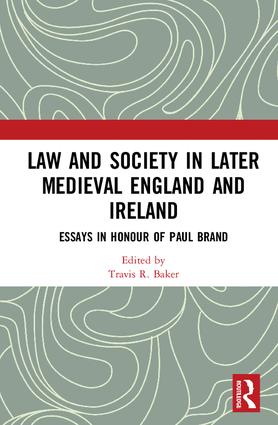
BOOK: Travis R. BARKER (ed.), Law and Society in Later Medieval England and Ireland: Essays in Honour of Paul Brand (London: Routledge, 2018), 280 p. ISBN 9781472477385, 105 GBP

(image source: Routledge)

Book abstract:
Law mattered in later medieval England and Ireland. A quick glance at the sources suggests as much. From the charter to the will to the court roll, the majority of the documents which have survived from later medieval England and Ireland, and medieval Europe in general, are legal in nature. Yet despite the fact that law played a prominent role in medieval society, legal history has long been a marginal subject within medieval studies both in Britain and North America. Much good work has been done in this field, but there is much still to do. This volume, a collection of essays in honour of Paul Brand, who has contributed perhaps more than any other historian to our understanding of the legal developments of later medieval England and Ireland, is intended to help fill this gap. The essays collected in this volume, which range from the twelfth to the sixteenth century, offer the latest research on a variety of topics within this field of inquiry. While some consider familiar topics, they do so from new angles, whether by exploring the underlying assumptions behind England’s adoption of trial by jury for crime or by assessing the financial aspects of the General Eyre, a core institution of jurisdiction in twelfth- and thirteenth-century England. Most, however, consider topics which have received little attention from scholars, from the significance of judges and lawyers smiling and laughing in the courtroom to the profits and perils of judicial office in English Ireland. The essays provide new insights into how the law developed and functioned within the legal profession and courtroom in late medieval England and Ireland, as well as how it pervaded the society at large.
On the editor:

Travis R. Baker is a private scholar living in San Diego, California

Table of contents:
 1. Justice Delayed: Absent Recognitors and the Angevin Legal Reforms, c. 1200 [William Eves]
2. Testament and Inheritance: The Lessons of the Brief Widowhood of Isabel, Countess of Pembroke [David Crouch]
3. A Crossroads in Criminal Procedure: The Assumptions Underlying England’s Adoption of Trial by Jury for Crime [Elizabeth Papp Kamali and Thomas A. Green]
4. The General Eyre and Royal Finance [Jens Röhrkasten]
5. Royal Privilege and Episcopal Rights in the Later Thirteenth Century: The Case of the Ashbourne Advowson, 1270-1289 [Joshua C. Tate]
6. The Clerk William Tyssyngton and the Pursuit of Fugitives in the Late Thirteenth-Century [Karl Shoemaker]
7. Profits and Perils of an Irish Legal Career: Sir Elias Ashbourne (d. 1356), Chief Justice and Marcher Lord [Robin Frame]
8. Two Jurisdictions in Dispute About Canonical Appeals: London and Canterbury, 1375-6 [F. Donald Logan]
9. The Outlaw in Later Medieval Ireland [Áine Foley]
10. The Origins and Development of Judicial Tenure "During Good Behaviour" to 1485 [Ryan Rowberry]
11. "Et Subridet etc.": Smiles, Laughter and Levity in the Medieval Year Books [Gwen Seabourne]
12. Men of Law and Professional Identity in Late Medieval England [Anthony Musson]
13. Legal Services for the Poor in the Early Common Law [David J. Seipp]
More information with the publisher.

(source: Legal History Blog)

31 May 2018

BOOK: Laurent KONDRATUK (dir.), Dialectica est bene disputandi scientia. Mélanges à la mémoire de Jean Werckmeister (Besançon: Presses universitaires de Franche-Comté, 2018), ISBN 978-2-84867-619-7, € 39.

(image source: LCDPU)

Book abstract:
Cet ouvrage regroupe une vingtaine de contributions à la mémoire de Jean Werckmeister (1947-2011). Ce professeur de droit canonique à la Faculté de théologie catholique de Strasbourg était spécialiste d’Yves de Chartres et de Gratien et de droit matrimonial. Membre de la Iuris Canonici Medii Aevi Consociatio, il a notamment dirigé la Revue de droit canonique.Cet historien du droit canonique a pris part à de multiples débats au sein du catholicisme. Esprit libre et soucieux de justice, il a défendu Mgr Gaillot ou encore plaidé pour les divorcés remariés. Cette attitude lui a valu une opposition constante de la Curie romaine.


Table of contents:


René HEYER (Université de Strasbourg) - Préface
Laurent KONDRATUK (Université de Franche-Comté) - Le rire de Gratien. De l'initiative des mélanges à la mémoire de Jean Werckmeister
Jean WERCKMEISTER, Les débats canoniques sur la formation du lien matrimonial au XIIe siècle
Pier Virginio AIMONE (Université pontificale Urbanienne - Rome) – Remarques sur un canon 'intransigeant' de la Summa Aimonis, concernant la vie commune du clergé
Anne BAMBERG (Université de Strasbourg) - « Rétablissez le droit au tribunal… ». Recherches autour du promoteur de justice dans les causes en nullité de mariage
Brigitte BASDEVANT-GAUDEMET (Université de Paris-Sud) - L’autorité du pontife romain. Remarques terminologiques autour du Décret de Gratien
Caroline DECOSTER (Université de Franche-Comté) - La grâce du prince. La rémission des crimes politiques à la chute d’Etienne Marcel
Silvio FERRARI (Université de Milan) - Shifting protection from beliefs to believers: an European way out from the quandary of blasphemy laws?
Catherine JORDY (Université de Strasbourg) – Mariages et trucages. Le thème du couple dans le cinéma de Chaplin
Francis MESSNER (CNRS) – La formation des cadres religieux en droit local des cultes alsacien mosellan
Marcel METZGER (Université de Strasbourg) - Sacrements, ou mystères ? Enjeux d’une révisionMarie-Jo PORCHER (Strasbourg) - YHWH, le roi, et le mensonge. Un essai de lecture en continu des premiers Psaumes
Elisabeth SCHNEIDER (Fribourg-en-Brisgau) – Persona et le sacrement du baptême dans le droit canonique médiévalRoland SUBLON (Université de Strasbourg) – En attendant… trois homélies
Benoît-Michel TOCK (Université de Strasbourg) - Les actions juridiques et leur mémoire à l’abbaye d’Arrouaise au XIIe siècle
Rik TORFS (KU Leuven) – Jean Werckmeister et le can. 915
Eugène VASSAUX (Strasbourg) - Calvin contre Castellion. Le problème de la liberté de conscience
Marco VENTURA (Université de Sienne) - You Shall Go to Hell: Legal Arguments on Conversions before the Supreme Court of India
Delphine VIELLARD (Strasbourg) - Cinq lettres de Sirice, évêque de Rome (384-399). Traduction et notes
François WERCKMEISTER (Université de Strasbourg) – Chaplin et le mariage : entre f(r)ictions et réalitéLes contributeurs
Tabula gratulatoria
More information here.

03 October 2014

BOOK: Jan Hallebeek, Martin Schermaier, Roberto Fiori, Ernest Metzger, Jean-Pierre Coriat (eds.), Inter cives necnon peregrinos. Essays in honour of Boudewijn Sirks (Göttingen: Vandenhoeck & Ruprecht, 2014) ISBN 978-3-8471-0302-8


Vandenhoeck & Ruprecht published a consistent volume of essays (856 p.) assembled by Jan Hallebeek (VU Amsterdam), Martin Schermaier (Bonn), Roberto Fiori (Tor Vegata), Ernest Metzger (Glasgow) and Jean-Pierre Coriat (Paris II Panthéon-Assas) in honour of Prof. em. dr. Boudewijn Sirks (Regius Professor of Civil Law and Emeritus Fellow All Souls, Oxford), who recently retired. The book was presented at Prof. Sirks' valedictory lecture in July 2014.

Editor presentation:
The contributions to this volume are concerned with the Roman law of antiquity in its broadest sense, covering both private and public law from the Roman Republic to the Byzantine era, including legal papyrology. They also examine the reception of Roman law in Western Europe and its colonies (specifically the Dutch East Indies) from the Middle Ages to the promulgation of the German Bürgerliche Gesetzbuch in 1900. They reflect the wide interests of Professor Boudewijn Sirks, whom the volume honours on the occasion of his retirement and whose work and career have transcended frontiers and nations.

(source: Rechtshistorische Courant, October 2014 and Glasgow Legal History)