Search

Showing posts with label Second scholasticism. Show all posts

21 March 2024

BOOK: Rafael Ramis BARCELÓ, La Segunda Escolástica. Una propuesta de síntesis histórica (Madrid: Dykinson, 2024), pp. 443 (open access)


ABOUT THE BOOK 

This book is a historical synthesis of the second scholasticism. Based on the sociology of science and the history of ideas, a study method is proposed, a chronological division, with various periods and stages, is explained, highlighting the causes and consequences and the most relevant features of each era. Starting from three dimensions (schools, authors and themes), the development of the second scholasticism is studied, in dialogue with the other manifestations of the culture of its time, and in the epilogue the transition to the third scholasticism is analyzed. This book tries to underline the integration of the second scholasticism within the framework of modern thought.

ABOUT THE AUTHOR

Rafael Ramis Barceló (Mallorca, 1983) is Full Professor of History of Law and Institutions and deputy director of the Institute of Hispanic Studies in Modernity (IEHM) of the University of the Balearic Islands. He graduated in Law, Philosophy, Comparative Literature, Religious Sciences, Political Science and Sociology, and received a doctorate in Law. His lines of research are the history of legal thought, the history of universities and the history of ideas (15th-18th centuries).

The book can be downloaded for free here.

21 October 2022

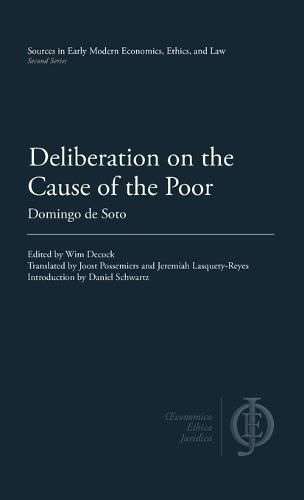
BOOK: Domingo DE SOTO, Deliberation on the Cause of the Poor (Transl. Joost POSSEMIERS, & Jeremiah LASQUETY-REYES, introd. Daniel SCHWARTZ) [Sources in Early Modern Economics, Ethics and Law, Second Series, ed. Wim DECOCK] (Grand Rapids: CLP Academic, 2022), 184 p., ISBN 978194901109, 29,95 USD


(image source: readings)

Abstract:
May beggars be excluded from public spaces? May vagabonds be denied access to foreign cities? Should assistance to the poor rely on private charity rather than public welfare institutions? These and similar questions are at the heart of Deliberation on the Cause of the Poor, a remarkable treatise on poor relief by Domingo de Soto (1495-1560), one of Spain’s most famous jurist-theologians. Confronted with the reform of poor laws in cities across Europe, Soto warns against the potentially dire consequences of restricting access to poor relief for the sake of managerial efficiency. Denouncing the abuse of power by corrupt public officials and the instrumentalization of the sacrament of confession, he argues against well-intended public measures that actually jeopardize the poor’s direct access to life-saving help and assistance. Soto draws on manifold arguments from the Bible, the church fathers, natural law, Roman law, and canon law to defend the legitimate poor’s right to beg for assistance, while recalling the vital importance of the virtue of mercy. Edited by Wim Decock. Translated by Joost Possemiers and Jeremiah Lasquety-Reyes. Introduction by Daniel Schwartz.

 Read more here.

16 December 2020

BOOK: Domingo DE SOTO, Deliberazione nella causa dei poveri (1545), a cura e con introduzione di Valentina Benacchio, prefazione di Diego Quaglioni (Foligno: Il Formichiere, 2020) ISBN: 9788831248037, pp. 242, € 20,00

(Source: Il Formichiere)

ABOUT THE BOOK

A cura e con introduzione di Valentina Benacchio, prefazione di Diego Quaglioni.

La Deliberazione nella causa dei poveri del domenicano Domingo de Soto (1495-1560), uno dei grandi maestri della cosiddetta seconda scolastica, è un breve trattato in dodici capitoli, che a distanza di quasi mezzo millennio colpisce ancora il lettore per la sua forza argomentativa e per la sua capacità di resistenza alle pretese del potere e del diritto secolari di imporsi a guida e controllo delle coscienze. (dalla Prefazione di Diego Quaglioni)

Domingo de Soto (Segovia, 1494 - Salamanca, 1560), è stato uno dei maggiori teologi della Spagna nella prima modernità. Studente ad Alcalà de Henares nel 1513, quattro anni dopo era a Parigi. Entrò nell’Ordine dei Predicatori nel 1524, divenendo dottore in teologia l’anno successivo. Insegnò a Segovia e quindi a Salamanca, università che lasciò per divenire il confessore dell’imperatore Carlo V, in rappresentanza del quale prese parte al Concilio di Trento. Nel 1548 partecipò come teologo cattolico alla redazione dell’Interim di Augusta, con il quale la Dieta imperiale convocata da Carlo V stabilì un compromesso con i principi che aderivano alla religione riformata, in attesa delle deliberazioni del Concilio. Esponente di primo piano della cosiddetta Seconda Scolastica, fu uno strenuo difensore ed interprete del pensiero di Tommaso d’Aquino, il cui spirito si trova trasfuso in questa sua opera del 1545, dedicata all’erede al trono Filippo, il futuro Filippo II, e concepita a difesa del diritto dei poveri a migrare e a chiedere sostentamento nel nome di Dio. Altre opere, tutte di grande significato nella storia del pensiero occidentale, sono quelle nel campo della logica (Summulae, 1529; In dialecticam Aristotelis commentarii, 1544), della fisica (In VIII libros physicorum, 1545), della teologia (De natura et gratia libri III, 1547; In IV Sententiarum libros commentaria 1555-1556), della politica e del diritto (Commentarium in Epistulam ad Romanos, 1550; De justitia et jure libri X, 1556, la sua opera più importante).

ABOUT THE EDITOR

Valentina Benacchio (1993), ha compiuto i suoi studi al Liceo Brocchi di Bassano del Grappa, sua città natale, e si è laureata in Giurisprudenza nell’Università di Trento, sotto la guida di Diego Quaglioni. I suoi interessi di studio sono rivolti alla letteratura teologico-giuridica della prima età moderna e in particolare alla questione della povertà nel dibattio cinquecentesco.


More information with the publisher.