The Academia Matritense del Notariado and the Fundación Seminario de Derecho Romano Ursicino Álvarez will hold the eleventh edition of the Premio Internacional Ursicino Álvarez (Ursicino Álvarez International Prize) on Monday, 16 November 2026, at 19:00, at the Ilustre Colegio Notarial de Madrid, Spain.
This year's edition will honour two distinguished Italian scholars for their contributions to Roman law and legal scholarship:
- Prof. Aldo Schiavone – Universities of Florence and Rome La Sapienza, and Director of Scriptores iuris romani.
- Prof. Giuseppe Valditara – University of Turin, and Italian Minister of Education and Merit.
Established in 2007 to commemorate the centenary of the birth of Ursicino Álvarez Suárez (1907–1980), the International Prize recognises distinguished jurists whose scholarly work places Roman law at its centre. Over successive editions, the award has celebrated leading figures in Roman law scholarship, reflecting the enduring significance of the Roman legal tradition and its contribution to European legal culture.
The ceremony will take place at the Ilustre Colegio Notarial de Madrid, Calle Juan de Mena 9, 28014 Madrid, Spain.
Attendees are kindly requested to confirm their participation by contacting the organisers at academia@madrid.notariado.org.
Further information about the prize and its previous recipients is available on the official website of the Fundación Seminario de Derecho Romano Ursicino Álvarez.
Search
03 November 2026
AWARD CEREMONY: XI Premio Internacional Ursicino Álvarez (Madrid: Ilustre Colegio Notarial de Madrid, 16 NOV 2026)
28 August 2026
BOOK REVIEW: Rosa CONGOST, From masters of slaves to lords of lands: the transformation of ownership in the western world, by James Q. Whitman [Cambridge: Cambrdige University Press, 2025] (Comparative Legal History, XIV (2026), nr. 1 (June), pp. 131-136)
The book I review here is one that cannot fail to impress any reader interested in the historical evolution of property rights. This will be the case whether you are interested in the legal discourse around the concept of property, or in the real and material interests that may lie behind the discourse. In this review, I will emphasise the aspects of the book I find most interesting, while pointing out some questions that came to mind during my reading. I will highlight not only the most obvious findings, but also the possibilities the book offers for starting a dialogue with historians who, like me, are working on similar topics, albeit from different angles and perspectives.
This dialogue is facilitated by the author's ability to link the multiple references and quotations he provides from classic works, with which we are all familiar, with research from a wide variety of specialised fields. This is evident from the outset. Hence, Blackstone's statement that starts the introduction: ‘[t]here is nothing which so generally strikes the imagination, and engages the affections of mankind as the right of property, which allows the author to present his book as being about 'legal imagination’; an imagination, he immediately clarifies, that is expressed through the 'idioms of power' (10), a concept taken from Orlando Patterson's book Slavery and Social Death.' James Whitman shares one of the central theses of this book, which is the idea that the modern conception of property has its origins in a slave society. This is an idea that in itself already establishes a dialogue with the modern period, especially in a country such as the United States, which had to wait until the second half of the nineteenth century for the definitive triumph of the 'free-soil doctrines' and the 'disappearance of lawful slavery'. This reference locates us in the contemporary Common Law legal tradition where we are reminded that the success of the 'castle doctrine' and the homestead exemption proves the strong identification of property with land, an idea that is widespread throughout the Western world. To this effect, dialogue between scholars of different legal traditions is guaranteed from the outset because 'the West, as I [the book's author] will speak of it in this book, is the West of the Roman legal tradition' (14). In the last part of this review, I will emphasise the need for this dialogue […]
To read the full review, please click here. Online access is free for members of the European Society for Comparative Legal History.
DOI: https://www.tandfonline.com/doi/full/10.1080/2049677X.2026.2671610
29 April 2026
BOOK: Marek NOVÁK, Glossators and Commentators at the Strahov Library (Prague: Karolinum Press, 2025), 334 p., ISBN 978-80-246-6043-1
Abstract:
Private law in the Czech Republic, as in many countries, has its roots in Roman law, which reached its peak through codification by Emperor Justinian. However, modern civil codes are not directly based on Roman law source texts but on their later reception by medieval and modern jurists. This study aims to identify writings by authors belonging to the earliest stages of Roman law reception in the as-of-yet unsorted collection of the library of the Royal Canonry of Premonstratensians at Strahov. It discovers the works of glossators and commentators, analyses manuscripts, incunabula, and old prints and supplements the related data with examples of the used working methods. In addition, one of the results of the research was a set of proposals for correcting the library catalogue, which has already been implemented. The study therefore offers current shelf marks in alignment with the actual state of the collection and aims to serve as a practical guide for researchers interested in studying this segment of legal history.
Table of contents:
1. The beginnings of the reception of Roman law
2. Glossators
2.1 Legal school
2.2 Literary forms
2.2.1 Glossae
2.2.2 Summae
2.2.3 Tractatus
2.2.4 Quaestiones
2.2.5 Lecturae
2.2.6 Other forms
2.3 Authors and writings at the Strahov Library
2.3.1 Accursius
2.3.2 Azo
2.3.3 Odofredus
2.3.4 Placentinus
2.3.5 Roffredus
3. Commentators
3.1 Legal school
3.2 Literary forms
3.2.1 Commentaria
3.2.2 Tractatus
3.2.3 Consilia
3.2.4 Quaestiones disputatae
3.2.5 Repetitiones
3.2.6 Other forms
3.3 Authors and writings at the Strahov Library
3.3.1 Accoltis Aretinus, Franciscus de
3.3.2 Bologninus, Ludovicus
3.3.3 Castro, Paulus de
3.3.4 Cumanus, Raphael Raymundus
3.3.5 Decius, Philippus
3.3.6 Fulgosius, Raphael
3.3.7 Gambilionibus, Angelus Aretinus de
3.3.8 Laudensis, Martinus Garratus
3.3.9 Mayno, Jason de
3.3.10 Mugellanus, Dinus de Rossonis
3.3.11 Penna, Lucas de
3.3.12 Pistorio, Cinus de Sigibuldis de
3.3.13 Pontanus, Ludovicus
3.3.14 Rosate, Albericus de
3.3.15 Salyceto, Bartholomaeus de
3.3.16 Sancto Petro, Florianus de
3.3.17 Saxoferrato, Bartolus de
3.3.18 Socinus, Bartholomaeus
3.3.19 Tartagnus, Alexander
3.3.20 Ubaldis, Angelus de3.3.21 Ubaldis, Baldus de
Find more on Karolinum Press&The Chicago University Press.
29 April 2022
25 May 2020
BOOK: Nicole BELAYCHE & Sylvia ESTIENNE (dir.), Religion et pouvoir dans le monde romain, l’autel et la toge. De la deuxième guerre punique à la fin des Sévères (Rennes: Presses Universitaires de Rennes, 2020). ISBN: 9782753578685, pp. 420, € 25,00
ABOUT THE EDITORS
TABLE OF CONTENTS
A PDF version of the table of contents can be downloaded here.
More information with the publisher.
26 February 2020
SEMINAR SERIES: Zürcher Ausspracheabende zur Rechtsgeschichte, Universität Zürich - Frühjahrssemester 2020
The Centre for Legal History Research, University of Zurich, has published a list of new seminars for its “Zürcher Ausspracheabende zur Rechtsgeschichte”, Spring 2020:
06 June 2019
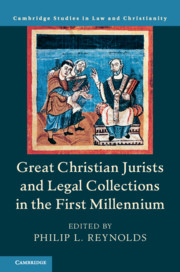
BOOK: Philip L. REYNOLDS, ed., Great Christian Jurists and Legal Collections in the First Millennium [Law and Christianity] (Cambridge: Cambridge University Press, 2019). ISBN 9781108471718, £ 99.99
Philip L. Reynolds is Charles Howard Candler Professor of Medieval Christianity and Aquinas Professor of Historical Theology at Emory University, Atlanta. A senior fellow of Emory's Center for the Study of Law and Religion, Reynolds directed the Center's project on the Pursuit of Happiness (2006–11). Reynolds was a Henry Luce III Fellow in Theology (2013–14) for his work on contemplative and apophatic theology and on the medieval reception of the pseudo-Dionysius. His books include Food and the Body (1999) and How Marriage Became One of the Sacraments (Cambridge, 2016).
1. Normative texts and practices of the first millennium Philip L. Reynolds
2. The many voices of Roman law Jill Harries
3. The law of the post-Roman kingdoms Alexander Callander Murray
4. Ecclesiastical councils Gregory I. Halfond
5. The papacy Clemens Gantner and Stefan Schima
6. The sacred palace, public penance, and the Carolingian polity Mayke de Jong
7. Canonical collections Roy Flechner
8. The practice and literature of penance Rob Meens
9. Monastic rules Albrecht Diem
Part II:
10. Lactantius Elizabeth De Palma Digeser
11. Ambrosiaster David Hunter
12. Augustine Brian Gronewoller
13. Leo I Susan Wessel
14. Gelasius I Bronwen Neil
15. Dionysius Exiguus David Heith-Stade
16. The rule of Benedict Hugh Feiss
17. Gregory the Great Carole Straw
18. Isidore of Seville Luca Loschiavo
19. Pseudo-Isidorus Mercator Clara Harder
20. Jonas of Orléans Francesco Veronese
21. Hincmar of Reims Charles West
22. Regino of Prüm Greta Austin
23. Burchard of Worms Greta Austin
24. New horizons in church law Robert Somerville.