Search

Showing posts with label Palestine. Show all posts

13 November 2025

BOOK: Paula ZICHI, Feminist Governance and International Law. A Critical Legal History from Mandate Palestine [Feminist and Queer International Law, eds. Gina HEATHCOTE & Tamsin Phillipa PAIGE] (London: Routledge, 2025), 266 p. ISBN 9781032568867, € 175


(image source: Routledge)


Abstract:
Documenting the intertwined history of international institutions and transnational feminism through the lens of Mandate Palestine in the inter-war period, this book elicits the historical formation of an early form of feminist governance at the international level. It is commonly accepted that ‘International Women’s Rights’ entered the halls of international institutions with the 1979 passage of the Convention on the Elimination of Discrimination Against Women. But as this book argues, feminist interventions in international law began much earlier. Engaging the history of feminist engagements with the first international institution of modern international law, the League of Nations, this book – based on archival research and drawing upon TWAIL and critical legal feminist approaches – focuses on the Arab-Palestinian feminist movement. Uncovering a peripheral feminist legal agenda, driven by women under colonial rule, the book interrogates feminist legal advances in three different fields: criminal and anti-trafficking laws, family and divorce laws, and human rights and prisoners’ laws. Detailing this early feminist legal activism, the book demonstrates how today’s feminists’ mission, as enshrined in the UN Charter and subsequent conventions, are the by-product of a much longer history of colonial resistance and contestation. This book will be of considerable interest to scholars and researchers in the fields of international law, international history, women’s and feminist history, and feminist legal studies.

Table of contents:

Introduction, Chapter 1: Palestine and Interwar Feminisms – Communities, Associations, Institutions; Chapter 2: Personal Status Laws as Technologies of Global Governance; Chapter 3: Colonial Penality Laws as Technologies of Global Governance; Chapter 4: Policing Women’s Labour as Technologies of Global Governance ; Chapter 5: Palestine in the Global Context: Comparative Perspectives; Chapter 6: Conclusion.

On the author:

Paola Zichi is a feminist legal scholar specializing in gender, history, and international law, with a particular focus on feminist histories and methodologies for legal research. She is currently a British Academy Postdoctoral Fellow at Warwick Law School, working on Feminist Lawyering and International Law in European History (1899–1949). Previously, she worked as an AHRC-funded postdoctoral researcher at the School of History, Queen Mary University of London (QMUL). Zichi completed her doctorate in Gender Studies at SOAS University of London. Her PhD project won the Helen Reece Prize, awarded by the Modern Law Review for the best PhD project in feminist legal studies. Her academic background bridges international law, history, criminology, and family law, with a particular emphasis on the intersections of gender, postcolonial theory, and legal history. Her work has been published in leading journals, and she serves on the editorial board of the Australian Feminist Law Journal. Her forthcoming book, Feminist Governance and International Law: A Critical Legal History from Mandate Palestine, explores the intersections of feminist activism and international institutions in the early twentieth century.

Read more here.


08 December 2020

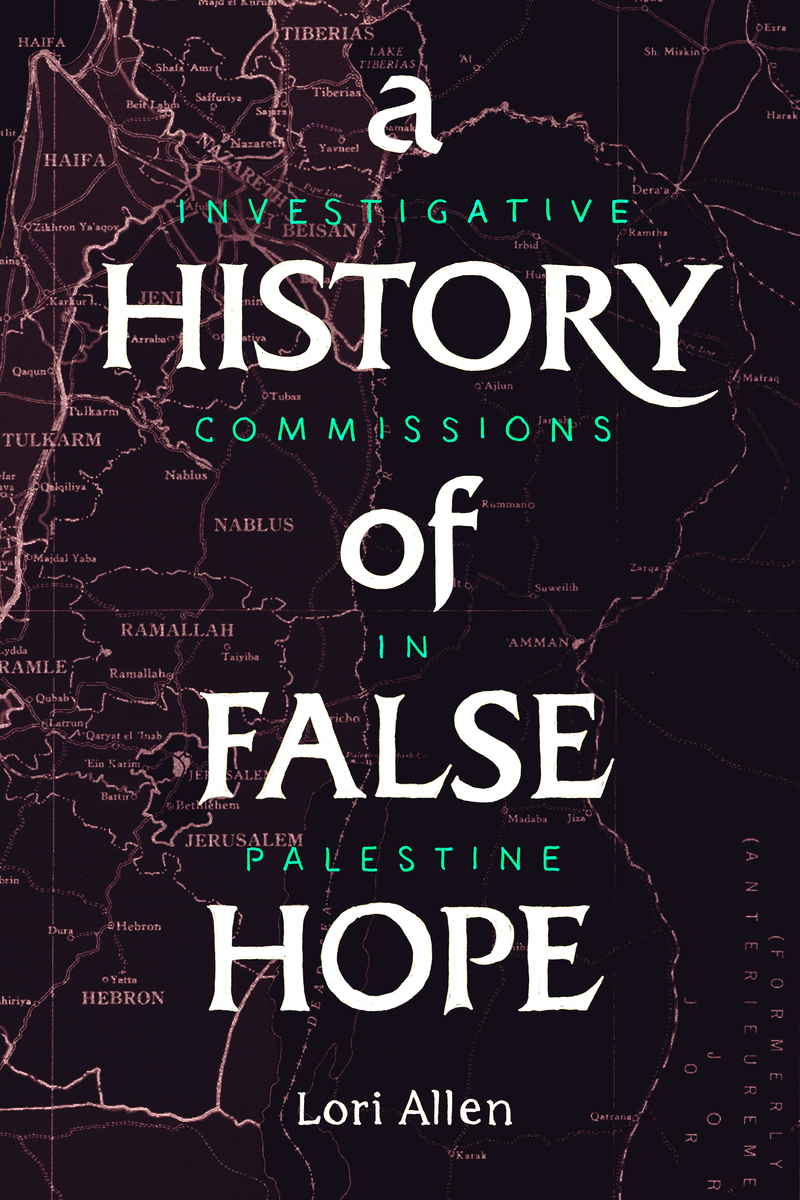
BOOK: Lori ALLEN, A History of False Hope - Investigative Commissions in Palestine (Stanford: Stanford University Press, 2020). ISBN 9781503614185, 30.00 USD.


(Source: SUP)

Stanford University Press is publishing a new book on the history of investigative commissions in Palestine.

ABOUT THE BOOK

This book offers a provocative retelling of Palestinian political history through an examination of the international commissions that have investigated political violence and human rights violations. More than twenty commissions have been convened over the last century, yet no significant change has resulted from these inquiries. The findings of the very first, the 1919 King-Crane Commission, were suppressed. The Mitchell Committee, convened in the heat of the Second Intifada, urged Palestinians to listen more sympathetically to the feelings of their occupiers. And factfinders returning from a shell-shocked Gaza Strip in 2008 registered their horror at the scale of the destruction, but Gazans have continued to live under a crippling blockade.

Drawing on debates in the press, previously unexamined UN reports, historical archives, and ethnographic research, Lori Allen explores six key investigative commissions over the last century. She highlights how Palestinians' persistent demands for independence have been routinely translated into the numb language of reports and resolutions. These commissions, Allen argues, operating as technologies of liberal global governance, yield no justice—only the oppressive status quo. A History of False Hope issues a biting critique of the captivating allure and cold impotence of international law.

ABOUT THE AUTHOR

Lori Allen is Reader in Anthropology at SOAS University of London. She is the author of The Rise and Fall of Human Rights: Cynicism and Politics in Occupied Palestine (Stanford, 2013).

TABLE OF CONTENTS

Introduction: International Law as a Way of Being

1 Petitioning Liberals: The King-Crane Commission

2 Universalizing Liberal Internationalism: The Arab Revolt and the Boycott of the Peel Commission

3 The Humanitarian Politics of Jewish Suffering: The Anglo-American Committee of Inquiry

4 Third World Solidarity at the General Assembly: A UN Special Committee on Human Rights

5 The Silences of Democratic Listening: The Mitchell Committee

6 The Shift to Crime and Punishment: UN Missions Renewing Hope in International Law

Conclusion: Toward an Anthropology of International Law, and Next Time and Again for Palestine


More info here


16 April 2020

BOOK: Steve E. ZIPPERSTEIN, Law and the Arab-Israeli Conflict : The Trials of Palestine (London: Routledge, 2020). ISBN 9780367435073, $35.96


(Source: Routledge)

Routledge is publishing a new book on law and the Arab-Israeli conflict.

ABOUT THE BOOK

During the British Mandate for Palestine (1922–1948), Arabs and Jews repeatedly used the law to gain leverage and influence international opinion, especially in three dramatic and largely forgotten trials involving two issues: the interplay between conflicting British promises to the Arabs and Jews during World War I, and the parties’ rights and claims to the Wailing Wall.

Focusing on how all three parties – Arab, Jewish, and British – used the law and the legal process to advance their objectives during the Mandate years, this volume reveals how the parties availed themselves – with varying degrees of success – of the law and the legal process. The book examines various legal arguments they proffered, and how that early tendency to resort to the law as a tool, a resource, and a weapon in the conflict has continued to this day. The research relies almost entirely on primary source documents, including transcripts of the public and secret testimony before the Shaw, Lofgren, and Peel Commissions, diaries, letters, government files, and other original sources.
This study explores the origins of many of the fundamental legal arguments in the Arab–Israeli conflict that prevail to this day. Filling a gap in research, this is a key text for scholars and students interested in the Arab–Israeli conflict, Lawfare, and the Middle East.

ABOUT THE AUTHOR

Steven E. Zipperstein, a former U.S. federal prosecutor, is a Senior Fellow at the Center for Middle East Development at UCLA. He also teaches in UCLA’s Global Studies program and School of Public Affairs, and as a Visiting Professor at Tel Aviv University Law School.

TABLE OF CONTENTS

Introduction  1. McMahon-Hussein, Balfour, and the Legality of the Jewish National Home  2. The Wailing Wall – Conflicting Legal Claims  3. The Shaw Commission  4. The Lofgren Commission  5. The Peel Commission  6. The Early Legal Battles and Their Relevance Today  Conclusion
More info here

02 November 2018

BOOK : Orna Alyagon DARR, Plausible Crime Stories : The Legal History of Sexual Offences in Mandate Palestine (Cambridge: Cambridge University Press, 2018). ISBN 9781108497237, £ 80.00


(Source : CUP)

Cambridge University Press is publishing a new book on the legal history of sexual offenses in Mandate Palestine next month.

ABOUT THE BOOK

Plausible Crime Stories is not only the first in-depth study of the history of sex offences in Mandate Palestine but it also pioneers an approach to the historical study of criminal law and proof that focuses on plausibility. Doctrinal rules of evidence only partially explain which crime stories make sense while others fail to convince. Since plausibility is predicated on commonly held systems of belief, it not only provides a key to the meanings individual social players ascribe to the law but also yields insight into communal perceptions of the legal system, self-identity, the essence of normality and deviance and notions of gender, morality, nationality, ethnicity, age, religion and other cultural institutions. Using archival materials, including documents relating to 147 criminal court cases, this socio-legal study of plausibility opens a window onto a broad societal view of past beliefs, dispositions, mentalities, tensions, emotions, boundaries and hierarchies.

ABOUT THE AUTHOR

Orna Alyagon Darr, Sapir Academic College, Israel and Ono Academic College, Israel
Orna Alyagon Darr is a Senior Lecturer at the law schools of Sapir Academic College and Ono Academic College. She is the author of Marks of an Absolute Witch: Evidentiary Dilemmas in Early Modern England (2011). Her work explores evidence law, criminal law and criminal procedure in their cultural, social and historical context, and her articles have been published in leading academic journals such as Law and History Review, Law and Social Inquiry, Continuity and Change and Yale Journal of Law and the Humanities.

TABLE OF CONTENTS

Acknowledgements
Introduction
1. Legal background
2. Cultural narratives underlying proof: male-to-male offences
3. Plausibility of children's testimonies: narrator's identity
4. Plausibility and ethnicity: audience-narrator nexus
5. Plausible emotions
6. Corroboration: plausibility embedded in evidentiary standards
7. Implausible counter-narratives
Conclusion
List of legal cases
Appendix: relevant criminal legislation
Bibliography
Index.

More information here