Search

Showing posts with label Ecclesiastical History. Show all posts

20 December 2023

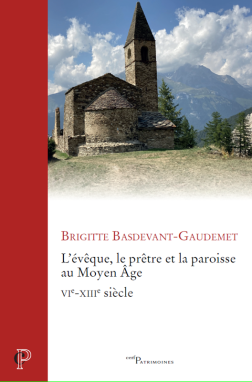
BOOK: Brigitte BASDEVANT-GAUDEMET, L’évêque, le prêtre et la paroisse au Moyen Âge, VIe-XIIIe siècle (Paris: éd. Cerf Patrimoine, 2023), 240 p. ISBN 9782204162081, € 29


Abstract:
Le cléricalisme fait aujourd’hui débat et soulève de multiples questions. Comment penser la discipline cléricale et le rapport entre le prêtre et les ? dèles au sein de la paroisse, ou la relation de l’évêque avec le clergé de son diocèse ? Le clerc, le prêtre, la hiérarchie cléricale doivent-ils être mis à part de l’ensemble de la société ? Si elle ne répond pas aux questions du XXIe siècle, l’histoire fournit des clés susceptibles d’éclairer ces débats brûlants d’actualité. Que savons-nous de la vie religieuse des villageois qui, sous la conduite d’un prêtre, se rassemblaient dans les églises dont les clochers, ruraux ou urbains, continuent d’égailler nos paysages ? Dans la société chrétienne de l’Occident médiéval, au ? l du temps, l’image du prêtre de paroisse se dessine, dans une Église toujours soucieuse tant de garantir sa liberté que de se réformer. Constituant le premier ordre de la nation, elle mène une lutte acharnée contre les intrusions exagérées des laïcs. Il convient de protéger le prêtre contre toute entreprise laïque abusive et d’assurer son indépendance à l’égard des pouvoirs temporels, tout en le plaçant, vis-à-vis de l’évêque, dans une relation d’obéissance ? liale qui n’est pas servitude. Une stricte discipline de vie s’impose à lui ; elle vise à renforcer le prestige nécessaire à l’exercice de sa mission supérieure, celle de conduire chacun au salut. L’ouvrage retrace ce lent cheminement de réformes, constamment remises sur le métier, même lorsque les efforts des décennies précédentes semblent avoir porté leurs fruits.

On the author:

Brigitte Basdevant-Gaudemet est professeur émérite de l’Université Paris-Saclay. Spécialiste d’histoire du droit canonique, elle a fondé le centre Droit et Sociétés religieuses, qu’elle a dirigé de nombreuses années. Parmi ses ouvrages, citons : Église et Autorités, Études d’histoire du droit canonique médiéval (Limoges, PULIM, 2006), Histoire du droit canonique et des institutions de l’Église latine, XVe-XXe siècle (Paris, éd. Économica, 2014).
Read more here.

04 June 2019

BOOK: R. H. HELMHOLZ, The Profession of Ecclesiastical Lawyers : An Historical Introduction [Law and Christianity] (Cambridge: Cambridge University Press, 2019). ISBN 9781108499064, £85.00


(Source: CUP)

Cambridge University Press has published a new book on ecclesiastical lawyers in English courts.

ABOUT THE BOOK

Historians of the English legal profession have written comparatively little about the lawyers who served in the courts of the Church. This volume fills a gap; it investigates the law by which they were governed and discusses their careers in legal practice. Using sources drawn from the Roman and canon laws and also from manuscripts found in local archives, R. H. Helmholz brings together previously published work and new evidence about the professional careers of these men. His book covers the careers of many lesser known ecclesiastical lawyers, dealing with their education in law, their reaction to the coming of the Reformation, and their relationship with English common lawyers on the eve of the Civil War. Making connections with the European ius commune, this volume will be of special interest to English and Continental legal historians, as well as to students of the relationship between law and religion.

  • Provides detailed accounts of the careers and learning of individual lawyers
  • Presents a different (and more optimistic) account of the collective work of the English civilians
  • Discusses connections with Roman and canon law
ABOUT THE AUTHOR

R. H. Helmholz, University of Chicago
R. H. Helmholz is Ruth Wyatt Rosenson Distinguished Service Professor of Law at the University of Chicago Law School. He is the author of Marriage Litigation in Medieval England (Cambridge, 1975), Roman Canon Law in Reformation England (Cambridge, 1990) and The Oxford History of the Laws of England: The Canon Law and Ecclesiastical Jurisdiction from 597 to the 1640s (2004).

TABLE OF CONTENTS

Part I. The Profession Described: Introduction
1. Law of the legal profession: advocates and proctors
2. The education of ecclesiastical lawyers
3. Ecclesiastical lawyers and the Protestant Reformation
4. English ecclesiastical lawyers and the courts before the coming of the Civil War
Part II. The Profession Illustrated:
5. Roger of Worcester (d. 1179)
6. Gilbert Foliot (d. 1187)
7. William of Drogheda (d. 1245)
8. John de Burgh (d. 1398)
9. Adam Usk (d. 1430)
10. Richard Rudhale (d. 1476)
11. Daniel Dun (d. 1617)
12. Clement Colmore (d. 1619)
13. Arthur Duck (d. 1648)
14. William Somner (d. 1669)
15. Richard Zouche (d. 1661)
16. Leoline Jenkins (d. 1685)
17. Hugh Davis (d. 1694)
18. George Lee (d. 1758)
19. Thomas Bever (d. 1791)
20. Francis Dickins (d. 1755)
21. Arthur Browne (d. 1805)
22. Henry Charles Coote (d. 1865)

More information here

31 October 2018

JOURNAL: Vergentis VI (2018)

(image source: Catedra Innocencio III)

Vergentis is a scientific initiative of the International Chair Innocent III of the Catholic University of Murcia and of the Institutum Utriusque Iuris of the Pontifical Lateran University for the research in History of Law, ius commune and Canon law.
The Journal, in its six-monthly editions, comes both in paper and digital format (the digital version is freely accessible, with no restriction, in open access modality) and it collects scientific articles that are submitted to two specialists in the subject, following the process of the double-blind peer review.
In addition to this, Vergentis is in charge of the paper and digital publication of the proceedings of the International Conference that the International Chair Innocent III holds every year in the Catholic University of Murcia, in the presence of the great personalities of the academic world; the Conference represents an opportunity to make a reflection and a debate regarding the History of Law, Canon Law and the related subjects, without forgetting the dialogue with the Positive Jurist and always considering the signs of times.
The international standing of the Journal, acknowledged as a forum of reflection, novelty and interdisciplinary university research, is regarded favourably and it is supported by more than 200 Historians of Law, Jurists and Canonists of the World, who compose the Scientific council of Referee and the Editorial Board.
Vergentis is regularly published in the catalogues of hundreds of libraries of the world and in the main databases of scientific journals such as Erih Plus - of the European Science Foundation-, DOAJ, WorldCat, OpenAire, Dialnet, MIAR and many others.

The most recent issue, focusing on 'The judicial process', is available now.


13 September 2018

BOOK: Neil Sydney PATTERSON, Ecclesiastical Law, Clergy and Laity : A History of Legal Discipline and the Anglican Church (London: Routledge, 2018). ISBN 9780815352648, £92.00


(Source: Routledge)

Routledge has published a new book on the history of legal discipline in the Anglican Church.

ABOUT THE BOOK

Discipline in an ecclesiastical context can be defined as the power of a church to maintain order among its members on issues of morals or doctrine. This book presents a scholarly engagement with the way in which legal discipline has evolved within the Church of England since 1688. It explores how the Church of England, unusual among Christian churches, has come to be without means of effective legal discipline in matters of controversy, whether liturgical, doctrinal, or moral. The author excludes matters of blatant scandal to focus on issues where discipline has been attempted in controversial matters, focussing on particular cases. The book makes connections between law, the state of the Church, and the underlying theology of justice and freedom. At a time when doctrinal controversy is widespread across all Christian traditions, it is argued that the Church of England has an inheritance here in need of cherishing, and sharing with the universal Church.

ABOUT THE AUTHOR

Revd Neil Patterson (MA BD) is Director of Vocations and Ordinands (Hereford) and a Member of the General Synod and the Ecclesiastical Law Society. He has published on ecclesiastical issues in books and periodicals.

TABLE OF CONTENTS

Introduction
Chapter 1: Toleration and its Effects
Chapter 2: The Old Discipline Lingers
Chapter 3: A Century of Doctrine Trials 1775-1871
Chapter 4: Law Defied – the Ritualists
Chapter 5: The Yearning to Fence the Altar
Chapter 6: Reluctance to Discipline
Chapter 7: The Lingering Temptation
Conclusion

More information here

28 May 2015

CONFERENCE & CFP: "Novos campos de pesquisa da historia das instituicoes eclesiasticas e suas normatividades no Brasil (XVI-XIX centuries)" ( Sao Paulo, November 10-12 2015)


WHAT Novos campos de pesquisa da historia das instituicoes eclesiasticas e suas normatividades no Brasil (XVI-XIX centuries), Conference and Call for papers

WHEN November 10-12 2015

WHERE Sao Paulo

O Instituto Max-Planck de História do Direito Europeu, com sede em Frankfurt, Alemanha, vem desenvolvendo uma nova linha de pesquisa sobre a história das instituições eclesiásticas, as suas normatividades e as suas formas de administração da justiça durante os séculos XVIXIX na América Latina. Dentro desse marco, o Instituto convoca todos os interessados ao Seminário “Novos campos de pesquisa da história das instituições eclesiásticas e suas normatividades no Brasil (séculos XVI-XIX)”, que acontecerá entre os dias 10 e 12 de novembro de 2015, na Sala de Conferências do Instituto Goethe, em São Paulo. Esta atividade está inserida dentro de um ciclo de seminários de trabalho realizados nos anos anteriores, em Ciudad de México, Lima e Bogotá, que versaram sobre a mesma temática, em relação aos vice-reinados da Nova Espanha, do Peru e do Novo Reino de Granada, respectivamente. Os programas e informações sobre os seminários anteriores podem ser acessados no endereço: http://www.rg.mpg.de/seminario_normatividades. O principal objetivo do Seminário é oferecer aos participantes um local de trabalho, encontro e debates de alto nível acadêmico sobre as novas perspectivas nesse campo de pesquisa, para as diversas regiões que compunham o Brasil colonial e imperial. Procura-se, dessa forma, facilitar os contatos pessoais e institucionais na comunidade acadêmica e favorecer a colaboração científica entre os participantes. A convocação está aberta a todos os jovens pesquisadores que estejam desenvolvendo suas pesquisas nessa temática, desde as mais variadas perspectivas disciplinares, como a história do direito, a história, a etnohistória, a teologia, as ciências da religião, a história da arte, a história cultural, etc. Serão consideradas particularmente interessantes as pesquisas que desenvolvam uma visão ampla e bem documentada do objeto de estudo e que exponham as ricas e complexas relações entre as diferentes áreas geográficas, culturais, escolas jurídicas e tradições historiográficas.

 Como em eventos anteriores, depois da revisão de especialistas externos, o MPIeR prevê a publicação dos trabalhos apresentados no Seminário de São Paulo em uma de suas séries de publicação. 2 Convocação Poderão participar jovens doutores, doutorandos ou mestrandos, cujas pesquisas estejam em avançado estágio de elaboração e cujo tema tenha estreita relação com a temática do Seminário. A inscrição deverá ser encaminhada até o dia 15 de Julho de 2015 a Otto Danwerth: danwerth@rg.mpg.de. Cada inscrição deverá estar acompanhada dos seguintes documentos (em formato Word): − Formulário de inscrição preenchido, que pode ser obtido na página: http://www.rg.mpg.de/4_novos_campos_de_pesquisa − Breve descrição do trabalho de pesquisa que será apresentado no Seminário (máx. 1.500 caracteres, sem contar espaços) − Curriculum Vitae atualizado (máx. 3 páginas), com uma lista das publicações, se for o caso. Um Comitê Científico avaliará as propostas e as selecionará por seu mérito acadêmico. A decisão do Comitê será comunicada aos selecionados até o dia 30 de Julho de 2015. O Instituto Max-Planck arcará com os gastos de viagem e estadia, para os selecionados que necessitarem. Os participantes serão reembolsados das despesas com transporte e estadia ao final do Seminário. Os idiomas do seminário serão português, espanhol e inglês. A documentação e os trabalhos poderão ser apresentados em qualquer uma dessas línguas. O Seminário acontecerá na Sala de Conferências do Instituto Goethe de São Paulo. Contato Otto Danwerth Max-Planck-Institut für europäische Rechtsgeschichte Hansaallee 41 D-60323 Frankfurt am Main Alemanha Tel.: +49-69-78978-167 Fax.: +49-69-78978-169 E-mail: danwerth@rg.mpg.de www.rg.mpg.de Sites: http://www.rg.mpg.de/seminario_normatividades http://www.rg.mpg.de/4_novos_campos_de_pesquisa http://www.facebook.com/seminariompibrasil

30 March 2015

PHD/POSTDOC POSITION: "Discourses of Weakness and Resource Regimes" (July 1, 2015)


WHAT: Discourses of Weakness and Resource Regimes, PHD/POST DOC POSITION in the field of late medieval /early modern history, legal history, or ecclesiastical history

WHEN: starting July 1, 2015 (3-year contracts)

WHERE: MPI, Max-Planck Institut fur europaische Rechtsgeschichte

The Max-Planck-Institute for European Legal History and the Goethe University Frankfurt am Main are partner institutions of the Collaborative Research Centre 1095 ‘Discourses of Weakness and Resource Regimes’. In this framework, the Max-Planck-Institute for European Legal History offers
Two PhD / Post-doctoral Positions in the field of late medieval / early modern history, legal history or ecclesiastical history (starting July 1, 2015, or later; 3-year contracts)

Research project

A Collaborative Research Centre / CRC (‘Sonderforschungsbereich’ / ‘SFB’ in German) is an institution established at German universities for a period of up to twelve years that enables researchers to pursue an outstanding research programme, crossing the boundaries of disciplines, institutes and faculties. Financed by the Deutsche Forschungsgemeinschaft (DFG), it facilitates scientifically ambitious, complex, long-term research by concentrating and coordinating the resources available at a university.
The CRC 1095 ‘Discourses of Weakness and Resource Regimes’ at the Goethe University, Frankfurt am Main, employs a transepochal and comparative approach in order to deal with the question of how discourses of weakness had an impact on the use of resources. These discourses can be observed in the history of all cultures at all times. Changes in the use of both material and immaterial resources constitute a special and important aspect of processes of historical transformation which will be addressed by historians, historians of science, anthropologists, philosophers, sinologists and legal historians within the framework of the new CRC 1095.
CRC sub-project C 01 ‘Knowledge of the pragmatici. Presence and significance of pragmatic normative literature in Ibero-America in the late 16th and early 17th century’, led by Prof. Dr. Thomas Duve, reflects upon the significance of normative texts which addressed themselves primarily to practitioners – especially those who would nowadays be seen as part of moral theology or confessional literature. The respective texts were ‘weak’ insofar as they lacked theoretical complexity compared to erudite treatises; they were ‘strong’, however, in terms of pragmatic usefulness because they offered the reader adaptable bases of normative knowledge. There are some indications that these resources helped to establish, even minimally, conceptions of normative order in early modern empires such as the Spanish one. It is the objective of the sub-project to bring to light not only the practical significance but also the intellectual weight of a literary genre which has received little attention for a long time. Characteristic of this genre are condensation processes which might constitute a considerable achievement in abstraction.