Search

Showing posts with label Common law tradition. Show all posts

30 October 2026

BOOK REVIEW: Giulio ABBATE, Legal education in the western world: a cultural and comparative history, by Rogelio PÉREZ-PERDOMO (Stanford: Stanford University Press, 2024) (Comparative Legal History, XIV (2026), nr. 1 (June), pp. 174-180)

(image source: Taylor&Francis)

Rogelio Pérez-Perdomo's work provides a comparative and historical account of legal education in the Western world, from ancient Rome to the present day. Following the traditional division of comparative law, it addresses both the civil and common law traditions, focusing on changes in legal education over the centuries and the interrelations between the two traditions in contemporary times. 

Adopting a longue durée perspective, the book presents itself as an 'introduction to a cultural and comparative history of the law' (1), and it achieves its purpose. Alongside the historical analysis of legal education through its main features, the book examines the interactions between legal education and its social and intellectual context, also focusing on 'the social role of the most important legal actors' (1) - legal professionals. 

This work demonstrates that legal education is, and has always been, inseparable from the ideas and concepts of law, its historical development and its social function. Law possesses a constitutive social force.' It has been a factor in the ordering and disciplining of society. Legal education, in turn, 'is linked to the law as a way of ordering society and to the conceptualisation of the law itself' (1), playing a significant social role. 

Pérez-Perdomo's work goes further, aiming to clarify the role of legal education in organising law and maintaining legal tradition. This methodological approach defines the first chapter of the book, which addresses the civil law tradition. The chapter's primary aim is to demonstrate the relationship between legal education and the conception of law, from classical Rome to Justinian. It outlines the gradual development of the legal field and the organisation of methods for legal knowledge and its transmission. These points are discussed particularly with reference to the opinions of the jurisconsults, which structured legal knowledge and contributed to the transformation of the legal field in response to the changing needs of Roman society. Legal education, in turn, reflected the prevailing concept of law. And 'once the law was consolidated as an intellectual discipline' (11), legal education subsequently assumed a more formal character. 

The work then examines the changes that occurred under Justinian's rule. The promulgation of the Corpus Iuris Civilis significantly altered the concept of law, which became identified exclusively with the written document sanctioned by political authority. As a result, the author argues, law became detached from […]


To read the full review, please click here. Online access is free for members of the European Society for Comparative Legal History.


DOI: https://www.tandfonline.com/doi/full/10.1080/2049677X.2026.2671641

23 September 2024

BOOK: Michael WIDENER & Ryan Greenwood, Histories of Legal Literature. A Hundred Years of English-Language (Clark, New Jersey: Talbot Publishing, 2024). ISBN-13: 9781616196912, pp. 202, $49.95


ABOUT THE BOOK

The history of the law is known above all through its literature, an extraordinarily diverse body of texts in an equally diverse variety of formats. Histories of Legal Literature maps the past hundred years of English-language scholarship with a bibliography of 998 publications on the origins, authorship, dissemination, design, readership, and preservation of the works that shaped the law books of today, including the vast legal literatures from outside the Anglo-American world. With the help of a detailed subject index and statistical analysis, Widener and Greenwood reveal the strengths and gaps in this body of scholarship and point to opportunities for new contributions. Histories of Legal Literature will be a useful reference for legal historians, book historians, librarians, and those working in allied fields.

ABOUT THE AUTHORS

Michael Widener was Rare Book Librarian at the Yale Law School Library until his retirement in 2021. He teaches a course on law books for the University of Virginia's Rare Book School. He is co-author (with Mark S. Weiner) of Law's Picture Books: The Yale Law Library Collection (Talbot Publishing, 2017), which won the 2018 Joseph L. Andrews Legal Literature Award from the American Association of Law Libraries. 

Ryan Greenwood is Curator of Rare Books and Special Collections at the University of Minnesota Law Library, and has served as Widener's co-instructor at Rare Book School. He is co-author (with Patrick Graybill) of Jewels of the Collection: Treasures of the Riesenfeld Rare Books Research Center, which won the 2024 Joseph L. Andrews Legal Literature Award from the American Association of Law Libraries.


About the book.

15 February 2022

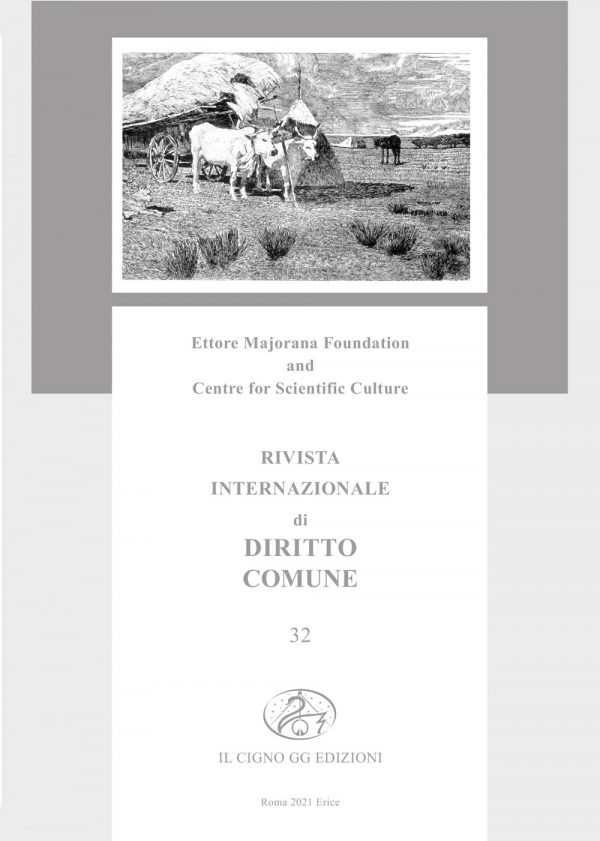
JOURNAL: Rivista internazionale di diritto comune (volume XXXII, 2021)

(Image source: Sikeedizioni)


The last issue of the Rivista Internazionale di Diritto Comune had been published. More information can be found on the website of the publisher.


***

 INDEX OF THE ISSUE

SAGGI

Glosses and the Juridical Genre “Apparatus glossarum" in the Middle Ages by Gero Dolezalek

The centre and the margins of the jungle of glossed manuscripts by Emanuele Conte

What Emil Secker has called “the jungle of glossed manuscripts” is a very heterogeneous set of sources. There are sets of glosses written to accompany stabilised texts of the ius commune, with the primary purpose of facilitating a coniunctio, the linking of norms located in different parts of the corpora of civil and canon law. There are also apparatuses drawn up to accompany the texts of the ius proprium, the main purpose of which is to outline the areas of application of the norms, the textual form of which is less stabilised than that of the Roman and canonical texts adopted for school teaching. The case of the glosses to Frederick II’s Liber Augustalis illustrates these differences in practice. Scholarly access to the sources of this exegesis in the form of glosses has been difficult because of the difficulty of preparing critical editions. Now the wide availability of digital images of manuscripts could open an easier way to consultation

Tra fonti letterarie e fonti giuridiche: una nuova biografia di Benincasa d’Arezzo iuris professor by Maura Mordini

This essay focuses on Benincasa d’Arezzo, a jurist mentioned by Dante in the Purgatorio at the beginning of Canto VI, who is otherwise known as Benincasa da Laterina by the scholars of Dante’s Commedia. Through the examination of some archival and juridical sources, and of some commentaries on Purgatorio, we reconstructed some links with the Laterina castle (Arezzo), wich was the place of origin of the jurist’s father. Benincasa has first been a student and then a colleague of Francesco d’Accursio, and he has teached in Arezzo and in Bologna. Later, between 1282 and 1286, Benincasa has carried out the role of judex assessor of the podestà in Siena and in Bologna, playing also significantly a technical and political role in the context of the ultra-regional Guelph alliance, and in view of the personal relationships with two members of the Guidi family, conti palatini in Tuscia. The death of Benincasa (post 1286 - ante 1292) is described by the various commentators of the Commedia. In particular, Anonimo Lombardo and Alberico da Rosciate add some interesting details to the story: the jurist has been murdered by Ghino di Tacco during a court hearing, probably in Perugia. In addition to the quæstio oxoniense and to the consilium regarding the Monterotondo castle, already known, around sixty Benincasa’s additiones on Digestum Vetus have been found in the manuscript 285, held by Collegio di Spagna in Bologna. The Tractatus de guarentigiato instrumento, attributed to Guido da Suzzara, contains a quæstio disputata about the topic of eviction, wich took place in Bologna between Benincasa d’Arezzo and Francesco d’Accursio. 

Legiferare giudicare consigliare interpretare. Giuristi legislazione imperiale diritto comune by Christian Zendri

The essay studies the formation of Henry VII’s ‘Pisan legislation’ (1313), the role of legal science in the construction and success of the text, and attempts to offer an interpretation, correcting the lection and explaining its genesis. 

Defensio est concessa et vindicta prohibita. Itinerari di storia della difesa legittima by Rosalba Sorice

The self-defense principle is built by medieval jurists on the reinterpretation of the rules of Roman law that admit the use of violence to defend oneself. The admissibility and excusability of the murder in defense criticized according to the principle of guilt which defines the criminal dimension of earthly liability. 

L’accusa di eresia ai papi negli anni del Grande Scisma (1378-1418) by Andrea Padovani

The blame of heresy, mutually launched by the followers of the ‘roman’ and ‘avignonese’ popes at the beginning of the Great Schism was, in a first stage, a mere pretext for further polemical issues. Only from the first years of the XVth century the accusation assumed a precise legal configuration based on the equivalence of heresy and prolonged schism: a good reason, indeed, for lawyers and cardinals invoking a general council to cut off the schism, after the failure of other means proposed for some time. The deposition of Gregory XII and Benedict XIII, for heresy, in the pisan assembly (1409) did not resolve the old controversy. Moreover, some followers of the two popes moved many doubts about the legitimacy of the sentence that condemned their respective leaders. The council of Constance (1418), once obtained the voluntary resignation to the papacy by John XXIII and Gregory XII, finally convicted the only Benedict XIII of heresy due to obstinate and culpable prolongation of the schism. 

Pietro d’Ancarano on Citizenship and Intestate Succession in Ferrara by Julius Kirshner

My study provides an analysis and edition of an autograph consilium of the Bolognese canonist Pietro d’Ancarano, which is preserved in the Biblioteca Classense of Ravenna. Written in 1401, the consilium was aimed at resolving a dispute over the claims to the intestate inheritance of a certain Lamberto of Florence, who at the time of his death during the plague of 1399-1400 was residing in Ferrara. Pietro’s consilium serves as a valuable historical witness, drawing attention to an under-explored corner of late fourteenth- and early fifteenth-century Ferrara, and highlighting the canonist’s role in civil law disputes. Above all, it underscores how the ius commune’s far-reaching protection of women’s rights and privileges empowered daughters to lay claim in a public forum to paternal property from which they were disqualified by discriminatory statutes dedicated to the perpetuation of patrilineal succession

“Perfectio spiritualis non in paupertate, sed in caritate consistit”. John of Capestrano and His Unpublished Tractatus de religione by Andrea Bartocci

Probably during the pontificate of Eugenius IV (1431-1447) John of Capestrano compiled his unpublished Tractatus de religione, where he compared the status of the religious orders on the spiritual and legal level; in this paper four manuscript copies of his Tractatus are identified

Consilii non fraudulenti nulla obligatio. Lawyers’ Liability and Legal Ethics in Lessius’s De iustitia et iure by Wim Decock

This contribution highlights the development of an ethics for lawyers in the work of Leonardus Lessius (1554-1623), a theologian-jurist from the Southern Netherlands. Drawing on the ius commune and scholastic predecessors, Lessius foremostly addressed the question whether lawyers were responsible for giving harmful advice. He reinforced the ius commune principle that “no obligation arises from an advice that is not fraudulent” (consilii non fraudulenti nulla obligatio). Lessius also emphasized the lawyer’s task as first judge, which implied an increase in his liability for accepting dubious and unjust cases. Advising a client to take legal action in an unjust case was not tolerated, as was the unnecessary prolonging of procedures. Lessius also insisted on lawyers’ duty to be well-trained and educated. In light of the professionalisation of the lawyer’s profession in the early modern period, it is probably not surprising that he put heavy weight on the adage, based on the ius commune, that “incompetence is tantamount to fault” (imperitia culpae adnumeratur). The paper ends by giving a taste of how Lessius’s doctrine of legal ethics was handed down to other jurists and theologians, from the seventeenth century Netherlands to eighteenth century Italy. 


NOTE E DOCUMENTI

Il matrimonio di Dante: un matrimonio tra impuberes? by Giuseppe Indizio

Dante’s marriage has recently been debated by scholars since it is considered insofar a marriage between impuberes. Accordingly, the few surviving sources are considered unreliable, on the assumption that such marriages were unlikely, if not impossible in Dante's time and, in particular, for his social class. A new look-through of the sources, in the light of canon law and of the practices then in force, leads us to different conclusions, questioning the very idea of a marriage between impuberes. 

Il rovesciamento della metafora del sole e della luna: Agostino, Giovanni di Parigi e Dante by Claudia di Fonzo

The contribution traces the history of the metaphor of the sun and the moon in the context of canon law starting from Dante's Monarchy and identifies in Giovanni di Parigi and Cino da Pistoia two interlocutors necessary to understand the image of the two suns that Alighieri proposes in Divine Comedy


RICORDI

Ricordi… non è mai troppo tardi, nr. 10: Frammenti di storia della storiografia in tema di sistema di ius commune by Manlio Bellomo

The essay presents a profile of the history of twentieth-century historiography on the system of ius commune. Starting from the third decade of the century, some innovative proposals have focused attention on the ius commune as a “spiritual fact” and on the link between the ius commune and the iura propria in the centuries following the year 1000. In the last decades of the twentieth-century a renewed historiographic approach was dedicated to recovering the distinction between ius commune and the system of ius commune. 

Ricordi… non è mai troppo tardi, nr. 11: Ius civile, ius canonicum, società medievale by Manlio Bellomo

The essay discusses the methodological problem of whether it is appropriate to search for the “influences” of the ius civile on the ius canonicum and vice versa, or whether we should rather speak of a reciprocal interaction among the different components of a unitary system. 

Ricordi… non è mai troppo tardi, nr. 12: I glossatori: fra i protagonisti del proto-capitalismo? by Manlio Bellomo

The title poses a provocative question and focuses on the reaction of the feudal classes to the spread of a system of ius commune and ius proprium that was incompatible with the old traditions of feudal society.

Ricordi… non è mai troppo tardi, nr. 13: Probleme der juristischen Geschichtsschreibung: ius commune und ius proprium im Europa des Mittelalters by Manlio Bellomo

The text returns to the theme of the relations between ius commune and ius proprium in the interpretations of twentieth-century historiography. 


A PROPOSITO DI

Historical research on Canon Law. With regard to the series Der Einfluss der Kanonistik by Silvia di Paolo and Paola Maffei

Reflections emerging from the series Der Einfluss der Kanonistik are examined, about the key role of canon law in the development of European (and non-European) legal culture; and about some among the possible paths of research offered by the works collected in the series and more generally by the canonical history. 


ORIENTAMENTI BIBLIOGRAFICI

  • Bibliografia


02 August 2021

BOOK: Amanda L. TYLER, Habeas Corpus: A Very Short Introduction (Oxford: University Press). ISBN: 9780190918989, pp. 184, $11.95


(Source: OUP)

ABOUT THE BOOK

The concept of habeas corpus--literally, to receive and hold the body--empowers courts to protect the right of prisoners to know the basis on which they are being held by the government and grant prisoners their freedom when they are held unlawfully. It is no wonder that habeas corpus has long been considered essential to freedom. For nearly eight hundred years, the writ of habeas corpus has limited the executive in the Anglo-American legal tradition from imprisoning citizens and subjects with impunity. Writing in the eighteenth century, the widely influential English jurist and commentator William Blackstone declared the writ a "bulwark" of personal liberty. Across the Atlantic, in the leadup to the American Revolution, the Continental Congress declared that the habeas privilege and the right to trial by jury were among the most important rights in a free society.

This Very Short Introduction chronicles the storied writ of habeas corpus and how its common law and statutory origins spread from England throughout the British Empire and beyond, witnessing its use today around the world in nations as varied as Canada, Israel, India, and South Korea. Beginning with the English origins of the writ, the book traces its historical development both as a part of the common law and as a parliamentary creation born out of the English Habeas Corpus Act of 1679, a statute that so dramatically limited the executive's power to detain that Blackstone called it no less than a "second Magna Carta." The book then takes the story forward to explore how the writ has functioned in the centuries since, including its controversial suspension by President Abraham Lincoln during the Civil War. It also analyzes the major role habeas corpus has played in such issues as the World War II incarceration of Japanese Americans and the US Supreme Court's recognition during the War on Terror of the concept of a "citizen enemy combatant." Looking ahead the story told in these pages reveals the immense challenges that the habeas privilege faces today and suggests that in confronting them, we would do well to remember how the habeas privilege brought even the king of England to his knees before the law.

ABOUT THE AUTHOR

Amanda L. Tyler is the Shannon Cecil Turner Professor of Law at the University of California, Berkeley School of Law, where she teaches and writes about the federal courts, the Supreme Court, constitutional law, legal history, and procedure. Tyler is the author of Habeas Corpus in Wartime: From the Tower of London to Guantanamo Bay. She is also a co-author, with Justice Ruth Bader Ginsburg, of Justice, Justice Thou Shalt Pursue: A Life's Work Fighting for a More Perfect Union. In addition, Tyler has served since 2016 as a co-editor of Hart and Wechsler's The Federal Courts and the Federal System, and she was a contributing author to Federal Court Stories and the Cambridge Companion to the United States Constitution. Tyler is a graduate of Stanford University and Harvard Law School and a former law clerk to the Honorable Guido Calabresi at the United States Court of Appeals for the Second Circuit and the Honorable Ruth Bader Ginsburg at the Supreme Court of the United States.

TABLE OF CONTENTS

Lists of Illustrations

Acknowledgments

Introduction

1: The English origins

2: The limits and potential of habeas corpus

3: Revolution

4: Habeas corpus comes to America

5: Habeas corpus in the early United States

6: Civil war and suspension

7: Reconstruction and expansion of the writ

8: World War II and the demise of the great writ

9: Habeas corpus today

Conclusion

References

Further Reading

Index


More information with the publisher.

07 December 2020

BOOK: Hamilton BRYSON, Some English Law Reporters of Seventeenth Century Cases (Independently published, 2020). ISBN 979-855488-030-8, pp. 278, $7.18

(Source: Amazon.co.uk)

ABOUT THE BOOK

This book is a bibliography of English law reporters who reported cases from the seventeenth century. It gives detailed information about the manuscripts and printed law books.

ABOUT THE AUTHOR

Professor Hamilton Bryson teaches and writes in the areas of English legal history, Virginia legal history, and Virginia procedure and practice. He has published numerous books and book chapters on these subjects, and is the founding editor of the Virginia Circuit Court Opinions. He has also edited and published several collections of early modern English law reports. Professor Bryson is a fellow of the Royal Historical Society, a member of the Executive Committee of the John Marshall American Inn of Court, and the Virginia Correspondent of the Selden Society. He serves on the Advisory Committee on rules of Court of the Supreme Court of Virginia.


More information here.

BOOK: Caroline LASKE, Law, Language and Change. A Diachronic Semantic Analysis of Consideration in the Common Law (Leiden: Brill, 2020). ISBN: 978-90-04-42848-5, € 116.00

(Source: Brill)

ABOUT THE BOOK

Series: Legal History Library, Volume: 42

In this monograph, Caroline Laske traces the advent of consideration in English contract law, by analysing the doctrinal development, in parallel with the corresponding terminological evolution and semantic shifts between the fourteenth and nineteenth centuries. It is an innovative, interdisciplinary study, showcasing the value of taking a diachronic corpus linguistics-based approach to the study of legal change and legal development, and the semantic shifts in the corresponding terminology. The seminal application in the legal field of these analytical methodologies borrowed from pragmatic linguistics goes beyond the content approach that legal research usually practices and it has allowed for claims of semantic change to be objectified. This ground-breaking work is pitched at scholars of legal history, law & language, and linguistics.

ABOUT THE AUTHOR

Dr Caroline Laske is a research fellow at the Ghent Legal History Institute and at the University of Bonn. Her interdisciplinary research lies at the intersection of law, history and language, applying linguistic analysis to study legal history & concepts, comparative law and translation.


More information with the publisher.

31 March 2020

BOOK: Robert W. GORDON, Taming the Past. Essays on Law in History and History in Law (Cambridge: University Press, 2017). ISBN: 9781316644003, pp. 446, $ 40.99

(Source: CUP)


ABOUT THE BOOK

Lawyers and judges often make arguments based on history - on the authority of precedent and original constitutional understandings. They argue both to preserve the inspirational, heroic past and to discard its darker pieces - such as feudalism and slavery, the tyranny of princes and priests, and the subordination of women. In doing so, lawyers tame the unruly, ugly, embarrassing elements of the past, smoothing them into reassuring tales of progress. In a series of essays and lectures written over forty years, Robert W. Gordon describes and analyses how lawyers approach the past and the strategies they use to recruit history for present use while erasing or keeping at bay its threatening or inconvenient aspects. Together, the corpus of work featured in Taming the Past offers an analysis of American law and society and its leading historians since 1900.

ABOUT THE AUTHOR

Robert W. Gordon is a Professor of Law at Stanford University, California. He was President of the American Society for Legal History in 2000-2, has served on several bar association committees and task forces devoted to reform of the profession, and has previously taught at the University of Wisconsin, Yale University, Connecticut, Harvard University Massachusetts and the University of Oxford.

TABLE OF CONTENTS

Introduction
Part I. The Common Law Tradition in Legal Historiography:
1. The common law tradition in American legal historiography
2. Holmes' common law as legal and social science
Part II. Legal Historians:
3. James Willard Hurst, against the common law tradition - social-legal history's pioneer
4. Hurst recaptured
5. Morton Horwitz and his critics: a conflict of narratives
6. The elusive transformation
7. Method and politics: Horwitz on lawyers' uses of history
8. E. P. Thompson's legacies
9. Owen Fiss, the constitution of liberal order at the 'Troubled Beginnings of the Modern State'
Part III. History and Historicism in Legal History and Argument:
10. Historicism in legal scholarship
11. Critical legal histories
12. The past as authority and social critic
13. Taming the past: three lectures on history in legal argument
14. Originalism and nostalgic traditionalism
15. Undoing historical injustice.

A PDF version of the table of contents is available here.


More information here.