Search

04 December 2012

PUBLICATION: Linda Darling on the "Circle of Justice"

Linda T. Darling, A history of social justice and political power in the Middle East: the Circle of Justice from Mesopotamia to globalization, New York: Routledge, 2012

From ancient Mesopotamia into the 20th century, "the Circle of Justice" as a concept has pervaded Middle Eastern political thought and underpinned the exercise of power in the Middle East. The Circle of Justice depicts graphically how a government’s justice toward the population generates political power, military strength, prosperity, and good administration.
This book traces this set of relationships from its earliest appearance in the political writings of the Sumerians through four millennia of Middle Eastern culture. It explores how people conceptualized and acted upon this powerful insight, how they portrayed it in symbol, painting, and story, and how they transmitted it from one regime to the next. Moving towards the modern day, the author shows how, although the Circle of Justice was largely dropped from political discourse, it did not disappear from people’s political culture and expectations of government. The book demonstrates the Circle’s relevance to the Iranian Revolution and the rise of Islamist movements all over the Middle East, and suggests how the concept remains relevant in an age of capitalism.

Source: http://www.routledge.com/books/details/9780415503624/ 

PUBLICATION: Ribas Albas on "Persona"

This book aims at reconstructing, as far as possible, the legal historical development that brought the Roman jurists to use the word "persona" (i.e. "mask") to describe a human being, with his dignity and liabilities, within the world of legal relationships.

José Maria Ribas Albas, Persona: desde el derecho romano a la teología cristiana, Granada: Comares, 2012 (2nd ed.)

For more information click here
 

PUBLICATION: Joan of Arc's Trial Revised

This book aims at presenting to the broader public the latest results of the researches on Joan of Arc's trial: the historical context and the legal details as well as historical and linguistic aspects here considered for he first time. 
 
François Neveux (ed.), De l’hérétique à la sainte. Les procès de Jeanne d’Arc revisités. Actes du colloque international de Cerisy (1er-4 octobre 2009), Caen, PU Caen (Symposia), 2012
 
For more information click here

PUBLICATION: David Deroussin on the History of Obligations

This new edition of the "Histoire du droit des obligations", destined to legal historians as well as to jurists, describes the essential evolutions of contracts and liability from Roman law until nowadays.

David Deroussin, Histoire du droit des obligations, Paris: Economica (Corpus), 2012 (2nd ed.)

For more information click here
Source: http://nomodos.blogspot.it/


PUBLICATION: Chauvet on the legal personality of animals in the Middle Ages


Have animals to be considered as persons? David Chauvet tries to answer this fascinating question analysing medieval trials.

David Chauvet, La personnalité juridique des animaux jugés au Moyen-Âge (XIIIe-XVIe siècles), Paris: L'Harmattan, 2012

For more information click here.
Source: http://nomodos.blogspot.it/
 

NOTICE: Muravyeva and Toivo on Gender in Late Medieval and Early Modern Europe


Routledge has just published Marianna Muravyeva and Raisa Maria Toivo (eds), Genderin Late Medieval and Early Modern Europe (2012):


Large ImageThis project is an attempt to challenge the canonical gender concept while trying to specify what gender was in the medieval and early modern world. Despite the emphasis on individual, identity and difference that past research claims, much of this history still focuses on hierarchical or dichotomous paring of masculinity and femininity (or male and female). The emphasis on differences has been largely based on the research of such topics as premarital sex, religious deviance, rape and violence; these are topics that were, in the early modern society, criminal or at least easily marginalizing. The central focus of the book is to test, verify and challenge the methodology and use the concept(s) of gender specifically applicable to the period of great change and transition.


The volume contains two theoretical sections supplemented by case-studies of gender through specific practices such as mysticism, witchcraft, crime, and legal behaviour. The first section, "Concepts", analyzes certain useful notions, such as patriarchy and morality. The second section, "Identities", seeks to deepen this analysis into the studies of female identities in various situations, cultures and dimensions and to show the fluidity and flexibility of what is called femininity nowadays. The third part, "Practises", seeks to rethink the bigger narratives through the case-studies coming from Northern Europe to see how conventional ideas of gender did not work in this particular region. The case studies also challenge the established narratives in such well-research historiographies as witchcraft and sexual offences and at the same time suggest new insights for the developing fields of study, such as history of homicide.


The contents include:


02 December 2012

NOTICE: Alma Poloni at the Universidad del Pais Vasco (5 December 2012)

Within the framework of the Seminar on Social Exchange in the Pre-Modern West, organized by Fabrizio Titone, Dr. Alma Poloni (University of Pisa) will give a lecture on commercial relationships, economic and social change in 13th communal Italy at the Universidad del País Vasco (Facultad de Letras )


What: Dr. Poloni on "Relazioni commerciali, decollo economico e cambiamento  sociale nel Duecento: il caso di Firenze, Lucca e Siena"
Where: Salón de Grados, Facultad de Letras de la Universidad del País Vasco (Vitoria-Gasteiz)
When: 5 December 2012, h. 11:00-13:00
 

30 November 2012

NOTICE: Tamm on The History of Danish Law


The next big thing? 

Dan Ernst of the always excellent Legal History Blog just wrote:

'You heard it here first. The Next Big Thing will be Danish Legal History.  An inexpensively priced entree is The History of Danish Law: Selected Articles and Bibliography, edited by Ditlev Tamm, who is Professor of the History of Law at the University of Copenhagen.'

See The History of Danish Law. 

28 November 2012

NOTICE: The Irish Legal History Society (Annual General Meeting 2012)


The Annual General Meeting of the Irish Legal History Society (see also its Facebook Page) will be held this Friday, 30 November 2012 in Dublin.  


By kind permission of the Dublin Cemetery Committee and the Glasnevin Trust, the Annual General Meeting of the Society for 2012 will be held in the Museum, Glasnevin cemetery on Friday 30th November following which the president of the Society, Prof. Norma Dawson, will deliver her presidential address entitled: “The Ulster Plantation Case 1892-98 - the end of the adventure?”


The meeting will be preceded by a guided tour of the graves of former members of the legal profession. These will include John Philpot Curran; Lord FitzGerald, the first Irish judge to be appointed to the Judicial Committee of the House of Lords; Lord Chancellors O’Hagan and Naish; Lord Chief Justice Monahan of the Court of Common Pleas; Chief Baron Christopher Palles PC of the Court of Exchequer; Sir Patrick Coll PC, Chief Crown Solicitor; the Hon George Gavan Duffy, President of the High Court and Eamon Duggan Solicitor who with Arthur Griffith and General Michael Collins are four of the five signatories of the Treaty interred in the Cemetery. Amongst the other graves proposed to be included in the tour are, Alexander M Sullivan MP, Governor General Timothy Michael Healy KC, Judge George Comerford Greene and his son James RC Greene Solicitor, David R Pigot solicitor and president of the Law Society, Senator Alexis FitzGerald solicitor and Sean McBride SC.


NOTICE: The Free State Constitution and the Modern Irish State

The Constitution Project @ UCC  (University College Cork, Ireland) has announced:

http://constitutionproject.ie/wp-content/uploads/2012/11/page0001.jpg 90 Years – The 1922 Irish Free State

Constitution and the Birth

of the Modern Irish State


As the notice explains:

The 6th December marks the 90th anniversary of the enactment of the first Constitution of modern Ireland. In order to commemorate this, we are holding a free public event to examine and to reflect on this significant document.

This will be held in room G30, Aras na Laoi, UCC at 6 pm on Thursday 6th December.

More details and a poster and programme are available here.

NOTICE: Edinburgh Law School Appointments


Edinburgh Law School’s second oldest Chair
filled by Professor John W. Cairns 

The University of Edinburgh Law School is pleased to announce that its established Chair in Civil Law has been filled by Professor John W. Cairns, FRSE. Dating from 1710, the Chair of Civil Law is the second oldest chair in Law and one of the most prestigious chairs in Civil Law in the United Kingdom. It has been held by a series of distinguished scholars including Sir Thomas (T.B.) Smith and Alan Watson, and was most recently occupied by Peter Birks, who vacated the chair in 1987 and subsequently became Regius Professor of Civil Law at the University of Oxford.

A graduate of the University of Edinburgh, Professor Cairns was Lecturer in Jurisprudence at Queen's University Belfast before returning to Edinburgh to hold the posts of lecturer, senior lecturer, reader and eventually the Chair of Legal History in 2000. He was Visiting Professor at the University of Miami (1988, 1991, 1995) and Southern Methodist University (1986). He held the office of Associate Dean (Postgraduate)/Director of the Graduate School in Law from 2000-2003. From 1996-2003 Professor Cairns was Book Review Editor of the Edinburgh Law Review and he has served on the editorial boards and committees of a number of legal history periodicals. He was consultant on Scots Law to the Edinburgh Edition of the Waverley Novels, and since 1998 has been Chairman of the Council of the Stair Society. From 2006 to 2008 Professor Cairns was president of the Eighteenth-Century Scottish Studies Society; he continues on its Board. In 2008, he became a founding member of the Advisory Board of the Alan Watson Foundation. He is a member of the Peer Review College of the AHRC. His current major research interests are legal theory and legal education in the Scottish Enlightenment; slavery and law in eighteenth-century Scotland; and the legal histories of Scotland and Louisiana, publishing extensively in all. He has recently been involved in a research network that drafted guidelines on the interpretation of slavery in international law.

24 November 2012

NOTICE: Rafael Altamira Prize 2012-2013

What: The Law Faculty of the Universidad Complutense de Madrid (Instituto de Metodología e Historia de la Ciencia Jurídica), in collaboration with the Asociación de Historia Colonial Lusitanista Comparada (HALCO) and the Grupo de investigación sobre Liberalismo, Krausismo y Masonería (Universidad de Comillas), established the first "Premio Rafael Altamira", which aims at awarding
a prize to (original) research works of professors active in universities in Spain or abroad, on topics related to social sciences, law, or those related to the specific researches of Rafael Altamira.
Where: Law Faculty of the Universidad Complutense de Madrid
When: Deadline - 10 December 2012

For all information click here

22 November 2012

NOTICE: McSweeney on English Judges and Roman Jurists

In a cornucopia of posts following the American Society of Legal History conference, the Legal History Blog posted the following:

McSweeney on Civilian Learning and English Case Law

Thomas McSweeney, who is in the second year of a VAP at Cornell Law, published English Judges and Roman Jurists: The Civilian Learning Behind England’s First Case Law in the Temple Law Review 84 (Summer 2012): Here is the abstract:
This Article looks at a historical problem—the first use of case law by English royal justices in the thirteenth century—and makes it a starting point for thinking about the ways legal reasoning works in the modern common law. In the first Part of the Article, I show that, at its origin, the English justices’ use of decided cases as a source of law was inspired by the work civil and canon law scholars were doing with written authorities in the medieval universities. In an attempt to make the case that English law was on par with civil law and canon law, the justices and clerks of the royal courts began to treat cases as if they were the opinions of great jurists, to apply the same types of dialectical reasoning that were used in civil law discourse to those cases, and to work them into systems of authority. They used cases, as the modern common law does; but they used cases to create systems of the kind we usually associate with civil law. In the second Part of the Article, I turn to the modern common law and, using the methods of medieval case law as a mirror, show that the differences between civil law and common law reasoning are more perceived than real. American lawyers tend to view common law as flexible and creative, whereas they view civil law as ossified and hierarchical. This largely stems from the fact that common lawyers focus on the judicial opinion as the place where legal reasoning takes place. By integrating other texts, like the student outline and the restatement—which seek to create a harmonious system out of judicial opinions—into the picture of common law reasoning, I show that common law reasoning shares quite a bit in common with civil law reasoning.

21 November 2012

NOTICE: Temporary position at Salem State University

Salem State University seeks to fill a one-year full-time position in World History and U.S. Constitutional/Legal History for the 2013-14 academic year. Responsibilities include teaching the required world history sequence, constitutional/legal history, and upper-division electives in the areas of specialization. Minimum qualifications include Ph.D. or ABD in history. Teaching experience preferred. Subject to available funding.

Source: Legal History Blog
Click here to apply
 

PUBLICATION: Second Issue of "Historia et Ius"

The second issue of "Historia et ius" has been published at the web address www.historiaetius.eu

"Historia et ius" invites interested scholars to send articles and texts for publication in the n. 3 of the journal, which will be posted  on the web on the 1st of June, 2013. Articles and texts for publication should be sent to the editorial board by the 31st of January, 2013.
Interested scholars shall send manuscripts specifying in which section they desire to publish to the following e-mail address:
Texts may be written in Italian, French, English, Spanish and German.

NOTICE: 2013 Max-Planck Summer Academy for Legal History


Max-Planck Summer Academy for Legal History: 

29 July – 16 August 2013 


The Max-Planck Summer Academy for Legal History, offered by the Max Planck Institute for European LegalHistory (MPIeR), provides an in-depth introduction to methods and principles of research in legal history. Although its main focus is on European legal history, there is special emphasis on global perspectives on legal history. It addresses a selected group on highly motivated early-stage researchers, usually PhD candidates, working on a research project with an interest in the basic research of historical formation and transformations of law and other normative orders. 


The academy consists of two modules and lasts three weeks; the first two weeks provide an introduction to the study of sources, methodological principles, as well as theoretical models and controversial research debates on basic research fields of legal history (module 1). During the third week the participants discuss a special research theme and develop their own approach to the theme (module 2). 


The overall aim of the Max Planck Summer Academy for Legal History is to provide early-stage researchers with an expertise on the methods and principles of legal history and to equip them with the ability to apply this knowledge to their research projects and other research in legal history or related disciplines.


18 November 2012

PUBLICATION: Porticvm. Revista d'Estudis Medievals, n. 4

Porticvm, a digital journal of medieval studies appearing half-yearly, aims to provide a platform for the work of young researchers in medieval art and history (http://www.porticvm.com/).
The editorial board consists of PhD students from European and North American universities, working on various aspects of medieval art and culture as Music or Filology. They encourage interdisciplinary submissions, as well as those with a particular focus on Romanesque and Gothic Art.
In the last number, one article in particular is devoted to the interactios between legal history and art history, with particular reference to the circulation of illuminated legal manuscripts:


M. A. Bilotta, Itinerari di manoscritti giuridici miniati attorno al Mediterraneo occidentale (Catalogna, Midi della Francia, Italia), mobilità universitaria, vie di pellegrinaggio fra il XIII e il XIV secolo: uomini, manoscritti, modelli, in "Porticvm", 4 (2012).  

To read the article click here

16 November 2012

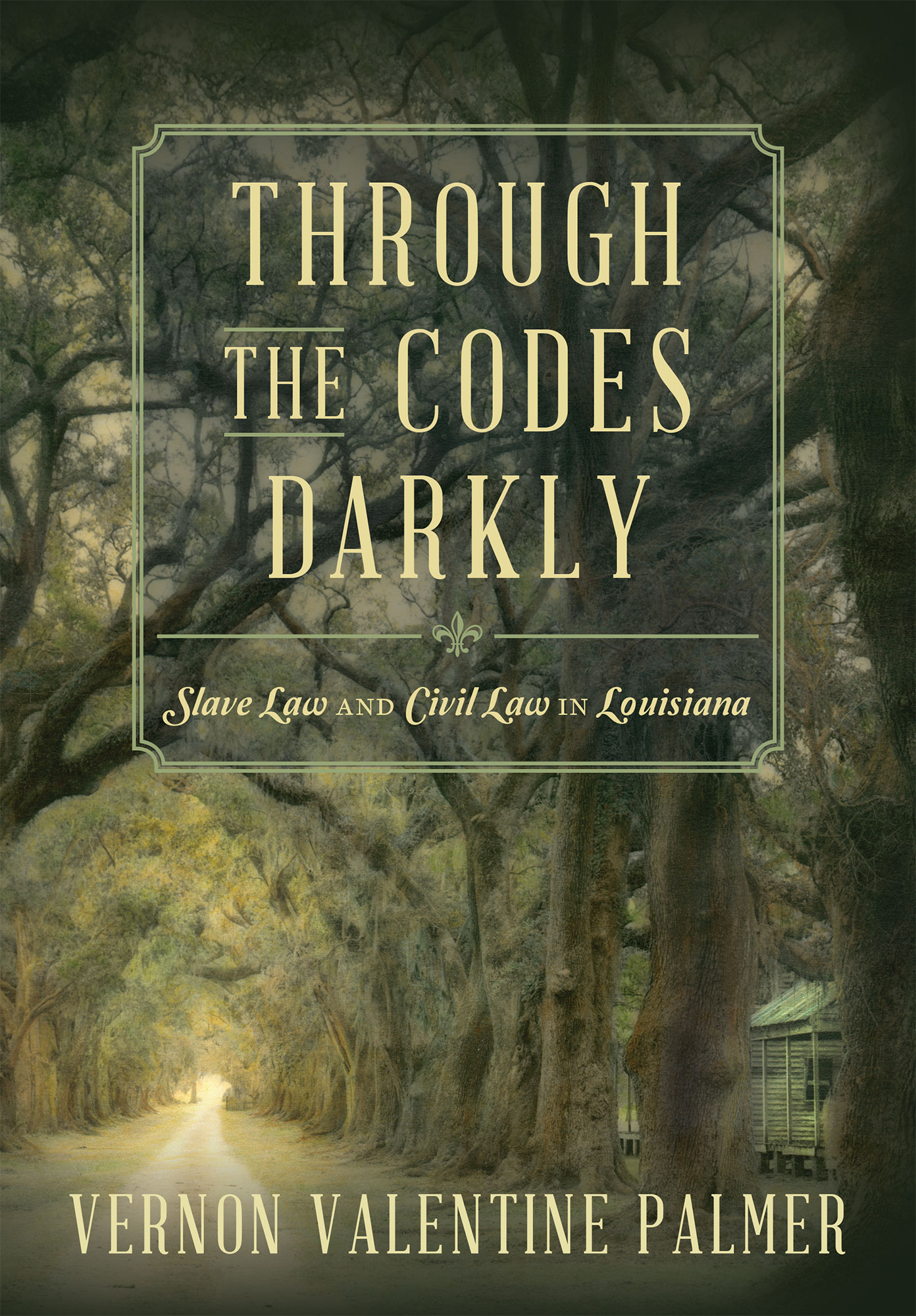
PUBLICATION: Palmer on Slave Law and Civil Law in Louisiana

JUST PUBLISHED

Vernon Valentine Palmer,
Through the Codes Darkly:
Slave Law and Civil Law in Louisiana

xvi, 196 pp. Hardcover $59.95. ISBN 9781616193119;
Paperback $49.95 ISBN 9781616193263.

This fascinating study offers:

• an examination of the complex French, Spanish, Roman and American heritage of Louisiana’s law of slavery and its codification

• a profile of the first effort in modern history to integrate slavery into a European-style civil code, the 1808 Digest
• a trailblazing study of the unwritten laws of slavery and the legal impact of customs and practices developing outside of the Codes
• an analysis that overturns the previous scholarly view that Roman law was the model for the Code Noir (1685)
• a new unabridged translation (by Palmer) of the revised Code Noir (1724) with the original French text on facing pages.

15 November 2012

PUBLICATION: James Q. Whitman's "The Verdict of Battle"

James Q. Whitman, The verdict of battle : the law of victory and the making of modern war, Cambridge, Mass. : Harvard University Press, 2012.

Today, war is considered a last resort for resolving disagreements. But a day of staged slaughter on the battlefield was once seen as a legitimate means of settling political disputes. James Whitman argues that pitched battle was essentially a trial with a lawful verdict. And when this contained form of battle ceased to exist, the law of victory gave way to the rule of unbridled force. The Verdict of Battle explains why the ritualized violence of the past was more effective than modern warfare in bringing carnage to an end, and why humanitarian laws that cling to a notion of war as evil have led to longer, more barbaric conflicts.
Belief that sovereigns could, by rights, wage war for profit made the eighteenth century battle’s golden age. A pitched battle was understood as a kind of legal proceeding in which both sides agreed to be bound by the result. To the victor went the spoils, including the fate of kingdoms. But with the nineteenth-century decline of monarchical legitimacy and the rise of republican sentiment, the public no longer accepted the verdict of pitched battles. Ideology rather than politics became war’s just cause. And because modern humanitarian law provided no means for declaring a victor or dispensing spoils at the end of battle, the violence of war dragged on.
The most dangerous wars, Whitman asserts in this iconoclastic tour de force, are the lawless wars we wage today to remake the world in the name of higher moral imperatives.

Clck here for ore information

14 November 2012

NOTICE: Seminar on "Famille, normes et pouvoir dans la modernité politique" at the EHESS (Paris, 15 November 2012-30 May 2013)

What: Seminar on "Famille, normes et pouvoir dans la modernité politique"
Where: EHESS, salle 1, 105 bd Raspail 75006 Paris
When: 1st, 3rd and 5th Thursdays of the month, 5:00 - 7:00 pm.


From November 15th 2012 until May 30th 2013, Pierre Bonin (prof. of legal history at Ecole de droit de la Sorbonne-Université Paris I: Pierre.Bonin@univ-paris1.fr) and Fanny Cosandey  (maître de conférences at l'EHESS: cosandey@ehess.fr)  will coordinate a seminar on the relationship between family and politics based on the dialogue between jurists and historians and focused on the 16th-18th cent. Nevertheless, the seminar will be open to other historical periods and to the interaction with other fields of research.  
  • 15 Nov. 2012 - Pierre Bonin, « Droit privé et construction de l’Etat en histoire du droit sous la IIIe république.
  • 29 Nov 2012 - Nicolas Kermabon, Stratégies matrimoniales, stratégies patrimoniales : le douaire des duchesses de Bretagne (XIIIe-XVe siècle).
  • 6 Dec. 2012 - Sylvie Steinberg, Droit et bâtardise (XVIe-XVIIe siècles).
  • 20 Dec. 2012 - Virginie Lemonnier-Lesage, L’autorité paternelle, reflet de l’autorité royale: l’exemple du consentement au mariage des enfants en droit normand.
  • 17 Jan. 2013 - Fanny Cosandey, Loi salique et souveraineté, argument du rang, argument du pouvoir.
  • 31 Jan. 2013 - Isabelle Poutrin, Le consentement en condition de contrainte, aspects juridiques: une recherche en cours.
  • 7 Feb. 2013 - Elie Haddad, La maison et les biens, enjeux politiques de la parenté dans la noblesse d'Ancien Régime.
  • 21 Feb. 2013 - Louis Assier-Andrieu, La famille sur la très longue durée, approche d'anthropologie historique.
  • 21 Mar. 2013 - Jean-Louis Halpérin, La famille sous la révolution: transformations juridiques et enjeux politiques.
  • 4 Apr. 2013 - Damien Salles, 1804-1870: retour sur l'institution de la Liste civile ou l'impossible séparation des sphères domestique et publique.
  • 18 Apr. 2013 - Eloïse Rocher, Les filiations de charges auliques féminines.
  • 16 May 2013 - Fanny Cosandey, Dire son nom par sa place, dire sa place par son nom: préséances et invocations lignagères.
  • 30 May 2013 - Michael Breen, Les procès en nullité de mariage pour cause d’impuissance du mari.
Source: http://nomodos.blogspot.fr/2012/11/ehess-sem-famille-normes-et-pouvoir.html. Click on this link for more information.