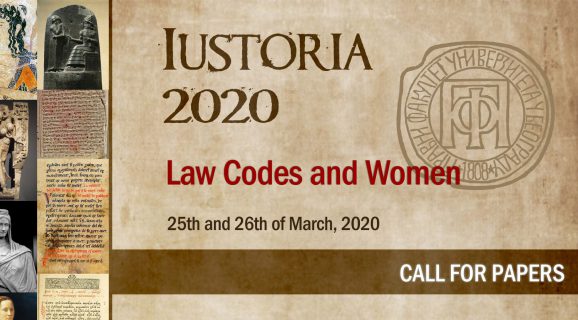
We learned that the University of
Belgrade Faculty of Law is receiving paper proposal for its first student
conference on legal history. Here the call:
The University of Belgrade
Faculty of Law is now receiving paper proposals for the First student
conference on legal history – the Iustoria 2020, to be held on the 25th and
26th of March, 2020, its topic being “Law Codes and Women”.
The choice of this subject stems
from an anniversary – this year marks the 175th anniversary of the Serbian
Civil Code (1844), and one of the most heavily debated issues during its
creation was precisely the regulation of the position of women: a woman’s right
to inherit, her role in the family, the legal capacity of a married woman…
Without a doubt, dilemmas such as these were present in the minds of other
creators of civil codes pertaining to the 19th and the beginning of the 20th
century – however, this is but a small portion of the issues that fall under
the realm of this conference. What was the status of women as perpetrators – or
victims – of crimes in criminal codes? What was the procedural status of women
as parties in lawsuits or as witnesses? Did commercial codes contain special
rules for women merchants? When we move further into the past, the very
presence of norms that are concerned with the status of women in the legal
codes of the Antiquity and the Middle Ages tells us a lot about their position
in society, and many laws contain specific and original institutions that
deserve scholarly attention. In recent history we could divert our attention to
women as lawmakers, and analyse their influence on modern codes of law. We are
looking forward to proposals related to these and many other issues pertaining
to the main subject!
All students of graduate and
post-graduate studies pertaining to law or other humanities are eligible to
apply for the conference. The applications should contain basic personal
information (name and surname, faculty, department, level and year of study),
along with an abstract containing anywhere between 500 and 1000 words.
The applications should be
e-mailed to
iustoria@ius.bg.ac.rs before
the 15th of January, 2020. The students will be informed by the 25th of January
whether or not their application has been accepted. A provisional programme for
the conference will be announced by the 1st of February. Drafts of the chosen
papers need to be sent by the 15th of March. For any additional information you
may enquire at the same e-mail address, or consult the official Facebook page
of the conference –
https://www.facebook.com/iustoria
Apart from the presentations
given by their colleagues, the students at the conference will have an
opportunity to attend several lectures given by renowned experts – more details
on this will be available in the final version of the programme.
As a general rule, the
participants who do not reside in Belgrade are expected to cover the travelling
and accomodation expenses by themselves. Exceptionally, there is a possibility
of securing accomodations either at the student dorms or with student host
families for those students who are unable to finance their stay at Belgrade.
These arrangements will depend on the number of available spots.
The final versions of the papers
presented at the conference, with final changes and corrections submitted
within a reasonable time after the conference, will be published in the first
issue of the future student journal for legal history!