
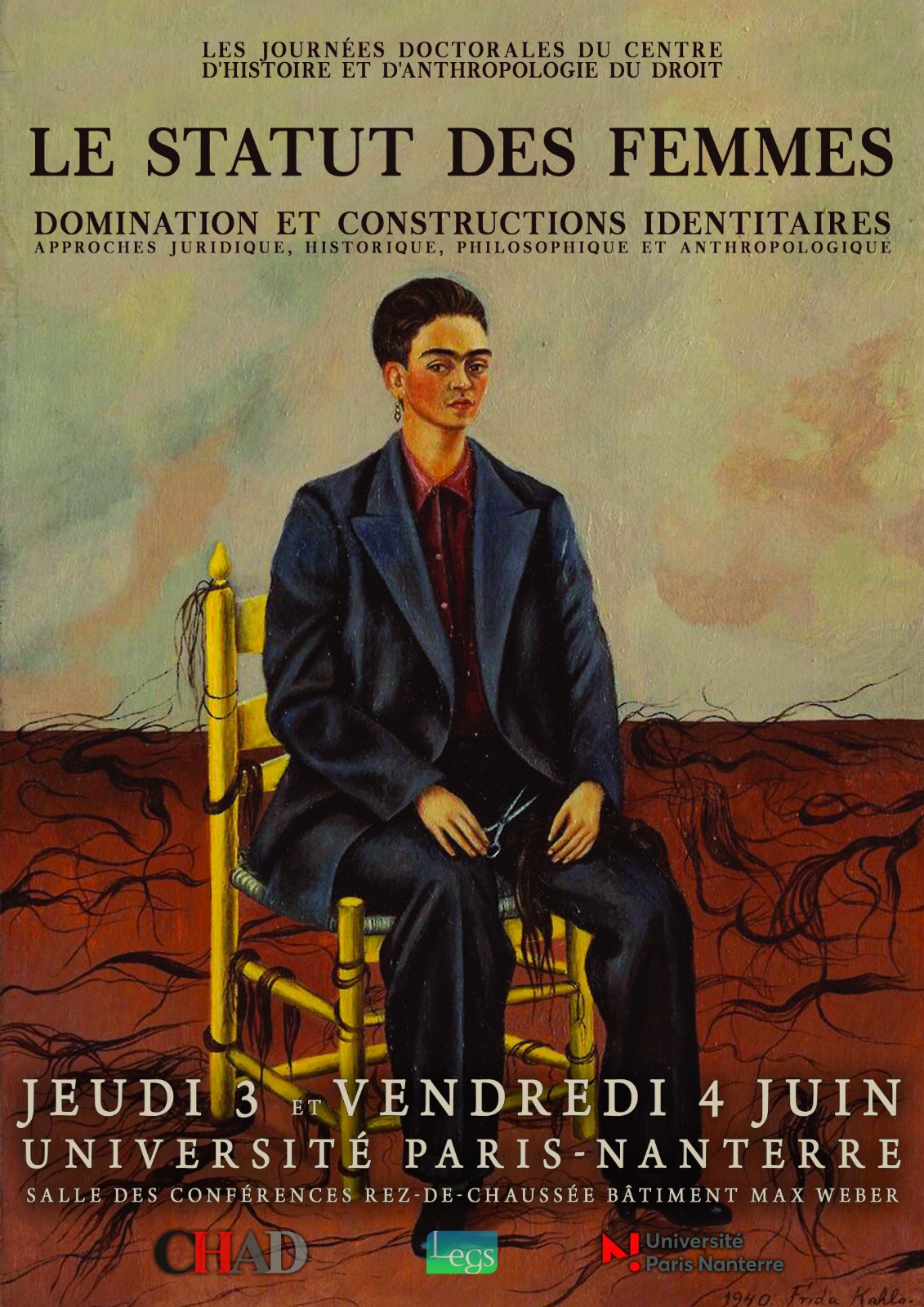
(Source: Centre d'histoire et d'anthropologie du droit, Université Paris Nanterre)
We learned of a conference at the Université Paris Nanterre about the status of women (Le statut des femmes. Domination et constructions identitaires).
Jeudi 3 juin 2021
9h30
Ouverture par Soazick Kerneis, Université Paris-Nanterre - CHAD
Sous la présidence d’Anne-Emmanuelle Berger, Paris VIII Vincennes Saint-Denis – LEGS
La condamnation de la mémoire des femmes romaines sous l’Empire
Claire Laborde, doctorante en histoire du droit, Paris-Nanterre
Traités de médecine légale et viol au XIXe siècle: l’inscription dans le corps des femmes et des filles
des critères de détermination de leur crédibilité dans le cadre de la mise en œuvre d’une procédure
judiciaire
Ghislaine Pedito, doctorante en histoire du droit, Paris-Nanterre
Le rôle émancipateur des récits de femmes pour la construction de la Vérité dans le contexte de la
justice transitionnelle
Antonio Laguado, doctorant en anthropologie du droit, Paris-Nanterre
« Leurs corps nous appartiennent ». Regard juridico-historique de la volonté d’appropriation du
corps des femmes par les Incels
Marjorie Coulas, doctorante en histoire du droit, Paris-Nanterre
14h
Sous la présidence de Sonia Dayan-Herzbrun, Paris-Diderot
Les vestales sont-elles des femmes ? Le statut des prêtresses romaines de Vesta
Ralph Evêque, docteur en histoire du droit, Paris-Nanterre
Magiciennes ou soignantes : la place des femmes dans les activités de guérison dans l’Angleterre de
l’époque Moderne 1542-1604
Marion Attia, doctorante en histoire du droit, Paris-Nanterre
Le crime de poison de l’édit de 1682 à la veille de la Révolution : un crime féminisé ?
Tom Riché, doctorant en histoire du droit, Paris-Nanterre
Les femmes face à l’invisible, la vision juridique de l’administration importée en Afrique
Occidentale Française durant la seconde vague de colonisation (XIX°-XX° siècles)
Maxime Tourette, doctorant en histoire du droit, Paris-Nanterre
Vendredi 4 juin 2021
9h30
Sous la présidence de Beatriz Collantes-Sanchez, Paris-Nanterre - LEGS
Le statut des femmes-colons en Islande à l’époque du Landnám : le témoignage du Livre de la
colonisation
Natalia Danilova, doctorante en histoire du droit, Paris-Nanterre
« One great brothel ». Critique du mariage et amélioration du statut des femmes dans la communauté abolitionniste de Nashoba (1825-1828)
Etienne Lamarche, doctorant en histoire du droit, Paris-Nanterre
Celles qui partent ne reviennent pas. Migration, genre, et recompositions communautaires chez
les mayas tseltals de San Juan Cancuc
Juliette Danfakha, doctorante en anthropologie, Paris-Nanterre
Les femmes et les procès pour terrorisme en France: une approche ethnographique
Joshua Isaac Bishay, doctorant en anthropologie du droit, Paris- Nanterre
14h00
Sous la présidence de Livia Holden, Paris-Nanterre - CHAD
La répudiation de l’épouse infidèle dans l’Église romaine orientale – une sanction distincte selon
les genres émanant des lettres canoniques de Saint Basile
Martin Le Roy, doctorant en histoire du droit, Paris-Nanterre
L’évolution du crime de rapt dans le droit byzantin
Christavgi Athanasiou, doctorante en histoire du droit, Paris IV Sorbonne
les genres émanant des lettres canoniques de Saint Basile
Martin Le Roy, doctorant en histoire du droit, Paris-Nanterre
L’évolution du crime de rapt dans le droit byzantin
Christavgi Athanasiou, doctorante en histoire du droit, Paris IV Sorbonne
«Mama» en kiswahili entre appellatif affectueux et titre d’appel courant
Naomi Omeonga Wa Kayembe, doctorante en anthropologie du droit, Paris-Nanterre
The traditional role of women in contemporary Japan
Mariko Nakahara - doctorante en anthropologie du droit, Paris-Nanterre
The traditional role of women in contemporary Japan
Mariko Nakahara - doctorante en anthropologie du droit, Paris-Nanterre
Detailed information can be found at the following page: https://chad.parisnanterre.fr/rencontres-scientifiques/chad-rencontres-scientifiques-310047.kjsp


