Search

Showing posts with label Mughal Empire. Show all posts

16 January 2024

PODCAST: Naveen KANALU RAMAMURTHY, "Le droit hanéfite dans l’Empire moghol. Institutions, normes et pratiques islamiques en Inde (1650–1700)" (Paris: Collège de France, 14 DEC 2023)

(image source: Collège de France)
 

Abstract:

Tout comme l’Empire ottoman et des khanats d’Asie centrale, l’Empire moghol (1526-1857) – dernière grande puissance impériale ayant dominé le sous-continent indien avant le colonialisme britannique –, était régi par des institutions, normes et pratiques issues du droit hanéfite, une des quatre écoles juridiques de l’islam sunnite. Comment les normes élaborées par le droit savant des juristes hanéfites ont-elles façonné les institutions mogholes ? À partir d’archives multilingues en arabe, en persan et en langues vernaculaires indiennes, nous proposons un petit tour d’horizon des pratiques administratives et juridiques mogholes afin de montrer des relations de pouvoir asymétriques qui existaient entre les agents de l’autorité impériale et les sujets dans les sociétés composées de différentes castes, ethnicités et religions. Il s’agit d’appréhender la normativité juridique entre les normes provenant de la méthode casuistique des juristes et leurs usages par les chancelleries, les administrateurs et les juges à l’œuvre dans l’Empire moghol, l’un des régimes de pouvoir impérial les plus centralisés à l’époque moderne. Nous interrogeons les pratiques quotidiennes de l’application des règles pour saisir le savoir-faire professionnel du système juridique hanéfite qui s’est développé dans la région. Nous faisons ainsi dialoguer la culture juridique de l’Inde moghole avec l’histoire des empires en terre d’Islam.

On the speaker:

Naveen Kanalu Ramamurthay, Maître de conférences, EHESS 

Listen to the podcast here. 

02 June 2020

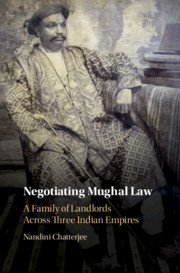
BOOK: Nandini CHATTERJEE, Negotiating Mughal Law : A Family of Landlords across Three Indian Empires (Cambridge: Cambridge University Press, 2020). ISBN 9781108486033, $ 99.99


(Source: CUP)

Oxford University Press is publishing a micro-history analysis to explore law, empire and society in Mughal India.

ABOUT THE BOOK

Based on a completely reconstructed archive of Persian, Hindi and Marathi documents, Nandini Chatterjee provides a unique micro-history of a family of landlords in Malwa, central India, who flourished in the region from at least the sixteenth until the twentieth century. By exploring their daily interactions with imperial elites as well as villagers and marauders, Chatterjee offers a new history from below of the Mughal Empire, far from the glittering courts of the emperors and nobles, but still dramatic and filled with colourful personalities. From this perspective, we see war, violence, betrayal, enterprise, romance and disappointment, but we also see a quest for law, justice, rights and righteousness. A rare story of Islamic law in a predominantly non-Muslim society, this is also an exploration of the peripheral regions of the Maratha empire and a neglected princely state under British colonial rule. This title is also available as Open Access.

ABOUT THE AUTHOR

Nandini Chatterjee, University of Exeter

Nandini Chatterjee is Associate Professor of History at the University of Exeter. She has published widely on the British and Mughal empires, including her book The Making of Indian Secularism: Empire, Law and Christianity, 1830–1950 (2011).

TABLE OF CONTENTS

Introduction
1. Malwa: land of many empires
2. Zamindars: lords of the marches
3. Contractors: engaging the state
4. Transactions: recording deals
5. Disputes: judges and courts
6. Invaders: marathas and the British
7. Identity: professionals or warlords?
Conclusion. Fragments to archives: a methodological manifesto
Appendix. A catalogue of the P Das archive
Glossary.

More info here