ABOUT THE BOOK
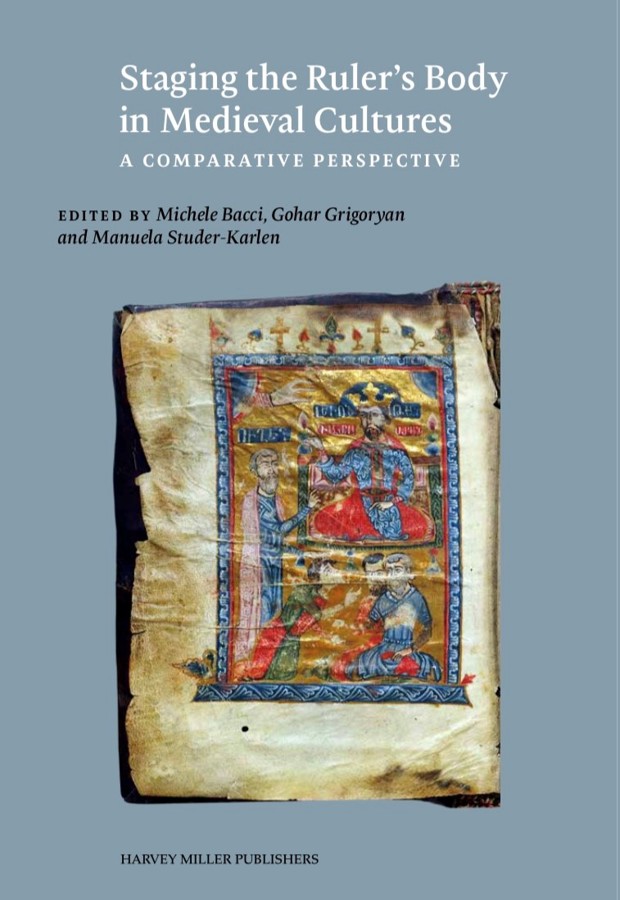
This book explores the viewing and sensorial contexts in which the bodies of kings and queens were involved in the premodern societies of Europe, Asia, and Africa, relying on a methodology that aims to overcoming the traditional boundaries between material studies, art history, political theory, and Repräsentationsgeschichte. More specifically, it investigates the multiple ways in which the ruler’s physical appearance was apprehended and invested with visual, metaphorical, and emotional associations, as well as the dynamics whereby such mise-en-scène devices either were inspired by or worked as sources of inspiration for textual and pictorial representations of royalty. The outcome is a multifaced analysis of the multiple, imaginative, and terribly ambiguous ways in which, in past societies, the notion of a God-driven, eternal, and transpersonal royal power came to be associated with the material bodies of kings and queens, and of the impressive efforts made, in different cultures, to elude the conundrum of the latter’s weakness, transitoriness, and individual distinctiveness.
ABOUT THE EDITORS
Michele Bacci is Professor of Medieval Art History at Fribourg University, Switzerland, and a member of the Academia Europaea. His research has been focused on artistic interactions in the Medieval Mediterranean and beyond, and the history of cult-objects and holy sites from a phenomenological-comparative viewpoint. He is the author of numerous publications, including Il pennello dell’Evangelista (1998), The Many Faces of Christ (2014), the Mystic Cave (2017), and Veneto-Byzantine Artistic Interactions (2021).
Gohar Grigoryan, Ph.D. (2017), University of Fribourg, is currently senior researcher at the same university within an SNSF-funded project. She is the author of over two dozen peer-reviewed articles on medieval Armenian art and history and of an upcoming monograph on royal imagery in Cilician Armenia.
Manuela Studer-Karlen, Ph.D. (2010), University of Fribourg, is a SNSF Professor for Medieval Art at the University in Bern. She has published a monograph on late antique sarcophagi and recently her habilitation has been published with the title: "Christus Anapeson. Image and Liturgy". Her research centres on the history of visual-cultural processes in late antiquity, the interactions among text, image and space in Byzantine churches, medieval Georgian art, and Gothic ivories.
TABLE OF CONTENTS
- The Ruler’s Multiple Bodies and Their Mise-en-Scène: Some Introductory Remarks (MICHELE BACCI)
- Staging the Body of the Lord of the Sevenfold World. Methectic Spaces and Chiasmatic Viewing in Sasanian Iran (MATTHEW P. CANEPA)
- Queen Consort Mariam Dadiani and Female Architectural Patronage in Late Medieval Georgia (NATIA NATSVLISHVILI)
- The ‘Just Judgement’ of King Lewon IV. Representational Strategies of Righteous Rulership in Cilician Armenia (GOHAR GRIGORYAN)
- Royal Imagery and Devotional Spaces in Early Solomonic Ethiopia. The Case of Gännätä Maryam (JACOPO GNISCI)
- Staging as Metaphor. The King’s Body and the Theatricality of Power (ANTONY EASTMOND)
- Clothes maketh the emperor? Embodying and Performing Imperial Ideology in Byzantium through Dress (MARIA PARANI)
- Staging for Commemoration: The Cherubikos Hymnos (MANUELA STUDER-KARLEN)
- The Khan in the West. The Reception of Mongol Political Power in the Texts and Images of Medieval Latin Europe (ELEONORA TIOLI)
- Staging the Virgin Mary as the Ruler of the Sienese City-State (KAYOKO ICHIKAWA)
- Shaping the Face of Power. The Portraits of King Robert of Anjou (1309-1343) (MIRKO VAGNONI)
- Staging the Royal Corpse. Reburials of Monarchical Bodies at the Basilica of San Isidoro in León (ALEKSANDRA RUTKOWSKA)
- The Presence and Propaganda of Jaime the Conqueror of Aragon (r. 1213-76) in the Llibre dels Fets. The Image, Action, and Rhetoric of a King (SOFIA FERNANDEZ POZZO)
- The Royal Presence of Pedro IV (r. 1336-87) in Contemporary Textual and Iconographic Sources (MARTA SERRANO-COLL)
- Staging the Absent King. Effects of Presence on Medieval Royal Thrones (SABINE SOMMERER)
More information can be found here.