Search

Showing posts with label Corpus iuris canonici. Show all posts

28 February 2022

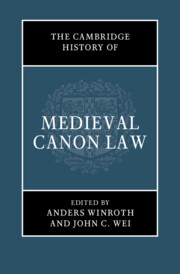
BOOK: Anders WINROTH, John C. WEI, The Cambridge History of Medieval Canon Law (Cambridge: Cambridge University Press, 2022), 550 p. ISBN : 978-1-1070-2504-2


ABOUT THE BOOK 

Canon law touched nearly every aspect of medieval society, including many issues we now think of as purely secular. It regulated marriages, oaths, usury, sorcery, heresy, university life, penance, just war, court procedure, and Christian relations with religious minorities. Canon law also regulated the clergy and the Church, one of the most important institutions in the Middle Ages. This Cambridge History offers a comprehensive survey of canon law, both chronologically and thematically. Written by an international team of scholars, it explores, in non-technical language, how it operated in the daily life of people and in the great political events of the time. The volume demonstrates that medieval canon law holds a unique position in the legal history of Europe. Indeed, the influence of medieval canon law, which was at the forefront of introducing and defining concepts such as ‘equity,’ ‘rationality,’ ‘office,’ and ‘positive law,’ has been enormous, long-lasting, and remarkably diverse.


THE AUTHORS

Anders Winroth, taught medieval history at Yale University from 1998–2020, and currently teaches at the University of Oslo. The author of The Making of Gratian’s ‘Decretum,’ (Cambridge University Press, 2000) which revolutionized our understanding of medieval canon law, he was a named a MacArthur Foundation Fellow in 2003. He serves as President of the Institute of Medieval Canon Law.

John C. Wei, holds a Ph.D. in medieval history from Yale University and a J.D. from Yale Law School. He is the author of Gratian the Theologian (2016) and the editor of the decretist Reverentia sacrorum canonum. He has authored many articles on medieval law and theology.


The table of contents can be find here.


24 February 2022

BOOK: Sarah RIGAUDEAU, Le testament en droit canonique du XIIe au XVe siècle (Paris, Institut Francophone pour la Justice et la Démocratie, 2021) 576 p. ISBN : 978-2-37032-328-6


ABOUT THE BOOK

Pour les juristes français, les formes du testament sont le résultat d’une combinaison produite par l’influence du droit romain, des coutumes de l’ancienne France et de la législation révolutionnaire. L’apport du droit canonique à la formation du droit moderne et contemporain du testament, bien que majeur, est le plus souvent totalement passé sous silence. La réintroduction du testament au XIIe siècle est incontestablement due à la redécouverte du Corpus Juris Civilis. Cet ensemble fournit du procédé une définition particulièrement claire, l’entendant comme un acte de dernière volonté révocable. L’influence du droit romain, d’abord importante dans le Midi, a donc conditionné la diffusion de l’institution dans la pratique. Très tôt, cependant, s’est opéré un mouvement de simplification des formes exigées. La plupart des règles romaines sont écartées. L’Église n’exige en réalité aucune formalité, mais seulement des preuves de l’acte. Cette attitude très souple permet au plus grand nombre de tester, le plus souvent simplement par oral. Ouvrir à chacun une telle possibilité a bien sûr d’abord pour but de permettre à tous les chrétiens d’effectuer des legs pieux susceptibles, au-delà du rachat de leurs fautes, de venir enrichir le patrimoine ecclésiastique. Cette politique n’en débouche pas moins sur une promotion sans précédent de l’acte à cause de mort et de la liberté de disposer.


ABOUT THE AUTHOR

Docteur en histoire du droit et qualifiée aux fonctions de maître de conférences, Sarah Rigaudeau est actuellement chargée d’études documentaires aux Archives de Paris.


01 June 2021

JOURNAL: Studia Gratiana (XXX, 2020). "Gratianus magister decretorum. Il Decretum tra storia, attualità e prospettive di universalità"


(Source: Biblioteca Apostolica Vaticana)

We learned of the publication of a new issue of the Studia Gratiana.


TABLE OF CONTENTS

  • Brian Ferme, Presentazione;
  • Manlio Sodi, Francesco Reali, Introduzione;
  • Francesco Reali, Alle origini del diritto civile europeo;
  • Giovanna Murano, Graziano, monaco benedettino, magister e vescovo di Chiusi: le testimonianze iconografiche;
  • Francesco Giammarresi, Fonti romanistiche del Decretum;
  • Manlio Sodi, Teologia sacramentaria e Diritto tra XI e XII secolo. A proposito di alcune tematiche del Decretum;
  • Orazio Antonio Bologna, La lingua del Decretum e la prima traduzione italiana;
  • Anders Winroth, L'universale Graziano da Chiusi: un uomo per il suo e per tutti i tempi;
  • Francesco Reali, Istituti alternativi al testamento: tra alto Medio Evo e oggi;
  • Giovanni Luchetti, Graziano e la cultura europea oggi;
  • Cecilia Natalini, Graziano e l'Europa del diritto;
  • Isabella Gagliardi, Confessione e direzione spirituale. Alcune note a margine del Decretum;
  • Mario Ascheri, Per un primo orizzonte di sintesi