Search

14 December 2020

BOOK: Arnd KOCH, Michael KUBICIEL and Martin LÖHNIG (Eds.), Strafrecht zwischen Novemberrevolution und Weimarer Republik (Tübingen: Mohr Siebeck, 2020). ISBN 978-3-16-159511-0, 89.00 EUR


(Source: Mohr Siebeck)

Mohr Siebeck is publishing a new book on penal law between the November Revolution and the start of the Weimar Republic.

ABOUT THE BOOK

Im November 2018 jährte sich die Ausrufung der Republik zum einhundertsten Mal. Die Umbruchphase war mit großen Hoffnungen verbunden, führte jedoch zu bürgerkriegsähnlichen Zuständen und mündete in dementsprechenden Enttäuschungen. Obwohl die Phase zwischen der Novemberrevolution und der Etablierung der ersten deutschen Republik im Laufe des Jahres 1919 eine tiefe Zäsur markiert, ist sie bislang nur ausschnittsweise Gegenstand rechtshistorischer Forschung gewesen. Das gilt insbesondere für die Frage, ob und inwieweit in dieser kurzen Zeit zwischen Revolution und Republik die Grundlagen für strafrechtliche Institutionen und Denkfiguren gelegt wurden, welche die Weimarer Republik prägten und (in radikalisierter Form) bis zur NS-Zeit fortwirkten.

ABOUT THE EDITORS

Arnd Koch ist Inhaber des Lehrstuhls für Strafrecht, Strafprozessrecht, Risiko- und Präventionsstrafrecht sowie Juristische Zeitgeschichte an der Universität Augsburg.


Michael Kubiciel ist Inhaber des Lehrstuhls für Internationales, Europäisches und Deutsches Straf- und Strafprozessrecht, Medizin- und Wirtschaftsstrafrecht an der Universität Augsburg.


Martin Löhnig ist Inhaber des W3-Lehrstuhls für Bürgerliches Recht, Deutsche und Europäische Rechtsgeschichte sowie Kirchenrecht an der Universität Regensburg, https://orcid.org/0000-0002-4616-1905


The Table of Contents can be found here


More info here

BOOK: Peter HILPOLD, European International Law Traditions (Cham: Springer, 2020). ISBN 978-3-030-52027-4, 135.19 EUR


(Source: Springer)

Springer is publishing a book on European international law traditions.

ABOUT THE BOOK

International Law is usually considered, at least initially, to be a unitary legal order that is not subject to different national approaches. Ex definition it should be an order that transcends the national, and one that merges national perspectives into a higher understanding of law. It gains broad recognition precisely because it gives expression to a common consensus transcending national positions.

The reality, however, is quite different. Individual countries’ approaches to International Law, and the meanings attached to different concepts, often diverge considerably. The result is a lack of comprehension that can ultimately lead to outright conflicts.

In this book, several renowned international lawyers engage in an enquiry directed at sorting out how different European nations have contributed to the development of International Law, and how various national approaches to International Law differ. In doing so, their goal is to promote a better understanding of theory and practice in International Law.


ABOUT THE EDITOR

Dr. Peter Hilpold is Professor of International Law, EU Law and Public Comparative Law at the University of Innsbruck. He holds several University degrees (law, economics, industrial management, languages) and has been granted a series of academic awards. He is a co-editor of the journal “Europa Ethnica” and a member of the Editorial Board of the “Austrian Review of International and European Law”. Futhermore, he is a member of the Advisory Board of the “Hague Yearbook of International Law” as well as of the journal “Diritti Umani e Diritto Internazionale”. He is also a permanent collaborator of the journal “Archiv des Völkerrecht” and the author of over 250 publications.


More info here

BOOK: Robert GALLAGHER, Edward ROBERTS and Francesca TINTI (Eds.), The Languages of Early Medieval Charters - Latin, Germanic Vernaculars, and the Written Word (Leiden-New York: Brill, 2020). ISBN 978-90-04-42811-9, 134.00 EUR.


(Source: Brill)

Brill is publishing a new book on the interplay between Latin and Germanic vernaculars in early medieval records.

ABOUT THE BOOK

This is the first major study of the interplay between Latin and Germanic vernaculars in early medieval records. Building on previous work on the uses of the written word in the early Middle Ages, which has dispelled the myth that this was an age of ‘orality’, the contributions in this volume bring to the fore the crucial question of language choice in the documentary cultures of early medieval societies. Specifically, they examine the interactions between Latin and Germanic vernaculars in the Anglo-Saxon and eastern Frankish worlds and in neighbouring areas. The chapters are underpinned by an important comparative dimension on account of the two regions’ shared linguistic heritage and numerous cross-Channel links. 

ABOUT THE EDITORS

Robert Gallagher is Lecturer in Early Medieval History at the University of Kent. His primary research focus is the politics and textual cultures of early medieval Britain, with special interests in documentary activity, multilingualism, Latin verse, and manuscript use. 


Edward Roberts is Lecturer in Early Medieval History at the University of Kent. He specializes in the history of Carolingian and Ottonian Europe, with particular interests in historical writing, legal culture, charters, bishops, and institutional change.

 
Francesca Tinti is Ikerbasque Research Professor at the University of the Basque Country, UPV/EHU. She has published widely on early medieval religious, social, and cultural history, with a special focus on Anglo-Saxon England, its documentary culture, and its relations with the European continent. 

TABLE OF CONTENTS

Contents

List of Illustrations

Abbreviations

Notes on Contributors


1 Latin and Germanic Vernaculars in Early Medieval Documentary Cultures: Towards a Multidisciplinary Comparative Approach

  Francesca Tinti


2 Charters, Languages, and Communication: Recent Work on Early Medieval Literacy

  Rosamond McKitterick


3 The Multilingualism of the Early Middle Ages: Evidence from Peripheral Regions of the Regnum orientalium Francorum

  Wolfgang Haubrichs


4 Germanic Names, Vernacular Sounds, and Latin Spellings in Early Anglo-Saxon and Alemannic Charters

  Annina Seiler


5 Language, Formulae, and Carolingian Reforms: the Case of the Alemannic Charters from St Gall

  Bernhard Zeller


6 Signalling Language Choice in Anglo-Saxon and Frankish Charters, c.700–c.900

  Edward Roberts and Francesca Tinti


7 The Endorsement Practices of Early Medieval England

  Robert Gallagher and Kate Wiles


8 Traces of Bilingualism in Early Medieval Northern Italy: the Evidence from Eighth- and Ninth-Century Private Charters

  Marco Stoffella


9 Languages of Boundaries and Boundaries of Language in Cornish Charters

  Charles Insley


10 Vernacular Writing in Early Medieval Manorial Administration: Two Tenth-Century Documents from Werden and Essen

  Stefan Esders


11 Royal Authority, Regional Integrity: the Function and Use of Anglo-Saxon Writ Formulae

  Albert Fenton


12 From Memorandum to Written Record: Function and Formality in Old English Non-Literary Texts

  Kathryn A. Lowe


13 Writing, Communication, and Currency: Dialogues between Coinage and Charters in Anglo-Saxon England

  Rory Naismith


14 Epilogue

  Janet L. Nelson


Index


More info here

BOOK: Gregory ABLAVSKY, Federal Ground - Governing Property and Violence in the First U.S. Territories (Oxford: Oxford University Press, 2020). ISBN 9780190905699, 39.95 USD.


(Source: OUP)

Oxford University Press is publishing a new book on the growth of federal authority in the first US territories.

ABOUT THE BOOK

Federal Ground depicts the haphazard and unplanned growth of federal authority in the Northwest and Southwest Territories, the first U.S. territories established under the new territorial system. The nation's foundational documents, particularly the Constitution and the Northwest Ordinance, placed these territories under sole federal jurisdiction and established federal officials to govern them. But, for all their paper authority, these officials rarely controlled events or dictated outcomes. In practice, power in these contested borderlands rested with the regions' pre-existing inhabitants-diverse Native peoples, French villagers, and Anglo-American settlers. These residents nonetheless turned to the new federal government to claim ownership, jurisdiction, protection, and federal money, seeking to obtain rights under federal law.

Two areas of governance proved particularly central: contests over property, where plural sources of title created conflicting land claims, and struggles over the right to use violence, in which customary borderlands practice intersected with the federal government's effort to establish a monopoly on force. Over time, as federal officials improvised ad hoc, largely extrajudicial methods to arbitrate residents' claims, they slowly insinuated federal authority deeper into territorial life. This authority survived even after the former territories became Tennessee and Ohio: although these new states spoke a language of equal footing and autonomy, statehood actually offered former territorial citizens the most effective way yet to make claims on the federal government. The federal government, in short, still could not always prescribe the result in the territories, but it set the terms and language of debate-authority that became the foundation for later, more familiar and bureaucratic incarnations of federal power.

ABOUT THE AUTHOR

Gregory Ablavsky is associate professor of law and of history (by courtesy) at Stanford University. He has published extensively in law reviews and history journals on the history of sovereignty, territory, and property in the early United States, particularly in the early American West. In 2015, the American Society for Legal History awarded his article The Savage Constitution the Cromwell Prize for the year's best article in American legal history.

TABLE OF CONTENTS

Introduction


Part I: Property

Chapter 1: Sources of Title in the Territories

Chapter 2: The Land Company Experiment

Chapter 3: The Rise of Federal Title


Part II: Violence

Chapter 4: Federal Sovereignty

Chapter 5: Laws of War and Peace

Chapter 6: Expenses of Sovereignty


Part III: Statehood

Chapter 7: Equal Footing


Epilogue: Three Systems

Acknowledgments

Abbreviations


More info here

BOOK: Michael GAGARIN and Paula PERLMAN, The Laws of Ancient Crete, c.650-400 BCE (Oxford: Oxford University Press, 2020). ISBN 9780198832515, 40.00 USD


We missed this book on the laws of Ancient Crete back in 2016, and which is now being published in paperback version.

ABOUT THE BOOK

This volume presents the Greek text of approximately 200 stone inscriptions, which detail the laws of ancient Crete in the archaic and classical periods, c.650-400 BCE. The texts of the inscriptions, many of which are fragmentary and relatively unknown, are accompanied by an English translation and also two commentaries; one focused on epigraphical and linguistic issues, and the other, requiring no knowledge of Greek, focused on legal and historical issues.

The texts are preceded by a substantial introduction, which surveys the geography, history, writing habits, social and political structure, economy, religion, and law of Crete in this period.

ABOUT THE AUTHORS

Michael Gagarin, Professor Emeritus of Classics, University of Texas at Austin,Paula Perlman, Professor of Classics, University of Texas at Austin

Michael Gagarin is Professor Emeritus of Classics at the University of Texas at Austin.

Paula Perlman is Professor of Classics at the University of Texas at Austin.

TABLE OF CONTENTS

Preface
Acknowledgements
List of Figures
Abbreviations
Note on Chronology
Introduction
Archaic and Classical Crete: Unity or Diversity?
Setting the Stage
The Inscriptions
Government
Persons
Social Institutions
Economy
Inter-Polis Relations
Religion
Law
Catalogue of Texts
Axos
Datala
Dreros
Eleutherna
Eltynia
Gortyn
Knossos
Lyktos
Phaistos
Prinias
Location of Inscriptions
Bibliography
Index of Greek Words
Index Locorum
Subject Index


More info here

11 December 2020

ONLINE SERIES: Method, methodology and critique in international law (Asser Institute, 2020-2021)


(image source: Asser)

Description:

In recent decades, the field of international law has seen a multiplication of methodological approaches, a growing variation in methods and a critical reflection on central epistemological and stylistic registers. Changes in the course of the discipline have thereby often been fueled not by new substantive claims in existing (doctrinal, analytical or political) controversies, but through the emergence of different modes of seeing, thinking and writing. The aim of the new Asser lecture and workshop series is to explore various new ways of ‘doing’ international legal scholarship. This includes a focus on the opportunities, pitfall and politics of varying methodological approaches, their embedded epistemological, sociological or philosophical commitments as well as the particular technical crafts they demand. Researchers participating in the workshops will not only gain a better grasp of how to position themselves in an increasingly complex methodological landscape. They will also enhance their understanding of what is at stake in the various ‘turns’ that are continuously performed in international law (such as the ‘turn’ to practice, history, discourse, political economy, critical sociology, materiality, geography or aesthetics to name but a few).

Program:

Programme: 'Method, methodology and critique in international law' 16 December 2020 – 14.00. Introducing the Asser workshop series on method, methodology and critique in international law – Dimitri Van Den Meerssche and Wouter Werner 20 January 2021 – 11.00. Political economy – John Haskell and Ntina Tzouvala 17 February 2021 – 14.00. Historiography – Rose Parfitt and Nehal Bhuta 17 March 2021 – 14.00. Postcolonialism and critical race theory – Luis Eslava and Ayça Çubukçu 21 April 2021 – 14.00. Critical sociology and discourse analysis – Sara Dezalay and Antoine Vauchez 19 May 2021 – 14.00 STS and ANT – Marieke de Goede and Gavin Sullivan 9 June 2021 – 14.00. Legal anthropology and ethnography – Emma Nyhan and Matt Canfield 22 September 2021 – 14.00. Posthumanism and new materialism – Matilda Arvidsson and Sara Kendall 20 October 2021 – 14.00. Critical geography – Nik Rajkovic and Sofia Stolk 17 November 2021 – 14.00. Architecture, space & design – Renske Vos and Amin Parsa 15 December 2021 – 14.00. Aesthetics, affect & emotion – Emily Kidd White and Rebecca Sutton December 2021 (dates tbc) Concluding two-day workshop with keynote speaker Gerry Simpson 

Full program here

(source: ESILHIL)

BOOK: Ville ERKKILÄ & Hans-Peter HAFERKAMP, Socialism and Legal History The Histories and Historians of Law in Socialist East Central Europe (London: Routledge, 2020). ISBN 9780367414757, pp. 204, £96.00


(Source: Routledge)

ABOUT THE BOOK

This book focuses on the way in which legal historians and legal scientists used the past to legitimize, challenge, explain and familiarize the socialist legal orders, which were backed by dictatorial governments.  The volume studies legal historians and legal histories written in Eastern European countries during the socialist era after the Second World War. The book investigates whether there was a unified form of socialist legal historiography, and if so, what can be said of its common features. The individual chapters of this volume concentrate on the regimes that situate between the Russian, and later Soviet, legal culture and the area covered by the German Civil Code. Hence, the geographical focus of the book is on East Germany, Russia, the Baltic states, Poland and Hungary. The approach is transnational, focusing on the interaction and intertwinement of the then hegemonic communist ideology and the ideas of law and justice, as they appeared in the writings of legal historians of the socialist legal orders. Such an angle enables concentration on the dynamics between politics and law as well as identities and legal history. Studying the socialist interpretations of legal history reveals the ways in which the 20th century legal scholars, situated between legal renewal and political guidance gave legitimacy to, struggled to come to terms with, and sketched the future of the socialist legal orders. The book will be a valuable resource for academics and researchers working in the areas of Legal History, Jurisprudence and Philosophy of Law and European Studies.


ABOUT THE EDITORS

Ville Erkkilä is a Postdoctoral Researcher at the Center for European Studies, University of Helsinki, Finland.

Hans-Peter Haferkamp is Full Professor of Private Law and History of German Law. He is the Director of the Institute of Modern History of Private Law, German and Rhenish Legal History, University of Cologne


TABLE OF CONTENTS 

Introduction: Socialist interpretations of legal history

Ville Erkkilä

PART I Framing the socialist legal historiography

1 The transformations of some classical principles in socialist Hungarian civil law: The metamorphosis of ‘bona fides’ and ‘boni mores’ in the Hungarian Civil Code of 1959

András Földi

2 We few, we happy few? Legal history in the GDR

Martin Otto

3 Roman law studies in the USSR: An abiding debate on slaves, economy and the process of history

Anton Rudokvas and Ville Erkkilä

4 Strategies of covert resistance: Teaching and studying legal history at the University of Tartu in the Soviet era

Marju Luts-Sootak

5 The Western legal tradition and Soviet Russia: The genesis of H. J. Berman’s Law and Revolution

Adolfo Giuliani

PART II Legal historians of socialist regimes

6 Juliusz Bardach and the agenda of socialist history of law in Poland

Marta Bucholc

7 Valdemārs Kalniņš (1907–1981): The founder of Soviet legal history in Latvia

Sanita Osipova

8 Getaway into the Middle Ages?: On topics, methods and results of ‘socialist’ legal historiography at the University of Jena

Adrian Schmidt-Recla and Zara Luisa Gries

9 Roman law and socialism: Life and work of a Hungarian scholar, Elemér Pólay

Éva Jakab


More information with the publisher.

BOOK: Antoine VAUCHEZ and Pierre FRANCE, The Neoliberal Republic - Corporate Lawyers, Statecraft, and the Making of Public-Private France (Ithaca: Cornell University Press, 2020). ISBN 978-1-5017-5257-5, 113.95 EUR.


Cornell University Press is publishing a book on the revolving door between public service and private enrichment in 21st century France.

ABOUT THE BOOK

The Neoliberal Republic traces the corrosive effects that the revolving door between public service and private enrichment has on the French state and its ability to govern and regulate the private sector. Casting a piercing light on this circulation of influence among corporate lawyers and others in the French power elite, Antoine Vauchez and Pierre France analyze how this dynamic, a feature of all Western democracies, has developed in concert with the rise of neoliberalism over the past three decades.

Based on interviews with dozens of public officials in France and a unique biographical database of more than 200 civil servants-turned corporate lawyers, The Neoliberal Republic explores how the always-blurred boundary between public service and private interests has now been critically compromised, enabling the transformation of the regulatory state into either an ineffectual bystander or an active collaborator in the privatization of public welfare. The cumulative effect of these developments, the authors reveal, undermines democratic citizenship and the capacity to imagine the public good.

ABOUT THE AUTHORS

Antoine Vauchez is a CNRS Research Professor at Université Paris 1-Sorbonne and a Permanent Visiting Professor at iCourts Research Centre at the University of Copenhagen. He is co-author of How to Democratize Europe.

Pierre France is a Ph.D. candidate in the Department of Political Science at Université Paris 1-Sorbonne.


More info here

BOOK: Gintaras SVEDAS and Donatas MURAUSKAS, Legal Developments During 30 Years of Lithuanian Independence (Cham: Springer, 2020). ISBN 978-3-030-54782-0, 135.19 EUR


(Source: Springer)

Springer is publishing a book on key changes in Lithuania’s legal and institutional framework since its restoration of independence.

ABOUT THE BOOK

This volume provides an overview of selected major areas of legal and institutional development in Lithuania since the Restoration of Independence in 1990. The respective chapters discuss changes in fields varying from the constitutional framework to criminal law and procedure. The content highlights four major aspects of the fundamental changes that have affected the entire legal system: the Post-Soviet country’s complex historical heritage; socio-political and other conditions in the process of adopting new (rule of law) standards; international legal influences on the national legal order over the past 30 years; and finally, the search for entirely new national legal models.


Over a period of 30 years since gaining its independence from the Soviet Union, Lithuania has undergone unique social changes. The state restarted its independent journey burdened by the complicated heritage of the Soviet legal system. Some major reforms have taken place swiftly, while others have required years of thorough analysis of societal needs and the search for optimal examples in other states. The legal system is now substantially different, with some elements being entirely new, and others adapted to present needs.

ABOUT THE EDITORQ

Prof. habil. Dr. Gintaras Švedas, Vilnius University, Law Faculty, Vilnius, Lithuania

Asst. Prof. Dr. Donatas Murauskas, Vilnius University, Law Faculty, Vilnius, Lithuania


More info here

10 December 2020

JOURNAL: Histoire, économie & société, 2020/4 - 39e année: (Ré)inventer la monarchie à l’échelle continentale: l’Europe napoléonienne

 
(Source: Cairn Info)

(Ré)inventer la monarchie à l’échelle continentale : l’Europe napoléonienne

Page 4 à 8
Modernité et légitimité dans l’Europe consulaire et impériale 1799-1815
Flavien Bertran de Balanda

Page 9 à 27
Disgrâces, étiquette et cérémonial: le rôle de la vie de cour dans la diplomatie napoléonienne
Charles-Éloi Vial

Page 28 à 44
Napoléon et sa famille: réinventer la monarchie ?
Vincent Haegele

Page 45 à 60
L’arrière-garde de l’absolutisme: la monarchie danoise face à ses détracteurs (1799-1848)
Michael Bregnsbo

Varia

Page 61 à 80
L’année 1819, symbole du réveil économique de la France sous la Restauration
Hubert Bonin

Page 81 à 93
«Nous sommes des Modernes»: la prophétie de Benjamin Constant sur l’avènement du nouveau monde libéral face à l’ancien (1819)
Éric Anceau, Flavien Bertran de Balanda

Page 94 à 109
La Marine, le scorbut, la choucroute, l’oseille confite et la guerre de Crimée
Jean-Christophe Fichou

Page 110 à 126
Chefs politiques et chefs militaires en Côte d’Ivoire depuis 1960
Arthur Banga

Comptes rendus

Page 129 à 135
Comptes rendus


More information here.

BOOK: Pedro Gustavo TEIXEIRA, The Legal History of the European Banking Union (London: Bloomsbury, 2020). ISBN 9781509940622, 67.50 GBP


(Source: Bloomsbury)

Bloomsbury is publishing a book on the legal history of the European banking union.

ABOUT THE BOOK

How was the Banking Union, the most advanced legal and institutional integration in the single market, created? How does European law impact European integration?

To answer these questions, this book provides a sweeping account of the evolution of European law. It identifies five integration periods of the single financial market, intertwined with the development of global finance, from its origins, through its expansion and crisis, to the Banking Union. Each period is defined by innovations to deepen integration, such as the single passport for financial services, soft governance and comitology, agencies, or a single rulebook.

Providing a far-reaching explanation of the legal and institutional rationality of the European Banking Union, this book demonstrates that the Banking Union is not an accident of history or simply the product of the existential crisis of the Monetary Union. It has deep roots in the evolutionary process of European law and its drive towards supranational integration.

ABOUT THE AUTHOR

Pedro Gustavo Teixeira is Director-General of the Directorate-General for Governance and Operations of the Single Supervisory Mechanism of the European Central Bank, Secretary of its Supervisory Board, and Lecturer at the Institute for Law and Finance of the Goethe University, Frankfurt am Main.

TABLE OF CONTENTS

Introduction

Chapter 1: Integration through Harmonisation

Chapter 2: Integration through Competition

Chapter 3: Integration through Governance

Chapter 4: (Dis-) Integration through Crisis

Chapter 5: Integration through Centralisation – The Banking Union

Chapter 6: Decrypting the Past and Future of the Banking Union

Conclusion


More info here

BOOK: Raffaele TETI, Un diritto per gli imprenditori. Il diritto commerciale dalle codificazioni ottocentesche al Codice civile del 1942 (Roma: Donzelli, 2018). ISBN: 9788868438135, pp. 196, € 25,00


ABOUT THE BOOK

A differenza di altre discipline giuridiche, l’evoluzione del diritto commerciale non è stata oggetto di studi approfonditi. Eppure seguire il percorso di questa branca del diritto risulta di particolare importanza in quanto mette in luce i conflitti tra gli interessi dei diversi soggetti economici. Attraverso la lettura di testi legislativi, dei progetti di riforma e dei contributi della dottrina, il libro segue le varie tappe del diritto commerciale, ossia il diritto privato della borghesia capitalistica, dal primo Codice di commercio, quello francese del 1807, che rappresentò il modello per la maggior parte delle codificazioni europee, fino al Codice civile italiano del 1942. Se il Code de commerce non conteneva una disciplina dei contratti commerciali, con il primo codice dell’Italia unita (1865) si assiste al progressivo affermarsi di regole diverse da quelle previste dal Codice civile e idonee a soddisfare le esigenze di celerità degli scambi e di tutela del credito proprie delle attività produttrici di nuova ricchezza. Tra la fine dell’Ottocento e l’inizio del Novecento, l’attenzione viene rivolta ai dibattiti sulla riforma del diritto commerciale, in un periodo in cui lo sviluppo della grande impresa industriale sollevava problemi inediti e faceva emergere nuovi interessi meritevoli di tutela. Successivamente, sotto il fascismo, si aprirà un’ampia discussione su come avrebbe dovuto essere il nuovo diritto commerciale nell’ordine giuridico del regime fascista. L’autore infine analizza il Codice del 1942, che realizzerà l’unificazione all’insegna della «commercializzazione del diritto privato»: quelle che un tempo erano regole riservate ai soli rapporti commerciali diventavano regole generali per i rapporti privati.

ABOUT THE BOOK

Raffaele Teti è stato professore ordinario di Diritto commerciale all’Università di Pisa. Autore di molteplici scritti in tema di diritto societario e di contratti bancari, si è anche interessato di storia del diritto commerciale pubblicando, tra l’altro, Codice civile e regime fascista. Sull’unificazione del diritto privato (Giuffrè, 1990) e Imprese, imprenditori e diritto, in Annali della storia d’Italia, XV, L’industria (Einaudi, 1999).


More information is available with the publisher.

BOOK: Ana SÁEZ-HIDALGO and Berta CANO ECHEVARRÍA(Eds.), Exile, Diplomacy and Texts Exchanges between Iberia and the British Isles, 1500–1767 (Leiden: Brill, 2020). ISBN: 9789004273658, € 105.00

(Source: Brill)

ABOUT THE BOOK

Series: Intersections, Volume: 74

In Exile, Diplomacy and Texts, Ana Sáez-Hidalgo and Berta Cano-Echevarría offer an interdisciplinary narrative of religious, political, and diplomatic exchanges between early modern Iberia and the British Isles during a period uniquely marked by inconstant alliances and corresponding antagonisms. Such conditions notwithstanding, the essays in this volume challenge conventionally monolithic views of confrontation, providing through fresh examination of exchanges of news, movements and interactions of people, transactions of books and texts, new evidence of trans-national and trans-cultural conversations between British and Irish communities in the Iberian Peninsula, and of Spanish and Portuguese ‘others’ travelling to Britain and Ireland. 

Contributors include: Berta Cano-Echevarría, Rui Carvalho Homem, Mark Hutchings, , Thomas O’Connor, Susana Oliveira, Tamara Pérez-Fernández, Glyn Redworth, Marta Revilla-Rivas, and Ana Sáez-Hidalgo.

ABOUT THE EDITORS

Ana Sáez‐Hidalgo, Ph.D. (2003), Universidad de Valladolid, teaches English Literary and Cultural Studies, and has published on medieval and early modern Anglo‐Spanish relations, recusants and book culture, and co-edited John Gower in England and Iberia (2014) and The Fruits of Exile (2009). 

Berta Cano-Echevarría, Ph.D. (1999), University of Valladolid is Associate Professor of English Literature and Culture at that university. She has published broadly on the literature of English exiles in Spain and on Anglo-Spanish cultural manifestations and textual transmission.


More information with the publisher.

09 December 2020

BOOK: Christoph WAMPACH, Armed Reprisals from Medieval Times to 1945 [Studien zur Geschichte des Völkerrechts, 40] (Baden-Baden: Nomos Verlag, 2020), 336 p. ISBN 978-3-8487-7718-1, OPEN ACCESS


(image source: Nomos)

Book presentation:

Since the 19th Century, armed reprisals escaped the efforts of regulation, despite at that time being a burning issue in international law. Why was this? Beginning with the law of reprisals in Medieval Times and its progressive obsolescence in Modern Times, this study demonstrates that the great Powers made a privilege out of this employment of force in peacetime and kept it in a legal grey zone. This enabled them to resort to armed reprisals against small States without incurring the consequences of a formal war. The work also explains the legal scholars’ hesitant attitude to clarify these armed reprisals and shows why the League of Nations failed to solve the problem.

Download the book here.

(source: ESILHIL)

BOOK: First Matthew MCMANUS, A Critical Legal Examination of Liberalism and Liberal Rights (Cham: Springer, 2020). ISBN 978-3-030-61024-1, 103.99 EUR


(Source: Springer)

Springer is publishing a new book offering a critique of the liberal state and liberal rights.

ABOUT THE BOOK

This book has two aims. First, to provide a critical legal examination of the liberal state and liberal rights in the law, and secondly, to present a systematic alternative to liberal approaches to both the law and rights, grounded in a left wing conception of human dignity.  

At the opening of the 21st century a remarkable thing happened. Liberalism, once considered the only doctrine left standing at the end of history, began to face renewed competition from both the political left and the post-modern conservative right. This book argues that the way forward is not to abandon, but to radicalize, the potential of the liberal project. Analysing major theoretical positions in order to build a critical genealogy of liberal rights, McManus lucidly develops a left wing alternative to the classic liberal approach to rights drawing on the traditions of liberal egalitarians and deliberative democracy theory.  Societies, he argues, should be committed to advancing the human dignity of all through the enshrinement of certain rights into positive state law, the expansion of democracy and a resolute commitment to economic equality. 

ABOUT THE AUTHOR

Matthew McManus is a Professor of Politics at Whitman College and the author of Making Human Dignity Central to International Human Rights Law and The Rise of Post-Modern Conservatism, amongst other books.


More info here

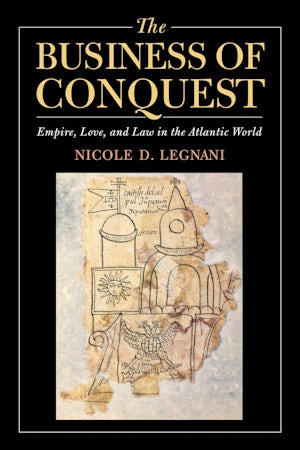
BOOK: Nicole D. LEGNANI, The Business of Conquest - Empire, Love, and Law in the Atlantic World (Notre Dame: University of Notre Dame Press, 2020). ISBN 9780268108960, 55.00 USD


The University of Notre Dame Press is publishing “The Business of Conquest - Empire, Love, and Law in the Atlantic World”.

ABOUT THE BOOK

The Spanish conquest has long been a source of polemic, ever since the early sixteenth century when Spanish jurists began theorizing the legal merits behind native dispossession in the Americas. But in The Business of Conquest: Empire, Love, and Law in the Atlantic World, Nicole D. Legnani demonstrates how the financing and partnerships behind early expeditions betray their own praxis of imperial power as a business, even as the laws of the Indies were being written. She interrogates how and why apologists of Spanish Christian empire, such as José de Acosta, found themselves justifying the Spanish conquest as little more than a joint venture between crown and church that relied on violent actors in pursuit of material profits but that nonetheless served to propagate Christianity in overseas territories. Focusing on cultural and economic factors at play, and examining not only the chroniclers of the era but also laws, contracts, theological treatises, histories, and chivalric fiction, Legnani traces the relationship between capital investment, monarchical power, and imperial scalability in the Conquest. In particular, she shows how the Christian virtue of caritas (love and charity of neighbor, and thus God) became confused with cupiditas (greed and lust), because love came to be understood as a form of wealth in the partnership between the crown and the church. In this partnership, the work of the conquistador became, ultimately, that of a traveling business agent for the Spanish empire whose excess from one venture capitalized the next. This business was thus the business of conquest and featured entrepreneurial violence as its norm—not exception.


The Business of Conquest offers an original examination of this period, including the perspectives of both the creators of the colonial world (monarchs, venture capitalists, conquerors, and officials), of religious figures (such as Las Casas), and finally of indigenous points of view to show how a venture capital model can be used to analyze the partnership between crown and church. It will appeal to students and scholars of the early modern period, Latin American colonial studies, capitalism, history, and indigenous studies.

ABOUT THE AUTHOR

Nicole D. Legnani is assistant professor of Spanish and Portuguese at Princeton University. She is the translator of Titu Cusi: A 16th-Century Account of the Conquest.


More info here

BOOK: Guillaume PÉRISSOL, Le droit chemin. Jeunes délinquants en France et aux États-Unis au milieu du XXe siècle (Paris: PUF, 2020). ISBN: 9782130818779, pp. 576, € 25,00

Le droit chemin. Jeunes délinquants en France et aux États-Unis au milieu du XXe siècle
(Source: PUF)

ABOUT THE BOOK

Le premier tribunal pour enfants apparaît en 1899 à Chicago. Ce modèle, saturé d’idéaux de compassion et de réhabilitation, connaît un succès mondial. Que signifie une telle réussite ? La comparaison franco-américaine permet de mieux comprendre les systèmes de justice des mineurs, actuels et passés. Zazous, prostitués, blousons noirs : la période qui suit la Seconde Guerre mondiale est particulièrement propice à l’analyse, à travers de multiples portraits. Se posent alors de manière aiguë des questions sur l’autorité et l’éducation, dans un contexte de panique internationale autour de la délinquance juvénile.
Cet ouvrage s’inscrit dans un champ interdisciplinaire innovant, au croisement de l’histoire de la jeunesse et de l’histoire de la justice et du contrôle social. Ill s’appuie sur des sources inédites, comme les dossiers des tribunaux pour enfants de Boston et de Paris. Ces archives très riches permettent de découvrir les jeunes jugés déviants et les moyens employés pour les remettre dans « le droit chemin ».

ABOUT THE AUTHOR

Guillaume Périssol est enseignant-chercheur en histoire à l’École nationale de protection judiciaire de la jeunesse du ministère de la Justice. Il est également chercheur associé au CESDIP. Accueilli comme research fellow à l’Université Harvard en 2012, il publie régulièrement en France et aux États-Unis sur la question de la délinquance juvénile.


More information with the publisher.

08 December 2020

BOOK: Inge BILLY, Wieland CARLS, Katalin GONCZI and Marija LAZAR (Eds.), Sächsisch-magdeburgisches Recht in Tschechien und in der Slowakei - Untersuchungen zur Geschichte des Rechts und seiner Sprache (Berlin: De Gruyter, 2020). ISBN 978-3-11-044402-5, 149.95 EUR


(Source: De Gruyter)

De Gruyter is publishing a new book on Saxon-Magdeburg law in the territories of the current Czech Republic and Slovakia.

ABOUT THE BOOK

Der wechselseitige rechtliche und sprachliche Einfluss sächsisch-magdeburgischer Rechtsnormen wird am Beispiel des Sächsischen Weichbildrechts und des Silleiner Stadtrechtsbuchs vorgestellt. Rechts-, forschungs- und sprachgeschichtliche Grundlagen zum Untersuchungsgebiet Tschechien/Slowakei sowie eine detaillierte Analyse des Verhältnisses zwischen der deutschen, tschechischen und slowakischen Rechtssprache zeichnen diesen Band aus.

ABOUT THE EDITORS

Inge Bily, SAW Leipzig; Wieland Carls, SAW Leipzig; Katalin Gönczi, Forschungsstelle "Magdeburger Recht"; Marija Lazar, SAW Leipzig.

TABLE OF CONTENTS

Frontmatter

Inge Bily, Wieland Carls, Katalin Gönczi, und Marija Lazar

Seiten: I–IV

Inhalt

Inge Bily, Wieland Carls, Katalin Gönczi, und Marija Lazar

Seiten: V–XII

Vorwort

Heiner Lück

Seiten: 1–2

A. Einleitung

Wieland Carls

Seiten: 3–10

B. Analyse des Rechtstransfers

Katalin Gönczi

Seiten: 11–76

C. Forschungsüberblick zu den Untersuchungsgebieten Tschechien und Slowakei

Wieland Carls

Seiten: 77–98

D. Rechtsquellen sächsisch-magdeburgischen Rechts im Untersuchungsgebiet

Wieland Carls und Inge Bily

Seiten: 99–134

E. Deutsch-tschechische (frühneuhochdeutsch-alttschechische) kontrastive Wortanalyse anhand einer deutschen Handschrift des „Sächsischen Weichbilds“ mit Glosse (Textzeuge: Hs. B) und einer tschechischen Handschrift des „Sächsischen Weichbilds“ mit Glosse (Textzeuge: Hs. P)

Inge Bily

Seiten: 135–396

F. Verzeichnisse

Inge Bily

Seiten: 397–456

G. Linguistische Forschungen zum Sächsischmagdeburgischen Recht in der Slowakei

Marija Lazar

Seiten: 457–516

H. Zusammenfassung und Bewertung der Untersuchungsergebnisse

Wieland Carls

Seiten: 517–526

I. Kommentare zu den beiliegenden Karten und Listen der Ortsnamen

Inge Bily

Seiten: 527–534

J. Quellen- und Literaturverzeichnis

Wieland Carls

Seiten: 535–634

K. Register

Wieland Carls

Seiten: 635–686

L. Kartenbeilagen

Inge Bily, Birgit Hölzel, und Romana Schwarz

Seiten: 687–688


More info here

BOOK: Antonio GASPARETTO JÚNIOR & Pedro Ivo DIAS TANAGINO, Democracia e estado de exceção: entre o temporário e o permanente (Curitiba: Editora CRV, 2020). ISBN:978-65-5868-050-5, pp. 236, R$ 54,00

 
(Source: Editora CRV)

ABOUT THE BOOK

O livro que o leitor tem em mãos se caracteriza pela diversidade temática que se encontra nos seus dez capítulos, escritos por autores e autoras que atualmente apresentam sólidas pesquisas nos campos do Direito, da História e da Ciência Política, em torno dos conceitos de “democracia” e “estado de exceção”. Suas investigações exibem os mais variados objetos e problemas de estudo, abordados a partir de diferentes enfoques, com grande aposta na interdisciplinaridade em suas abordagens. Estes estudos se aprofundam sobre conceitos, pensadores, instituições, constituições, códigos, leis e normas, questões de gênero, etnias, sexualidade, identidade e classe social, analisados à luz dos problemas, contradições, utopias e desafios que compõem os processos de lutas, compromissos, golpes e resistências em que se formaram os sistemas democráticos contemporâneos. Esses temas têm ganhado cada vez mais centralidade nas Ciências Sociais, e conquistam a atenção de grandes públicos com o destaque que têm recebido na imprensa e na internet, diante das transformações que demarcam o avanço do neoliberalismo e da globalização, que vem trazendo a reboque alguns dos principais dilemas e contradições de nossos tempos. No centro desses debates encontra-se uma miríade de disputas em torno do passado e do futuro das democracias em que vivemos.

ABOUT THE EDITORS

Antonio Gasparetto Júnior: pós-Doutorando em História pela Universidade de São Paulo (USP), Doutor (2018), Mestre (2014), Bacharel e Licenciado (2010) em História e Bacharel em Administração Pública (2017) pela Universidade Federal de Juiz de Fora (UFJF), com estágio de doutoramento (Chercheur Invité) na École Doctorale d’Histoire Moderne et Contemporaine da Université Paris-IV – Sorbonne (2015-2016). Professor Formador na Universidade Federal Fluminense (UFF), Professor Conteudista na Universidade de Pernambuco (UPE), Professor Substituto no Instituto Federal do Sudeste de Minas Gerais (IF Sudeste MG) e Professor Efetivo de Educação Básica (PEB) no estado de Minas Gerais. Pesquisador integrado ao Laboratório de História Política e Social (LAHPS) e do Laboratório de Estudos e Pesquisas da Contemporaneidade (LEPCON). 

Pedro Ivo Dias Tanagino: bolsista de pós-doutoramento (PNPD-CAPES) na Pontifícia Universidade Católica de São Paulo (PUC/SP). Doutor e mestre em História pela Universidade Federal de Juiz de Fora (UFJF), com estágio de doutoramento no Instituto de Ciência Sociais da Universidade de Lisboa (ICS-ULisboa). Autor da tese A Síntese Integral: a teoria do integralismo na obra de Miguel Reale (1932-1939). (UFJF, 2018).


More information and the table of contents with the publisher.

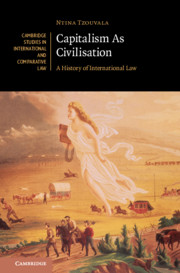
BOOK: Ntina TZOUVALA, Capitalism As Civilisation - A History of International Law (Cambridge: Cambridge University Press, 2020). ISBN 9781108497183, USD 110.00


(Source: CUP)

Cambridge University Press is publishing “Capitalism As Civilisation - A History of International Law”.

ABOUT THE BOOK

Methodologically and theoretically innovative, this monograph draws from Marxism and deconstruction bringing together the textual and the material in our understanding of international law. Approaching 'civilisation' as an argumentative pattern related to the distribution of rights and duties amongst different communities, Tzouvala illustrates both its contradictory nature and its pro-capitalist bias. 'Civilisation' is shown to oscillate between two poles. On the one hand, a pervasive 'logic of improvement' anchors legal equality to demands that non-Western polities undertake extensive domestic reforms and embrace capitalist modernity. On the other, an insistent 'logic of improvement' constantly postpones and engages such a prospect based on ideas of immutable difference. By detailing the tension and synergies between these two logics, Tzouvala argues that international law incorporates and attempts to mediate the contradictions of capitalism as a global system of production and exchange that both homogenises and stratifies societies, populations and space.

ABOUT THE AUTHOR

Ntina Tzouvala, University of Melbourne

Ntina Tzouvala is an ARC Laureate Postdoctoral Fellow at Melbourne Law School. Her research focuses on the political economy, the history, and the theory of international law.

TABLE OF CONTENTS

1. The standard of civilisation in international law: politics, theory, method
2. The standard of civilisation in the nineteenth century: between the 'logic of improvement' and the 'logic of biology'
3. The institutionalisation of civilisation in the interwar period
4. Arguing with borrowed concepts: 'The sacred trust of civilisation' in the South West Africa Saga
5. From Iraq to Syria: legal arguments for the civilising missions of the twenty-first century
6. Thinking through contradictions on a warming planet.

More info here

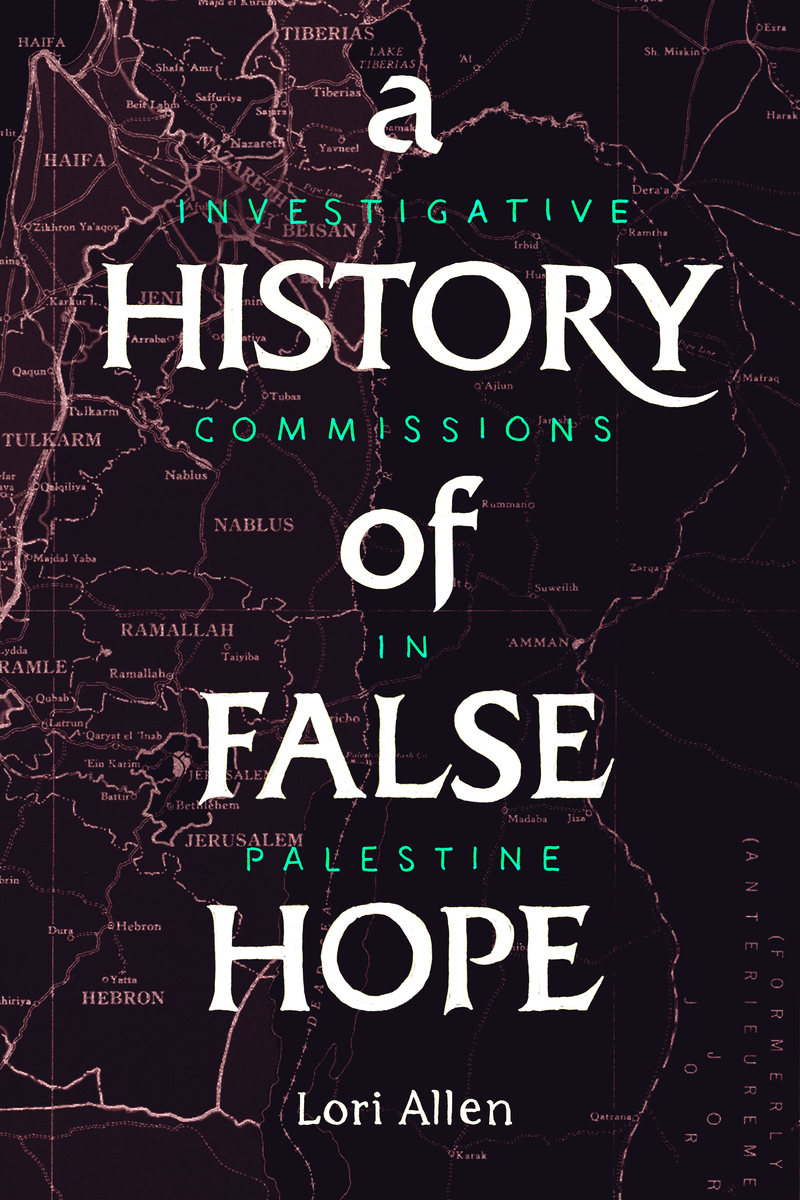
BOOK: Lori ALLEN, A History of False Hope - Investigative Commissions in Palestine (Stanford: Stanford University Press, 2020). ISBN 9781503614185, 30.00 USD.


(Source: SUP)

Stanford University Press is publishing a new book on the history of investigative commissions in Palestine.

ABOUT THE BOOK

This book offers a provocative retelling of Palestinian political history through an examination of the international commissions that have investigated political violence and human rights violations. More than twenty commissions have been convened over the last century, yet no significant change has resulted from these inquiries. The findings of the very first, the 1919 King-Crane Commission, were suppressed. The Mitchell Committee, convened in the heat of the Second Intifada, urged Palestinians to listen more sympathetically to the feelings of their occupiers. And factfinders returning from a shell-shocked Gaza Strip in 2008 registered their horror at the scale of the destruction, but Gazans have continued to live under a crippling blockade.

Drawing on debates in the press, previously unexamined UN reports, historical archives, and ethnographic research, Lori Allen explores six key investigative commissions over the last century. She highlights how Palestinians' persistent demands for independence have been routinely translated into the numb language of reports and resolutions. These commissions, Allen argues, operating as technologies of liberal global governance, yield no justice—only the oppressive status quo. A History of False Hope issues a biting critique of the captivating allure and cold impotence of international law.

ABOUT THE AUTHOR

Lori Allen is Reader in Anthropology at SOAS University of London. She is the author of The Rise and Fall of Human Rights: Cynicism and Politics in Occupied Palestine (Stanford, 2013).

TABLE OF CONTENTS

Introduction: International Law as a Way of Being

1 Petitioning Liberals: The King-Crane Commission

2 Universalizing Liberal Internationalism: The Arab Revolt and the Boycott of the Peel Commission

3 The Humanitarian Politics of Jewish Suffering: The Anglo-American Committee of Inquiry

4 Third World Solidarity at the General Assembly: A UN Special Committee on Human Rights

5 The Silences of Democratic Listening: The Mitchell Committee

6 The Shift to Crime and Punishment: UN Missions Renewing Hope in International Law

Conclusion: Toward an Anthropology of International Law, and Next Time and Again for Palestine


More info here


BOOK: Henry KHA, A History of Divorce Law: Reform in England from the Victorian to Interwar Years (London: Routledge, 2020). ISBN 9780367420062, 120.00 GBP


(Source: Routledge)

Routledge is publishing a book on the legal history of the Matrimonial Causes Act 1857.

ABOUT THE BOOK

The book explores the rise of civil divorce in Victorian England, the subsequent operation of a fault system of divorce based solely on the ground of adultery, and the eventual piecemeal repeal of the Victorian era divorce law during the Interwar years. The legal history of the Matrimonial Causes Act 1857 is at the heart of the book. The Act had a transformative impact on English law and society by introducing a secular judicial system of civil divorce. This swept aside the old system of divorce that was only obtainable from the House of Lords and inadvertently led to the creation of the modern family justice system. The book argues that only through understanding the legal doctrine in its wider cultural, political, religious and social context is it possible to fully analyse and assess the changes brought about by the Act. The major developments included the end of any pretence of the indissolubility of marriage, the statutory enshrinement of a double standard based on gender in the grounds for divorce, and the growth of divorce across all spectrums of English society. The Act was a product of political and legal compromise between conservative forces resisting the legal introduction of civil divorce and the reformers who demanded married women receive equal access to the grounds of divorce. Changing attitudes towards divorce that began in the Edwardian period led to a gradual rejection of Victorian moral values and the repeal of the Act after eighty years of existence in the Interwar years.

The book will be a valuable resource for academics and researchers with an interest in Legal History, Family Law, and Victorian Studies.

ABOUT THE AUTHOR

Henry Kha is a Lecturer in the School of Law, Macquarie University, Australia.

TABLE OF CONTENTS

1 Introduction

2 The Tripartite Divorce System

3 The Enactment of the Matrimonial Causes Act 1857

4 Divorce under the Matrimonial Causes Act 1857

5 The Divorce Courts

6 Divorce Law Reform in the Early Twentieth Century

7 Quo Vadis? The Road to Divorce


More info here

BOOK: Heidi BOHAKER, Doodem and Council Fire: Anishinaabe Governance through Alliance (Toronto: University of Toronto Press, 2020). ISBN 9781442647312, USD 48.75


The University of Toronto Press is publishing a book on the Anishinaabe and clan identification markings on treaties and legal documents during the 17th-19th centuries.

ABOUT THE BOOK

Combining socio-legal and ethnohistorical studies, this book presents the history of doodem, or clan identification markings, left by Anishinaabe on treaties and other legal documents from the seventeenth through the nineteenth centuries. These doodems reflected fundamental principles behind Anishinaabe governance that were often ignored by Europeans, who referred to Indigenous polities in terms of tribe, nation, band, or village – classifications that failed to fully encompass longstanding cultural traditions of political authority within Anishinaabe society.


Making creative use of natural history, treaty pictographs, and the Ojibwe language as an analytical tool, Doodem and Council Fire delivers groundbreaking insights into Anishinaabe law. The author asks not only what these doodem markings indicate, but what they may also reveal through their exclusions. The book also ooutlines the continuities, changes, and innovations in Anishinaabe governance through the concept of council fires and the alliances between them. Original and path-breaking, Doodem and Council Fire offers a fresh approach to Indigenous history, presenting a new interpretation grounded in a deep understanding of the nuances and distinctiveness of Anishinaabe culture and Indigenous traditions.


ABOUT THE AUTHOR

Heidi Bohaker is an associate professor in the Department of History at the University of Toronto.

TABLE OF CONTENTS

Preface

Introduction

1. The Doodem Tradition

2. Family in All Four Directions

3. Anishinaabe Constitutionalism

4. Governance in Action

5. Doodem in the Era of Settler Colonialism

Conclusion

Bibliography


More info here

07 December 2020

PODCAST: House of Wisdom with Dr. Inge van Hulle


(Source: House of Wisdom)


The House of Wisdom Podcast has recently talked to Dr. Inge van Hulle about her new book “Britain and International Law in West Africa: The Practice of Empire”.

"Anthea Roberts asked the question how international is international law? When we look back at the development of international law within West Africa during the 19th century we realise there were many voices involved, not just Britain.  

In this episode, we talk to Dr. Inge Van Hulle about her new book - Britain and International Law in West Africa: The Practice of Empire. We discuss the influence ex colonial powers have had on the development of the international legal system, changing narratives about our perceptions of West Africa, and whether we need to rethink how we teach and research international law.   

Dr. Inge Van Hulle is Assistant Professor of Legal History at Tilburg University, The Netherlands. Prior to joining Tilburg University she worked as a PhD research assistant at the department of Roman law and legal history at KU Leuven where she obtained her PhD in 2016. Her area of expertise is International Legal Theory and International Legal History, in particular colonialism and West Africa."

(Source: Houseofwisdompodcast.co.uk)

BOOK: Sigrid BOYSEN, Die postkoloniale Konstellation - Natürliche Ressourcen und das Völkerrecht der Moderne (Tübingen: Mohr Siebeck, 2020). ISBN 978-3-16-157564-8, 99.00 EUR


(Source: Mohr Siebeck)

Mohr Siebeck has published a new book on post-colonial international environmental law.

ABOUT THE BOOK

Die Begründung des internationalen Umweltrechts suchen die meisten in der Ortlosigkeit seines Gegenstands: Die ökologische Frage kann im Alleingang souveräner Staaten nicht bewältigt werden. Die etwa im Klimaschutzrecht evidenten regulatorischen Probleme lassen sich hiernach nur durch mehr Verrechtlichung und Konstitutionalisierung lösen. Doch das internationale Umweltrecht ist keineswegs ortlos, sondern hat eine sehr konkrete Geographie. Es ist keine Überwindung des Staatenvölkerrechts, sondern die Ausgestaltung der zentralen weltpolitischen Verschiebung im 20. Jahrhundert – der Auflösung des klassischen Imperialismus. Sigrid Boysen rekonstruiert die Begriffe und Institute des heutigen internationalen Umweltrechts genealogisch. Was einst dazu diente, die handelspolitischen Unsicherheiten nach Ablösung der kolonialen Herrschaft zu stabilisieren, teilt die Erde auch heute ein in industrialisierte Zonen und deren äußere Natur.

ABOUT THE AUTHOR

Sigrid Boysen Geboren 1972; Studium der Rechtswissenschaft in Göttingen, Bristol und Hamburg; 2005 Promotion; 2018 Habilitation; seit 2014 Professorin für Öffentliches Recht, Völker- und Europarecht an der Helmut-Schmidt-Universität.

https://orcid.org/0000-0003-2361-0162


More info here

BOOK: Hamilton BRYSON, Some English Law Reporters of Seventeenth Century Cases (Independently published, 2020). ISBN 979-855488-030-8, pp. 278, $7.18

(Source: Amazon.co.uk)

ABOUT THE BOOK

This book is a bibliography of English law reporters who reported cases from the seventeenth century. It gives detailed information about the manuscripts and printed law books.

ABOUT THE AUTHOR

Professor Hamilton Bryson teaches and writes in the areas of English legal history, Virginia legal history, and Virginia procedure and practice. He has published numerous books and book chapters on these subjects, and is the founding editor of the Virginia Circuit Court Opinions. He has also edited and published several collections of early modern English law reports. Professor Bryson is a fellow of the Royal Historical Society, a member of the Executive Committee of the John Marshall American Inn of Court, and the Virginia Correspondent of the Selden Society. He serves on the Advisory Committee on rules of Court of the Supreme Court of Virginia.


More information here.

BOOK: Caroline LASKE, Law, Language and Change. A Diachronic Semantic Analysis of Consideration in the Common Law (Leiden: Brill, 2020). ISBN: 978-90-04-42848-5, € 116.00

(Source: Brill)

ABOUT THE BOOK

Series: Legal History Library, Volume: 42

In this monograph, Caroline Laske traces the advent of consideration in English contract law, by analysing the doctrinal development, in parallel with the corresponding terminological evolution and semantic shifts between the fourteenth and nineteenth centuries. It is an innovative, interdisciplinary study, showcasing the value of taking a diachronic corpus linguistics-based approach to the study of legal change and legal development, and the semantic shifts in the corresponding terminology. The seminal application in the legal field of these analytical methodologies borrowed from pragmatic linguistics goes beyond the content approach that legal research usually practices and it has allowed for claims of semantic change to be objectified. This ground-breaking work is pitched at scholars of legal history, law & language, and linguistics.

ABOUT THE AUTHOR

Dr Caroline Laske is a research fellow at the Ghent Legal History Institute and at the University of Bonn. Her interdisciplinary research lies at the intersection of law, history and language, applying linguistic analysis to study legal history & concepts, comparative law and translation.


More information with the publisher.