Search

Showing posts with label history of private law. Show all posts

02 June 2026

PRIZE: Jean Stengers Prize 2023-2025 to Dave DE RUYSSCHER (Brussels: Académie Royale, 22 MAY 2026)

Prof. Dr. Dave De ruysscher has been awarded the Jean Stengers Prize of the Académie Royale de Belgique for the triennial period 2023–2025. 

He received this distinction in recognition of his study A Political Economy Imparted: Trade, Law, and Institutions in Antwerp c. 1400–1680, a work that sheds new light on the interplay between legal frameworks and economic development in the early modern Low Countries. 

More information at VUB CORE.   

01 June 2026

ADVANCE ARTICLE: Roxana BANU, "Constructing Imperial Authority: The Intersection of British Imperial Constitutional Law and Private International Law" (Oxford Journal of Legal Studies) [OPEN ACCESS]


(image source: OUP)

Abstract:

Historians and constitutional law scholars are starting to uncover the imperial dimensions of the British constitution. But our accounts of the nature of authority in the British imperial context remain incomplete without an engagement with private international law, which played a significant role in conceptualising imperial authority. This article focuses on the forgotten interplay between imperial constitutional law and private international law. It shows how key doctrinal principles of private international law were referenced either as alternatives to or counterparts of key imperial constitutional law principles. Imperial actors would appeal to one or another image of imperial authority constructed by either imperial constitutional law or private international law to gain more autonomy or to tighten control. Far from being a relic of the past, the significance of this history can be traced in contemporary cases and debates about the nature of authority in the UK and its overseas territories.

Read the article here: DOI 10.1093/ojls/gqag012.

21 May 2026

BOOK: Vid ŽEPIĆ, Favor debitoris. Varstvo dolžnika v rimskem pravu (Ljubljana: Univerza v Ljubljani, Pravna fakulteta & Litteralis d.o.o., 2026), 496 p., ISBN 978-961-7162-25-7, € 79.90

(image source: Knjigarna Pravna)

Abstract: 

Monografija obravnava razvoj načela favor debitoris oziroma krepitev varstva dolžnika v poznoantičnem rimskem pravu. Na podlagi analize cesarskih konstitucij od 4. do 6. stoletja prikazuje, kako so družbene, gospodarske in politične spremembe vplivale na zakonodajne ukrepe za zaščito dolžnika kot šibkejše stranke obligacijskega razmerja.

Posebna pozornost je namenjena razlagi pogodb, omejevanju pogodbene avtonomije, prenehanju obveznosti ter izvršbi in zavarovanju terjatev. Raziskava obenem osvetljuje vpliv gospodarske krize, provincialne pravne prakse, stoiške filozofije in vzhodnorimskih pravnih šol na razvoj poznega rimskega prava ter pokaže, kako so ti procesi vplivali tudi na kasnejši razvoj socialnih korektivov v civilnem pravu.

On the author:

Dr. Vid Žepič je docent na Katedri za pravno zgodovino Pravne fakultete Univerze v Ljubljani.

Table of contents:

Uvod
     1.1 Razvojne težnje in dejavniki rimskega obligacijskega prava
     1.2 Metodologija
     1.3 Stanje raziskav

(2) Razvojni dejavniki postklasičnega prava
     2.1 Cesarske konstitucije – ius novum
     2.2 Razvojni dejavniki

(3) Favor debitoris in njegove pojavne oblike
     3.1 Favor debitoris – pojmovna analiza
     3.2 Razlaga pravnih poslov
     3.3 Omejevanje pogodbene avtonomije
     3.4 Prenehanje obveznosti
     3.5 Zavarovanje in izvršba

(4) Sklep
     4.1 Favor debitoris v rimskem pravnem izročilu
     4.2 Razvojni dejavniki načela favor debitoris
     4.3 Pot do materializacije civilnega prava

(5) Zusammenfassung

Find more on Pravna fakulteta Univeza v Ljubljani & Knjigarna pravna.

01 May 2026

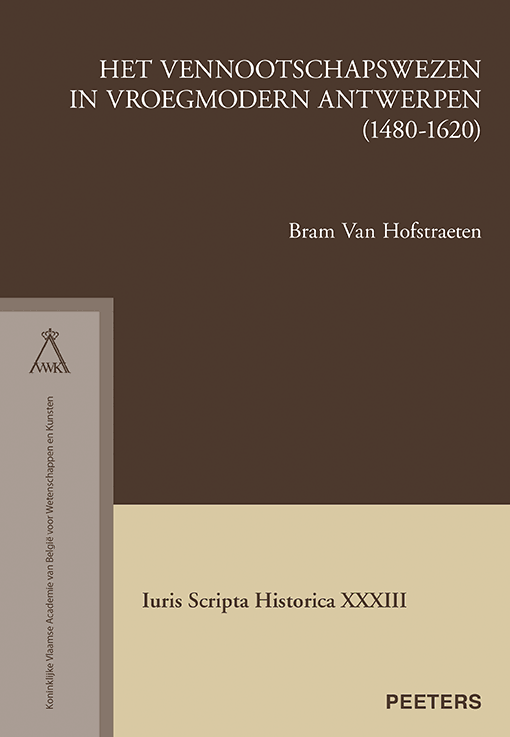
BOOK: Bram VAN HOFSTRAETEN, Het vennootschapswezen in vroegmodern Antwerpen (1480-1620) [Iuris Scripta Historica; 33] (Leuven: Peeters, 2025), VIII + 480 p. ISBN 9789042955356, € 85

(image source: Peeters)

Abstract:
In 1608 werd in Antwerpen de Consuetudines compilatae voltooid. Deze vierde en laatste redactiepoging van het Antwerpse gewoonterecht bevat maar liefst 27 artikels van vennootschapsrechtelijke aard. Kort na het verschijnen van de compilatie weerklonk echter de kritiek dat de redacteuren tal van nieuwe, niet-costumiere normen hadden ingevoerd. Dit boek onderzoekt de houdbaarheid van deze kritiek, in het bijzonder met betrekking tot het geredigeerde vennootschapsrecht. Enerzijds wordt de juridische oorsprong van de vennootschapsrechtelijke bepalingen in de Consuetudines compilatae onderzocht; anderzijds wordt hun inhoud getoetst aan de vennootschappelijke gebruiken zoals die in de zestiende-eeuwse handelspraktijk geobserveerd werden. Als dusdanig zal blijken dat de redacteuren in de eerste plaats remedies wensten te formuleren voor de meest voorkomende oorzaken van vennootschapsgerelateerde onenigheden. Dat zij zich hierbij vaak lieten inspireren door niet-Antwerpse en niet-costumiere rechtsbronnen beïnvloedde de verhouding tussen het geredigeerde vennootschapsrecht en de Antwerpse ondernemers. Men had immers een juridisch kader gecreëerd dat niet noodzakelijk strookte met de gangbare zestiende-eeuwse vennootschappelijke gebruiken in de Scheldestad.

See table of contents here.

More information with the publisher.


30 April 2026

WORKSHOP: Saskia LETTMAIER, "Marriage and Madness: The Origins of the Marriage of Lunatics Act of 1742" [Stanford Center for Law and History Workshop] (Stanford: Stanford University, 5 MAY 2026) (9:45 PM - 10:45 PM CET) [HYBRID]


Saskia Lettmaier, Professor of Law and Global Legal History at the University of Hamburg, will present her paper, "Marriage and Madness: The Origins of the Marriage of Lunatics Act of 1742"

Abstract:

In 2021, the Parliament of the Irish Republic—as the last legislature in Great Britain and Ireland—abolished an Act to Prevent the Marriage of Lunatics. This Act had its origins in a British statute of 1742, which was subsequently extended to Ireland and was in force in all parts of the British isles from 1811 until 1959, when it was abolished for England and Wales. The Act has been almost completely ignored by (legal) history. Quite undeservedly so, for it may claim to be the first English general act since the Elizabethan settlement to interfere with the traditional canon law of marriage, predating the much more famous Hardwicke Marriage Act by more than a decade. It rendered absolutely void the marriages of persons who had been found lunatic by commission under the Great Seal or whose persons and estates had been placed under trustees by Act of Parliament. Such persons could no longer contract a valid marriage after 24 June 1742, not even during a lucid interval, unless they had first been declared of sound mind by the Lord Chancellor or other competent authority. Yet there is little evidence to suggest that unsuitable marriages by lunatics constituted a widespread social problem in mid-eighteenth-century England. Given the English reluctance to pass general acts in this period, why was the esoteric topic of lunatics’ marriage singled out for general legislative treatment, rather than being dealt with—like the thorny issue of divorce—through private acts on a case-by-case basis? This paper seeks to answer that puzzle. In doing so, it explores the intersection of marriage law, property protection, elite family strategy, and parliamentary power, taking us into the worlds of high society and high politics in eighteenth-century Britain.

 Pratical information:

                             Tuesday, May 5
                         12:45-1:45 PM (PT)
          Room 320D, Stanford Law School
                              and via Zoom 

To RSVP, click here. 

14 April 2026

REGISTRATION and PROGRAM: Journées internationales de la Société d'histoire du droit et des institutions des pays flamands, picards et wallons: dirigeants et dirigés (Versailles: Musée Lambinet, 15-16 MAY 2026) [DEADLINE 5 MAY 2026]

(Election of the President of the French (Third) Republic in the Salle du Congrès, Versailles; source: Wikimedia Commons

Sixteen speakers are announced for the Journées internationales de la Société d'histoire du droit et des institutions des pays flamands, picards et wallons: dirigeants et dirigés, to be held in Versailles on 15 and 16 May 2026.


Journées internationales d’Histoire du droit et des institutions des pays flamands, picards et wallons

Internationale rechtshistorische dagen van de Vereniging voor de Geschiedenis van het Recht en de Instituties van Vlaanderen, Picardië en Wallonië


Versailles, les 15 et 16 mai 2026


“Dirigeants et dirigés”


Programme provisoire


Vendredi 15 mai 2026


9 h 30 :  Accueil des participants au Musée Lambinet

9 h 45 : Ouverture du colloque par les organisateurs, Catherine Lecomte et Tanguy Le Marc’hadour

10 h : Séance 1 - Gouvernants et dirigeants (I) :

Antoine Leclère, doctorant, FRS-FNRS/Université de Liège/Vrije Universiteit Brussel : « Un dirigeant pour la Révolution liégeoise : les débats autour du Conseil de régence (1789-1790) »

Antonio Grilli, professeur, Università degli studi, ecampus : « Direction d'en haut, entre énergie et humanité : Louis-Ghislain de Bouteville et François-Joseph Rudler (1795-1798 ».

Catherine Denys, professeure, Université de Lille : « Diriger la police d’une colonie d’Ancien Régime, Pierre-Henry Saucet à Port-Louis (île Maurice) dans les années 1780 ».

11 h 15 : Pause-café

11 h 30 : Séance 2 - Gouvernants et dirigeants (II) :

Julie Rocheton, professeure, Loyola University, New Orleans : « Diriger après 1789 : la famille Derbigny entre Picardie et Louisiane »

Xavier François-Leclanché, docteur en droit, consultant : « Gouvernants et gouvernés après la chute de Napoléon (1814) »

Frederik Dhondt, professeur, Vrije Universiteit Brussel : « Les dirigeants dirigés ?  Perspectives externes sur les élites « belges » de 1725 »

12 h 45 : Pause méridienne

14 h 30 : Séance n° 3 - Diriger la ville

Sophie Petit-Renaud, professeure, Université de Versailles-Saint-Quentin : « Dire le ‘murmure’: qualifier et contrôler la parole populaire dans les registres de délibérations de l’échevinage d’Amiens au XVe siècle »

Fred Stevens, professeur ém., KU Leuven : « Turnhout 1830. La gouvernance d’une petite ville devenue zone frontalière »

15 h 30 : Pause

15 h 45 Séance n° 4 - Diriger l’Etat

Nicolas Jehiel, doctorant, Université de Lille : « La rhétorique légaliste de l’“ordre moral” lors de la crise du 16 mai 1877, au service du dualisme constitutionnel »

Catherine Lecomte, professeure ém., Université de Versailles-Saint Quentin, présidente honoraire de la société : « Versailles, capitale de la République »

17 h : Visite

20 h : Banquet de la société


Samedi 16 mai 2026


9 h : Séance 5 - Diriger par la Justice

Jeroen Chorus, senior consultant, professeur ém., Leiden : « Recyclage du droit romain dans la théologie morale à Leuven, vers l'an 1500 : le futur Pape Hadrien VI »

Brent Huygh, doctorant, Vrije Universiteit Brussel : « Protecteur de toutes les communautés” : Le Conseil de Brabant et les litiges des administrations villageoises, XVIIe-XVIIIe siècles »

Téo Boufflers, Université d’Artois : « Le droit de chasse, entre ayant-droit et usager, entre Cambrésis et Artois »

10h 30 : Pause-café

10 h 45 : Séance 6 - Diriger en temps de guerre et d’occupation (I)

Stefano Cattelan, postdoctorant, Vrije Universiteit Brussel & Brussels School of Governance : « Gouverner par la neutralité : dirigeants et dirigés dans la République de Venise en temps de guerre (1688–1714) »

Thibault Barbieux, maître de conférences, Université de Versailles-Saint-Quentin : « La capitulation de Lille (1667), instrument juridico-politique entre gouvernants et gouvernés »

Ambre Jarassier, doctorante en histoire du droit, Université de Nantes : « La réforme de l’armée par Napoléon III : la défiance des militaires face au chef de l’État »

12 h 15 : Pause méridienne

13 h 30 : Séance 7- Diriger en temps de guerre et d’occupation (II)

Louise Martens, doctorante, KU Leuven/FWO : « Le devoir de défendre : les avocats belges devant les juridictions pendant et après la Deuxième Guerre mondiale »

Sebastiaan Vandenbogaerde, professeur, université de Gand : « Entre soumission et négociation. Les autorités locales en Flandre pendant la Première Guerre mondiale (1914-1918) »

Séance 8 :  Perspectives contemporaines

Aziz Sadik, docteur en droit, Université Mohamed V, Rabat : « Obéir ou résister ? Les formes juridiques et sociales de contestation des dirigés »

15 h :  Assemblée générale de la société

16 h : Visite

Invitation and registration form below:


Société d'histoire du droit et des institutions

des pays flamands, picards et wallons 

(fondée à Lille en 1929)


Journées internationales d'histoire du droit et des institutions

VersAILLES, les 15 et 16 mai 2026


À l’invitation de la présidente honoraire Catherine Lecomte, doyenne honoraire de la faculté de droit et de science politique de l’Université de Versailles Saint Quentin en Yvelines, les journées internationales d'histoire du droit et des institutions 2026 auront lieu cette année à Versailles, les 15 et 16  mai 2026, et auront pour thème général :


« Dirigeants et dirigés ».


Le sujet propose une réflexion sur les gouvernements à travers la personne de ses dirigeants, ses qualités attendues, ses modes de désignation, ses réseaux, ses limites personnelles et les garde-fous institutionnels. Le thème des Journées n’est pas en outre limité à une réflexion sur les seuls dirigeants politiques mais s’étend à l’étude des dirigeants d’autres organisations juridiquement constituées et productrices elles-mêmes d’une réglementation, comme les dirigeants militaires, municipaux, provinciaux, mais aussi les dirigeants spirituels (la direction de l’Église) ou économiques (les directions de sociétés). Enfin, le thème de la rencontre comprend aussi l’étude des dirigés, de leur adhésion à leurs dirigeants ou à l’inverse la manière dont ils s’expriment et s’organisent pour limiter leurs dérives.


Les séances de travail se dérouleront au musée Lambinet, situé 54, boulevard de la Reine.


Pour les déjeuners, nous nous rendrons dans un restaurant près du lieu des sessions.


Le vendredi, après les sessions, ainsi que le samedi, après l’assemblée générale clôturant le congrès, nous prévoyons une visite d’un haut lieu de Versailles. Les demandes et les démarches administratives sont en cours.


Le traditionnel dîner de la Société se déroulera le vendredi soir au centre-ville.


Les détails des lieux des déjeuners, du dîner et du banquet seront communiqués ultérieurement, lorsque le programme des sessions sera établi (l’appel à communications étant encore en cours, ledit programme ne peut pas encore être fixé).


Les frais d'inscription au congrès s'élèvent à 30 euros par participant(e) et comprennent la documentation et les pauses café ; la participation aux frais des déjeuners du vendredi midi et du samedi midi est fixée à 35 euros par personne par repas et la participation au dîner du vendredi soir à 60 euros par personne.


L’inscription se fait en envoyant le formulaire d’inscription avant le 5 mai 2026 par courriel à : tanguy.lemarchadour@univ-artois.fr.


Le numéro de compte bancaire sera ultérieurement envoyé aux inscrits pour leur permettre de régler par virement.


Le bureau de la Société,                                            


Le Président,                                                              Le Secrétaire Général,

Tanguy Le Marc’hadour                                  Christian PFISTER


Les Vice-Présidents,                                                 Le Trésorier,

Stanislas HORVAT                                                    Pascal HEPNER

Michael MILO                                  


Société d'histoire du droit et des institutions des pays flamands, picards et wallons


Journées internationales d'histoire du droit et des institutions

VERsailles, 15-16/05/2026


FORMULAIRE D'INSCRIPTION / REGISTRATION FORM


À envoyer avant le 5 mai 2026 par courriel à : tanguy.lemarchadour@univ-artois.fr

To be sent before May 5th, 2026 by e-mail at : tanguy.lemarchadour@univ-artois.fr


Monsieur/Mr – Madame/Mrs : ………………………………………………………………..


Adresse / Address :             ...………………………………………………………………………

                                   …………………………………………………………………...........

Portable / Cell phone  …………………………………………………………………..……..


E-mail : ……………………………………………..


1° Droit d’inscription congrès / Registration fee Congress      ……  30 €             Total :      .…. €


2° Lunch vendredi / Lunch Friday 15-05-2026                       

    Nombre de personnes / Number of persons :                            …… x 35 €               Total :      .…. €


3° Lunch samedi / Lunch Saturday 16-05-2026          

    Nombre de personnes / Number of persons :                            …… x 35 €               Total :      .…. €


4° Dîner vendredi soir / Dinner Friday evening (nombre limité / limited number)

    Nombre de personnes / Number of persons :                            …… x 60 €               Total :      .…. €


5° Total à payer / Total amount to be paid:                                                                   ..……... €


6° Visites / Visit :

le vendredi 15 mai / on Friday 15 May :

Participera / Will participate :                     OUI/YES – NON/NO

            Nombre de personnes / Number of persons :      ……


le samedi 16 mai / on Saturday 16 May :

            Participera / Will participate :                     OUI/YES – NON/NO

            Nombre de personnes / Number of persons :      ……


Payements au compte bancaire de la SOCIETE/ Payments on bank account of the SOCIETY :

IBAN _FR76 1670 6000 1416 5360 2370 606- BIC __AGRIFRPP867_____________

Au nom de / Account holder : _La société des amis de l’histoire en sud Artois__________________


Attention : Toute inscription donne lieu à l’obligation de paiement des frais

Be aware that registration leads to the obligation to pay the foreseen cost


23 March 2026

CALL FOR PAPERS: Age of Empires II. Europe and the Empires of the West in a Changing World Order (1900–1937) (Győr: University of Győr, 27-29 OCT 2026) [DEADLINE 30 APR 2026]

(image source: Wikimedia Commons)


The Exposition Universelle, the world exhibition held in Paris in 1900 under the theme ‘19th century: an overview’, opened as a confident display of European and Western dominance. The optimism that shaped contemporary beliefs in a bright future and in scientific progress was reinforced by the many technical solutions and inventions on display—several of which have since become part of everyday life. Yet behind the glittering façade of an event proclaiming the uninterrupted advance of civilisation, intensifying competition among the world’s leading powers was increasingly evident, alongside mounting tensions over access to resources and markets. Europe’s leading states made considerable efforts to expand, develop, and administer their empires, while the limits of cooperation were exposed by a series of open crises in the years following the turn of the century. Moreover, the outcomes of nineteenth-century globalisation—expanding international institutions, accelerating information flows, and deepening transnational economic relations—proved insufficient to prevent the collapse of the nineteenth-century world order in the First World War.


Although the conflict, which profoundly affected territories beyond Europe as well, ultimately enabled the victors to establish a new international order, it did not bring the anticipated easing of tensions or the arrival of a stable and peaceful era. The redrawing of Europe’s political map created space for nationalist and nation-state aspirations; however, strategic considerations remained paramount, and the settlement failed to achieve broad legitimacy. Continental tensions persisted, while the traditional strategic aims of European actors continued, largely unchanged, from the pre-war period. Empire-building, together with a renewed multiplicity of expansionist aspirations, thus became a defining feature of the era. At the same time, newly created institutions sought to shape the international arena alongside both established and emerging state regimes.


In 1937 Paris hosted a world exhibition once again, organised under the theme ‘Arts and technology in modern life’ - the last European world exhibition before the outbreak of war. It entered history not only as the final such event created in the shadow of the post-war peace treaties, but also as an exhibition marked by political rivalry and by visible signs of impending collapse. Although vast territories remained under European control—either directly or through League of Nations mandates—expectations concerning the effective functioning of international organisations, the consolidation of international legal institutions, and the reorganisation of economic and cultural relations increasingly proved illusory. The history of Europe and the empires of the Western world order had reached a new frontier.


The organisers of The Age of Empires II – Europe and the Empires of the West in a Changing World Order (1900–1937) consider it essential to strengthen academic dialogue and to bring together speakers from diverse disciplines and regions. We warmly encourage proposals from researchers in legal history, international law, history, international relations, economics, and related fields, including interdisciplinary approaches.


Key topics (non-exhaustive)

1.Global system or European system? Political and legal instruments of empire-building; stages in the evolution of the international system

2.Economic dimensions of empire-building: transformations in world trade and financial mechanisms; economic and legal perspectives

3.The realm of information: communication networks, international communication organisations, and technological control as a tool of imperial power

4.State territory, citizenship, and mobility within imperial spaces

5.Representation and symbolism: forms and layers of imperial representation

6.Collapses and transitions: the legacies of the Austro-Hungarian Monarchy, Germany, Russia, and the Ottoman Empire

7.The crisis of parliamentarianism and its alternatives: imperial and popular models of representation in a changing world

8.Nation-building and identity: empire-building and the ‘melting pot’ of national unification in new imperial formations

9.Press communication and models of news regulation: state control and instruments of mass communication

10. Variations in social thought: state intervention and instruments of social welfare

The Department of Legal History at the Faculty of Law and Political Sciences, University of Győr, is organising an international symposium from 27 to 29 October 2026. We invite researchers working within the thematic and chronological scope of the conference to present their findings in a 20-minute paper, followed by discussion. Accepted contributions will be published in the form of a study (30,000–40,000 characters). Application Applications must be submitted by 30 April 2026 to aoe2026@sze.hu  and should include: an abstract (including the proposed topic) of no more than 500 words; and a short biography of no more than 100 words. Applicants will be notified of the outcome by 31 May 2026. Presentations may be delivered in English, German, or French.


Attila Barna - Balázs Pálvölgyi

Organizers

16 March 2026

SYMPOSIUM: "Connaître la responsabilité aquilienne. Un héritage indispensable au-delà du droit" (Liège: ULiège, 12-13 MAR 2026)

(image source: ULiège)

The university of Liège organised a two-day international symposium on the Lex Aquilia and its heritage on 12 and 13 March.

Program:


Jeudi 12 mars

  • 14h30-15h00: Introduction par Marc BOURGEOIS, Doyen de la Faculté de droit, Science Politique et Criminologie
  • 15h00-16h30: La responsabilité aquilienne dans l’Antiquité : origines et évolutions romaines - Aquilian Liability in Antiquity: Roman Origins and Developments
    • Discussant : Pascal PICHONNAZ (Université de Fribourg)
    • Communications :
      Jean-François GERKENS (Université de Liège)
      Sara GALEOTTI (Università Roma Tre)
  • 16h30-17h00 : Pause-café
  • 17h00-18h30: Au-delà de la responsabilité aquilienne - Beyond Aquilian Liability
    • Discussant : Jean-François GERKENS (Université de Liège)
    • Communications :
      Doris FORSTER (Université de Genève)
      Wouter DRUWÉ (KU Leuven)

Vendredi 13 mars

  • 9h30-11h00: La responsabilité aquilienne entre héritage antique et défis modernes - Aquilian Liability Between Ancient Heritage and Modern Challenges
    • Discussant : Wolfgang ERNST (University of Oxford)
    • Communications :
      Maria Floriana CURSI (Università degli Studi di Roma Tor Vergata)
      Valentina CVETKOVIC-DORDEVIC (Univerzitet u Beogradu)
      Olivier DESCAMPS (Université Paris 2 Panthéon-Assas)
  • 11h00-11h30 : Pause-café
  • 11h30-13h00: Entre antiquité et modernité : une évolution constante - Between Antiquity and Modernity: A Constant Evolution
    • Discussant : Wim DECOCK (Université catholique de Louvain et Université de Liège)
    • Communications :
      Wolfgang ERNST (University of Oxford)
      Wiktoria SARACYN (Uniwersytet Warszawski)
      Francesco Saverio TAVAGLIONE (Université de Liège) 
  • 14h30-15h30: Les enjeux pratiques de la responsabilité aquilienne dans les ordres juridiques actuels - Practical Challenges of Aquilian Liability in Current Legal Systems
    • Discussant : Wouter DRUWÉ (KU Leuven)
    • Communications :
      Elisa SCHILS (Université de Liège)
      Céline JOISTEN (Université de Liège)
      Marie-Sophie BONDON (La Rochelle Université)
  • 15h30 - 16h00: Pause-café
  • 16h00-17h00: Les nouveaux défis de la responsabilité aquilienne : l’intelligence artificielle - The New Challenges of Aquilian Liability: Artificial Intelligence
    • Discussant : Boudewijn SIRKS (University of Oxford)
    • Communications :
      Pascal PICHONNAZ (Université de Fribourg)
      Ljupcho GROZDANOVSKI (Université de Liège
  • 17h00: Conclusions


Read more here

  •