Search

Showing posts with label open access. Show all posts

23 October 2026

FIRST VIEW ARTICLES: Law and History Review [OPEN ACCESS]

(image source: CUP)


Female Perseverance in the Courtroom: Gendered Litigation Patterns in Early Modern Brabant and Limburg (Klaas Van Gelder) [OPEN ACCESS]
DOI 10.1017/S0738248026101862
Abstract:

This article contributes both methodologically and substantially to the debates on uses of justice in early modern Europe and, more specifically, about how and to what extent women asserted their rights in the courtroom. The approach is quantitative, with an analysis involving three courts in the duchies of Brabant and Limburg during the seventeenth and early eighteenth centuries: the princely Council of Brabant as well as the local aldermen’s benches of the towns of Vilvoorde and Tienen. Systematically determining the proportion of women at the beginning of court cases (through the court rolls and distribution books) and comparing it to the proportion at the end of the proceedings (through the judgment books) reveals remarkable gender patterns: When women decided to go to court, they were more likely than men to litigate until a final judgment was rendered. Moreover, they sued on a narrower range of issues than men, with a preponderance of cases on inheritance, annuities, and debts. The explanation for this perseverance in court may be that women were less able to use informal forums for conflict resolution, or—more likely based on the sources that form the basis of this contribution—that they experienced a greater need to prove their rights than men.

From Exclusion to Protection: Chinese Merchant Capital in the Philippines Under US Law and Empire, 1921–1926 (Jilene Adelina Chan Chua) [OPEN ACCESS]
DOI 10.1017/S0738248026101837
Abstract:

Scholarship about the Chinese Question has largely understood it as a “coolie” question, but what if it was reframed in terms of merchants? Well-studied US anti-Chinese laws like the 1882 Chinese Exclusion Act targeted working-class rather than elite Chinese, like merchants and students. But in 1921, the US-controlled Insular Government in the Philippines enacted a statute known as the Chinese Bookkeeping Act (Act No. 2972), marking a moment when US Chinese exclusion laws were directed toward businessowners. The act banned Chinese-language record-keeping and affected merchants ranging from small storeowners to multi-millionaire tycoons. A group of Chinese merchants in the Philippines sued the colonial government and appealed their case to the US Supreme Court, which ruled the Bookkeeping Act unconstitutional in 1926. For the “coolie” Chinese question, the US Supreme Court said “yes” to exclusion, but for the merchant Chinese question, the Court said “no.” The Court’s rejection of a merchant Chinese exclusion became part of the Philippines’ transformation into a US colony. In relation to a patriotic Filipino capital and unmarked Euro-American capital, Chinese capital won rights even as it was framed within US law as “alien” by American and Filipino judges and politicians and, surprisingly, by the Chinese merchants themselves.

Keeping It (Too Much) in the Family: Annulment by Reason of Affinity in Eighteenth-Century Venice (Celeste McNamara) [OPEN ACCESS]
DOI
Abstract:

Although divorce was increasingly available through religious and civil courts in 18th-century Europe, the Catholic Church still considered marriage indissoluble. Thus, the only legal route out of a marriage was annulment. Historians have noted several strategies for annulments in premodern Europe, most often claims of lack of consent. One less common but interesting way to seek annulment was to claim affinity by fornication, in which one spouse claimed a premarital sexual relationship with a close relative of the other. Couples could also make a similar claim of a violation of public honesty, in which a person was originally betrothed to one person but then married their close relative. Both constituted impediments to marriage according to canon law. In 18th-century Venice, the Patriarchal tribunal heard a steady stream of these cases. Couples, along with their families, friends, and neighbors, provided detailed testimony to the tribunal to attain annulments. This article argues that the narrative structures and testimonies in these cases demonstrate that 18th-century Venetians thought that bad marriages should not be indissoluble, in spite of the Catholic Church’s refusal to allow divorce, and were willing to push the boundaries of truth to work around the legal restrictions they faced.

Love or Law: Viking Foundations of Medieval English Dispute Settlement (Jake A. Stattel) [OPEN ACCESS]
DOI 10.1017/S0738248026101850
Abstract:

In prominent legal historical works, Michael Clanchy and Stephen D. White constructed an important paradigm for medieval dispute settlement by adapting the phrase “law and love” from the Anglo-Norman Leges Henrici Primi. Yet, rarely has this aphorism’s background been explored. This article argues that “love or law” has roots in Viking-Age Scandinavia, where this Old Norse terminology represented a unique dynamic of dispute resolution revolving around harsh “law” pressuring parties to make “love” settlements outside of court. Contrasting sharply with Anglo-Saxon disputing norms centered on formal compensation tariffs, “love or law” found its way to England’s tenth-century Danelaw, first recorded in the Wantage Code. This alliterative pair continues in English writings, while “love-days” become a major cultural feature, and more broadly, the dynamic of threateningly punitive “law” inducing “love” agreements appears in action within early common law case records. In ways that recollect Icelandic and Danelaw practices, negotiated compensation occurring “under the shadow of law” may have been a major feature of medieval English dispute as hinted by our surviving sources. Scandinavian dispute concepts, occasionally coined by unique “love or law” vocabulary, may have had a subtle yet profound influence on some of the grounding assumptions of English common law. 

Filling the Legal Void: Missionaries as Legal Actors in Regulating Monogamous Unions in the Congo Free State (1885–1908) (Ilaria Masseroni) [OPEN ACCESS]
DOI 10.1017/S0738248026101916
Abstract:

In the Congo Free State, where the administration of Leopold II concentrated on economic exploitation and largely neglected family law, Belgian missionaries assumed functions the state left unattended. This article examines how they became legal actors in the regulation of marriage between 1885 and 1908, imposing monogamy as a condition of Christian and civilized life against the widespread practice of polygamy. Officiating marriages, keeping civil registers, adjudicating disputes over dowry, and organizing Catholic villages where monogamous unions were institutionalized, missionaries operated as intermediaries between the colonial administration and Congolese communities, their authority resting at once on canon law and on the practical demands of governance. Drawing on missionary periodicals, correspondence, decrees, and administrative records, the study reconstructs a legal role that has received little scholarly attention, situating it within debates on legal pluralism and vernacular imperial constitutionalism that treat law as a fluid practice articulated by diverse actors rather than a fixed body of metropolitan rules. By placing missionaries at the center of colonial lawmaking, the article shows how religion and law were interwoven in the making of the colonial state, even as local communities resisted and reshaped the norms imposed upon them. In conclusion, this study reveals the complexities of missionary involvement in colonial governance and offers new insights into the intersection of law, religion, and colonialism in Central Africa.

Law and Justice in the Court of the Marshalsea of the King’s Household, 1509–1547 (Jonathan McGovern)  [OPEN ACCESS]
DOI 10.1017/S0738248026101941
Abstract:

The court of the marshalsea, which originated in the late thirteenth century, exercised jurisdiction over a circular area of twelve miles’ radius centered on the king’s current residence. This article offers the first scholarly discussion of this mysterious court in the reign of Henry VIII. It begins by discussing the court’s criminal jurisdiction and its judicial procedure in felony cases, explaining the significance of a 1542 statute that expanded and clarified its jurisdiction over serious crimes committed within the palace precinct. The article then analyzes the court’s civil jurisdiction and suggests reasons why its officers may have been willing to stretch jurisdictional rules in cases of trespass. Next, the article discusses what is known about the personnel of the court, charting the rise of the under-steward of the marshalsea (referred to as steward from 1539) as its chief controlling officer. I show that by 1542, the court’s jurisdiction had become trifurcated into a plea side, an rdinary criminal side, and a “palace” criminal side. Reforms to the court in the reign of Henry VIII illustrate a general process of judicial regularization that occurred in the early sixteenth century. The regularization of legal institutions during Henry’s reign was a “reformation from within” that promised to be far less destructive than the “reformation from without” forced on the marshalsea and other legal institutions under the Stuarts.

The Founding as Ideology (Aaron Hall) [OPEN ACCESS]
DOI 10.1017/S0738248026101886
Abstract:

The “Founding” is a keyword in the United States’ constitutional vocabulary. Across popular politics, public law, and civic culture, it signifies a closed moment of constitutional creation—and often much more. Invocations commonly involve vague yet powerful significations about constitutional authority, memory, and meaning-making. Particularly as “originalist” judicial and academic writing leans on these submerged qualities, it is worth asking: what is the Founding? This Article proposes a conceptual answer in historical context. Through a close study of contours of antebellum constitutionalism, it argues for understanding the Founding as an ideology that committed Americans to venerate and defer to an authoritative, originary constitutional era. Forged as citizens grappled with the politics of slavery, the Founding structured language and perception, motivated action and inaction, and delimited boundaries of political possibility. This Article studies two essential sites of inculcation apart from formal power—civic ceremonies and educational practices—to sketch the structure of the constitutional Founding as ideology. Then, it outlines how that ideology authorized constitutional actions of voting, legislating, judging, protesting, and seceding. In conclusion, the Article suggests that its analysis models a broader framework for interpreting the diffuse materials of constitutional life across periodizations of constitutional history. Approaching the Founding as ideology can allow scholars to better see how its relative authority over time and the purposes to which it has been directed have shaped American constitutional experience.

Writing Women into the Constitution: Gendered Citizenship and Reproductive Autonomy in Republican China (Yu Liu)  [OPEN ACCESS]
DOI 10.1017/S0738248026101801
Abstract:

This article reinterprets the constitutional history of Republican China by foregrounding women as active participants in constitution-making and critique. While the Guomindang (KMT) portrayed constitutions as instruments to conclude the Nationalist Revolution, proclaiming gender equality as already achieved and subsuming women’s rights under nationalist and eugenic imperatives, feminist actors engaged constitutional discourse as a strategic arena for political struggle. Drawing on writings, petitions, and debates from the 1930s to the 1940s, the article shows how women transformed reproductive labor, maternal welfare, and birth control into constitutional questions central to the meaning of citizenship. Through birth control clinics, Women’s Constitutional Research Associations, and lobbying for quotas, equal pay, maternity protections, and property rights, feminists treated the constitution not as a fixed text but as an opportunity to reshape institutional design and challenge structures that perpetuated gendered exclusion. Their critiques exposed the biopolitical logics embedded in eugenic policy, marriage regulation, and maternalist ideology, while their proposals articulated a competing vision of constitutionalism that sought to use legal reform as leverage for broader transformation. Situating the Chinese case alongside global examples of bottom-up constitutional engagement, the article argues that women’s activism produced a distinctly gendered form of popular constitutionalism. It highlights both the possibilities and limits of pursuing equality through constitutional reform within an ascendant party-state and underscores the enduring tension between constitutional governance and women’s reproductive autonomy.

Time Out of Joint: Raymond Carré de Malberg and the Referendum in the Public Law of the Third Republic (Amnon Lev) [OPEN ACCESS]
DOI  10.1017/S0738248026101783
Abstract: 

The article examines the state theory of French public lawyer Raymond Carrré de Malberg. It argues that he responds in a highly original way to a crisis of public law government that is tied to the emergence of the social sciences and to the democratization of society. The analysis ties Carré de Malberg’s attempt to salvage the idea of public law government to his reflections on the referendum, which he will reject as incompatible with the regime of the Third Republic, only to rehabilitate it in his late work. The analysis brings to light a depletion of the ideological resources of public law government, which speaks to a European-wide crisis of public law. As we shall show, it also speaks to an overarching crisis of a bourgeois society that had channeled its power through the legislature but realized that this organ of government would not continue to be the seat of power in society.

16 October 2026

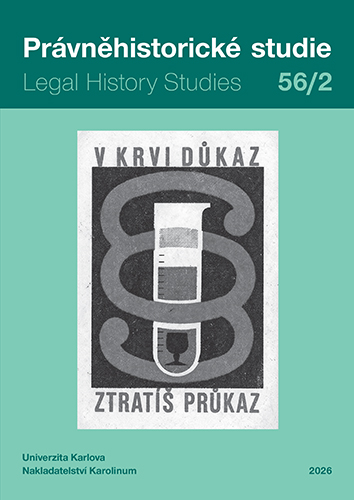
JOURNAL: Právněhistorické studie / Legal History Studies LVI (2026), Nr. 2 [OPEN ACCESS]


On the journal:
Právněhistorické studie / Legal History Studies (Charles University journal; below referred to as PHS or Journal) is a scientific journal listed in the international prestigious database SCOPUS. The journal is published by Charles University in Prague under the guarantee of the Department of Legal History of the Faculty of Law of Charles University. It is published by the Karolinum Press. The journal focuses on the field of legal history and related topics. Issue 1 of the Journal was published by the Czechoslovak Academy of Sciences Publishing in June 1955. The Journal was initially published by the Cabinet of Legal History of the Czechoslovak Academy of Science (CSAV), later by the Institute of State and Law (CSAV) and then by the Institute of Legal History of the Faculty of Law of Charles University. PHS is issued three times a year in April, August, and December and it presents original scientific works/papers as well as reviews, annotations and news from the scientific field of legal history. It also introduces annotated texts of a legal history nature. PHS accepts manuscripts from domestic as well as foreign authors. Manuscripts submitted by foreign authors are published in original language, namely in English, Slovak, German, French, Italian or Polish. PHS (ISSN 0079-4929) is registered in the Czech national ISSN centre (supervised by the State Technical Library). The Journal is registered by the Ministry of Culture of the Czech Republic according to Act No. 46/2000 Sb., on Rights and Liabilities for the Publishing of Periodicals and Change of Some Acts (Press Act), and it is allocated with registration number of periodical press MK E 18813. PHS is an open journal and ensures open access to scientific data (Open Access). The entire content is released as open to the public on the web pages of the journal.

Table of contents (with links to the articles):

  • Editorial
    Petra Skřejpková
    • Od rituálov k alimentácii: Náčrt raného vývoja fideikomisov v prospech familia libertorum
      Timotej Práznovský
      DOI 10.14712/2464689X.2026.550
      Abstract:
      The paper explores the early development of the Roman legal institution known as the fideicommissum familiae relictum, with a particular focus on its application in favour of groups of freedmen (familia libertorum). It argues that the phrase ne de nomine suo exiret – commonly found in testamentary dispositions and funerary inscriptions – reflects a concern with ensuring the continuity of burial rites and private cults (sacra privata). Drawing on epigraphic evidence and legal sources, particularly the Digest of Justinian and fragments from jurists such as Aburnius Valens and Scaevola, the paper examines how land bequests to freedmen were structured to guarantee the upkeep of tombs and the perpetuation of ancestral worship. The analysis reveals that over time, particularly from the mid-2nd century CE onward, the institution appears to have shifted towards a more alimentary function, providing support for freedmen in the absence of biological heirs. Legislative developments, such as Hadrian’s ban on dispositions to uncertain persons (personae incertae), curtailed the long-term application of such fideicommissa, leading to alternative legal mechanisms, including transfers to municipalities. The development of fideicommissa in favour of freedmen thus illustrates broader transformations in Roman private law and social practice, including the decline of traditional religion and the rise of new forms of property management and welfare provision in the Roman world.

    • K vplyvu provinčných práv a východorímskych právnických škôl na zavedenie pojmu dos adventicia do justiniánskej kodifikácie
      Róbert Brtko
      DOI 10.14712/2464689X.2026.551
      Abstract:
      The article examines the origin and legal significance of the concept of dos adventicia in Roman law. Although Justinianic sources and post-classical legal texts distinguish between dos profecticia and dos adventicia, the article proceeds from the thesis that this distinction was not originally formulated by classical Roman jurists. On the basis of an analysis of Ulpian’s fragment D. 23, 3, 5, the relevant scholia to the Basilica, the post-classical Regulae Ulpiani, and imperial constitutions preserved in Justinian’s Code, it is shown that classical law primarily operated with the category of dos profecticia, whereas other forms of dowry were defined only negatively, that is, as dowry not originating from the father of the family or from his property. Particular attention is paid to the interpolated passages in D. 23, 3, 5, 9 and D. 23, 3, 5, 11, as well as to the rescript of Emperor Gordian III preserved in C. I. 6, 20, 4. The article further examines the influence of provincial legal traditions, Hellenistic legal culture, and the pedagogical activity of Eastern Roman law schools, especially those in Berytus and Constantinople, on the terminology and systematics of the legal regulation of dowry. It concludes that dos adventicia should be understood not as an authentic classical concept, but rather as a product of post-classical legal development that was later incorporated into Justinian’s codification.
    • Between Custom and Sanction: Theft in the Vinodol Code and the Poljica Statute
      Fuad-Meša Čičić
      DOI 10.14712/2464689X.2026.552
      Abstract:
      This paper addresses the regulation of theft as an illicit act in two major medieval Croatian legal monuments: the Vinodol Code (1288) and the Statute of Poljica. Rather than offering a systematic comparison of legal systems, the study concentrates on the legal nature, normative structure, and penal treatment of theft within these statutory frameworks, situating the offence in its broader social and institutional context. The central premise is that, although medieval law did not articulate theft through modern criminal-law categories, both statutes treated it as conduct attracting distinctly criminal sanctions rather than as a purely civil wrong. Attention is directed to the criteria shaping liability and punishment, including the manner of commission, the value of the stolen property, the status of the parties, and the communal or territorial context of the offence. In the Vinodol Code, theft is predominantly addressed through graded pecuniary sanctions and restitution, reflecting a compensatory model. By contrast, the Statute of Poljica adopts a markedly stricter penal regime, frequently prescribing corporal punishment, capital sanctions, and social exclusion, thereby emphasizing deterrence and collective self-protection within a customary legal order. Both legal monuments place considerable emphasis on communal participation in adjudication, including compurgation and character-based proof, illustrating a legal culture in which property offences were regulated through collective responsibility and social control. While certain conceptual parallels with Roman law may be observed, the regulation of theft in both texts is primarily rooted in native legal traditions shaped by local social structures and customary norms. The paper situates theft as a key indicator of the criminal dimension of medieval Croatian statutory law and its role in preserving social order and communal cohesion.

    • Autokratické tendence německého císaře Viléma II. ve vztahu k legislativnímu procesu Říšského sněmu (1888–1900)
      František Stellner, Kristina Kaiserová
      DOI 10.14712/2464689X.2026.553
      Abstract:
      The study “Autocratic Tendencies of German Emperor Wilhelm II in Relation to the Legislative Process of the Reichstag (1888–1900)” analyzes the constitutional and political framework of the German Empire during the reign of Wilhelm II, focusing on his approach to the legislative process and interaction with the Reichstag. It examines whether the emperor’s attitude toward parliament evolved in connection with personnel changes in the highest German and Prussian offices and how the dual identity of “emperor-king” influenced governance. The paper discusses mechanisms of pressure and circumvention applied by Wilhelm II toward the Reichstag, including rhetoric, court networks, and personnel policy, and evaluates their limits within the federal structure. It also addresses the concept of “personal rule” and its historiographical interpretations, contrasting rhetorical antiparliamentarism with practical dependence on parliamentary majorities. The analysis combines micro- and macro-historical perspectives, using constitutional texts, parliamentary records, and correspondence of key actors. The conclusion emphasizes that despite autocratic impulses, the emperor’s power was structurally constrained, and legislative outcomes depended on negotiation and compromise, contributing to the gradual parliamentarization of decision-making in the German Empire.
    • Výzva svědomí a hledání spravedlnosti – Tolstého „Vzkříšení“ z pohledu práva
      Radim Seltenreich
      DOI 10.14712/2464689X.2026.554
      Abstract:
      In his article, the author discusses Tolstoy’s work Resurrection, which is often characterized as a distinctly “legal novel”. For a better understanding of the context, he first introduces us to Tolstoy’s life and work, in which law played an important role, if only because he studied law, even though he did not complete his studies. In this context, for example, he showed a lifelong interest in the issue of the death penalty. The novel Resurrection is based on a real case that Tolstoy learned about from the famous Russian lawyer Koni. Tolstoy changed the facts somewhat, but it is interesting to note that in the novel he makes precise references to specific legal provisions during the court proceedings. The work is a strong criticism of criminal law and the prison system in Russia at the time, with Tolstoy also addressing the philosophy of crime and punishment, rejecting the punishment of one person by another as part of his “Christian anarchism”.

    • Veřejní notáři na meziválečné Podkarpatské Rusi
      David Hubený
      DOI 10.14712/2464689X.2026.555
      Abstract:
      As in many other areas of the administration of Subcarpathian Ruthenia, in the area of justice, a number of temporary measures persisted, which proved to be long-term, but mainly functional, even if they did not fully satisfy the call for the fulfillment of autonomous status. In the case of public notaries, this was also mostly due to the fact that an independent organizational arrangement would not be practical and viable, considering the size and population of the given territory. Therefore, the public notaries of Subcarpathia were initially administered by the Košice judicial board, or rather by the local high court, and later joined the organization of Slovak public notaries. Looking at the biographies of many public notaries, one cannot help but get the impression that in the case of appointment to the position, it was a reward for previous political or official activity in favor of Czechoslovakia or the promotion of Slavic reciprocity, sometimes, on the contrary, it could be a saturation of a not entirely reliable public figure. Although, considering the very small number of notaries, it might seem that in the conditions of Subcarpathian Ruthenia it was a lucrative position ensuring more than a decent income, most of the public notaries there got into financial problems in the first half of the thirties, and even in times of boom not all positions were economically advantageous enough to ensure their holders a sufficient livelihood. Knowing this fact, it is clear how very poor Subcarpathian Ruthenia was and how desperate the situation of the vast majority of the local population was.

    • Německé vojenské soudnictví a vojenské trestní právo se zvláštním zřetelem k Protektorátu Čechy a Morava
      Jaromír Tauchen
      DOI 10.14712/2464689X.2026.556
      Abstract:
      The article deals with the activities of the German military judiciary (Wehrmachtjustiz) in the Protectorate of Bohemia and Moravia during the period of Nazi occupation. Despite its significance, this issue has so far been neglected in Czech legal historiography. The study presents a systematic analysis of the structure, legal basis and operation of German military courts, whose jurisdiction extended beyond German military personnel to include Czech civilians. Particular attention is paid to the legal foundations of military criminal law, the specific features of court proceedings, and the ideological instrumentalization of military justice as a tool of repression. The functioning of military courts is illustrated through selected institutional examples, especially the military court of the 193rd Division stationed in Prague. The study demonstrates how military criminal law and procedure, especially after 1939, gradually developed into an instrument of terror used to suppress resistance, discipline soldiers and enforce ideological conformity. The text is based on original archival materials, including directives, military court rulings and legal regulations of the Third Reich.
    • Kodifizierung vertraglicher Rechtsgeschäfte zwischen natürlichen Personen im V. Teil des Bürgerlichen Gesetzbuches von 1964 in der Tschechoslowakei. Allgemeine Definition, politischer und internationaler Kontext und konzeptionelle Fragen
      Jiří Šouša, Vít Mužík
      DOI 10.14712/2464689X.2026.557
      Abstract:
      Following the recent anniversary of the Czechoslovak Civil Code of 1964, this article contributes to the legal-historical and civil law scientific discourse on this legal regulation. The article is the first of two articles focusing on contractual obligations between natural persons. These obligations were intended to be supplementary to the services provided mainly by legal entities. It focuses primarily on codification work concerning contractual obligation law, its conceptualization, and the legal institution of civil assistance, all in the context of the preparation of the 1964 Civil Code, or rather in the context of the recodification of law in Czechoslovakia and other Eastern Bloc countries in the 1960s. The article also reflects specific cases and points out the similarities and specific features that distinguished the Civil Code of 1964 from a historical and international perspective. The article shows the extent to which the examined regulation of Part V of the Civil Code of 1964 was an expression of the political doctrine of the 1960s in the context of other innovations, or in relation to the traditional Marxist-Leninist doctrine. The article shows whether, and to what extent, similar to the later International Trade Code, it followed (or rather suffered from) traditional elements of obligations, albeit in a modified and truncated form and using the terminology of the time, in contrast to the rest of the 1964 Civil Code. The article highlights the differences between law in books and law in action. It therefore also addresses issues of continuity and discontinuity, autonomy of the parties’ free will, and the scope for judicial discretion with regard to the topic under examination. The article also reflects the finding that experience with the Civil Code of 1964 shows that the political utilitarianism of law does not necessarily limit its adaptability and functionality. On the contrary, even such regulations can be very adaptable to social and legal evolution. The most important general findings and insights from the research are clearly summarized in the conclusion. The article will be followed by another article by the same authors, which will focus on specific legal institutions of contractual law between natural persons according to the original wording of Part V of the Czechoslovak Civil Code of 1964.

    • „V krvi důkaz, ztratíš průkaz!“ aneb k trestnému činu opilství v socialistickém Československu
      Milan Dobeš
      DOI 10.14712/2464689X.2026.558
      Abstract:
      The article focuses on the offence of drunkenness, understood as an endangerment offence, with particular emphasis on drink-driving. It combines a doctrinal legal analysis with an examination of criminal files from the District Court for Prague 1 and surveys the interpretation of the statutory elements, investigative and evidentiary practice, and sanctioning policy. In the sanctioning dimension, a central role is played by disqualification from activity – most notably disqualification from driving – conceived as an instrument of both special and general prevention and as a means of the immediate protection of public safety. The imposition and duration of disqualification reflected the degree of intoxication, the nature and circumstances of the driving, recidivism, and the offender’s professional responsibility; in more serious cases it was supplemented by a custodial sentence. The article also addresses practical issues in the enforcement of disqualification and their implications. The individualisation of punishment was further shaped by assessments and guarantees issued by workplace collectives and other socialist organisations, which could support the choice of a more lenient sanction or the early remission of the remainder of the disqualification.

    • The Concept of Possession in Roman Law and Common Law
      Barbora Hniličková
      DOI 10.14712/2464689X.2026.559
      Abstract:
      This article examines the legal regulation of possession in Roman law and in contemporary common law. Its objective is to identify and assess the key similarities and differences between these two legal traditions and to demonstrate that, despite their fundamental systematic distinctions, the influence of Roman law on the development of common law has been more substantial than often assumed. The analysis shows that, notwithstanding divergent historical developments and systematic characteristics, both systems articulate conceptually comparable understandings of possession. The findings further confirm that Roman law contributed, at least to some degree, to the shaping of common law, underscoring the enduring reach of Roman law not only within continental legal systems but also within modern common law jurisdictions.
    • Crimen maiestatis: Symbolism and Ritual Protection of Authority in Roman Criminal Law
      Marie Neumann
      DOI 10.14712/2464689X.2026.560
      Abstract:
      This article focuses on the development of the crime of high treason throughout the era of the Roman Empire, focusing on symbolism and ritual protection of authority in Roman criminal law. Using legal sources and historical cases, it illustrates the changes of this offence, with an emphasis on the changing perceptions of authority. The article draws on legal sources, especially the Code of Justinian and Theodosius and the Digest of Justinian, but also on non-legal sources, especially the work of Titus Livy, as well as other ancient historians. Furthermore, the article works with a variety of domestic and foreign secondary sources, especially monographs and scholarly articles.
    • Herbert David: Justice v říšské župě Sudety optikou vzpomínek jejího hlavního představitele
      Adam Šplíchal
      DOI  10.14712/2464689X.2026.561
      Abstract:
      This study examines the fate of justice in the Reichsgau Sudetenland through the recollections of its leading representative, Dr. Herbert David (1900–1987). Drawing on archival research in German repositories and David’s own memoirs, the article reconstructs the transformation of the legal system in the Sudetenland after its annexation to the Third Reich in 1938. David’s memories, written decades later, represent a unique and hitherto underexplored source that illuminates the personnel challenges, institutional restructuring, and ideological pressures faced by the judiciary in this border region. His testimony reveals both the practical functioning of courts under Nazi rule and the tensions between local actors and central Reich authorities. By contextualizing David’s narrative with secondary literature on Nazi law and Sudeten German politics, the article highlights the interplay between law, ideology, and power in a newly established Reichsgau. It also addresses the limitations and biases of David’s recollections, while emphasizing their value as the only surviving insider account of judicial administration in the Sudetenland during the years 1938–1945.

    • Právní aspekty reorganizace československého divadelnictví po druhé světové válce
      Kateřina Šustová
      DOI 10.14712/2464689X.2026.562
      Abstract: 
      After World War II (in May 1945), Czechoslovakian theaters were reopened. The so-called theater revolution began, during which the theater industry in Czechoslovakia experienced fundamental changes in organizational structure. Despite the efforts of Austria-Hungary and the First Czechoslovak Republic, this space was still regulated by the Theater Act of November 25, 1850 (Ministry of the Interior law No. 454/1850). There were also plans to consolidate the regulation of the theater industry in Czechoslovakia, as Hungarian legal article XXXI had been in effect since 1848 in Slovakia. This was a different (and even older) legal regulation than the one in Bohemia. This work explores the legal considerations of the aforementioned reorganization of theaters. The main goal of the research is to describe how the pre-World War regulatory environment affected the evolution of theater industry regulation thereafter, including mapping out any significant path dependencies. This work subsequently addresses the regulatory changes that occurred in the theater industry after the adoption of the Theater Act in 1948. This author found that the adoption of the Theater Act in 1948 capped a long-term effort by theaters to modify the legal regulation of the theater industry. However, this impeded entrepreneurship and gave monopoly to government-designated theater operators, who were allowed to use the property of the previously private theaters. On the other hand, there were some positive changes, particularly in the field of theater education and puppet theater, which came to be seen as on equal footing with other types of theater arts. However, even the Theater Act of 1948 was not sufficient, and new theater regulation, Act No. 55/1957, on theater activities (Theatre Act), emerged shortly thereafter and came into effect on November 16, 1957.

    • That’s What Should Be Done! Reflections on the Margins of the Monograph of Peter Candy, Ancient Maritime Loan Contracts
      Maciej Jońca
      DOI 10.14712/2464689X.2026.563
      Abstract:
      In 2025, Dr. Peter Candy (University of Cambridge) published a monograph titled “Ancient Maritime Loan Contracts”. In it, he challenged many of the findings that had been firmly established in the study of Roman law since the 19th century. In his examination of Roman maritime law, he first undertook a “democratization” of the ancient sources. This led him to a surprising conclusion. Namely, the Romans (like the Greeks) did not recognize a separate maritime loan contract. They used a single, consistent loan structure that could be adapted for various purposes – including conducting business at sea. This work deserves attention among legal historians because the author not only debunked a (seemingly) unshakable dogma but also demonstrated how ancient sources remain a flexible and forward-looking subject for research. There are no topics about which nothing more can be written, as long as there are people who are not afraid to ask old sources new questions.

    • Ve službě právní historii – za profesorem JUDr. Karlem Malým, DrSc., dr.h.c.mult.
      Vladimír Kindl
    • Zemřel doc. JUDr. Karel Schelle, CSc., spiritus rector Encyklopedie českých právních dějin
      Ladislav Vojáček
    • BALOGH, E. (ed.). Golden Bulls and Chartas: European Medieval Documents of Liberties
      Jan Marčík
    • VYŠNÝ, P. – MARTIŠKOVÁ, M. Praktikum zo svetových dejín štátu a práva
      Ingrid Lanczová
    • POLLÁK, A. – KOLUMBER, D. – GAJARSKÝ, A. Keď zákony tvorí vláda a parlament mlčí. Zmocňovacia normotvorba na česko-slovenskom príklade v rokoch 1918–1945
      Jan Kabát
    • TAUCHEN, J. (ed.) – KUBEŠ, V. Dějiny filozofie práva
      Vojtěch Jarkovský
    • LACLAVÍKOVÁ, M. – DOMANICKÝ, M. Počiatky zľudovenia súdnictva a etablovanie funkcie sudcov z ľudu na Slovensku v rokoch 1948 – 1953 (normatívna báza a prvotné problémy)
      Ingrid Lanczová

    Read the full issue here.

    07 October 2026

    BOOK: Dante FEDELE & Orazio CONDORELLI (eds.), Droit international et relations interconfessionnelles : étude d'une dynamique historique (XVe-XXe siècle) [Études d’histoire du droit et des idées politiques, vol. 40; dir. Florent GARNIER] (Toulouse: Presses de l'Université Toulouse Capitole, 2026) [OPEN ACCESS]


    (image source: openedition)

    Abstract:

    Issu d’un projet international mené par le Centre d’histoire judiciaire (CNRS-Université de Lille) et le Département de droit de l’Université de Catane, cet ouvrage explore les relations complexes entre droit international et relations interconfessionnelles du XVe au XXe siècle. À rebours d’une vision longtemps dominante qui faisait de la modernité juridique l’aboutissement d’un processus linéaire de sécularisation, les contributions réunies ici interrogent les modalités selon lesquelles les rencontres et les conflits entre groupes de religions différentes ont contribué à façonner des concepts, des principes et des pratiques ayant structuré le droit international. Adoptant une perspective de longue durée, l’ouvrage envisage le droit international non pas comme un simple ordre interétatique, mais comme un cadre normatif pluriel destiné à réguler les interactions entre des acteurs aux statuts variés. À travers une série d’études de cas couvrant les périodes médiévale, moderne et contemporaine, il montre combien les débats théologiques et canoniques ont nourri la recherche de formes de coexistence et de dialogue entre confessions. En proposant une réflexion historique sur un sujet dont l’actualité demeure manifeste, ce volume contribue à une meilleure compréhension des dynamiques religieuses qui continuent de façonner les relations entre les sociétés humaines.

    Editors:

    Dante Fedele (dir.) Chargé de recherche HDR au Centre d'Histoire Judiciaire (HMR 8025 CNRS-Université de Lille) Orazio Condorelli (dir.) Professeur de Droit et Religion, Université de Catane 

    Read the full book on openedition. 

    30 September 2026

    BOOK REVIEW: Jan MARKERT on Eckart CONZE, Friedlos. Die Deutschen zwischen Kriegsgewalt und Friedenssuche von 1648 bis heute (München: Deutscher Taschenbuch Verlag, 2026) (H/Soz/Kult)


    (image source: H/Soz/Kult)

    First paragraph:
    Die Frage nach der Aktualität historischer Publikationen ist nicht immer leicht zu beantworten. Der wissenschaftliche Blick in die Vergangenheit grenzt jede Gegenwartsbezogenheit meist auf strukturabstrakte Kontinuitätsdebatten oder Forschungskontroversen ein. Nur selten gewinnen Bücher und Studien a posteriori durch tagesaktuelle Entwicklungen explizit den Charakter eines Kommentars des Zeitgeschehens. Einer dieser Ausnahmefälle liegt jedoch mit Eckart Conzes umfassender Darstellung der deutschen Kriegs- und Friedensgeschichte vor. Das Nachwort datiert den Abschluss der Manuskriptarbeiten auf den Januar 2026 (S. 510). Nur einen Monat später wurde auch Deutschland durch den Beginn des Irankrieges vor neue sicherheitspolitische Herausforderungen gestellt. Dieser neue globale Konflikt verleiht dem Buch des Marburger Historikers geradezu ungewollt Tagesaktualität, weshalb es nicht nur für ein geschichtsinteressiertes Publikum von Interesse sein dürfte.

    Read more here. 


    24 September 2026

    ARTICLE: Arno DAL RI Jr., "François Laurent in Brazil. The defense of the Principle of Nationalities that crossed the Atlantic (1899-1978)" Sartoniana XXXVIII (2025), 53-84 [OPEN ACCESS]


    (image source: UGent)

    On the journal:

    Sartoniana is a yearly publication that publishes the lectures delivered as part of the Sarton Chair of History of Science at Ghent University. All articles are published in open access, as of volume 40 with a CC-BY licence, which permits unrestricted use, distribution, and reproduction in any medium, provided the original author and source are credited.

    Read more here: DOI 10.21825/sartoniana.101334.

    21 September 2026

    BOOK: Michael WERNER, Diesseits und jenseits der Nation : Deutsch-französische Verflechtungen 1815-1870 [Deutsch-Französische Geschichte, vol. 6] (Heidelberg: Heidelberg University Publishing, 2025) [OPEN ACCESS]


    (source: HeiUP)

    On the series:

    Inspired by the »histoire croisée«, the eleven-volume handbook series Deutsch-Französische Geschichte sheds light on the complex history of relations between Germany and France from the 9th century to the present day. The peer review of the volumes was ensured by the GHIP’s international scientific advisory board which acted as a review committee. The German-language volumes are published by the Wissenschaftliche Buchgesellschaft (WBG) Darmstadt and Heidelberg University Press, while the French-language volumes are published by the Presses universitaires du Septentrion (PUS) Villeneuve d'Ascq.

    Abstract:

    Das 19. Jahrhundert gilt als Zeitalter der Verwandlung. In Deutschland und Frankreich ist der Zeitraum von 1815 bis 1870 von vielfältigen politischen, sozialen und kulturellen Entwicklungen bestimmt, die mit dem Prozess der Nationsbildung zu tun haben. Der Fokus des Bandes liegt jedoch nicht auf nationalen Entwicklungspfaden. Vielmehr beleuchtet er, im Sinne einer histoire croisée, transnationale Verflechtungen, die Frankreich und Deutschland wechselseitig geprägt haben. Dabei wird gezeigt, wie sich die Prozesse auf vielfältigen Ebenen entfalteten: von Politik und Wirtschaft über Bildung und Forschung bis hin zu Medien, Vereinen und den Künsten. Auch prä- und postnationale Entwicklungen werden in den Blick genommen. So entsteht ein vielschichtiges Bild, das die bisherigen Vorstellungen einer „Erfindung der Nation“ zugleich erweitert und relativiert.

    See here for a full list of volumes. 

    Read the full book in open access: DOI 10.17885/heiup.1519. 

    16 July 2026

    OPEN ACCESS: Sébastien DUBOIS, Bruno DEMOULIN, & Jean-Louis KUPPER (Eds.). Les institutions publiques de la principauté de Liège (980-1794). [Studia, 133] (Brussels: State Archives of Belgium, 2012), 2 vol.

    (image: Joseph Clement of Bavaria, Prince-Bishop of Liège; source: Wikimedia Commons)

     Abstract:

    Bonne nouvelle ! Le guide 𝘓𝘦𝘴 𝘪𝘯𝘴𝘵𝘪𝘵𝘶𝘵𝘪𝘰𝘯𝘴 𝘱𝘶𝘣𝘭𝘪𝘲𝘶𝘦𝘴 𝘥𝘦 𝘭𝘢 𝘱𝘳𝘪𝘯𝘤𝘪𝘱𝘢𝘶𝘵é 𝘥𝘦 𝘓𝘪è𝘨𝘦 (980-1794) est désormais consultable en ligne et téléchargeable gratuitement ! Les Archives de l’État à Liège conservent de riches fonds d’archives de la principauté de Liège, mais pour y accéder, il faut connaître l’histoire, l’organisation, les compétences et les activités des institutions de l’un des États les plus singuliers de l’Europe d’Ancien Régime. L’organisation politique et administrative liégeoise (où pouvoirs temporel et spirituel s’entrecroisent) est complexe et différente des autres états d’Ancien Régime et, bien sûr, des institutions contemporaines. L’ouvrage offre une synthèse complète et structurée des institutions liégeoises -administratives, judiciaires, financières et militaires ; tant centrales (Conseil privé, États, Chambre des comptes, Cour allodiale, Cour féodale, etc.) que régionales (duché de Bouillon, comté de Looz, condominium de Maastricht, etc.) et locales (villes, métiers, échevinages, etc.). Chaque ville fait l’objet d’une notice spécifique. Chaque notice suit un cadre clair : histoire, organisation, compétences, activités, principaux textes normatifs, listes de fonctionnaires, sources archivistiques et éditions, bibliographie.

    Read more here. 

    (source: Celida [Centre liégeois de documentation archivistique)

    10 July 2026

    CLH ARTICLE: Lukasz Jan KORPOROWICZ, The Polish Blackstone: an examination of nineteenth-century Polish scholars’ interpretations of Blackstone and his Commentaries (Comparative Legal History, XIV (2026), nr. 1, pp. 73-96) [OPEN ACCESS]

    (Image source: Taylor&Francis)

    Abstract:
    The principal goal of this article is to address the reception of William Blackstone's legal thought and the awareness of his contributions within the context of nineteenth-century Polish legal scholarship. Despite the considerable differences between English and Polish legal traditions, the limited proficiency in the English language within Poland, and the relatively gradual evolution of Polish legal thought, Blackstone's works were acknowledged by academic circles in Poland in the nineteenth century. Over time, this awareness manifested in direct engagement with certain aspects of Blackstone's perspectives. Nonetheless, the temporal disparity between Blackstone's period of influence and the evolution of legal scholarship in partitioned Poland significantly limited the practical opportunities for the integration and application of Blackstonian jurisprudence.

    To read the article, please click here. The article is available in open access; the full issue is freely accessible online to members of the European Society for Comparative Legal History.

    DOI: /10.1080/2049677X.2026.2671597


    09 July 2026

    BOOK: Xavier PRÉVOST, Rafael RAMIS BARCELÒ, Luigi Alberto SANCHI (eds.), Qu’est-ce que l’humanisme juridique? - Che cos’è l’umanesimo giuridico? - ¿Qué es el humanismo jurídico? (Madrid: Dykinson, 2026). ISBN: 979-13-7047-310-5, 202 p. [OPEN ACCESS]


    (Source: uc3m)

    Abstract:

    El presente libro tiene como objetivo responder a una pregunta fundamental: ¿Qué es el humanismo jurídico? Tras la introducción de Xavier Prévost y Luigi Alberto Sanchi, se recogen las reflexiones de Patrick Arabeyre, Mario Ascheri, Diego Quaglioni, Italo Birocchi, Wouter Druwé y Rafael Ramis Barceló, quienes abordan las cuestiones esenciales desde una amplia perspectiva europea. A continuación, se presentan, como estudios de caso, dos traducciones al francés —realizadas por Philippe Cocatre Zilgien y Théo Crea— de obras de dos célebres humanistas: François Douaren y Eguiner Baron. The present book seeks to answer a fundamental question: What is legal humanism? Following the introduction by Xavier Prévost and Luigi Alberto Sanchi, the volume brings together contributions by Patrick Arabeyre, Mario Ascheri, Diego Quaglioni, Italo Birocchi, Wouter Druwé and Rafael Ramis Barceló, who address the essential issues from a broad European perspective. The book then offers, as case studies, two French translations—prepared by Philippe Cocatre Zilgien and Théo Crea—of works by two renowned humanists: François Douaren and Eguiner Baron.

    Table of contents:

    Introduction / Xavier Prévost, Luigi Alberto Sanchi (pp. 9-18). -- De quoi le bartolisme est-il le nom? / Patrick Arabeyre (pp. 19-40). -- Umanesimo giuridico e crisi del diritto comune / Mario Ascheri (pp. 41-50). -- Umanesimo giuridico e senso della tradizione / Diego Quaglioni, Saxum Sysyphi (pp. 51-62). -- Il problema della definizione dell’umanesimo giuridico: uno specchio per lo storico del diritto / Italo Birocchi (pp. 63-82). -- L’humanisme juridique dans le contexte des Pays-Bas méridionaux / Wouter Druwé (pp. 83-98). -- El humanismo jurídico: definición, etapas y categorías para su estudio / Rafael Ramis-Barceló (pp. 99-134). -- François Douaren, De docendi discendique iuris ratione (1544) : proposition de traduction / Philippe Cocatre-Zilgien (pp. 135-194). -- La préface De ratione docendi discendique iuris civilis, ad iuventutem écrite par Eguiner Baron / Théo Crea (pp. 195-202)

    More information and open access PDF available here.