Search

Showing posts with label Blackstone. Show all posts

10 July 2026

CLH ARTICLE: Lukasz Jan KORPOROWICZ, The Polish Blackstone: an examination of nineteenth-century Polish scholars’ interpretations of Blackstone and his Commentaries (Comparative Legal History, XIV (2026), nr. 1, pp. 73-96) [OPEN ACCESS]

(Image source: Taylor&Francis)

Abstract:
The principal goal of this article is to address the reception of William Blackstone's legal thought and the awareness of his contributions within the context of nineteenth-century Polish legal scholarship. Despite the considerable differences between English and Polish legal traditions, the limited proficiency in the English language within Poland, and the relatively gradual evolution of Polish legal thought, Blackstone's works were acknowledged by academic circles in Poland in the nineteenth century. Over time, this awareness manifested in direct engagement with certain aspects of Blackstone's perspectives. Nonetheless, the temporal disparity between Blackstone's period of influence and the evolution of legal scholarship in partitioned Poland significantly limited the practical opportunities for the integration and application of Blackstonian jurisprudence.

To read the article, please click here. The article is available in open access; the full issue is freely accessible online to members of the European Society for Comparative Legal History.

DOI: /10.1080/2049677X.2026.2671597


19 July 2019

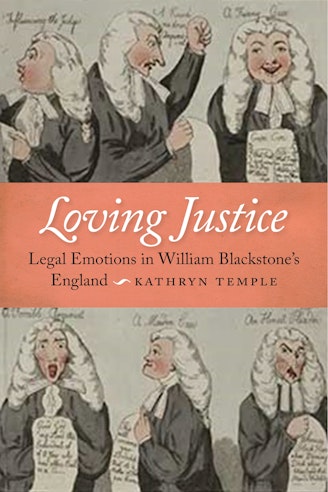
BOOK: Kathryn TEMPLE, Loving Justice: Legal Emotions in William Blackstone’s England (New York: NYU Press, 2019). ISBN 9781479895274, $45.00


(Source: NYU Press)

NYU Press has published a new book on legal emotions and William Blackstone’s Commentaries on the Laws of England.

ABOUT THE BOOK

A history of legal emotions in William Blackstone’s England and their relationship to justice

William Blackstone’s masterpiece, Commentaries on the Laws of England (1765–1769), famously took the “ungodly jumble” of English law and transformed it into an elegant and easily transportable four-volume summary. Soon after publication, the work became an international monument not only to English law, but to universal English concepts of justice and what Blackstone called “the immutable laws of good and evil.”

Most legal historians regard the Commentaries as a brilliant application of Enlightenment reasoning to English legal history. Loving Justice contends that Blackstone’s work extends beyond making sense of English law to invoke emotions such as desire, disgust, sadness, embarrassment, terror, tenderness, and happiness. By enlisting an affective aesthetics to represent English law as just, Blackstone created an evocative poetics of justice whose influence persists across the Western world. In doing so, he encouraged readers to feel as much as reason their way to justice.

Ultimately, Temple argues that the Commentaries offers a complex map of our affective relationship to juridical culture, one that illuminates both individual and communal understandings of our search for justice, and is crucial for understanding both justice and injustice today.

ABOUT THE AUTHOR

Kathryn D. Temple is Associate Professor and former Chair of the English Department at Georgetown University. She is the author of Scandal Nation: Law and Authorship in England, and the recipient of numerous fellowships, including the NEH and the ACLS Burkhardt.

More info here

04 December 2014

BOOK: "Re-Interpreting Blackstone's Commentaries, A Seminal Text in National and International Contexts", edited by Wilfrid Prest (2014)


Re-Interpreting Blackstone's Commentaries, A Seminal Text in National and International Contexts, edited by Wilfrid Prest

all information here

This collection explores the remarkable impact and continuing influence of William Blackstone's Commentaries on the Laws of England, from the work's original publication in the 1760s down to the present. Contributions by cultural and literary scholars, and intellectual and legal historians trace the manner in which this truly seminal text has established its authority well beyond the author's native shores or his own limited lifespan. 
In the first section, 'Words and Visions', Kathryn Temple, Simon Stern, Cristina S Martinez and Michael Meehan discuss the Commentaries' aesthetic and literary qualities as factors contributing to the work's unique status in Anglo-American legal culture.

The second group of essays traces the nature and dimensions of Blackstone's impact in various jurisdictions outside England, namely Quebec (Michel Morin), Louisiana and the United States more generally (John W Cairns and Stephen M Sheppard), North Carolina (John V Orth) and Australasia (Wilfrid Prest). Finally Horst Dippel, Paul Halliday and Ruth Paley examine aspects of Blackstone's influential constitutional and political ideas, while Jessie Allen concludes the volume with a personal account of 'Reading Blackstone in the Twenty-First Century and the Twenty-First Century through Blackstone'.
This volume is a sequel to the well-received collection Blackstone and hisCommentaries: Biography, Law, History (Hart Publishing, 2009).

Editor
  • Wilfrid Prest is Professor Emeritus in Law and History at the University of Adelaide.


Contents
Preface
List of Contributors
List of Illustrations 
List of Figures and Tables
List of Abbreviations