Search

Showing posts with label English legal history. Show all posts

08 May 2026

ADVANCE ARTICLE: Julia RUDOLPH, "William Blackstone, Family Man: New Contexts in Gender, Jurisprudence, and Jamaica" (Law & History Review) [OPEN ACCESS]


(image source: Cambridge Core)

Abstract:

While much has been written about William Blackstone, the jurist, politician, and legal writer, this article provides a critical new understanding of Blackstone, the husband, friend, and investor. It considers Blackstone’s legal and economic actions as well as ideas, analyzing his strategies for managing family wealth and comparing them to the strategies employed by a member of his extended family who was a Jamaican planter. Here, the article contributes to recent scholarship on the global dimensions of English and British legal history. It offers a fuller account of Blackstone’s proximity to the colonial plantation economy by investigating how economic change and imperial controversies impacted his personal and professional life. It also exposes Blackstone’s conventionally masculine bias by detailing the different ways in which he privileged male interests when making personal investment choices and when coming to judicial decisions about women’s property claims. A gendered ideology, which positioned male authority as central to the success of the household, state, and empire, furnished the framework within which Blackstone justified the operation of law and directed his own actions as head of his family. Placing Blackstone’s jurisprudence and experience within the contexts of patriarchy and colonialism, the article sheds new light on this influential figure, showing how he embodied the core features of an eighteenth-century family man and shaped modern ideas about male authority, property, and power.

The full article can be read here in open access: DOI 10.1017/S0738248026101618.

(Source: Legal History Blog)

03 April 2026

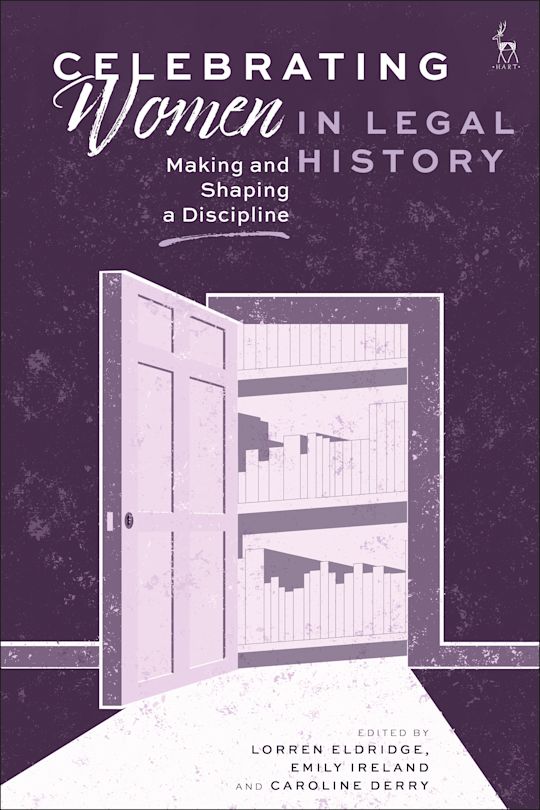
BOOK: Lorren ELDRIDGE, Emily IRELAND & Caroline DERRY (eds.), Celebrating Women in Legal History. Making and Shaping a Discipline (London: Bloomsbury, 2026), 232 p. ISBN 9781509983919


(image source: Bloomsbury)

Abstract:

This book champions the work of women in legal history, and their contributions to both the discipline and feminist activism over nearly two centuries. It considers women in academia, which was, in theory, open to women before they could become lawyers in most European countries. And it considers women working beyond the academy: many studied legal history in other ways; in local history societies, through archival work, and via activism. Women legal historians have been under-recognised or forgotten altogether, even where they made substantial scholarly contributions. In focusing on the work of women in legal history, this book lays the foundations for a transformational reassessment of the discipline. It asks searching questions about what counts as legal history. It demonstrates that work by and about women should appear in our legal history courses, be discussed in our seminars, and be cited in our academic work. If the field of legal history is lively, innovative, and wide-ranging, everyone working in it benefits. By shining a light on undervalued scholarship, and areas which have received insufficient attention, we challenge assumptions in our discipline and advance its methods. Whilst some women were pioneers and worked to change gendered aspects of the law, others led more ordinary lives, disappearing from the gaze of legal history even as they contributed to it. This book tells some of their stories.

Table of contents:

Foreword, Erika Rackley (University of Birmingham, UK)
1. Selden's Sister and Women in Legal History, 2. Unwritten Stories: Recovering and Writing Women's Legal History, 3. Missing Mildred Miles, 4. Rights and Duties of Englishwomen: The Life and Work of Erna Reiss (1888-1974), Feminist Legal Historian, 5. Aere Perennius: The Life and Legacy of Professor Olivia Robinson, 6. The First Women Scholars in Serbian and Yugoslav Legal History at the University of Belgrade Faculty of Law, 7. Jelena Danilovic: The First Woman to Teach Roman Law in Serbia, 8. Madge Easton Anderson: Making and Shaping Legal History from Scotland, 9. Scotland's Representative: Chrystal Macmillan and Suffragist Legal Historical Practice,  

10. The Marriages of Captain John Campbell of Carrick: How a Wronged Wife Changed English Marriage Law, 


 On the editors:

Lorren Eldridge is Assistant Professor at the University of Cambridge, UK; Emily Ireland is a Lecturer in Law at the University of Liverpool, UK.; Caroline Derry is Lecturer in Law at The Open University, UK.

More information here


19 February 2026

CALL FOR PAPERS: Crossing Intellectual Boundaries in English Legal History (Oxford: Christ Church, 10-11 SEP 2026) [DEADLINE 26 MAR 2026]


(image: Sir Francis Bason; Source: Wikimedia Commons)

A workshop in English Legal History will take place in Christ Church, Oxford on 10 and 11 September 2026. The organisers, Ciara Kennefick and Ian Williams, invite proposals for papers which address in whole or in part the theme of Crossing Intellectual Boundaries in English Legal History. The organisers aim to advance the interdisciplinary study of English legal history by exploring this theme in detail with colleagues in law and those from other disciplines who study the impact of other learning on English law.

English law has been marked by the reception or rejection of different bodies of learning in different periods, as lawyers and judges moved beyond their core legal learning or resisted the influence of ideas and techniques from other fields. These intellectual boundaries could be legal, such as between the common law, the civil law and equity. But English law has also engaged with learning beyond law; medicine, theology, economics and mathematics are just four examples. What were the reasons for these engagements with other learning? What were the consequences? Was English law more open to other learning in certain periods and if so, why was that the case?

Proposals for papers should be no more than 400 words and should be sent to ciara.kennefick@law.ox.ac.uk and ian.williams@law.ox.ac.uk by 5pm on 23 March 2026. The aim is to assign a commentator to each paper. Full papers will therefore be due by 5pm on 28 August 2026. Colleagues who are interested in attending the workshop in the capacity of commentator only are invited to write to this effect to Ciara Kennefick and Ian Williams by 5pm on 23 March 2026. The authors of the papers which are selected will be offered accommodation in Oxford on 10 and 11 September. Funding to support the travel of graduate students within the UK is available.

Depending on the extent to which the papers selected cohere with each other, it may be possible to produce an edited volume or a special edition of a journal. Participants are welcome to submit proposals for papers which they intend to publish elsewhere.

11 November 2025

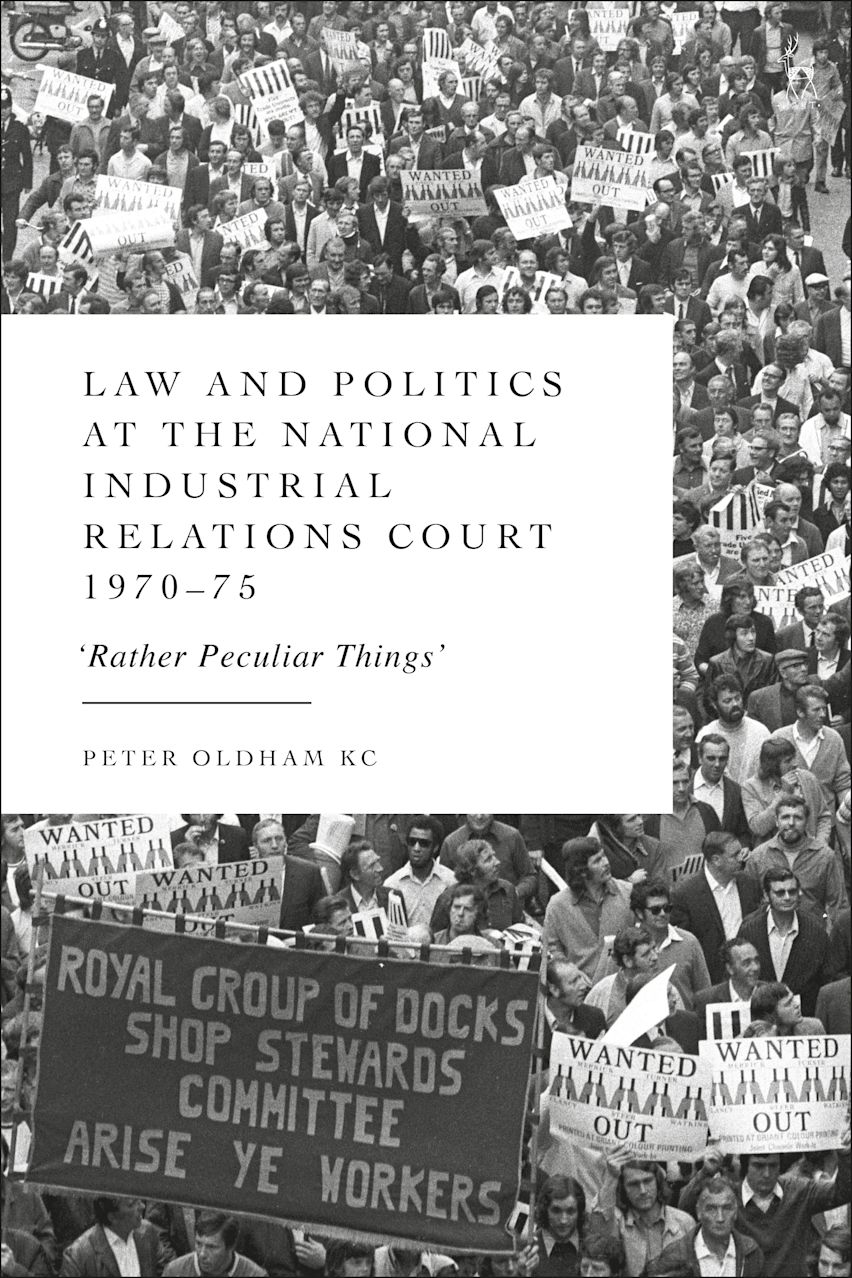
BOOK: Peter Oldham KC, Law and Politics at the National Industrial Relations Court 1970-75. 'Rather Peculiar Things' (London: Bloomsbury/Hart, 2025), 208 p. ISBN 9781509985418, 108 USD


(image source: Bloomsbury)

Abstract:

This book gives extraordinary new insights into the legal, political and industrial strife in the UK of the early 1970s, focusing on the National Industrial Relations Court and how its independence came to be injured at a time of national crisis. Constitutional and employment lawyers, and indeed anyone interested in the history of the times, will not want to be without this deeply researched yet entertaining work. When the Heath Government came to power in 1970, it set up the National Industrial Relations Court to referee highly contentious disputes between unions and employers. Regarded with hostility by the labour movement from the start, the Court and its President, Sir John Donaldson, faced mounting suspicion, and were regularly front-page news. When Donaldson jailed five dockers in 1972 – the Pentonville Five – for defying the Court's orders, strikes erupted and the docks closed. With the country's food supplies dwindling, a state of emergency loomed. How had it come to this? Could a way through be found? This is a revelatory account of the National Industrial Relations Court's defining crisis, set in the context of a wider, and frequently startling, exposition of how Donaldson went about his role as its President. Peter Oldham KC combines decades of experience as a barrister with archival research to shine a bright new light on how and why the Court found itself doing – in Donaldson's own words – 'rather peculiar things'.

Table of contents:

Foreword, Sir Patrick Elias
1 'Little Cause for Gratitude to our Profession': The Origins of the National Industrial Relations Court
2 'Doubt Upon my Parentage': Donaldson's Appointment
3 'It is a Court and Totally Independent of the Government': Communication between the Department of Employment and the NIRC
4 'Less than Orthodox': Donaldson's Expansive Presidency
5 'Angry after Lunch': Prosecuting Martyrs
6 'The Answer Which We Were All Seeking', or 'Seemed to be a Load of Rubbish to Me': Three Days in July 1972
7 'Judges are not Expendable. Lord Chancellors Are': Con-Mech

8 'Not a Happy Outcome for Anyone': The End of the NIRC, and What Donaldson did

On the author:

Peter Oldham is a barrister at 11 King’s Bench Walk, UK.

Read more here


15 October 2025

VIDEO: The Legal System of the Channel Islands (FranceTv, des Racines et des Ailes, 8 OCT 2025)

(image source: Francetv)
 

The well-known culture and heritage program Des Racines et des Ailes devoted an episode to the Channel Islands, including the legal system inherited from the Duchy of Normandy. Legal historian Sophie Poirey (Université de Caen) visits the Guersney courthouse with a local judge. The financial and legal industry of Jersey is treated as well. See here.

27 May 2025

BOOK: Saskia LETTMAIER, Spouses, Church, and State. Marriage Law in England and Protestant Germany from the Reformation until the Close of the Nineteenth Century [Beiträge zum ausländischen und internationalen Privatrecht; 143] (Tübingen: Mohr Siebeck, 2025), 415 p., ISBN 978-3-16-162493-3

Cover von 'undefined'

ABOUT THE BOOK:
 
Saskia Lettmaier widmet sich der vielleicht bedeutendsten Transformation, die das Ehe(band)recht in den letzten 500 Jahren erfahren hat: Seiner Umgestaltung von einer einheitlichen, in der Hand der Universalkirche liegenden und von theologischen Denkmustern geprägten Ordnung hin zu einer Vielzahl von disparaten staatlichen Einzelordnungen, die von säkularen Leitvorstellungen geprägt sind. Am Beispiel von England und Preußen analysiert sie, wie und warum es zu diesem Wandel kam und warum die Veränderungen von Territorium zu Territorium unterschiedlich ausfielen.
 
Find more here.


20 December 2024

JOURNAL: Bulletin/Handelingen LVIII (2024) (Royal Commission for the Publication of Old Laws and Ordinances of Belgium) [OPEN ACCESS]


(image source: KCOWV/CRALO)

Table of contents:

Rapport d’activités 2022 Werkzaamhedenverslag 2022 (5-8)

Rapport d’activités 2023 Werkzaamhedenverslag 2023 (9-15)

Two legal opinions by Gabriel van der Muyden and Elbert de Leeuw (1553) (Alain Wijffels) (17-113)

First paragraphs:

The privileges of the German Hanse in England were resumed by a decree of the English Privy Council on 24 February 1552. The Council’s decision was triggered by complaints from the London Merchant Adventurers, who claimed that the privileges were detrimental to both the Crown and the English merchants. Moreover, they submitted, recent cases had shown that the Hansards were prone to misuse their privileges, which caused an even greater prejudice to the Treasury and the English merchant community. The merchants’ complaints also gave them an opportunity to rake up old grievances which for generations had marred Anglo-Hanseatic relations, such as the limited access for English merchants in Prussia, in spite of formal agreements of reciprocity allowing Hansards to trade in England, and Englishmen in Prussia.

During the Fall of 1552 and the Spring of 1553, Hanseatic diets deliberated on counter-measures, but also decided to accept the English authorities’ invitation to send an embassy to London in order to negotiate the Hanse’s position in England. The Hanseatic position, however, was that there were no reasons justifying the resumption of their privileges. Their embassy’s mission was therefore to obtain the restoration of these privileges in full.

In June 1553, the embassy’s members were gathering in Bruges and Antwerp, both in order to obtain more detailed information about the Hanseatic trade between England and the Low Countries, and because of the reports of the English King’s ill-health4. They were still in the Southern Netherlands when the news of Edward VI’s death (on 6 July) reached them, followed by reports on the uncertain political situation and succession during the following days. Eventually, when Mary Tudor’s accession was confirmed, they crossed the Channel later in July and settled in London, where they could benefit from the facilities of the Steelyard, the main Hanseatic office in England.

While still in Flanders and Brabant, three members of the Hanseatic embassy, all three doctors of law, made around the 12th of July the journey to Leuven in order to meet and consult “Dr. Gabriel” (i.e. van der Muyden, Mudaeus), about legal issues in connection with their mission in England. The full scope of this consultation is not documented, but two unpublished consilia attributed to van der Muyden (1500-1560) and his junior colleague Elbert de Leeuw (Leoninus, c. 1519-20-1598) deal specifically with the issue of the restrictions imposed by the Gdańsk authorities to foreign, including English, merchants trading in the Polish city. The issue reflected a long-standing controversy in Anglo-Hanseatic relations, which had been raised at several earlier conferences, without ever reaching any substantial agreement. The two consilia (published hereafter) were most probably written during the summer of 1553 as a result of the Hanseatic visit to van der Muyden, whether immediately or within weeks after the meeting with the Leuven professor. Both consilia were obviously written on behalf of the Hanseatic delegates and countenance the position held by the Hanse and Gdańsk in particular.

Read more here. Open access version here.


18 November 2024

BOOK: Gregory J. DURSTON, A "Dereliction of Moral Feeling". Crime in Victorian Norfolk (Bury St Edmonds: Abramis, 2024), 290 p. ISBN 1845498356


(image source: Saxo)

Abstract:

This book considers crime in Norfolk during the Victorian era. Although a companion volume to the author's earlier book on the criminal justice system in the same part of East Anglia, it can be read entirely independently of that work. It examines the pattern, nature, and incidence of offending in the county during the years from about 1837 to 1901. However, as well as examining general trends in crime over that period, the book also focuses in specific detail on important individual offences, such as, and inter alia, murder, rape, sodomy, burglary, robbery, theft and poaching. The study of crime in England's more rural counties at this time has often been neglected in favour of the country's rapidly expanding, and so 'eye-catching', urban, mining, and industrial parts, especially London and the North. The book goes some way to redressing this neglect by focusing on an area where social change and population increase had been slightly more modest, but which still made up a significant part of the nation, even at the end of the Victorian period.

Read more here


10 July 2024

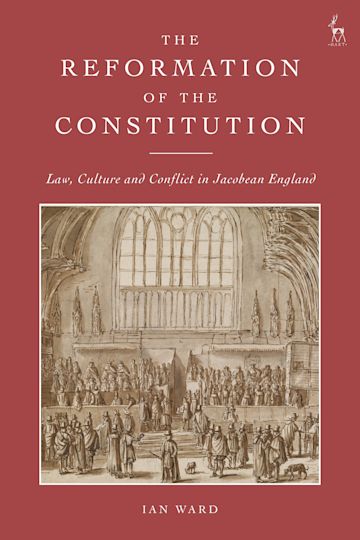
BOOK: Ian WARD, The Reformation of the Constitution. Law, Culture and Conflict in Jacobean England (Oxford: Hart, 2024), ISBN


(image source: Hart)

Abstract:

This book revisits one of the defining judicial engagements in English legal history. It provides a fresh account of the years 1606 to 1616 which witnessed a series of increasingly volatile confrontations between, on the one side, King James I and his Attorney-General, Sir Francis Bacon, and on the other, Sir Edward Coke, successively Chief Justice of Common Pleas and Lord Chief Justice. At the heart of the dispute were differing opinions regarding the nature of kingship and the reach of prerogative in reformation England. Appreciating the longer context, in the summer of 1616 King James appealed for a reformation of law and constitution to complement the reformation of his Church. Later historians would discern in these debates the seeding of a century of revolution, followed by another four centuries of reform. This book ventures the further thought that the arguments which echoed around Westminster Hall in the first years of the seventeenth century have lost little of their resonance half a millennium on. Breaks with Rome are little easier to 'get done', the margins of executive governance little easier to draw.

Table of contents:

Introduction: Irony and Rhyme 1. Reformation 2. The Aspirations of James Stuart 3. The Casebook of Sir Edward Coke 4. The Lives of Francis Bacon 5. Apotheoses Epilogue

 Read more here.

22 May 2024

BOOK: Brodie WADDELL & Jason PEACEY (eds.), The Power of Petitioning in Early Modern Britain (London: UCL Press, 2024). ISBN: 9781800085503, pp. 286 [open access]


(Source: UCL PressUCL Press)


ABOUT THE BOOK

The ‘humble petition’ was ubiquitous in early modern society and featured prominently in crucial moments such as the outbreak of the civil wars and in everyday local negotiations about taxation, welfare and litigation. People at all levels of society – from noblemen to paupers – used petitions to make their voices heard and these are valuable sources for mapping the structures of authority and agency that framed early modern society.

The Power of Petitioning in Early Modern Britain offers a holistic study of this crucial topic in early modern British history. The contributors survey a vast range of sources, showing the myriad ways people petitioned the authorities from the sixteenth to the eighteenth centuries. They cross the jurisdictional, sub-disciplinary and chronological boundaries that have otherwise constrained the current scholarly literature on petitioning and popular political engagement. Teasing out broad conclusions from innumerable smaller interventions in public life, they not only address the aims, attitudes and strategies of those involved, but also assesses the significance of the processes they used. This volume makes it possible to rethink the power of petitioning and to re-evaluate broad trends regarding political culture, institutional change and state formation.


ABOUT THE EDITORS

Brodie Waddell is Senior Lecturer in Early Modern History at Birkbeck, University of London.

Jason Peacey is Professor of Early Modern British History at University College London.


TABLE OF CONTENTS

List of figures and tables

List of contributors

1 Introduction: power, processes and patterns in early modern petitioning

Brodie Waddell and Jason Peacey

2 Genre, authorship and authenticity in the petitions of Civil War veterans and widows from north Wales and the Marches

Lloyd Bowen

3 The process and practice of petitioning in early modern England

Hannah Worthen

4 ‘The universal cry of the kingdom’: petitions, privileges and the place of Parliament in early modern England

Jason Peacey

5 Gathering hands: political petitioning and participative subscription in post-Reformation Scotland

Karin Bowie

6 ‘For the dead Fathers sake’? Orphans, petitions and the British Civil Wars, 1647-1679

Imogen Peck

7 The edges of governance: contesting practices and principles of justice in seventeenth-century fen petitions

Elly Robson

8 Shaping the state from below: the rise of local petitioning in early modern England

Brodie Waddell

9 The local power of petitioning: petitions to Cheshire quarter sessions in context, c.1570-1800

Sharon Howard

10 Afterword

Ann Hughes

Index


More info with the publisherpublisher.

06 May 2024

ARTICLE: Nicholas SANINIS, "Exemplary Damages Practice in late Eighteenth- and Early Nineteenth-Century England" (American Journal of Legal History)


(image source: OUP)

Abstract:

A longer perspective on the modern Anglo-American law of exemplary (or punitive) damages views it as having first begun to emerge after the cases of Huckle v Money and Wilkes v Wood were decided in 1763. This article seeks to further deepen and clarify this perspective. It does so by systematically tracing the evolution of the adjudicative practice according to which English civil juries awarded ‘exemplary damages’ from the period circa 1764 to the early nineteenth century. It shows that this practice scarcely ‘hardened into law’ in the aftermath of the Huckle and Wilkes decisions. In fact, as had been the case long before 1763, for a long time after it, jury determinations as to exemplary damages in common law tort actions remained entirely outside the control of any formal legal doctrine which either of these decisions were taken to have authoritatively recognized.

Read the full article here: DOI  10.1093/ajlh/njae005

02 May 2024

BOOK: Peter CANE & H. KUMARASINGHAM (eds.), The Cambridge Constitutional History of the United Kingdom (Cambridge: Cambridge University Press, 2023), ISBN 9781009277778 and 9781009277105, € 116,17 and € 116,71


(image source: CUP)

Vol. 1: Exploring the Constitution (eds. Peter Cane & H. Humarasingham)
DOI 10.1017/9781009277778

Part I - Perspectives
1 - The Historical Constitution 3-34 By H. Kumarasingham
2 - Law and the Constitution 35-58 By Peter Cane
3 - Political Constitutionalism 59-87 By Richard Bellamy
4 - The Economic Constitution 88-112 By Tony Prosser
5 - Religion and the Constitution to 1688 113-139 By Pippa Catterall
6 - Religion and the Constitution since the Glorious Revolution 140-167 By Pippa Catterall
7 - The Social Democratic Constitution 168-194 By K. D. Ewing
8 - The Constitution of Rights 195-220 By Peter Cane
9 - The People and the Constitution 221-253 By Vernon Bogdanor
10 - Constitutional Theory and Thought 254-282 By Jeffrey Goldsworthy

Part II - Actors and Institutions
11 - Monarchy 285-308 By Edward Cavanagh
12 - Legislatures 309-334 By Michael Gordon
13 - The Executive and the Administration 335-358 By Janet McLean
14 - Judiciaries 359-385 By Joshua Getzler
15 - Coercive Institutions 386-405 By Brice Dickson
16 - Locality, Regionality and Centrality 406-430 By Luke Blaxill
17 - Political Parties 431-454 By Robert Crowcroft

Part III - Politics
18 - Conservatism 457-479 By Asanga Welikala
19 - Liberalism 480-498 By Emily Jones
20 - Socialism 499-519 By Stephen Sedley
21 - Unionism 520-539 By James Mitchell, Alan Convery
22 - Nationalism 540-560 By Michael Keating

Read more with CUP.

Vol. 2: The Changing Constitution (eds. Peter Cane & H. Kumarasingham)
DOI 10.1017/9781009277105

1 - The Kingdoms of Anglo-Saxon England (450–1066) 1-29 By Simon Keynes
2 - England after the Conquestpp 30-62 By George Garnett
3 - England in the Thirteenth Centurypp 63-83 By Paul Brand
4 - England in the Fourteenth Centurypp 84-107 By Christine Carpenter, Andrew M. Spencer
5 - England in the Fifteenth Centurypp 108-130 By David J. Seipp
6 - England in the Sixteenth Centurypp 131-159 By David Chan Smith
7 - The English Constitution in the Seventeenth Centurypp 160-186 Crises of Inadequacy By Glenn Burgess
8 - A European Perspectivepp 187-206 By Tamar Herzog
9 - Wales before Annexationpp 207-230 By Robin Chapman Stacey
10 - The Scottish Constitution before 1707 231-258 By Laura A. M. Stewart
11 - The Eighteenth-Century Constitution 259-287 Settlement and Resettlement By R. A. Melikan
12 - The Constitutional and Parliamentary History of Ireland till the Union 288-316 By Thomas Bartlett
13 - The United Kingdom in the Nineteenth Century 317-342 By Ewen A. Cameron
14 - The United Kingdom in the Twentieth Century 343-369 By Andrew Blick
15 - The Twenty-First-Century Constitution 370-397 By Vernon Bogdanor
16 - Wales since the Annexation 398-421 By Matthew Cragoe
17 - Scotland in the Union 422-442 By Stephen Tierney
18 - Ireland in the Union 443-467 By Donal K. Coffey
19 - The Making of Empire 468-495 By Coel Kirkby
20 - Constitution and Empire 496-528 By H. Kumarasingham

Read more with CUP.


11 March 2024

BOOK: Gregory DURSTON, Known to the Police: The Criminal Justice System in Victorian Norfolk (Bury St Edmunds: Abramis, 2023), 446 p. ISBN 978-1845498207, 64 USD


Abstract:

This book considers the Victorian criminal-justice system in the context of a single English county, Norfolk. It examines all its aspects, from the commission of a crime, via the initial detection and arrest of suspects, to their investigation, prosecution, trial, and conviction, finishing up with their final penal disposal. To a significant degree, the changes that occurred during this period produced the system that operates today, and so are worthy of detailed consideration. Furthermore, many of the challenges faced by the Victorian justice system continue to trouble its 'modern' equivalent and so are of interest to those tasked with addressing them in the present day. The book will be of interest to legal and social historians and students, to those who work in today's criminal justice system, as well as to the curious general reader.

Read more here.

01 February 2024

BOOK: Allen BOYER & Mark NICHOLLS, The Rise and Fall of Treason in English History (London: Routledge, 2024), ISBN 9780367509934, 104 GBP


(image source: Routledge)

Abstract:

This book explores the development and application of the law of treason in England across more than a thousand years, placing this legal history within a broader historical context. Describing many high-profile prosecutions and trials, the book focuses on the statutes, ordinances and customs that have at various times governed, limited and shaped this worst of crimes. It explores the reasons why treason coalesced around specific offences agreed by both the monarch and the wider political nation, why it became an essential instrument of enforcement in high politics, and why, over the past three hundred years, it has gradually fallen into disuse while remaining on the statute book. This book also considers why treason as both a word and a concept remains so potent in wider modern culture, investigating prevalent current misconceptions about what is and what is not treason. It concludes by suggesting that the abolition or 'death' of treason in the near future, while a logical next step, is by no means a foregone conclusion.

Table of contents:

Introduction  1. Origins to 1066  2. Treason at the King’s Discretion, 1066-1352  3. The Great Statute of Treason and its Aftermath: 1352-1500  4. An Ultimate Weapon of State: Treason in Tudor England  5. The World Turned Upside Down: A Crisis of Treason, 1600-1700  6. Treason in the Eighteenth Century  7. The Death of Treason

On the authors:

Allen Boyer is a graduate of Vanderbilt University and the University of Virginia School of Law, and he earned his doctorate at the University of St Andrews. As a lawyer, he served as senior appellate counsel at the New York Stock Exchange Division of Enforcement. In a parallel career, he has published numerous articles on legal history, and five books, notably Sir Edward Coke and the Elizabethan Age and Rocky Boyer’s War. Mark Nicholls is a Fellow, and former President, Librarian and a Tutor of St John’s College Cambridge. He has published extensively on British conspiracies and succession politics. His books include Investigating Gunpowder Plot (1991), A History of the Modern British Isles 1529-1603 (1999) and, with Penry Williams, Sir Walter Raleigh in Life and Legend (2011).

Read more here


13 December 2023

DATABASE: The Proceedings of the Old Bailey, 1674-1913 (ninth edition)


(source: Youtube)

The Proceedings of the Old Bailey announce its ninth edition, or the "New Old Bailey Online" to explore 127 million words and 197 752 trials held at the "Old Baily, or Central Criminal Court in London".

The database can be consulted here.

16 August 2023

BOOK: Cerian GRIFFITHS, Łukasz Jan KORPOROWICZ (eds.), English Law, the Legal Profession, and Colonialism. Histories, Parallels, and Influences (Londra: Routledge, 2023), ISBN 9781032326191

(Image source: Routledge)


ABOUT THE BOOK

Modern legal history is increasingly interested in exploring the development of legal systems from novel and nuanced approaches. This edited collection harnesses the lesser-researched perspectives of the impact of global and imperial factors on the development of law. It is argued that to better understand these timely discussions, we must understand the process and significance of colonisation itself. The volume brings together experts in the field of law and history to explore the ways in which law and lawyers contributed to the expansion of the British Empire, and the ways in which the Empire influenced the Metropole. The book sheds new light on the role of the law and legal actors during the pivotal centuries that saw the establishment of the Empire. Exploring such topics as Atlantic relations, the impact of British jurists upon Indian law, and the development of the law settler colonies, this collection reveals some of the lesser-known intersections between law, history, and empire. The book will be of interest to students and researchers in legal history, comparative history, equity and trusts, contract law, the legal profession, slavery, and the British Empire.


ABOUT THE EDITORS

Cerian Griffiths is an Assistant Professor at the Faculty of Law and Business, Northumbria University.

Łukasz Jan Korporowicz is an Associate Professor and Vice Dean for Research at the Faculty of Law and Administration, University of Lodz; Head of the Centre for Anglo-American Legal Tradition of the University of Lodz.


TABLE OF CONTENTS

Preface

1.       Introductory Remarks (MICHAEL LOBBAN)

Part 1 – Atlantic Relations

2. The Role of Legislation in Racial Identities within the English Atlantic 1640s-1700s (JUSTINE K. COLLINS)
3. London’s Middle Temple and Law Students from the New World (SALLY HADDEN)

Part 2 – Indian Relations

4. Sir James Mackintosh: the Colonial Judge (ŁUKASZ JAN KORPOROWICZ)
5. Remaking Britain in the Image of the Raj: James Fitzjames Stephen’s ‘Indian’ Correctives to Electoral Reform (MATILDE CAZZOLA)

Part 3 – Australia and South-East Asia Relations

6. The Colonial Government Bill 1864: Towards a Code of Colonial Constitutional Law (GREG TAYLOR)
7. Outlaws in their native land: the 'incompetence' of Aboriginal witnesses in 19th Century Colonial Australia (ANDREW ALEXANDER, HOLLY NICHOLLS, DAVID PLATER)
8. Governance Through Vagrancy Law in Hong Kong, 1841-1939 (CHRISTOPHER M. ROBERTS, HAZEL W.H. LEUNG)

Part 4 – Legal Doctrines, Empire and Legacies

9. Imagination and Colonial Challenges to English Legal Historiography (RICHARD W. IRELAND)
10. The Last Will and Testament of John Gardner Kemeys: Jamaican Mortgages and English Inheritance Disputes (JULIA RUDOLPH)
11. Winds of Change in Common Law Jurisdictions: The Concept of Good Faith and Fair Dealing in the Performance of Contracts (JAN HALBERDA)
12. Conclusion: Legal History in a Global Setting: Voices from the Peripheries (CERIAN GRIFFITHS, ŁUKASZ JAN KORPOROWICZ)


More information can be found here.

10 August 2023

BOOK: Laura FLANNIGAN, Royal Justice and the Making of the Tudor Commonwealth, 1485–1547 [Cambridge Studies in Early Modern British History] (Cambridge: Cambridge University Press, 2025), ISBN 9781009371353


On the book:
The dawn of the Tudor regime is one of most recognisable periods of English history. Yet the focus on its monarchs' private lives and ministers' constitutional reforms creates the impression that this age's major developments were isolated to halls of power, far removed from the wider populace. This book presents a more holistic vision of politics and society in late medieval and early modern England. Delving into the rich but little-studied archive of the royal Court of Requests, it reconstructs collaborations between sovereigns and subjects on the formulation of an important governmental ideal: justice. Examining the institutional and social dimensions of this point of contact, this study places ordinary people, their knowledge and demands at the heart of a judicial revolution unfolding within the governments of Henry VII and Henry VIII. Yet it also demonstrates that directing extraordinary royal justice into ordinary procedures created as many problems as it solved. 

Table of contents:

Introduction. Part I. The New Justice System: Chapter 1. The principle and problem of justice Chapter 2. Conciliar justice at centre and periphery Chapter 3. 'Travailing between the prince and petitioners': the court of requests Part II. Seeking and Requesting Justice: Chapter 4. Geography and demography Chapter 5. Disputes and dispute-resolution Chapter 6. 'Your poor orator': petitioning the king Part III. Delivering and Contesting Justice: Chapter 7. Before the king's honourable council Chapter 8. Answers and arguments Chapter 9. 'A final peax': passing judgment Conclusion. Justice and the Tudor Commonwealth.

On the author:

Laura Flannigan is a researcher at the University of Oxford. She has published several articles in Law and History Review and Historical Research, and was awarded the Sir John Neale Essay Prize in 2020. Her volume on the Court of Requests archive is forthcoming (List and Index Society, 2023).

 Read more here: DOI 10.1017/9781009371346.

27 June 2023

CFP: Seventeenth International Congress of Medieval Canon Law (ICMCL) - Canterbury, UK, 7-13 July 2024 [DEADLINE 15 DEC 2023]


(Canterbury Cathedral. Source: University of Kent)


The 17th International Congress of Medieval Canon Law, co-sponsored by ICMAC (Iuris Canonici Medii Aevi Consociatio/International Society of Medieval Canon Law) will be based at the University of Kent campus in Canterbury, UK, between Sunday, 7 July, and Saturday, 13 July 2024. These congresses take place every four years on alternate sides of the Atlantic and constitute the leading academic conferences in the field of medieval canon law. Traditionally they have drawn scholars from many countries, including not only medievalists and lawyers, but also those who study related fields, such as Western jurisprudence and legal norms, Roman law, ecclesiastical and papal history, theology and biblical exegesis, manuscript studies, and the history of culture, society, and ideas.

ICMAC, the congress organisers Prof. Barbara Bombi FBA, Dr Edward Roberts, and Prof. Peter Clarke and congress programming committee invite proposals for individual 20-minute papers and for sessions (of 3 x 20-minute papers or 4 x 15-minute papers) on any aspect of medieval canon law, including, but not limited to, the following themes:

  • Texts and Jurisprudence
  • Influence of the ius commune on the Western Legal Tradition and International Law
  • Canon Law and Local Ecclesiastical History
  • Canon Law, Theology, and Pastoral Care
  • Medieval Law in Comparative Perspective

Proposals should be submitted as Word attachments via email to the congress address (icmcl2024@gmail.com) no later than 15 December 2023.

An individual paper proposal should comprise: paper title and language of presentation; a brief abstract (100-150 words); the speaker’s details (name; academic status; institutional affiliation; email address).

A session proposal should comprise the above for each paper proposed, together with: the details (as for speakers above) of the session organiser and session chair; the session title; a brief rationale (50-100 words) for the session, i.e., how the papers are related.

Proposals are welcomed from those at all stages of their academic career, including PhD students and post-doctoral researchers, as well as independent scholars. Papers may be delivered in these languages: English; French; German; Italian; or Spanish. Scholars not presenting in English are encouraged to use PowerPoint presentations and/or provide written English summaries of their papers.

Regular sessions will not feature papers on text-editing projects (but can include papers on manuscript studies). Updates on such projects will be showcased in a poster session during the Congress. Scholars who wish to present on such projects may submit two proposals if they desire, one for the poster session and another for a regular session.

The organisers would especially welcome proposals on the theme ‘Bridging the Divide’, focusing on Canterbury as a place of significance in the history of Western Christianity and medieval canon law before and after the Protestant Reformation and as the centre of the global Anglican communion. Contributions to this theme might cover such topics as:

  • Canterbury’s role in the compilation and diffusion of medieval canon law in the English Church
  • Canon law and local jurisdictions: application of canon law in the archbishops’ and other local church courts
  • Canon law and secular law: the impact of the Becket crisis on medieval canon law (especially after the Constitutions of Clarendon in 1164) and its long-term legacy
  • Global Anglicanism: the continuing influence of medieval canon law in the Anglican communion and other post-Reformation churches

Although the chronological focus of the Congress is typically c. 500 – c. 1500, we would also welcome contributions from early modernists to this theme, which is designed to bridge the all too separate study of pre- and post-Reformation Christianity and explore continuities and synergies in the history of canon law over the longue durée. Historians of early modern Catholicism are also invited to offer papers exploring continuities of pre-Tridentine canon law in Europe and the New World, including among English Catholics.

In addition, we would welcome contributions to the strand ‘Canon law and governance’, which will explore how the study of medieval canon law can help inform current public policy debates, notably on the role of international law, electoral systems, constitutional reform, and representative government. The strand will thus focus on these four topics:

  • Canon law and international law: the transnational influence of medieval canon law on the emergence of national legal systems
  • Constitutionalism and canon law: the interaction of medieval canon law and secular law in the development of governing institutions
  • Communities and canon law: the role of medieval canon law in the emergence and definition of groups and communities, such as women and clergy
  • Elections and consent: the influence of medieval canon law on the role of elections and consent in government

Papers on other aspects of medieval canon law and governance, such as human rights, are also welcome. The purpose of this strand is to show the continuing relevance of medieval canon law to political issues and appeal to a broader public audience.  Invited speakers in this special strand include:

  • Orazio Condorelli (University of Catania, Italy)
  • Christof Rolker (University of Bamberg, Germany)
  • Caroline Humfress (University of St Andrews, UK)
  • Nicholas Vincent FBA (University of East Anglia, UK)
  • Sara Butler (Ohio State University, USA)
  • Charles West (University of Sheffield, UK)
  • Dr Joseph Canning (Queens’ College, Cambridge, UK)
  • Dr Danica Summerlin (University of Sheffield, UK)
  • Kenneth Pennington (Catholic University of America, Washington DC)

23 March 2023

BOOK: Margarent MCGLYNN, The King's Felons: Church, State and Criminal Confinement in Early Tudor England (Oxford: Oxford University Press, 2023), 400 pp., ISBN 9780192887689, £110


(image courtesy: Oxford University Press)

Book description: 
The King's Felons examines the subtle but intentional development of criminal confinement as an alternative to capital punishment in early Tudor England. As the judicial establishment looked for ways to enhance law and order without provoking political opposition, they increasingly turned to two traditional mitigations of criminal punishment: benefit of clergy and sanctuary.

Often reviled as corrupt clerical rights which served to undermine secular authority and the rule of law, benefit of clergy and sanctuary in fact provided the justices with room to manoeuvre, allowing them to punish a larger number of felons less harshly while avoiding political scrutiny. The King's Felons explores the evolution of this approach over a period of sixty years, allowing us to see not only the internal development of both law and process, but the ways in which the judicial system responded to external pressures.

The dissolution of the monasteries between 1536 and 1540, together with the steady erosion of the wealth and power of the bishops, meant that the institutional and financial foundations on which the justices built this system began to crumble as it was reaching fruition. Over the next two decades they scrambled, with limited success, to secure some small vestiges of the system they had built. The epilogue connects the state of the system in the aftermath of this collapse to our existing understanding of the system in the later part of the century.

Providing the first detailed study of criminal justice in the early Tudor period, The King's Felons highlights the role of the Church in the administration of criminal justice and reframes our understanding of many significant acts of the Reformation parliament. This book is a must-read for students and scholars of Tudor history, legal historians and those interested in the role of the church with regard to politics, law, and crime.
Table of contents: 
Introduction
Part One: The Foundations
1:Benefit of Clergy: Common Learning
2:Sanctuary: Common Learning
3:Processes and Records at the End of the Fifteenth Century
Part Two: Building a Bureaucracy
4:Benefit of Clergy in the Reign of Henry VII
5:Sanctuary in the Reign of Henry VII
6:Benefit of Clergy 1509-1529
7:Sanctuary 1509-1529
Part Three: The Limits of a Quiet Evolution
8:Sanctuary and Benefit of Clergy 1529-39
9:Sanctuary and Benefit of Clergy after 1540
Epilogue
About the author: 
Margaret McGlynn is Professor of History and the Vice-Provost of Academic Planning, Policy and Faculty at Western University. Her research and administrative work both focus on the ways in which policy and regulation intersect with cultural norms during periods of rapid change, as well as the ways in which the adaptation of old policies can support or modify the introduction of new ones.
More information can be found here

07 February 2023

BOOK: Luke TAYLOR, Constructing the Family: Marriage and Work in Nineteenth-Century English Law (Toronto: University of Toronto Press, 2022). ISBN: 9781487546526, pp. 424, $90.00


(Source: UTP)

ABOUT THE BOOK

In nineteenth-century England, legal conceptions of work and family changed in fundamental ways. Notably, significant legal moves came into play that changed the legal understanding of the family. Constructing the Family examines the evolution of the legal-discursive framework governing work and family relations. Luke Taylor considers the intersecting intellectual and institutional forces that contributed to the dissolution of the household, the establishment of separate spheres of work and family, and the emergence of modern legal and social ideas concerning work and family. He shows how specific legal-institutional moves contributed to the creation of the family's categorical status in the social and legal order and a distinct and exceptional body of rules – Family Law – for its governance. Shedding light on the historical processes that contributed to the emergence of English family law, Constructing the Family shows how work and family became separate regulatory domains, and in so doing reveals the contingent nature of the modern legal family.

ABOUT THE AUTHOR

Luke Taylor is an assistant professor at the Lincoln Alexander School of Law at Toronto Metropolitan University.

TABLE OF CONTENTS

List of Figures and Tables
Acknowledgments
Introduction

Chapter 1: Ideology and Population Management 
A. Ideology
B. Population Management

Chapter 2: The Invention of Family Law in English Scholarly Legal Thought
I. Introduction
II. Blackstone, Legal Science, and the Productive Household
A. The “private œconomical relations”
B. Master and Servant
C. Husband and Wife
D. Blackstone and Nineteenth-Century Legal Thought
III. Household and Marriage in the Early Nineteenth Century
IV. The Influence of Jurisprudence
A. The Analyst: John Austin
B. The Historicist: Friedrich Carl von Savigny
V. The Influence of Statutory Developments
A. Divorce and the Legal Character of Marriage
B. Decriminalization and the Legal Character of Work
VI. Classical Legal Thought in England: Abstracting Contract and Subtracting Marriage
A. Consolidating Contract by Distinguishing Marriage: Pollock and Anson
B. Translating CLT into Taxonomy: Holland
VII. The Emergence of English Domestic Relations Law
VIII. The Emergence of Family Law
A. Cementing the Family/Work and Status/Contract Distinctions: Salmond
B. Family Law and Employment Law Emerge and Diverge
C. Family Law in the Textbook Tradition
IX. Conclusion

Chapter 3: Law and the Disarticulation of Work from Family Life
I. Introduction
II. Property, Poverty, and Wage Labour
A. Property: Enclosure, Households, and Work
B. Poverty: The Discipline of Work 
III. Wage Labour, Contract, and the Subordination of Workers
A. The Philosophical Basis of Coercion under Contract
B. Punishment and Performance
IV. Conclusion

Chapter 4: Women and Youth, Work and Family
I. Introduction
II. Women, Work, and the Domestic Sphere
A. Paid Domestic Labour
B. Unpaid Domestic Labour
III. Youth, Work, and the Paths of Apprenticeship
A. Early Modern Apprenticeship Law
B. Household to Employment: The Transformation of Traditional Apprenticeship
C. Household to Family: The Transformation of Parish Apprenticeship
IV. Conclusion

Chapter 5: Legislating Marriage
I. Introduction
II. Civilizing Marriage
A. Lord Hardwicke’s Act
B. Lord Lyndhurst’s Act
C. Civil Marriage Act
III. Incentivizing Marriage
A. Poor Laws
B. Compensation Statutes 
IV. Stabilizing Marriage
A. Divorce 
B. Married Women’s Property
V. Conclusion

Chapter 6: The Public Importance of Marriage in English Common Law
I. Introduction
II. Stretching the Bounds of Contract: The Action for Breach of Promise to Marry 
A. Heart Balm for Women (Only)
B. “It would be indelicate to expect that she should consent in words”
C. Expectations of Emotional Harm
III. The Status of Marriage in the Conflict of Laws
A. Marriage, Contract, and Deference to Lex Loci Celebrationis
B. Dissolution, Domicile and State Control
C. Domicile and Marital Validity
D. Dissolving the Status of Marriage
IV. Conclusion

Conclusion
Marriage, Family, and Work: Past and Present
Bibliography
Cases
Statutes
Books, Chapters, and Articles
Government Reports and Documents
Newspapers, Non-legal Periodicals, and Blogs
Parliamentary Debates


More information with the publisher.